

Is your home actually as comfortable as your thermostat claims, or are you just paying for cooling that never reaches the bedrooms? In the volatile Australian climate, relying on a single central sensor often leads to astronomical energy bills and hidden mould growth in damp wet areas. Integrating a dedicated smart temperature and humidity sensor into your setup isn't just about high-tech convenience. It's a practical necessity for maintaining a healthy, efficient household. Whether you're trying to protect a sensitive wine cellar or ensure a baby's room stays at the perfect degree, these compact devices provide the granular data needed to take control of your environment.
We understand that the technical jargon around Zigbee 3.0 versus Matter protocols can feel like a barrier to entry. You want hardware that's SAA-certified, reliable, and easy to automate without needing a degree in systems engineering. This 2026 guide simplifies the selection process for Australian homeowners and trade professionals alike. You'll learn how to automate bathroom fans to prevent damp before it starts, optimise your AC usage, and implement NDIS SDA-compliant solutions for better accessibility. We'll show you exactly how to choose and deploy the right sensors to create a truly responsive home in Point Cook and beyond.
Key Takeaways
- Understand why active climate monitoring is essential in high-humidity areas like Point Cook to stop mould growth before it starts.
- Learn how to choose between Zigbee 3.0 and Matter protocols to ensure your smart temperature and humidity sensor remains responsive and battery-efficient.
- Discover why SAA certification and precision accuracy ratings are non-negotiable for maintaining home insurance validity and reliable data.
- Master the "Bathroom Humidity Loop" and other smart automations that trigger exhaust fans or cooling modules based on real-time environmental changes.
- Identify the benefits of using trade-grade hardware designed for NDIS SDA compliance and local Australian regulatory standards.
Why Every Australian Home Needs a Smart Temperature and Humidity Sensor
A smart temperature and humidity sensor is a compact, wireless device designed to monitor your indoor climate and trigger specific actions via your smart home hub. Unlike a traditional thermometer that simply displays a number, these sensors act as the "brain" for your home's environmental automations. They provide real-time data that can turn on a dehumidifier, adjust a split-system air conditioner, or activate an exhaust fan without you lifting a finger. For Australian homeowners, this technology has moved from a luxury gadget to a core component of a healthy, energy-efficient household.
Living in Point Cook means dealing with the "Melbourne Factor"; volatile weather patterns and high coastal humidity often create the perfect breeding ground for mould. A smart temperature and humidity sensor allows you to track these fluctuations with precision. It's about more than just comfort. It's about protecting significant investments like timber flooring, musical instruments, and wine collections that are sensitive to rapid climate shifts. By monitoring these variables, you can intervene before the air quality drops or your energy bills spike during a Victorian heatwave.
Combating Mould and Damp in Victorian Wet Areas
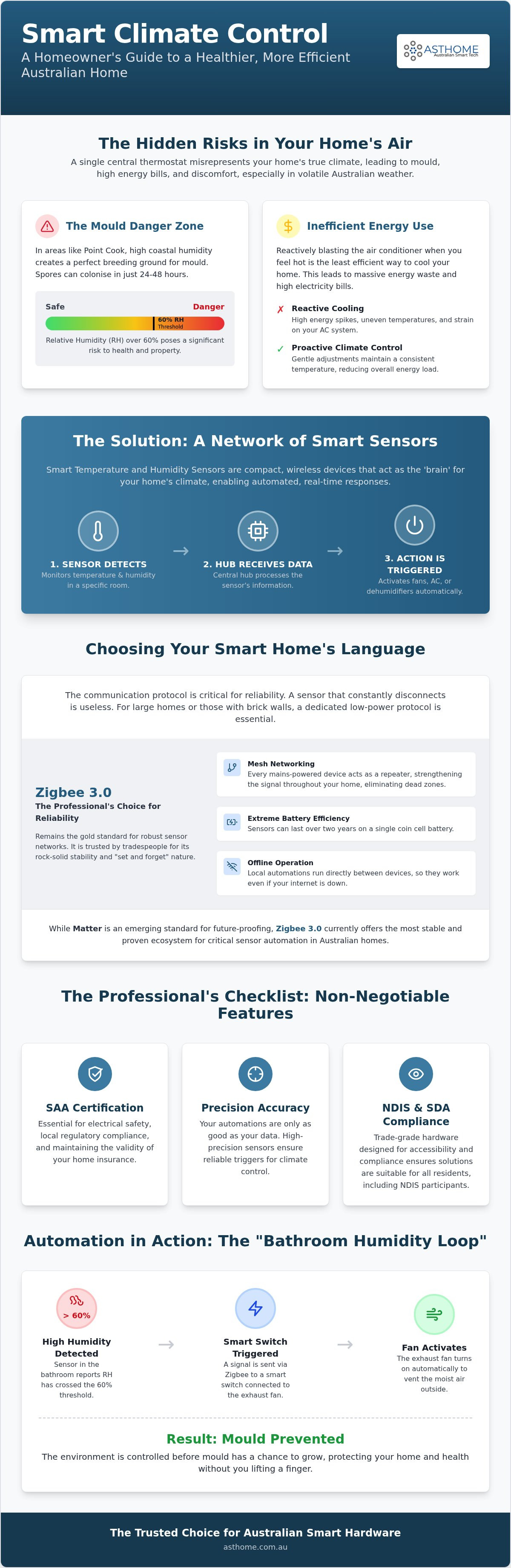
Relative humidity (RH) levels exceeding 60% are the danger zone for Victorian homes. Once moisture hits this threshold, mould spores can begin to colonise surfaces in bathrooms and laundries within 24 to 48 hours. By understanding how humidity sensors work, you can see why professional-grade accuracy is vital for identifying "dead zones" where air stagnates. Poor indoor air quality isn't just an aesthetic issue; it carries genuine health implications for Aussie families, particularly those with asthma or respiratory sensitivities. Using a sensor to monitor these wet areas ensures you know exactly when to increase ventilation.
Optimising Your Home's Thermal Comfort
Managing energy costs is a priority for every household. Most people wait until they feel uncomfortably hot to blast the air con, which is the least efficient way to cool a room. Sensors allow you to track the "real feel" temperature and identify insulation gaps by comparing indoor data against outdoor conditions. This is particularly critical for vulnerable residents. Ensuring a baby's room or an elderly relative's living space stays within a safe, consistent range provides peace of mind. You can set your smart modules to trigger gentle cooling when the room hits 26°C, preventing the space from overheating and reducing the load on your system. This proactive approach keeps your home comfortable while keeping your electricity usage under control.
Zigbee vs Matter: Choosing the Right Protocol for Your Sensor
The communication protocol you choose is the single most important decision for your smart home architecture. It dictates how your devices talk to each other and, more importantly, whether they stay connected when you need them most. A smart temperature and humidity sensor that loses its connection in a damp bathroom or a distant bedroom is effectively useless. In large Point Cook townhouses, where Wi-Fi signals often struggle to penetrate multiple floors or brick walls, choosing a dedicated low-power protocol is essential for a stable network that won't drop out. Relying on standard Wi-Fi for dozens of sensors can quickly overwhelm your router and lead to frustrating latency issues.
The Case for Zigbee 3.0 in Australian Homes
Zigbee 3.0 remains the gold standard for reliability in professional-grade sensor networks. Unlike Wi-Fi, which connects every device directly to your router, Zigbee uses mesh networking. This means every mains-powered device acts as a repeater, extending the range throughout your property. For sensors tucked away in cupboards or wet areas, this mesh ensures the signal always finds a path back to the hub. You can easily link your sensor to a Zigbee 3.0 smart switch module australia to create local automations that run even if your internet goes down. Because Zigbee is incredibly energy-efficient, these sensors often last two years or more on a single coin cell battery. It's a "set and forget" solution that tradespeople trust for its long-term stability.
Matter: Future-Proofing Your Smart Home
Matter is the industry standard designed to end the "which app do I use" headache. It allows devices from different brands to work together natively within Apple Home, Google Home, or Amazon Alexa. Integrating your sensors with a matter smart switch setup ensures that your climate data can trigger actions across any ecosystem you choose. This interoperability is a key feature of ENERGY STAR certified smart home systems, which focus on making energy management simpler and more accessible. Most Matter sensors use Thread, a wireless protocol that provides faster response times and better stability than traditional Bluetooth connections. It's an excellent choice if you want to mix and match hardware without being locked into a single manufacturer's app.
When building out your system, consider whether you prefer the proven, ultra-stable mesh of Zigbee or the cross-platform flexibility of Matter. Both offer significant advantages over standard Wi-Fi sensors for professional installations. If you're ready to start your build, you can browse our range of SAA-certified sensors to find the right fit for your home.
Key Features to Look for in a Professional-Grade Smart Sensor
Selecting the right hardware goes beyond just checking the price tag. For a smart temperature and humidity sensor to be truly effective, it must offer high-precision accuracy. Professional-grade sensors typically boast ratings of ±0.3°C for temperature and ±3% for relative humidity. This level of detail is vital when you're using the data to trigger expensive appliances like air conditioners or heaters. If your sensor is poorly calibrated, your home might feel stifling before the AC kicks in, or you could be wasting energy by over-cooling a room that's already reached its target.
Data logging is another essential feature. High-quality sensors store historical data, allowing you to visualise climate trends over weeks or months. This history is invaluable for spotting recurring dampness in a laundry or identifying exactly when a wine cellar's temperature starts to drift. Look for devices that offer flexible mounting options too. Whether it's a magnetic back for the fridge, a 3M adhesive strip for tiled bathrooms, or a screw-in bracket for permanent installation on plasterboard, the sensor should fit your home's specific layout without hassle.
The Critical Importance of SAA Certification
In the Australian market, SAA certification is the non-negotiable benchmark for electrical safety. While it's tempting to source cheap, non-compliant sensors from international marketplaces, doing so introduces significant risk to your property. Licensed sparkies generally refuse to install hardware that hasn't passed these rigorous local standards. More importantly, using non-compliant gear can potentially void your home insurance. If an electrical fault occurs and investigators find uncertified devices integrated into your home's wiring or smart ecosystem, your claim could be rejected. Choosing SAA-certified hardware ensures your smart home remains a safe and protected asset.
Battery Life and Maintenance Realities
Maintenance shouldn't be a weekly chore. Most professional sensors use either AAA batteries or CR2032 coin cells. Models with e-ink screens often require AAA batteries to power the display, while the smallest, most discreet sensors rely on coin cells to maintain a slim profile. Regardless of the battery type, your smart home app should provide low-battery notifications. This ensures your mould-prevention automations never go offline unexpectedly. A typical Asthome Zigbee sensor provides a reliable battery lifespan of up to two years on a single CR2032 coin cell. This longevity makes Zigbee the preferred choice for sensors located in hard-to-reach areas like high ceilings or deep inside pantry cupboards.
Automation Masterclass: Putting Your Sensor to Work in Point Cook
Automation transforms a passive data point into an active solution for your home. The "Bathroom Humidity Loop" is a prime example for Victorian coastal households. Instead of a standard timer that turns off while the room is still steamy, you can program your exhaust fan to run until the relative humidity drops below 55%. This ensures the air is truly dry; it prevents the silent growth of mould in grout and ceilings that often occurs when fans are switched off too early.
Smart cooling is another high-impact application for a smart temperature and humidity sensor. By triggering your AC via a smart module when the living room hits 26°C, you prevent the house from heat-soaking. It's significantly more efficient to maintain a steady temperature than to crash-cool a room that has already reached 30°C. You can also layer this logic with a motion sensor to ensure the cooling only activates if someone is actually using the space, saving power when the house is empty.
Accessibility and NDIS Smart Home Kits
For participants living in Specialist Disability Accommodation (SDA), climate control is a vital component of independence. Sensors are a core part of an ndis sda smart home technology australia plan. They allow for hands-free environmental management for those with limited mobility. You can set up voice alerts for temperature extremes or automate smart blinds to close when the afternoon sun hits. This assists those with sensory needs or physical limitations to maintain their environment without manual effort or carer intervention.
Advanced Logic for the Modern Aussie Reno
Modern renovations benefit from "if/then" logic that spans multiple devices. A common frustration is the AC running while a sliding door is open to the backyard. You can program your system to cut power to the cooling module if a window sensor is triggered. Similarly, your smart curtains can adjust based on the heat detected by your smart temperature and humidity sensor, protecting your furniture from UV damage. Creating distinct "Summer" and "Winter" profiles allows your home to react differently to the seasons, ensuring your Victorian home remains efficient year-round.
Ready to start building your responsive home? Shop our range of SAA-certified sensors and start automating your climate today.
Why Asthome is the Trusted Choice for Australian Smart Hardware
Asthome isn't just another online retailer. We are practitioners who have transitioned into the digital age, providing hardware that we'd be proud to install in our own homes. Being based in Point Cook, Victoria, means we understand the specific environmental challenges of the region. Local expertise translates to faster domestic shipping and support that actually knows what an Australian summer looks like. When you buy a smart temperature and humidity sensor from us, you aren't just getting a gadget. You're getting a component that has been vetted for the local market and backed by years of trade experience.
Our focus remains on safety and standards. Every module we stock carries the "sparkie-approved" seal of SAA certification. This is the rhythmic safety anchor of our business. We don't cut corners with uncertified international stock. This commitment provides peace of mind for everyone from DIY enthusiasts to specialised NDIS SDA providers. We ensure that every piece of equipment meets the strict regulatory requirements of the Australian electrical grid. We're here to eliminate uncertainty for our customers by prioritising quality and regional regulatory adherence.
Trade Accounts for Licensed Professionals
We speak the language of the trade. Licensed electricians can access dedicated trade accounts to streamline procurement for large-scale smart home rollouts. This includes wholesale pricing and technical support from peers who understand electrical ratings and communication standards. Whether you're managing a complex install for a power point or a network of climate sensors, we provide the documentation and literacy required for compliant work. We help you move systematically from broad project requirements to specific technical solutions without the fluff.
The Asthome Difference: Quality Over Convenience
The market is flooded with cheap sensors that drop off the network or provide inaccurate data. We curate our range to include only the most reliable Zigbee 3.0 and Matter modules. Our selection process prioritises utility and certification status over decorative features. This ensures your automations remain active and your home remains safe. We understand the high stakes of the industry, especially when it comes to NDIS-compliant kits where reliability is a matter of accessibility and health. Choosing a vetted smart temperature and humidity sensor from our collection means investing in long-term performance. Our business is run by professionals who value your time and technical requirements.
If you're ready to upgrade your home with hardware you can trust, start with our vetted collection. Browse our range of SAA-certified smart sensors today and experience the difference of trade-grade technology.
Build a More Responsive, Efficient Australian Home
Taking control of your indoor climate is no longer a matter of manual adjustments and guesswork. By selecting the right protocol, whether it's the proven stability of Zigbee 3.0 or the universal compatibility of Matter, you ensure your automations remain fast and reliable. Professional grade accuracy and SAA certification are the non-negotiable benchmarks for a safe, compliant installation. These standards protect your property's insurance and your family's health by preventing mould and managing thermal comfort with precision. Integrating a smart temperature and humidity sensor into your ecosystem is the first step toward a truly intelligent, self-managing household.
Asthome provides the technical expertise and trade-grade hardware needed for these sophisticated builds. We offer local support from our Point Cook base and provide specialised trade pricing for licensed professionals. Whether you're retrofitting a single bathroom or designing an NDIS SDA compliant residence, we have the certified components to make it happen. Upgrade your home's IQ with SAA-certified smart sensors from Asthome and start enjoying a more comfortable, energy-efficient lifestyle today. Your smarter, healthier home is just one sensor away.
Frequently Asked Questions
Do I need a hub for a smart temperature and humidity sensor?
Yes, if you choose a Zigbee or Matter-over-Thread sensor, you will need a compatible hub or gateway. A Zigbee Gateway Hub acts as the central translator between your sensors and your home network. While Wi-Fi sensors exist, they consume significantly more power and can clutter your router. Using a hub ensures your sensors remain responsive and your battery life lasts for years rather than months.
Are smart sensors SAA certified in Australia?
All smart sensors sold by Asthome are SAA certified for the Australian market. This certification is a legal requirement for electrical safety and ensures the hardware meets local regulatory standards. Licensed electricians generally won't install non-compliant gear; using uncertified devices can jeopardise your home insurance coverage. Always look for the RCM mark to verify a product's compliance status before purchase.
Can a smart sensor really prevent mould in my bathroom?
A smart temperature and humidity sensor prevents mould by automating your ventilation based on real-time data. Instead of relying on a manual switch, the sensor triggers your exhaust fan as soon as relative humidity climbs. It keeps the fan running until the air is dry enough to stop mould spores from colonising surfaces. This proactive approach is far more effective than trying to scrub away mould after it has already appeared.
How long do the batteries last in a Zigbee smart sensor?
You can typically expect a battery lifespan of up to two years from a Zigbee 3.0 sensor. These devices use ultra-low-power protocols that only wake up when a significant change in temperature or humidity is detected. Most models use a standard CR2032 coin cell or AAA batteries. Your smart home app will send a low-battery notification well before the device goes offline; this ensures your climate automations remain active.
Will these sensors work with Home Assistant or Apple HomeKit?
Our sensors are designed for broad compatibility with major ecosystems. If you use Home Assistant, our Zigbee sensors integrate seamlessly via a ZHA or Zigbee2MQTT coordinator. For Apple HomeKit users, selecting a Matter-certified sensor ensures native support without needing a third-party bridge. This flexibility allows you to build complex automations across different platforms while maintaining local control and data privacy.
Where is the best place to mount a temperature sensor in a room?
Mount your sensor at approximately eye level on an internal wall for the most accurate readings. Avoid placing it directly next to windows, doors, or air conditioning vents, as drafts will skew the data. Direct sunlight will also cause "false high" readings. For bathroom installs, place the sensor away from direct water splashes but close enough to the shower to detect rising steam quickly.
Can I use a smart sensor outdoors in the Victorian climate?
Most standard smart sensors are designed for indoor use and lack the IP rating required for direct exposure to rain. However, you can use them in sheltered outdoor areas like a covered alfresco or veranda. In the volatile Victorian climate, extreme temperature shifts and morning dew can damage non-weatherproof electronics. If you need to monitor the garden, ensure the sensor is housed in a dedicated weatherproof enclosure to prevent moisture ingress.
How many sensors do I need for a standard three-bedroom home?
A standard three-bedroom home usually requires five to seven sensors for comprehensive coverage. We recommend placing one in each bedroom, one in the main living area, and one in every bathroom or laundry. This allows you to create specific climate zones. For example, you can automate individual bedroom cooling while monitoring the laundry for dampness, ensuring every corner of your home is protected and efficient.