

The best-looking automated wall switch may be the wrong fit for your home. The right choice depends on the wiring behind the existing switch, the lights it controls and the smart-home system you want to use.
Choosing between a switch module and a complete smart wall switch can be tricky. Wiring, lighting and connectivity all affect the decision, and Matter, Zigbee and Wi-Fi each work differently within a smart-home setup.
This guide compares the main switch formats and connectivity options, with practical checks to help you narrow down what suits your installation. Asthome Smart Electrical Supplies supplies Matter and Zigbee switch modules, plus Wi-Fi light switches in 1-, 2-, 3- and 4-gang formats. Its products are SAA certified for the Australian market. You’ll also find a broad range of smart-home brands and components at competitive prices, with prompt customer service for product questions.
Key Takeaways
- An automated wall switch can support manual operation alongside smart controls, with features such as schedules and scenes depending on the device.
- Compare modules, complete smart switches and separate smart controls by what changes at the wall and how each fits your project.
- Check the lighting load, wiring and product specifications before deciding. Neutral-wire requirements vary by device.
- Match Matter, Zigbee or Wi-Fi to your existing smart-home ecosystem and preferred way to control your lights.
- Use a five-step shortlist: define the load, inspect the installation, choose a format, match the ecosystem and check certification.
What does an automated wall switch do, and what can it control?
An automated wall switch is a wall-mounted control that operates a compatible electrical circuit manually and, where supported, through a smart-home system. Depending on the device, you may be able to switch lights remotely, set schedules or include them in scenes with other connected devices. These functions depend on the switch and control system, so check the product specifications rather than assuming every model supports them.
The key benefit is keeping a familiar control at the wall while adding other ways to operate the circuit. For a foundational overview of how smart switches work, including wireless control, see Wikipedia’s explanation.
What is the difference between a switch module and a smart wall switch?
A switch module is installed behind a compatible existing wall switch. It adds smart control while retaining the existing wall control, subject to the module’s requirements and the installation. A complete smart wall switch replaces the control at the wall with a smart-switch unit. Choose between them based on the existing installation and whether you want to keep or replace the visible wall control.
What can you automate with a wall switch?
A wall switch most commonly controls a lighting circuit. Depending on its specifications, a device may also switch other compatible connected loads. Check the product’s supported load and intended use rather than assuming it will work with any circuit or fitting.
Smart functions vary by product, but may include:
- Remote switching: operate the circuit through a compatible app or smart-home system.
- Schedules: set lights to switch on or off at chosen times, if the device supports scheduling.
- Scenes: group a light with other compatible devices for a coordinated action.
On-off control isn’t the same as dimming. Automating a circuit doesn’t make every connected lamp dimmable. Dimming requires compatible dimmer hardware and lighting, and the product specifications need to support that combination. Asthome’s range includes switch modules, smart Wi-Fi light switches and a Smart Zigbee Dimmer Module, giving you different formats to compare with your lighting and control needs.
Compare automated wall switch formats before you choose
The main difference between formats is what changes at the wall and how smart control is added. Use this comparison to narrow down an automated wall switch, then check the existing installation and the product’s stated requirements.
| Format | What changes at the wall | Likely project fit | Smart-control approach |
|---|---|---|---|
| In-wall switch module | The existing switch stays in place; a module is fitted behind it. | A project aiming to retain the current wall control, if the installation suits the module. | The module connects the switch circuit to compatible smart-home controls. |
| Complete smart wall switch | The existing wall control is replaced. | A refresh where changing the visible switch is part of the plan. | Smart control is built into the replacement switch, according to its capabilities. |
| Conventional switch with separate smart control | The conventional switch remains; a separate compatible control is added. | A setup where you want to keep the existing switch and use an additional smart-control method. | Control depends on the separate device and how it works with the lighting circuit and wider system. |
Automation can also support more deliberate operation of lighting and appliances. The Australian Government’s smart-home information explains how automated control may save you energy and money, though outcomes depend on how a system is used.
When is an in-wall switch module worth considering?
A module may suit a project where you want to keep the existing wall switch and add smart control behind it. This retains the familiar control at the wall, but it isn’t a universal retrofit. The space behind the switch, the wiring and the module’s specifications all affect suitability. Check these details before choosing a module, rather than assuming every existing switch can accommodate one.
When might a complete smart wall switch be a better fit?
Choose this format when replacing the visible wall control is part of the project. Gang count matters: Asthome’s Smart Wi-Fi Light Switch range includes 1-, 2-, 3- and 4-gang formats, so consider how many controls you need at that wall location. Appearance is another practical factor, but the switch still needs to suit the lighting circuit and your smart-home setup.
For a wider view of options, read Asthome’s Australian smart light switch guide. Asthome supplies Matter and Zigbee switch modules and Wi-Fi smart switches. Its products are SAA certified for the Australian market. Explore the smart switch range to compare formats and product details.
Will an automated wall switch suit your wiring, lights and smart-home system?
Suitability comes down to four things: the wiring at the switch, the connected load, the product’s specifications and its compatibility with your smart-home setup. A switch that looks right on paper may still be unsuitable if its wiring requirements or supported load don’t match the installation.
Check the switch and lighting together: the switch needs to support the circuit, and the connected lights need to suit the type of control. Neutral-wire requirements vary by product. Check the selected device’s documentation instead of assuming every switch module needs a neutral wire, or that none do.
How do Matter, Zigbee and Wi-Fi differ for switch control?
These technologies provide different ways for smart devices to communicate with a control system. Matter is designed to support compatibility across participating smart-home products and platforms. Zigbee is a wireless protocol used by compatible devices, with some setups relying on a suitable hub or gateway. Wi-Fi switches connect through a Wi-Fi-based setup, though the required app and ecosystem depend on the product.
There’s no universal winner. Compare the product’s stated compatibility with the devices, app and platform you already use. For more detail on Matter, see Asthome’s Matter smart switch guide.
What wiring and lighting details affect compatibility?
Before shortlisting a switch, consider the wiring at the wall, the space available for a module, the connected load and whether you need on-off switching or dimming. A product may specify a neutral wire, a supported load range or other installation conditions. Treat these details as selection criteria, not assumptions.
Dimming requires a compatible combination of switch, driver and lighting. A dimmer module alone doesn’t make an incompatible lamp dimmable. Check that the relevant components support the intended dimming arrangement.
- Wiring: Match the product’s wiring requirements to the installation.
- Space: Allow for the module and existing wiring behind the switch.
- Load and control: Check the supported load and whether the device switches or dims.
- Ecosystem: Confirm the stated Matter, Zigbee or Wi-Fi compatibility fits your setup.
For fixed-wiring work, have a licensed electrical professional assess the installation requirements. Asthome’s products are SAA certified for the Australian market, and its customer service team can help with product information.
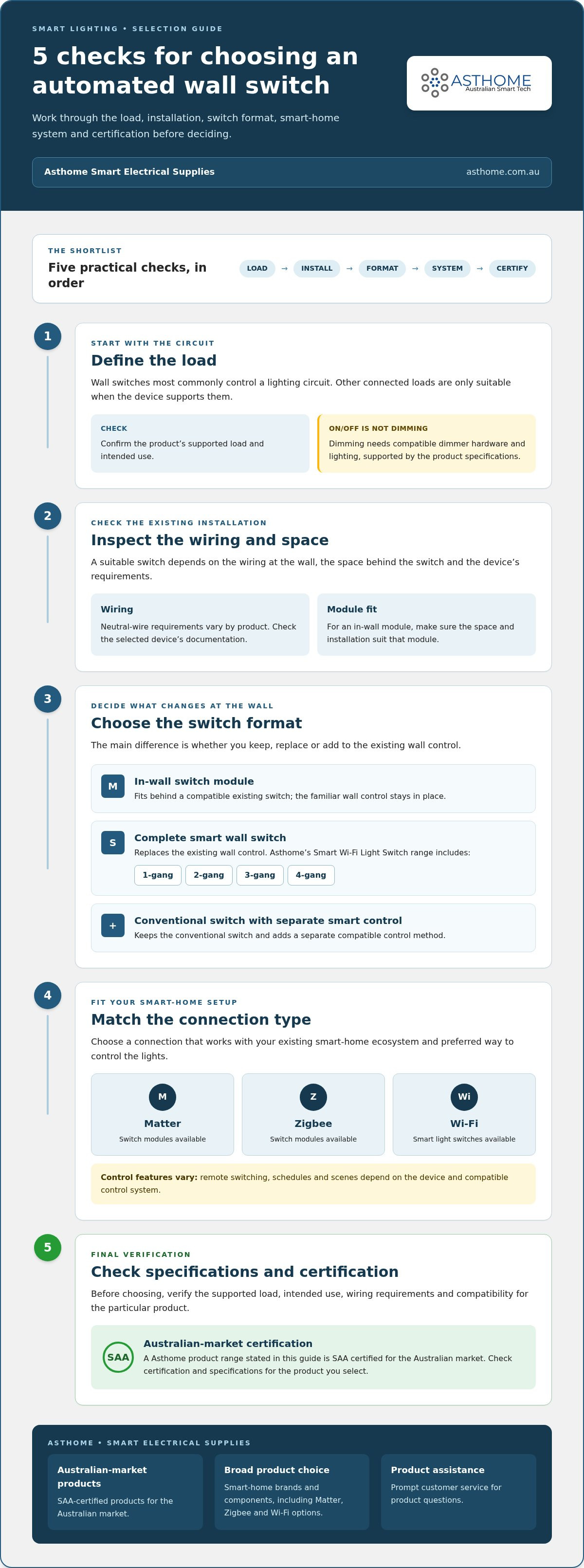
How to select an automated wall switch: a practical buying framework
Use this five-step process to build a shortlist based on your project, not assumptions. Start with the product’s stated specifications when assessing whether an option may fit.
- Define the load. Identify what the switch will control, such as a lighting circuit, and whether you need on-off switching or dimming.
- Inspect the installation. Note the existing switch arrangement, wiring and available space. Have a licensed electrical professional assess fixed-wiring requirements.
- Choose the format. Decide whether you want to retain the existing wall control with a module or replace it with a complete smart switch.
- Match the ecosystem. Compare the product’s stated Matter, Zigbee or Wi-Fi compatibility with your smart-home setup.
- Check certification. Look for clear certification information relevant to the Australian market.
Which product details belong on your shortlist?
Compare function, format and compatibility side by side. Record whether each option switches or dims, its gang format, its connectivity type and the ecosystems it states it supports. Check the product information for wiring and load requirements too. Don’t fill gaps with guesswork. Asthome’s products are SAA certified for the Australian market, a useful consideration when comparing options.
- Function: on-off switching or dimming.
- Format: module or complete switch, plus gang count where relevant.
- Connectivity: Matter, Zigbee or Wi-Fi, and stated system compatibility.
- Certification: clear information for Australian-market use.
What should homeowners and trade buyers prioritise?
For a home project, start with the control experience you want and the smart-home devices already in place. Then compare your preference with the switch’s stated wiring, load and ecosystem requirements. For licensed electrical professionals, project specifications and product documentation help shape a practical shortlist. Asthome offers trade accounts with discounted pricing for verified licensed electrical professionals.
Keep product selection separate from installation work. Choosing a compatible switch doesn’t establish whether it can be fitted to a particular circuit. A licensed electrical professional can assess the fixed-wiring requirements.
Ready to compare switch formats? Browse Asthome smart-home switches, including Matter and Zigbee modules and Wi-Fi switches. Asthome’s customer service team can assist with product questions.
Why choose an Australian-certified automated wall switch from Asthome?
Choosing an automated wall switch involves more than finding a format and connectivity option that suit your home. Product suitability, clear certification information and useful product assistance all matter. Asthome is an Australian smart-home retailer supplying SAA-certified products for the Australian market, alongside a broad range of smart-home brands and components at competitive prices.
What does Australian-market certification add to your decision?
Certification information is a practical point to consider when comparing electrical and smart-home products for use in Australia. Look for clear details on the product, and treat certification as one part of your decision alongside the device’s wiring, load and ecosystem specifications. Certification alone doesn’t determine whether a switch suits a particular circuit or installation.
Asthome focuses on supplying SAA-certified products for the Australian market. This gives retail customers and licensed electrical professionals a relevant local consideration when comparing switch options, while product specifications still need to match the project.
How can Asthome support your next switch project?
Compare the switch formats that match your plans. Asthome’s range includes Matter and Zigbee switch modules, plus smart Wi-Fi light switches in 1-, 2-, 3- and 4-gang formats. Reviewing these options side by side can help you narrow your shortlist by wall-control format and smart-home connection.
Asthome offers trade accounts with discounted pricing for verified licensed electrical professionals. Retail customers and trade buyers can also access prompt customer service and assistance with product questions. Use that support to understand product information as you compare options, then have a licensed electrical professional assess fixed-wiring requirements.
Ready to compare options for your home or project? Explore Asthome’s smart-home products, including switch modules and Wi-Fi smart switches.
Choose a switch that fits your home and system
The right automated wall switch suits the installation, connected lighting and smart-home ecosystem, not simply the one with the most features. Compare modules with complete wall switches, then check the product’s wiring, load and control specifications. For dimming, confirm that the switch and lighting are compatible.
Australian-market certification is another practical part of your shortlist. Asthome’s products are SAA certified for the Australian market, with Matter and Zigbee switch modules and Wi-Fi smart switches among its range. If you need help understanding product details, Asthome offers prompt customer service and product assistance.
Ready to compare options for your home or project? Explore Asthome’s smart-home switches and modules and take the next step with confidence.
Frequently Asked Questions
What is an automated wall switch?
An automated wall switch controls a compatible electrical circuit manually and through the smart-home controls supported by the device. For example, you may be able to switch a light on at the wall and also control it remotely or set a schedule using a compatible system. Features vary by product. An automated wall switch doesn’t automatically make connected lamps dimmable; dimming needs compatible switch hardware and lighting.
Can I automate an existing wall switch without replacing it?
Yes, an in-wall switch module may add smart control while retaining a compatible existing wall switch. The module is installed behind the switch, so its suitability depends on the wiring, available space and the device’s stated requirements. Not every existing switch or installation can accept a module. For fixed-wiring work, have a licensed electrical professional assess the installation and carry out the work.
Does an automated wall switch need a neutral wire?
Not always. Neutral-wire requirements depend on the specific switch or module, so there isn’t one rule for every automated wall switch. Check the product documentation for its wiring requirements and any other installation conditions. Don’t assume the wire is present or that a device will work without it. A licensed electrical professional can assess the wiring at the switch location.
Are Matter, Zigbee and Wi-Fi wall switches different?
Yes. Matter, Zigbee and Wi-Fi are different ways for smart devices to connect with a home-control system. Matter is a smart-home connectivity standard; Zigbee is a wireless protocol, and some Zigbee setups use a compatible hub or gateway. Wi-Fi switches connect through a Wi-Fi-based setup. Before choosing, compare the product’s stated compatibility with your existing devices, app and smart-home platform.
Can an automated wall switch dim any light?
No. Dimming depends on compatibility between the dimmer switch, the lighting and, where used, the LED driver. A standard on-off switch only controls whether a circuit is on or off, and adding smart control doesn’t make a lamp dimmable. Check the product specifications for the supported switching function and lighting compatibility. Asthome offers a Smart Zigbee Dimmer Module and a Dimmable LED Driver.
Are Asthome smart switch products SAA certified?
Yes. Asthome’s products are SAA certified for the Australian market. Certification information is a practical consideration when comparing smart switches, but it doesn’t confirm that a particular device suits every wiring setup or lighting load. Check the product’s stated specifications and compatibility for your project. Asthome’s range includes Matter and Zigbee switch modules and smart Wi-Fi light switches.
Who should install an automated wall switch in Australia?
A licensed electrician should install an automated wall switch that involves fixed wiring. Mains-wired work requires appropriate licensing in Australia, and professional assessment helps ensure the selected product suits the installation. Keep product selection separate from installation: compare the switch’s wiring, load and control requirements, then arrange for a licensed electrical professional to assess and complete the fixed-wiring work.