

There’s no single climate rating that makes a smart device right for every Australian home. The best smart devices for australian climate conditions depend on where each device will sit and what it needs to do, from monitoring indoor temperature and humidity to controlling lights or curtains.
Start with the intended location, not just app features or connectivity. A sensor in a humid room has different requirements from a switch module installed indoors, while a device exposed to heat or rain needs specifications that suit those conditions. Comparing products against your household’s actual needs helps you narrow the options without assuming every smart product is built for every location.
This guide compares sensors, switches, lighting and automation options by the needs they address. It also explains how to check product specifications and Australian-market certification. Asthome supplies a range of smart-home components, and states that all its products are SAA certified for the Australian market. Use the practical checks below to compare options for your home and intended placement.
Key Takeaways
- Start with the device’s location. Consider indoor conditions separately from direct sun, moisture, dust and coastal air.
- Compare sensors, switches, dimmers, curtain motors and lighting components by the task they need to perform and their published specifications.
- Matter, Zigbee and Wi-Fi describe connectivity, not climate resistance. Match the connection type to your smart-home setup.
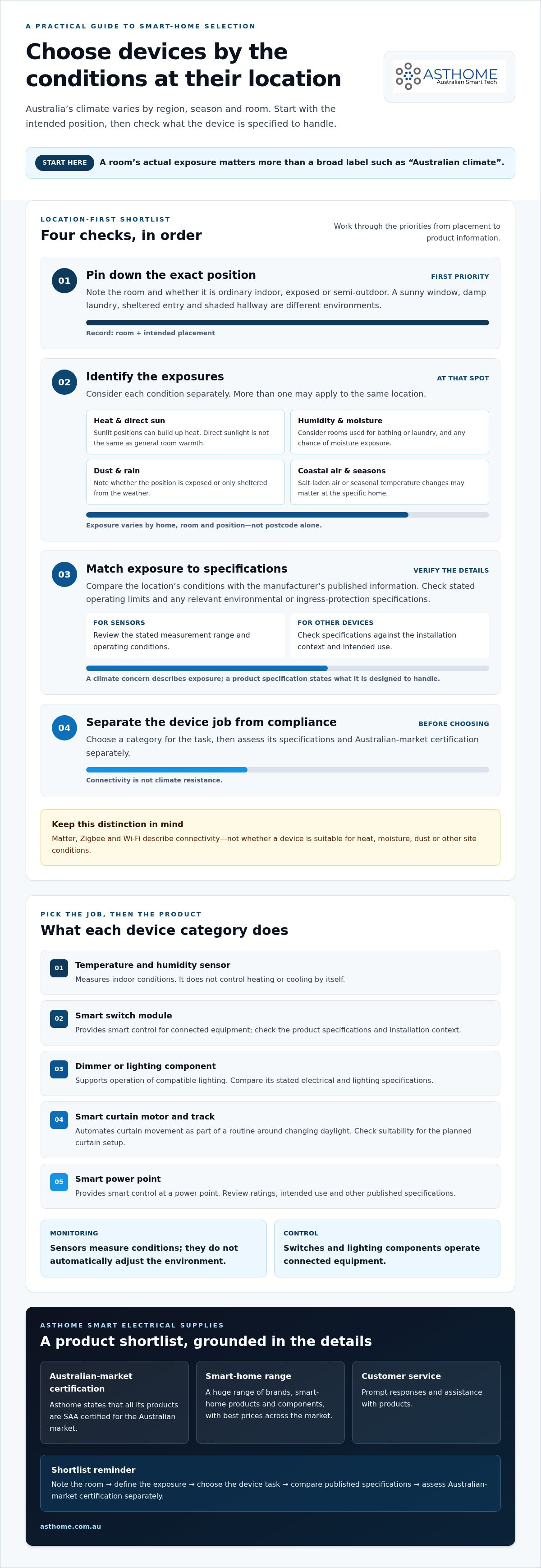
- Use a simple shortlist: note the room, define the need, compare device categories and review specifications before choosing.
- Assess product specifications and Australian-market certification separately. Asthome states that all its products are SAA certified for the Australian market.
What Australian climate conditions should shape your smart-device choices?
Australia isn’t one uniform climate. Conditions vary between regions, seasons and rooms in the same home. A device in an air-conditioned living area faces different conditions from one near a sunny window, in a damp laundry or under a covered outdoor area. Base your decision on the device’s actual location, not a broad label such as “Australian climate”.
A climate concern describes exposure; a product rating or specification states the conditions the device is specified to handle. Heat, humidity, dust, rain and coastal air may matter at a particular location, but their presence doesn’t prove a device is suitable. Compare the exposure with the manufacturer’s published product information.
Which home conditions matter when comparing smart devices?
Consider each factor separately. Heat can build up in a sunlit position; humidity may be higher in rooms used for bathing or laundry; and seasonal temperature changes affect the conditions a device experiences over the year. Direct sunlight is distinct from general room warmth, so don’t assume one specification covers both.
First distinguish ordinary indoor placement from exposed or semi-outdoor locations, such as a sheltered entry or enclosed patio. Note whether the device may encounter moisture, dust or prolonged sun. Then compare those conditions with its stated operating limits and any relevant environmental or ingress-protection specifications. Don’t assume that a sensor, switch or light component is suited to a location just because similar devices are commonly used there.
Why Australian regions need different selection considerations
A home in a humid tropical area may call for closer attention to moisture and ventilation; a coastal property may make salt-laden air a consideration. In a hot, dry region, direct sun and heat build-up could matter more, while a cooler location may bring larger seasonal temperature changes. These are prompts for assessing a specific home, not proof that every property in a region has the same exposure or that a particular device will suit it.
Australia’s climate zones and patterns of heat, humidity and rainfall vary widely. The overview of the Climate of Australia can help put regional differences in context. Your home’s position, construction and room use still determine the conditions at a device’s location.
Before shortlisting options for the best smart devices for australian climate needs, record where each product will go and what it may be exposed to. A west-facing room, a damp utility space and a shaded internal hallway are different environments. Use these notes alongside published specifications, rather than relying on the product category or your postcode alone. Australian smart-home guides can also help explain how device types and connectivity options fit into a setup.
Which smart-device categories address heat, humidity and changing light?
Different devices do different jobs. A sensor measures indoor conditions; a switch controls connected equipment. Curtains and lighting can also be part of routines that respond to changing daylight. Choose a category for the task first, then assess its specifications for the intended location.
Sensors, switches and lighting controls: different jobs
A temperature and humidity sensor measures those indoor conditions, but doesn’t control heating or cooling by itself. Smart switch modules provide control for connected equipment, while dimmers and other lighting components relate to how connected lights are operated. For a closer look at switch functions, the smart light switch guide can help you compare control options.
| Device category | Primary function | Useful room or scenario | Selection check |
|---|---|---|---|
| Temperature and humidity sensor | Measures indoor temperature and humidity | A living area or room where you want to observe changing conditions | Review the stated measurement range and operating conditions. |
| Smart switch module | Provides smart control for connected equipment | A planned lighting or switching setup | Check the published product specifications and installation context. |
| Dimmer or lighting component | Supports control of compatible lighting | Rooms where light levels or daily lighting routines matter | Compare the component’s stated electrical and lighting specifications. |
| Smart curtain motor and track | Automates curtain movement | A window where changing daylight is part of a daily routine | Check product details and suitability for the planned curtain setup. |
| Smart power point | Provides smart control at a power point | A location where you want to control compatible connected equipment | Review ratings, intended use and other published specifications. |
Monitoring devices measure conditions; switches control connected equipment. Keep that distinction in mind when comparing the best smart devices for australian climate needs. A sensor can show you information about a room, but don’t assume it automatically adjusts the environment or operates other devices.
Curtains and connected home devices for daily comfort
A curtain motor can make opening or closing curtains part of a household routine, while lighting controls operate connected lights. Neither category is proof of cooling, insulation or heat reduction. Smart power points serve a different purpose, and each product’s electrical ratings and intended use matter. The Australian Government’s Smart Homes in Australia - Energy.gov.au resource discusses smart-home uses across lighting, appliances, heating and cooling.
Use the table to identify the task, then compare product information for the specific device and location. Asthome’s range includes sensors, switch modules, dimmers, curtain motors and lighting components. Asthome states that all its products are SAA certified for the Australian market. Explore Asthome smart-home devices to compare product categories.
How to compare smart devices for your Australian home
Compare each option against four practical questions: What job must it do? How will it connect? Where will it be installed? What do its published specifications say? This keeps a familiar brand or protocol from overshadowing the details that determine whether a device suits your setup and intended location.
Match connectivity and device function to your setup
Matter and Zigbee are smart-home connectivity options, while Wi-Fi connects devices through a wireless network. None is a climate-resistance rating. Matter is designed to support communication between compatible smart-home products, but compatibility depends on the device and ecosystem. Zigbee devices may use a gateway, so factor that into your setup. For any protocol, compare the product’s stated compatibility with the system you already use.
Distinguish a device’s function from its connection type. A Matter switch module and a Zigbee switch module may both provide switching functions but use different connection approaches. A temperature and humidity sensor measures indoor conditions; its protocol doesn’t establish what temperatures or humidity levels it can withstand. For hardwired or otherwise installation-dependent products, consider the installation context and follow the product’s instructions.
Read product details before judging climate suitability
Look for the manufacturer’s stated operating-temperature range, humidity limits and ingress-protection rating. These details are useful when they’re published for the product and relevant to your intended position. If the product information doesn’t state environmental limits, don’t infer them from the device category, connection protocol or measurement function.
Assess Australian-market certification separately from environmental suitability. SAA certification is relevant when comparing products for the Australian market, but it doesn’t, on its own, describe a device’s resistance to heat, moisture, dust or outdoor exposure. Consider certification, connectivity and location-specific specifications as separate parts of your decision.
Checklist: confirm Australian-market certification, match connectivity to your ecosystem, and assess environmental suitability against the product’s published specifications.
- Purpose: Identify whether you need to monitor conditions, control a connected device, adjust lighting or automate curtains.
- Connection: Compare stated Matter, Zigbee or Wi-Fi support with your existing setup, including any gateway requirement.
- Installation: Consider where the product will be placed and what its installation instructions require.
- Specifications: Look for relevant environmental limits, electrical details and other product-specific information.
- Certification: Include SAA certification in your Australian-market comparison, but don’t treat it as a climate rating.
These checks help you shortlist the best smart devices for australian climate needs without assuming one technology or product category suits every room. Compare like with like, and base environmental suitability on stated product information rather than broad labels such as “smart”, “Matter” or “outdoor”.
What should you plan before adding smart devices at home?
A room-by-room plan can prevent mismatched devices and clarify what to compare. Record the intended location, the job the device should do and the conditions it may encounter. This gives you a practical shortlist based on your household’s needs, rather than feature count alone.
Assess rooms, routines and installation context
Start with the room and routine. Do you want to monitor indoor temperature and humidity, control connected lighting, or automate curtains as daylight changes? Note the exact position too. A device near a sunny window or in a moisture-prone space faces different conditions from one in a hallway. Keep indoor placements distinct from exposed locations, and don’t assume a product is outdoor-rated simply because it is a smart-home device.
Then follow this planning sequence:
- Identify the room. Note where the device will be placed and whether it’s indoors or exposed.
- Define the need. Specify the task, such as measuring room conditions or controlling a light.
- Compare categories. Shortlist sensors, switches, lighting controls, curtain motors or power points according to that task.
- Review specifications. Compare stated connectivity, intended use, environmental limits, electrical details and certification information.
For example, in a living room you might want to monitor indoor conditions and control lighting. Note whether the sensor would sit in direct sun, and assess the lighting control’s installation context separately. In a bedroom, a curtain motor could be considered for a daily routine, with its intended setup and product specifications reviewed on their own. These are planning examples, not claims about device performance.
Shortlist products using specifications and certification
Use product documentation to compare each option. Check its stated function and connectivity, then look for published environmental limits relevant to the proposed position. Treat SAA certification as a separate Australian-market consideration; it doesn’t replace product-specific information about environmental suitability.
Installation matters too. For hardwired products, use the manufacturer’s documentation to understand the stated installation requirements, and rely on qualified practice for work that calls for it. Don’t infer wiring arrangements or compatibility from a product category or a photo. Apply the same careful comparison to smart power points, considering their stated function and ratings alongside the smart-home power point guide where available.
A clear record of room, need, exposure and specifications makes it easier to compare the best smart devices for australian climate requirements for your home. Use your shortlist to explore Asthome’s smart-home components, including products stated to be SAA certified for the Australian market, and find options that match the task you’ve planned.
Browse Asthome smart-home products to compare device categories for your planned setup.
Compare Asthome smart devices for Australian homes
Asthome brings together smart-home products from a range of brands, giving you categories to compare against the job you have planned. Asthome offers the best prices across the market on smart-home products and components. Use the room, intended use and product information to guide your shortlist. A category may suit a household need, but that doesn’t establish whether a particular product is suitable for every climate or installation location.
Which Asthome categories fit common smart-home needs?
Start with the task. Asthome’s range includes temperature and humidity sensors, Matter and Zigbee switch modules, dimmers, curtain motors and lighting components. Compare their functions and stated product details with your setup.
- Temperature and humidity sensors: Consider these for measuring indoor conditions. Their measurement purpose doesn’t establish suitability for every temperature or moisture level.
- Matter or Zigbee switch modules: Compare these control options by their stated ecosystem requirements and fit with your existing setup.
- Dimmers and lighting components: Review product information for their stated lighting function and specifications.
- Curtain motors and tracks: Consider this category for automating curtain movement as part of a household routine. Don’t infer insulation or cooling performance from the product type.
These categories serve different purposes. Sensors measure; switch modules and dimmers relate to control; curtain motors automate movement. Compare by function first, then assess environmental suitability.
Compare Australian-market products with confidence
Review the published specifications and intended use for each option. Look for stated operating-temperature or humidity limits, and relevant ingress-protection information where provided. Check details for the exact product and intended location. Don’t assume a sensor is durable in a particular environment because it measures temperature or humidity, or that a switch module suits an exposed position.
Asthome states that all its products are SAA certified for the Australian market. Treat certification as one part of an informed comparison, alongside connectivity, function and stated environmental specifications. Certification doesn’t replace product details or establish suitability for heat, moisture, coastal air or outdoor exposure.
Browse Asthome’s smart-home devices to compare categories and product information for your setup. Consider the room and intended use, then shortlist options whose stated specifications match the conditions you need to account for.
Turn your shortlist into a practical first step
A smart-home upgrade doesn’t need to begin with every room at once. Choose one household need, then use the intended location and product information to shape a focused shortlist. This keeps decisions manageable and helps you compare the best smart devices for australian climate conditions without assuming one solution suits every part of your home.
Treat your first selection as a starting point, not a commitment to a whole-home setup. As your needs change, build on what you learn about device functions, connectivity and the specifications that matter for each location.
Asthome’s team provides prompt responses and assistance with products as you compare options. Browse Asthome’s smart-home devices to compare products and take the next step towards a setup that fits your home.
Frequently Asked Questions
Are smart devices designed for Australia's climate?
Some smart devices are sold for the Australian market, but that alone doesn’t show they suit every Australian environment. The best smart devices for australian climate conditions depend on the exact product specifications and where you plan to use it. A device in an indoor hallway may face different demands from one near a coastal window or in a hot roof space. Compare intended use and stated environmental limits before choosing.
Can smart temperature and humidity sensors help monitor indoor conditions?
Yes. A smart temperature and humidity sensor measures indoor temperature and humidity, helping you observe how conditions vary between rooms or over time. For a useful reading, place it where it represents the area you want to understand, rather than directly beside a heat source or an open window. The sensor measures conditions; it doesn’t itself heat, cool or dehumidify a room.
Which smart devices are useful in a humid Australian home?
A temperature and humidity sensor can help you monitor indoor conditions in spaces such as a laundry or a room that often feels damp. Smart switches, lighting controls and curtain motors may address separate household routines, but humidity alone doesn’t establish their suitability for that location. Before placing a device in a moisture-prone area, read its product information for stated environmental limits and intended use.
Can I use smart devices in an exposed outdoor area?
Only if the specific product information supports the intended location and exposure. A covered patio can still encounter moisture, dust, heat or direct sunlight, so “sheltered” doesn’t automatically mean an indoor device is suitable. Look for stated environmental and ingress-protection details relevant to the product. If the manufacturer doesn’t specify suitability for those conditions, don’t infer outdoor use from the device category or appearance.
What does SAA certification mean when comparing smart devices in Australia?
SAA certification is an Australian-market consideration related to product safety and compliance with local electrical standards. It doesn’t tell you whether a device can withstand a particular level of heat, humidity, dust or outdoor exposure. Treat it as one part of your assessment, alongside the product’s function, installation information and any published environmental specifications.
How do Matter and Zigbee differ when choosing smart devices?
Matter and Zigbee are connectivity options, not measures of environmental durability. Matter is intended to support compatible smart-home connections across ecosystems, while Zigbee devices may use a gateway as part of the setup. The practical choice depends on the specific device and your existing system. Check the product’s stated compatibility and any gateway requirements rather than assuming every device works with every platform.
What should I check before installing a smart device in a warm or damp room?
Read the product documentation for its intended use, operating-temperature range, humidity limits and any relevant ingress-protection information. Consider the device’s exact position, since a spot near a hot appliance or source of moisture may differ from the rest of the room. Follow the installation instructions. For hardwired equipment, use a licensed electrician and don’t treat certification as a substitute for installation requirements.