

The best smart home system for electricians to install isn’t necessarily the one with the longest feature list. It’s the option that suits the project, works with the client’s preferred ecosystem and can be specified with confidence for the Australian market. Matter, Zigbee and Wi-Fi each have different requirements, so compare the specific products and setup rather than choosing by protocol name alone.
Before selecting components, identify the devices the client needs, the platform they want to use and any equipment already in place. Then check product compatibility, Australian-market suitability and installation information for each item. This guide compares the options and provides a practical process for shortlisting products, checking open questions and avoiding mismatched devices.
Asthome Smart Electrical Supplies provides smart home products and electrical components, including Matter and Zigbee modules, Wi-Fi switches and lighting products. Asthome Smart Electrical Supplies states that all products are SAA certified for the Australian market. Check current availability and product-specific certification information before specifying.
Key Takeaways
- Define the project scope, the client’s preferred controls and the devices required before choosing a system.
- Compare Matter, Zigbee and Wi-Fi by their fit with the intended setup, then confirm compatibility for each specific product.
- Use a project checklist to separate confirmed requirements from details that still need manufacturer or supplier verification.
- Check Australian-market suitability and product-specific certification information before specifying.
- Asthome sells smart home components, and licensed electrical professionals can apply for verified trade accounts with discounted pricing.
What makes a smart home system suitable for electricians to install?
A smart home system is more than a connected switch. It brings together devices such as switches, sensors or locks, a communication method that lets them exchange information, and a control platform the client uses to operate them. For a foundational overview of connected home functions such as lighting and security, see this guide to a home automation system.
A suitable smart home system is the combination of devices, communications and controls that meets the project brief and works with the client’s existing or chosen platform. There’s no single protocol that suits every job. A connected switch may solve an immediate lighting need, but it is not automatically a complete system. Broader automation can involve several device categories and a compatible platform to bring them together—to see how comprehensive, tailored building systems are delivered internationally, discover Greenlines Automation.
Start with the job, not the protocol
First, define the scope. Is the project mainly about lighting and switching, or does it also include sensors, access control or broader automation? Clarify what the client wants to control and how they want to control it, such as through an app, voice control, physical switches or a combination. Record existing devices and the client’s preferred platforms before recommending hardware. This brings compatibility questions to the surface before components are selected.
For example, a lighting-focused brief might call for smart switches or dimming components. A project involving movement detection may also need sensors and a compatible control platform. Those product categories do not guarantee that the devices will work together. Check the requirements for each product and platform before treating them as one system.
What electricians should expect from a supplier
Product selection is only part of the job. Look for clear information about each product, its communication method, platform compatibility and Australian-market certification. Ask about the specific product and intended setup, then confirm unclear details with the manufacturer or supplier. A shared protocol alone does not confirm that two products are compatible or suitable for a particular installation.
Asthome is an Australian online retailer of smart home technology and electrical components, with Matter, Zigbee and Wi-Fi product categories. Asthome states that all its products are SAA certified for the Australian market. Before specifying, check current availability and product-specific certification information. Asthome supplies products, not electrical installation, commissioning or custom software services.
For electricians weighing the best smart home system for electricians to install, the practical test is straightforward: does the proposed combination suit the brief, align with the client’s platform preferences and have its product details confirmed? Start there, then compare protocols and components against the actual job.
Matter, Zigbee or Wi-Fi: compare smart home system options
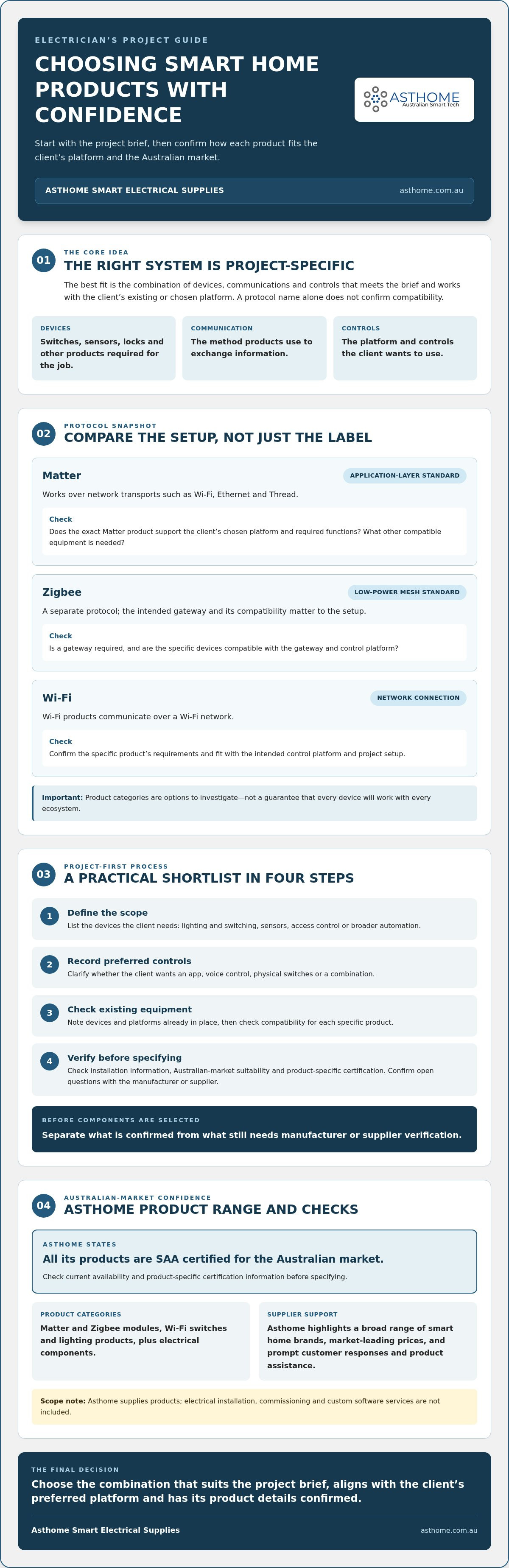
Matter, Zigbee and Wi-Fi describe different parts of a smart home setup. They are not interchangeable guarantees of compatibility or performance. Matter is an application-layer standard that works over network transports such as Wi-Fi, Ethernet and Thread. Zigbee is a separate, low-power mesh standard, while Wi-Fi products communicate over a Wi-Fi network. Google Home Developers provides background on Matter, Zigbee or Wi-Fi and how Matter operates across compatible network technologies.
Use the comparison below to form a shortlist, then check the actual device, gateway and control platform. The product categories are examples to investigate, not a promise that every device will work with every ecosystem.
| Option | Ecosystem fit to check | Product categories to consider | Project questions |
|---|---|---|---|
| Matter | Suitability depends on the specific Matter product and the client’s intended platform. | Matter smart switch modules and other products explicitly identified as Matter-compatible. | Does the exact product support the client’s chosen platform and required functions? What other compatible equipment is needed? |
| Zigbee | Check the intended Zigbee gateway and its compatibility with the devices and control platform. | Zigbee switch and dimmer modules, sensors and gateway products. | Is a gateway required? Have the specific devices and gateway been confirmed as compatible? |
| Wi-Fi | Confirm support for the client’s chosen app or platform. The Wi-Fi label alone does not establish ecosystem compatibility. | Smart Wi-Fi light switches and other Wi-Fi products specified for the project. | What network and platform requirements does the manufacturer specify? Will the proposed devices work together in this setup? |
When a Matter-based approach may fit
Consider Matter when the client wants compatible devices to work with a supported control platform. Verify the exact product and setup rather than relying on the protocol name alone. Check the product’s stated Matter compatibility, the client’s intended platform and any additional equipment required by the manufacturer. For module-specific considerations, read the Australian Matter smart switch guide.
When to consider Zigbee or Wi-Fi products
Existing equipment, the product categories required and gateway needs can make Zigbee or Wi-Fi a better fit for a particular project. Do not assume that devices using the same protocol will automatically work together. Confirm compatibility and product requirements with the manufacturer or supplier. For retrofit planning, see the Zigbee smart switch retrofit guide.
The best smart home system for electricians to install is the one that matches the brief and has its device, platform and gateway compatibility checked. Asthome states that its products are SAA certified for the Australian market. Verify product-specific details before specifying. To review available product categories, explore Asthome’s smart home components.
How to assess compatibility, certification and support before specifying
A familiar protocol is a useful starting point, not proof that a product suits the job. Compatibility depends on the specific device, the client’s control platform and any required gateway or other equipment. Product certification is a separate check. Keep both questions on the specification list before selecting components.
Check protocol compatibility against the intended setup, then verify Australian-market certification for the exact product. One check does not replace the other.
Check the exact product and intended setup
Match the product category and its stated capabilities to the brief. For example, a smart switch module needs to meet the project’s switching requirements and work with the intended platform. Use current manufacturer or supplier information to confirm compatibility, including any gateway requirements. If a detail is missing or unclear, record it as an open question and request confirmation instead of making an assumption.
- Product: Does its category and stated function match the job?
- Platform: Is compatibility with the client’s chosen platform confirmed?
- Setup: Are gateways or other required devices identified?
- Documentation: Is the product information current and specific to the item being considered?
Ask the supplier or manufacturer for current product documentation and clarification on product-specific details. Confirm unresolved points before specifying or installation, and keep the answers with the project records. CEDIA’s professional certification information relates to industry credentials. That is a different consideration from product certification and should not be treated as evidence that a device is suitable for the Australian market.
Treat Australian-market certification as a selection checkpoint
Asthome states that all products in its range are SAA certified for the Australian market. Check the information for the exact product you plan to specify. Do not infer a particular item’s certification details from its brand, protocol or product category. Confirm current, product-specific information with the supplier or manufacturer.
For installation and electrical compliance questions, rely on the appropriately qualified professional and applicable product information. Product details can inform the selection process, but they do not replace professional judgement about the installation.
For electricians comparing the best smart home system for electricians to install, documenting compatibility and checking product certification separately makes the decision clearer. Keep the product information and any confirmations with the project records so the basis for the specification is easy to review.
Use a project-first checklist to choose the right system
A repeatable selection process helps you avoid choosing a platform before the client’s needs are clear. Work from the brief towards product selection, keeping confirmed requirements separate from anything that still needs checking. This gives you a practical basis for deciding which system suits the installation, without assuming one ecosystem is right for every job.
A five-step smart home system selection process
- Document the brief. Record what the client wants to control, their preferred control method, existing devices and project scope. Note whether the work centres on lighting, switching, sensors, access or a broader product mix.
- List what’s already known. Capture confirmed platform preferences and existing equipment. Mark unknowns, such as device compatibility or gateway requirements, for follow-up rather than treating them as settled.
- Shortlist protocols and product categories. Use the brief to identify candidates such as Matter or Zigbee modules, Wi-Fi switches, sensors or gateways. The shortlist is a starting point, not confirmation that the devices will work together.
- Verify each product. Check current manufacturer or supplier information for stated capabilities, platform compatibility, product-specific Australian-market certification details, availability and installation requirements.
- Resolve open questions before specifying. Ask the supplier or manufacturer to clarify uncertain product details. Keep confirmed information and outstanding questions together in the project notes.
Match the product mix to the installation
Build the specification around the functions in scope. A lighting project may involve a switch module, smart switch, dimmer or lighting product. A project that includes movement-based control may also call for a motion sensor and a compatible control setup. These are examples to assess, not a promise that every combination is compatible. For lighting-led jobs, use this Australian smart light switch guide to explore switch considerations. If sensors are in scope, the motion sensor guide for Australian homes offers additional product context.
Before finalising the product mix, confirm wiring, load and installation details using current documentation for each specific item. Do not fill gaps with assumptions based on another model or a shared protocol. Asthome states that all products in its range are SAA certified for the Australian market. Check the certification information for the exact product you’re considering.
This workflow makes the best smart home system for electricians to install a project decision, not a blanket recommendation. To review smart home components, visit Asthome’s smart home range.
Source smart home components through Asthome and plan your next step
Asthome is an Australian online retailer specialising in smart home technology and electrical components. Its products give electricians components to assess against a project brief and specify where suitable. Asthome supplies products rather than electrical installation services, so installation decisions and work remain with the appropriately qualified professional.
What electricians can source from Asthome
The range includes Matter and Zigbee modules, smart Wi-Fi light switches, dimmers, gateways, sensors and lighting products. Electricians can also explore smart curtain motors and tracks, smart door locks and smart power points. These product categories provide options to consider for switching, lighting, sensing and access requirements. Check the details of each item against the intended setup rather than assuming products will integrate because they are in the same range.
Asthome states that all products are SAA certified for the Australian market. Check current availability and product-specific certification information for the exact item you’re considering, and review its documentation before specifying.
Trade access and product information
Licensed electrical professionals can apply for a verified trade account to access discounted trade pricing. Verification requires professional licensing credentials. If you’re applying, check the current account process and information requested by Asthome. Trade account access does not establish that a particular component suits your project, so assess product details separately.
Compare the available product categories against your project requirements, then confirm the relevant details before specifying. Explore Asthome’s smart home products to find components to assess for your next job.
Choosing the best smart home system for electricians to install
The best smart home system for electricians to install is the one that fits the client’s brief, preferred controls and confirmed product requirements. Treat protocol compatibility and Australian-market product certification as separate checks, and confirm details for each component before specifying.
Asthome is an Australian online retailer with Matter, Zigbee and Wi-Fi products, plus components for switching, lighting and sensing. Asthome states that all its products are SAA certified for the Australian market. Check current availability and product-specific certification information as you shortlist components. Licensed electrical professionals can apply for verified trade accounts with discounted pricing.
Ready to compare components for an upcoming job? Explore Asthome’s smart home products and review the options that match your project. Start with the client’s requirements, then confirm the product details before specifying.
Frequently Asked Questions
What is the best smart home system for an electrician to install?
The best smart home system for electricians to install is the one that matches the job requirements and the client’s preferred controls. Start by identifying what needs to be controlled, which devices are already in place and what platform the client wants to use. Then verify that the proposed products work with that setup. A protocol label alone is not enough to confirm suitability, so check product information before specifying.
Is Matter or Zigbee better for an Australian smart home installation?
Neither is automatically better. The right choice depends on the products and control setup required for the project. Matter may suit a plan built around compatible Matter products and a supported platform. Zigbee may fit a setup using compatible Zigbee devices and a suitable gateway. In either case, confirm the exact product, platform and any gateway requirements using current manufacturer or supplier information before specifying.
Can Matter, Zigbee and Wi-Fi devices work together in one smart home?
They can be used in one home, but that does not mean every combination will work together. Compatibility depends on the specific devices, control platform and any required gateway or bridge. For example, a Zigbee device may need a compatible gateway to connect with the wider setup. Check each product’s documentation and confirm the complete arrangement with the manufacturer or supplier before promising integrated control.
How can an electrician check whether a smart home product is suitable for Australia?
Check current product-specific information from the manufacturer or supplier, including Australian-market certification details and installation documentation. Asthome states that all its products are SAA certified for the Australian market, but electricians should confirm the details for the exact item they’re considering. Do not assume a protocol, brand or product category establishes suitability. Refer installation and electrical compliance questions to an appropriately qualified professional.
Do electricians need a trade account to buy from Asthome?
A trade account is not stated as a requirement for purchasing, but licensed electrical professionals can apply for a verified account to access discounted trade pricing. Verification requires professional licensing credentials. If you’re applying, check the current account process and information requested by Asthome. Assess product details and availability separately, as trade account access does not establish that a particular component suits your project.
Does Asthome install smart home systems?
No. Asthome is an Australian online retailer of smart home technology and electrical components, not an electrical installation provider. Electricians can source products such as smart switch modules, sensors and gateways. Installation decisions and work remain with the appropriately qualified professional. Check product documentation and contact the supplier or manufacturer for clarification on a component’s stated features.
What should an electrician check before specifying a smart switch module?
Check that the module’s stated function suits the project and that it is compatible with the client’s intended platform and other devices. Confirm whether the setup requires a gateway, then consult current product documentation for wiring, load and installation details. Review Australian-market certification information for the exact product as well. If any requirement is unclear, record the question and seek confirmation from the manufacturer or supplier before specifying.