

What if the sleekest light switch in your new renovation is actually the biggest risk to your home insurance policy? It's a dangerous trap. When you're selecting switches for a 2026 Australian home, the stakes go beyond just flicking a light on. You need gear that looks premium but carries the mandatory SAA approval required by local law. Buying non-certified gear can void your insurance and put your family at risk, making your smart home dream a potential liability.
We know the confusion is real when you're staring at a wall of technical specs. You want aesthetic consistency across every GPO and wall plate, yet you're stuck wondering if you need a neutral wire or which smart protocol will actually last. This guide simplifies the technicals of gangs, ways, and smart modules so you can build with confidence. We'll show you how to master your electrical layout, ensuring your home is safe, future-proofed, and fully compliant with Australian standards. From electricians, for electricians, we're here to take the guesswork out of your build.
Key Takeaways
- Understand why SAA certification is the non-negotiable standard for protecting your home and ensuring insurance compliance.
- Master the technical distinction between gangs and ways to plan efficient lighting circuits for hallways and multi-entry rooms.
- Compare Matter, Zigbee, and Wi-Fi protocols to select the best smart switches for a reliable, future-proofed home network.
- Discover how integrated smart modules provide a sneaky peak into the future of accessible living for NDIS and SDA projects.
- Identify the hardware required to maintain a consistent aesthetic across all your wall plates and GPOs for a professional finish.
Understanding Modern Switches: More Than Just an On-Off Button
The 2026 "connected home" ecosystem has moved past the experimental phase. Today, switches serve as the primary interface for complex scenes and automation routines. We've seen a significant shift toward Matter-over-Thread hardware because it eliminates the lag associated with older Wi-Fi models. Instead of sending a signal to a server in another country just to turn on a lamp, Matter-certified switches communicate directly with your hub. This keeps your data local and your lighting responsive, even if your NBN connection drops out. It's a smarter, more resilient way to build.
Choosing between "dumb" plates and smart-enabled modules is the first major decision for any Aussie renovator. You no longer have to choose between a high-tech home and a specific aesthetic. Modern modules allow you to turn any standard mechanical switch into a smart point, providing a future-proofed system that respects your interior design. This hybrid approach is becoming the gold standard for Australian builds, offering the reliability of physical wiring with the convenience of app and voice control.
The Importance of SAA Certification in Australia
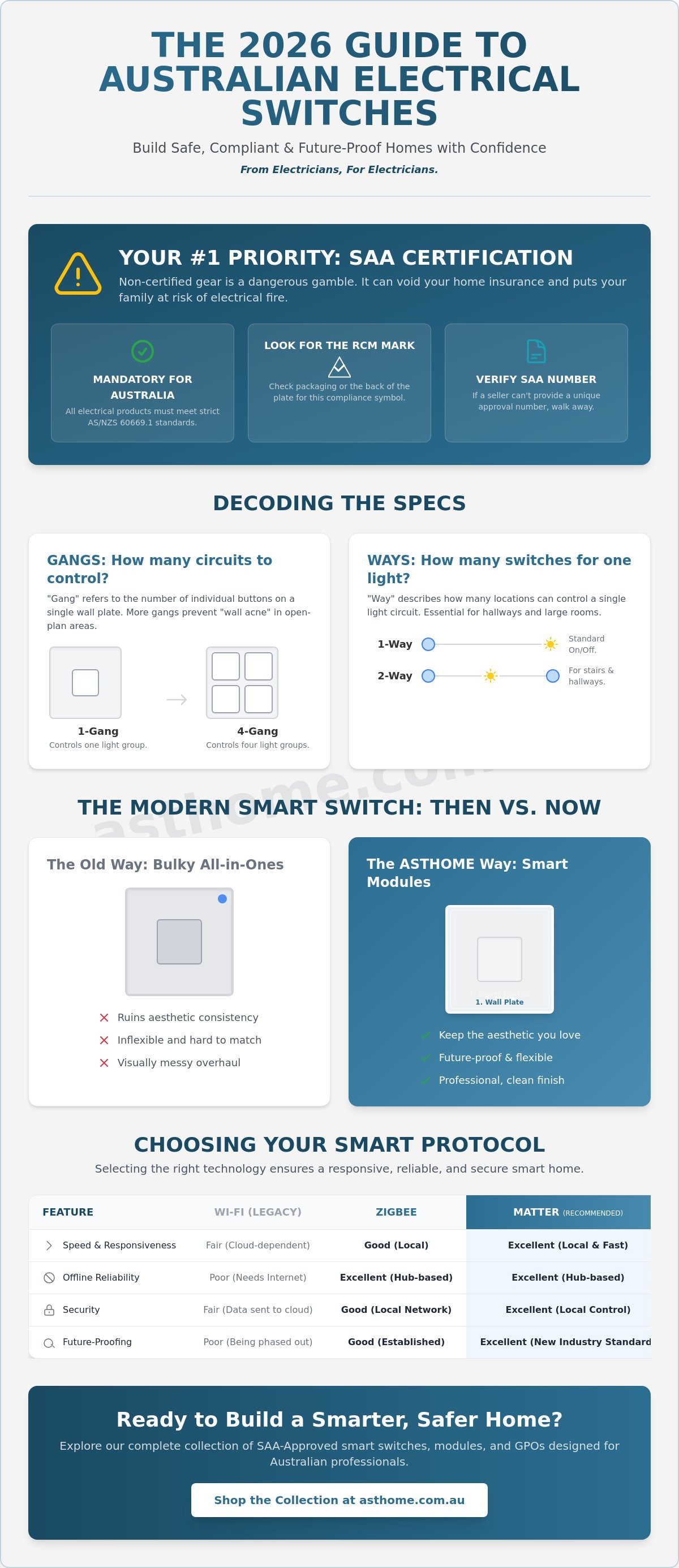
Before you look at the colour or the finish, you must look for the SAA mark. In Australia, every electrical product sold must meet strict AS/NZS 60669.1 standards. SAA certification is your guarantee that the hardware won't overheat or cause an electrical fire under standard loads. Installing non-compliant gear is a massive gamble. Most Australian home insurance providers include clauses that void your cover if a fire is traced back to non-SAA approved equipment. You can't risk your biggest asset on a cheap import that hasn't been through local testing labs.
Identifying genuine Australian-approved hardware is straightforward if you know what to look for. Check the back of the plate or the packaging for the Regulatory Compliance Mark (RCM), which is a triangle with a tick inside. You should also see a unique SAA approval number. If a seller can't provide this number, walk away. At Asthome, every product we stock is SAA Approved for Australia, ensuring your project meets all safety and licensing requirements from day one.
Switch Components: Plates, Mechs, and Modules
A standard setup consists of three parts: the wall plate, the mechanism (or "mech"), and the backing. Traditionally, if you wanted a smart home, you had to replace the entire plate with a bulky electronic unit. This often ruined the aesthetic consistency of your GPOs and light points. The modern approach uses smart modules. These small units sit behind your existing plates, giving you the brains of a smart system while keeping the look you love. It's a cleaner, more professional way to upgrade your home's functionality without a messy visual overhaul.
Take a sneaky peak at the back of a high-quality switch and you'll see the difference in build quality. We follow a "From Electricians, For Electricians" philosophy because we know that trade-quality components make the difference between a ten-minute install and a two-hour headache. Our range focuses on premium mechs that click with precision and modules that fit into standard Australian wall brackets without a struggle. By breaking the switch down into these components, you gain the flexibility to mix and match finishes while maintaining a unified smart protocol across the entire property.
Decoding the Specs: Gangs, Ways, and Amperage
Understanding electrical jargon is the first step to a successful install. In Australia, the term "Gang" refers to the number of individual buttons on a single wall plate. A 1-Gang switch controls one circuit, while a 4-Gang plate allows you to manage four separate light groups from one central spot. This is vital for modern open-plan living areas where you might have downlights, kitchen pendants, and outdoor lighting all meeting at a single entry point. Using a single multi-gang plate prevents "wall acne" and keeps your interior design clean.
Then there's the concept of "Ways." A 1-way switch is your standard on-off point. A 2-way setup is what you'll find in hallways or at the top and bottom of stairs, where two different switches control the same light. If you have a large room with three or more control points, you'll need an "Intermediate" switch in the middle. Getting these requirements right during the rough-in stage prevents massive rewiring costs later. You also need to consider physical fit. Standard Australian wall brackets use 84mm mounting centres. If you buy odd-sized gear from overseas, it simply won't fit your local plaster brackets or render boxes.
Amperage is the final technical hurdle. Most residential lighting switches are rated at 10 Amps (10A). This is more than enough for modern LED setups. However, if you're switching heavy inductive loads like large exhaust fans or specific commercial equipment, you may need a 15A or 20A rated mechanism. Always check the load requirements of your appliances before selecting your hardware to ensure the contacts don't weld together over time.
Choosing Gangs: 1-Gang to 4-Gang Solutions
Selecting the right number of gangs is about balancing utility and aesthetics. A 4-gang plate is a brilliant way to reduce clutter on a kitchen splashback or near a front door. Orientation also plays a role in your home's look. While vertical is the Australian standard, horizontal plates often look better tucked under cabinets or along bathroom vanities. Our Smart Wi-Fi Light Switch range comes in 1 to 4 gang configurations, allowing you to maintain a consistent, premium look across every room in the house.
Wiring Requirements: The Neutral Wire Dilemma
Smart technology usually requires a "neutral" wire to power the internal radio and keep the device connected to your network. Most Australian homes built before the early 2000s used a "loop-at-the-light" wiring method. This means there's often no neutral wire behind the wall plate, only an Active and a Load wire. If your sparky opens the wall and finds only two wires, a standard smart switch won't power up.
You don't need to rip out your walls to fix this. Zigbee "No Neutral" modules are a lifesaver for retrofits in older Aussie homes. These clever units draw a tiny amount of power through the light circuit itself, bypassing the need for a dedicated neutral wire. If you're planning a renovation and want to avoid expensive rewiring, you can find a range of SAA Approved smart modules that work perfectly with your existing cables.
Smart Switch Options: Matter, Zigbee, or Wi-Fi?
Choosing the right communication protocol for your switches determines how your home behaves when you aren't looking. By 2026, the Australian market has settled into three clear paths: Wi-Fi, Zigbee, and the universal Matter standard. While Wi-Fi is a popular choice for a single-room upgrade because it connects directly to your router, it can lead to network congestion if you install 30 or 40 devices. For a full-home build, we recommend moving toward a dedicated protocol that takes the load off your internet connection and ensures your lights respond instantly.
Zigbee 3.0 is the industry workhorse for a reason. It uses a mesh network where every mains-powered device acts as a signal repeater. This is a massive advantage in Australian homes with double-brick internal walls or sprawling single-storey layouts. If a switch in the lounge room is too far from the hub, it simply bounces its signal through the kitchen switch. This self-healing network ensures your lighting remains responsive even in the furthest corners of the property. Take a sneaky peak at our internal testing and you'll see why we've moved away from proprietary apps in favour of these open standards.
Matter Smart Switch Modules: The Future-Proof Choice
Matter is the protocol the industry has needed for years. It allows different brands to talk to each other without needing five different apps on your phone. Matter smart switches represent the ultimate in future-proofing because they work natively with Apple Home, Google Home, and Alexa simultaneously. We prioritise Matter for new builds in Point Cook and surrounding suburbs because it offers local control. Your lights will still trigger from your wall plates even if your NBN connection has an outage. It's about reliability, speed, and keeping your data inside your own four walls.
Zigbee 3.0: Reliability for Complex Automations
For complex automations involving dimming and motion sensors, Zigbee 3.0 remains a top-tier choice for professional installs. You'll need a Zigbee Gateway Hub to manage the traffic, but the payoff is a rock-solid system that doesn't rely on your Wi-Fi signal strength. This protocol is particularly effective for large-scale projects where you have 50 or more smart points. Our Zigbee 3.0 Smart Switch Module is designed for high-performance mesh setups, giving you a professional-grade response time that feels instantaneous. It's the standard choice for those who want their smart switches to work with trade-level reliability every single time.
Specialised Solutions: NDIS SDA and Commercial Needs
Modern electrical design isn't just about luxury; it's about accessibility. For Specialist Disability Accommodation (SDA), the right switches are essential tools for independence. Under the NDIS framework, automation allows participants to control their environment without physical strain. This is why we developed the NDIS SDA Compliant Smart Home Kit. It provides a turnkey solution for developers and sparkies working on high-physical-support builds. These kits ensure that every light, fan, and blind can be operated via voice, app, or physical button, meeting the strict compliance standards required for government-funded housing.
Commercial fit-outs also demand a higher level of durability. An office or retail space might have hundreds of light points running 12 hours a day. In these environments, you need 15A or 20A mechanisms that can handle the constant switching of large LED arrays or commercial HVAC systems. We focus on providing hardware that survives the rigours of a high-traffic business while maintaining a professional, modern look that matches the brand's interior design. Whether it's a warehouse in Truganina or a retail shop in Melbourne's CBD, the hardware needs to be as reliable as the person who installed it.
Automating for Accessibility
Voice control is a game-changer for NDIS participants, but it shouldn't be the only option. We believe in "redundant control," where a physical switch still provides tactile feedback for those with visual or motor impairments. Integrating smart switches with curtain motors and electronic door locks creates a cohesive ecosystem. A single "Goodnight" scene can lock the front door, close the blinds, and dim the lights to 10%. This level of integration isn't just a gimmick; it's a fundamental requirement for modern SDA projects aiming for the highest level of participant autonomy.
Trade Accounts and Professional Support
If you're a licensed sparky or a project manager, buying from a specialist wholesaler like Asthome offers advantages that big-box retailers can't match. Our "From Electricians, For Electricians" ethos means we understand the technical hurdles of a large-scale smart home rollout. You can access wholesale pricing through our trade accounts, ensuring your margins stay healthy on every job. We provide local Australian support for troubleshooting complex Zigbee meshes or Matter integrations, so you aren't left hanging on a support line to an overseas call centre. Take a sneaky peak at our trade portal to see how we can support your next commercial or NDIS project.
Top Switch Recommendations from the Asthome Collection
Selecting the right hardware is the final step in your renovation journey. After mastering the technicals of gangs and ways, you need switches that deliver on the promise of a future-proofed home. Our collection is curated from a "From Electricians, For Electricians" perspective, ensuring every piece of gear meets the strict AS/NZS 60669.1 safety standards. Whether you're looking for a subtle retrofit or a complete aesthetic overhaul, these recommendations represent the best of 2026 smart home technology.
Consistency is often the missing ingredient in a high-end build. We recommend pairing your new control points with our matching Smart Power Points (GPOs) to ensure a unified look across your splashbacks and skirting boards. Every GPO in our range is built to the same high standard as our switches, providing a seamless finish that separates a professional fit-out from a basic DIY job. By sticking to a single ecosystem, you also simplify your network management and app setup.
The "Retrofit King": Matter Smart Module
This is our most popular solution for a reason. The Matter Smart Switch Module sits directly behind your existing wall plates, allowing you to keep the premium look of your current hardware while gaining the full suite of Matter-over-Thread benefits. It fits easily into standard Australian wall brackets, making it a favourite for renovators who want smart functionality without replacing every plate in the house. It's a 5-minute setup process once the wiring is complete, allowing you to pair the device with Apple Home or Google Home without needing a proprietary bridge. Like all our modules, it is SAA Approved for Australia, meaning your insurance remains valid and your house stays safe.
The All-in-One: Smart Wi-Fi Touch Switches
If you want a modern, high-tech look, our integrated Wi-Fi touch units are the answer. These feature a sleek glass-look finish that is easy to clean and incredibly responsive to the touch. One of the biggest advantages is the ability to fit a 4-gang configuration into a standard single-gang wall cutout. This is a massive win for narrow hallways or bedside points where space is at a premium. To complete the look of your master suite, you can check out Attica House for luxury bedside tables that pair perfectly with premium wall plates. These units connect directly to your 2.4GHz Wi-Fi network, making them an excellent choice for targeted upgrades in specific rooms without the need for a central hub. For those focused on ambiance, we also suggest the Smart Zigbee Dimmer Module for precise control over your LED arrays. It allows you to set the perfect mood for movie nights or dinner parties with a single tap.
Browse the full range of SAA-approved switches here
Future-Proof Your Australian Home with Confidence
Mastering your home's electrical layout doesn't have to be a headache. You now understand that selecting the right switches involves balancing technical specs like gangs and ways with the latest smart protocols. Whether you're opting for the universal compatibility of Matter or the robust mesh reliability of Zigbee 3.0, the goal is a system that works every time you walk into a room. Safety remains your primary anchor. It's vital that 100% of the products you install are SAA Approved for Australia to protect your property and ensure your home insurance remains valid.
At Asthome, we're Matter and Zigbee experts who live by the "From Electricians, For Electricians" code. We've eliminated the guesswork so you can focus on a premium finish. Our range is curated to ensure technical excellence and aesthetic consistency across your entire project. Ready to upgrade your renovation or new build with trade-quality hardware? Shop our full range of smart switches and modules today. Your perfect smart home setup is just a few clicks away.
Frequently Asked Questions
Do I need a neutral wire for a smart switch in Australia?
Most smart switches require a neutral wire to keep the internal radio powered while the light is off. If you live in an older Australian home with "loop-at-the-light" wiring, you likely won't have a neutral at the wall plate. In these cases, you must use a specific "No Neutral" Zigbee module or have your sparky pull a new wire through the wall cavity.
Can I install these switches myself or do I need an electrician?
You must hire a licensed electrician to install any 240V hardware in Australia. Under the AS/NZS 3000 Wiring Rules, DIY electrical work is illegal and can void your home insurance. Your sparky will ensure the installation is safe and provide a Certificate of Electrical Safety (CES), which is a mandatory document for any insurance claims or property sales.
What is the difference between Matter and Zigbee switches?
Matter is a universal language that allows devices to work across Apple, Google, and Amazon platforms without needing a specific brand's hub. Zigbee is a dedicated mesh protocol that requires a Gateway Hub but offers better stability in large homes by repeating the signal between devices. Both are excellent for 2026 builds, but Matter is the simpler choice for hub-free setups.
Will these smart switches work with my existing Apple HomeKit or Google Home?
Yes, our Matter-certified range works natively with Apple HomeKit, Google Home, and Alexa simultaneously. If you choose Zigbee, you'll simply need a compatible Zigbee Gateway to bridge the devices into your preferred smart home app. Always check the product specifications to confirm the protocol matches your existing ecosystem before you buy.
Are all switches on Asthome SAA approved?
Yes, 100% of our inventory is SAA Approved for Australia. We don't stock grey-market imports because they haven't been tested to local AS/NZS standards. Every product we sell is legal for use in Australian homes and meets the strict safety requirements your electrician expects to see on the box during a fit-out.
Can I use a 10A smart switch for my air conditioner or oven?
No, a standard 10A switch is not rated for high-draw appliances like ovens or air conditioners. These heavy-duty units usually require 15A, 20A, or even 32A dedicated circuits and specialised mechanisms. Using a 10A switch for a high-load appliance is a fire risk and will likely weld the internal contacts shut within a few uses.
What happens to my smart switches if the power goes out?
Your switches will retain their programming and reconnect to your network automatically once the power returns. Most of our smart modules allow you to configure the "Power-on State" via the app. You can choose whether the light stays off, turns on, or remembers its last position before the outage occurred to avoid being woken up by lights after a midnight surge.
How many gangs can I fit on a standard Australian wall plate?
A standard Australian wall plate typically accommodates 1 to 6 gangs, though 1 to 4 is the most common configuration for smart units. If you need more than 4 points in one spot, we recommend using two plates side-by-side. This prevents the mechanisms from becoming too crowded behind the plate, which can lead to overheating and installation difficulties for your sparky.