

Would your home insurance policy actually pay out if a non-compliant, "grey market" smart hub caused a fault in your switchboard? It's a question many Australians overlook until it's too late, especially when trying to juggle competing Zigbee, Z-Wave, and Matter 1.5 protocols. You likely want a home that responds instantly, keeps your data off the cloud, and stays functional even when your NBN connection fails. We agree that a smart home should be a genuine convenience, not a technical headache or a safety risk for your family.
This guide explores how the homey ecosystem integrates with SAA-approved hardware to create a seamless, privacy-first environment. With the Homey Pro (2026) now retailing for A$699 and featuring a powerful 1.8 GHz Quad-Core processor with 4GB of RAM, local-first automation is no longer a DIY pipe dream. You'll discover how to unify your dashboard while meeting the strict Australian cybersecurity rules that came into effect on March 4, 2026. We provide a sneaky peak into the technical specs of the Pro, the A$449 Pro mini, and the A$119 Bridge to ensure your installation is safe, compliant, and ready for Zigbee 4.0.
Key Takeaways
- Compare the hardware differences between the Homey Pro and Homey Bridge to choose the right hub for your renovation or new build.
- Identify why SAA-approved hardware is essential for maintaining your home insurance and meeting Australian electrical safety standards.
- Learn how to integrate Matter and Zigbee modules with homey to build advanced local automations that don't rely on an internet connection.
- Discover the benefits of sourcing smart home tech from a local Point Cook retailer, including expert trade support and NDIS SDA compliance.
What is Homey? The Privacy-First Smart Home Controller
Think of your smart home as a complex electrical circuit. Every sensor, light, and GPO needs a way to communicate without causing a short in your daily routine. At Asthome, we view the homey ecosystem as the ultimate central "brain" that manages this traffic. Unlike basic hubs that struggle to talk to different brands, this controller acts as a universal translator for over 50,000 devices. We take a "From Electricians, For Electricians" approach to hardware. This means we prioritise gear that doesn't just look good on a shelf, but actually meets Australian standards and performs under pressure. Whether you use a phone, a wall-mounted tablet, or a desktop browser, the interface is designed to be logical and fast. It eliminates the clunky, fragmented experience of switching between ten different apps just to dim the lights in your lounge room.
The Evolution of Homey in Australia
The journey of Homey (smart hub) from a Kickstarter project to a professional-grade powerhouse has changed how we wire Victorian homes. In the early days, smart homes were a mess of proprietary bridges and messy cabling. By May 2026, the landscape has shifted toward unification. While big tech ecosystems like Amazon and Google often feel like data-harvesting tools first and controllers second, this platform remains independent. It supports the latest Matter 1.5 standards and Zigbee 4.0 protocols, which were officially announced in November 2025. This ensures your investment won't become an expensive paperweight when the next wireless standard hits the market. It's a premium solution for those who want a trade-quality setup without the "big brother" surveillance.
Privacy and Local Control: Why it Matters
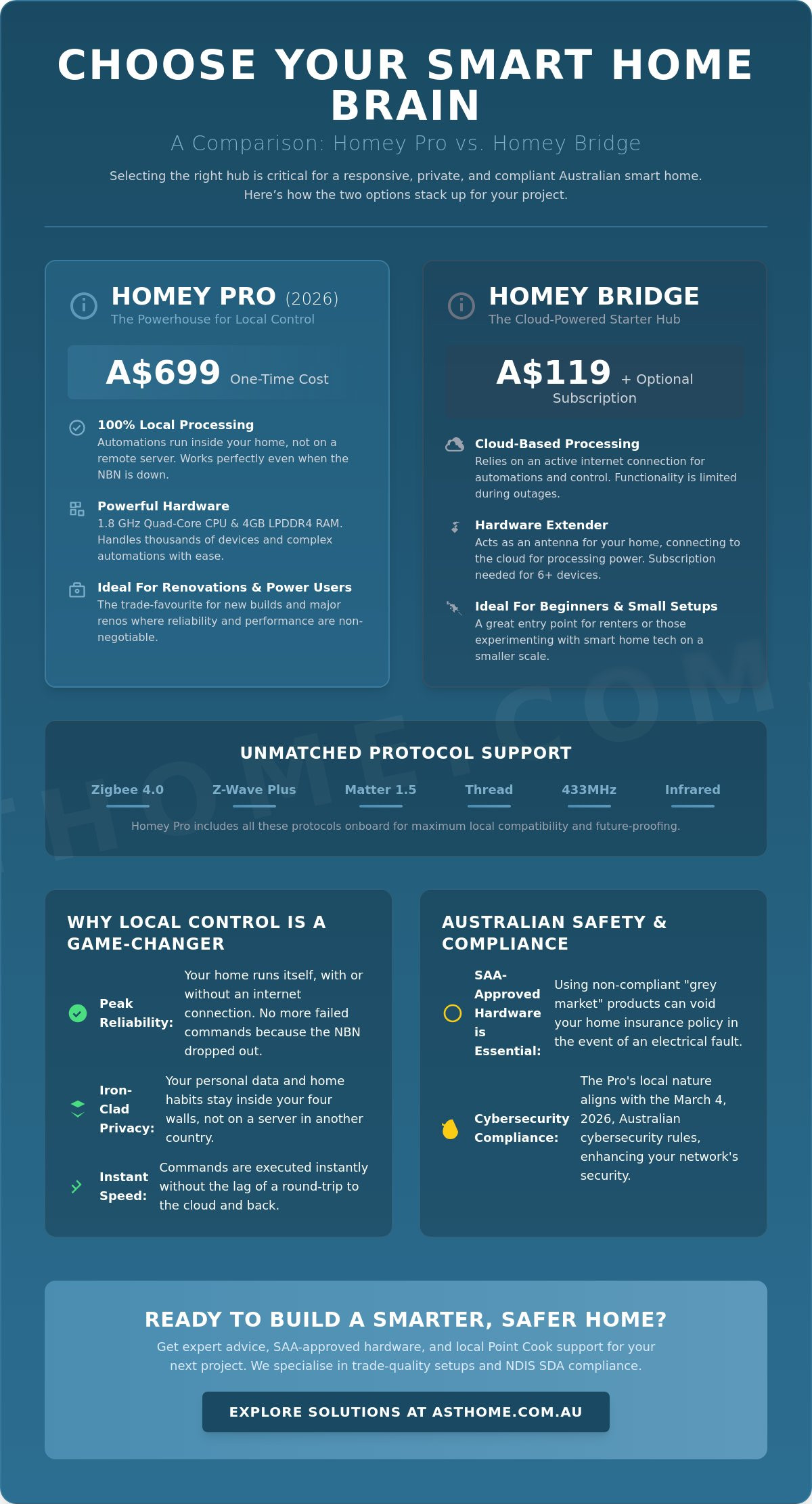
Most cheap smart hubs rely entirely on the cloud. If your NBN goes down or a server in another country crashes, your light switches stop working. That's unacceptable in a modern Australian home. The Homey Pro (2026) solves this with local processing. It features a 1.8 GHz Quad-Core ARMv8 CPU and 4GB of LPDDR4 RAM, allowing it to handle complex "Flows" right inside your house. Your data stays in your home, not on a server in North America. This is critical for NDIS SDA participants in suburbs like Point Cook, where system reliability is a matter of safety and independence rather than just a luxury. Here is a sneaky peak at the security side: because the hub processes locally, it naturally aligns with the new Australian cybersecurity rules that came into effect on March 4, 2026. These regulations mandate better vulnerability reporting and an end to universal default passwords, making your local network more secure than ever before.
Homey Pro vs. Homey Bridge: Which One Suits Your Reno?
Choosing between the flagship Pro and the entry-level Bridge depends on the scale of your electrical project. If you're undertaking a full renovation in Point Cook, the Homey Pro (2026) is the trade-favourite. At A$699, it's a one-time investment with zero monthly fees. It processes everything locally on its 1.8 GHz Quad-Core processor, ensuring your automations don't lag. Compare this to the A$119 Homey Bridge. The Bridge is a sleek bit of kit, but it relies on a cloud connection for its heavy lifting. If you want to connect more than five devices to the Bridge, you'll need a monthly subscription. This makes the Pro the more cost-effective choice for long-term, high-density smart home setups.
The Pro is a beast for protocol support. It handles Zigbee 3.0, Z-Wave Plus (700 Series), Matter 1.5, Thread, 433 MHz, and even has an Infrared blaster for your older split-system air conditioners. The Homey Pro mini (A$449) offers a middle-ground with 1GB of RAM and a 1.5 GHz processor, though it lacks some legacy protocol support without an added Bridge. Many homeowners worry about the privacy and security risks of IoT devices that constantly ping external servers. The Pro model mitigates this by keeping your automation logic within your four walls. If you're tackling a major renovation, don't settle for cloud-dependent hubs that lag when the internet drops. You can explore our range of SAA-approved smart modules to see what pairs best with your new hub.
Homey Pro: The Powerhouse for Power Users
The Pro model is the go-to for anyone serious about local control. With 4GB of LPDDR4 RAM, it handles 50,000+ devices without breaking a sweat. This memory capacity is essential for running over 100 homey apps simultaneously. Tradies love the Advanced Flow creator, which allows for complex, multi-stage automations that go far beyond "if this, then that." You can build intricate logic that factors in solar output, time of day, and motion sensor data all at once. It's the "set and forget" solution that professional installers trust for high-end residential work.
Homey Bridge: The Affordable Entry Point
The Bridge is best for smaller apartments or basic lighting setups where high-speed local processing isn't the primary concern. It's a cloud-hybrid device, meaning it requires an active internet connection to function. A sneaky peak at a typical Point Cook townhouse automation shows where the Bridge fits: it's perfect for managing a few smart globes and a couple of GPOs in a rental property. However, once your device count grows, the subscription fees and cloud latency often become a bottleneck. We usually recommend upgrading from the Bridge to the Pro during a home renovation to ensure your system is future-proofed for the Zigbee 4.0 standards announced in November 2025.
Ensuring SAA Compliance with Your Homey Setup
Wiring a smart home in Australia isn't just about getting the tech to talk; it's about making sure your house doesn't burn down and your insurance remains valid. While the homey hub acts as a sophisticated low-voltage director, the modules it controls are often hardwired into your 240V mains. In Victoria, using non-compliant hardware is a massive gamble. If a fault occurs and your gear lacks the proper certification, your insurer has every right to knock back a claim. We've seen plenty of DIY enthusiasts import cheap Zigbee or Matter modules from overseas that don't meet our strict standards. At Asthome, we only supply gear that is SAA Approved for Australia because we believe safety is non-negotiable.
An in-depth review of the Homey ecosystem highlights its focus on local control and privacy. However, for an Australian installation to be truly professional-grade, that local control must pair with trade-ready hardware. Every GPO and light switch in your home must carry the SAA mark. This ensures the device can handle the specific thermal and electrical stresses of the Australian grid. We take the "From Electricians, For Electricians" ethos seriously, ensuring that every product we recommend is ready for a licensed sparky to install without a second thought.
Smart Switches and the Law in Australia
You can't legally install a smart light switch or an in-wall relay yourself. In Australia, any work involving 240V wiring must be performed by a licensed electrician. This isn't just a suggestion; it's a legal requirement under AS/NZS 3000. When your electrician arrives, they'll look for the RCM (Regulatory Compliance Mark) or an SAA certificate number. If you've bought "grey market" gear that isn't Australian Approved, a professional contractor will likely refuse to install it to protect their own licence. Using compliant gear ensures your home remains a safe environment for your family while keeping you on the right side of the law.
Safe Integration: Hub vs. Hardware
It's vital to distinguish between your controller and your actuators. The Homey Pro is a low-voltage device that sits on your desk or shelf. It doesn't need to be hardwired into your MCB (Miniature Circuit Breaker). The real risk lies in the "invisible" modules tucked behind your wall plates. A sneaky peak at a standard Victorian switchboard reveals how crowded these spaces can get. Our Zigbee and Matter modules are designed with Australian wall boxes in mind. They offer the slim profile needed for a clean fit while maintaining the heavy-duty relay quality required for our local voltage. By organising your switchboard and wall cavities with SAA-certified gear, you're future-proofing your home for the Zigbee 4.0 standards that arrived in November 2025.
Automating with Homey: Integrating Matter and Zigbee Modules
Once your licensed electrician has installed your SAA-approved modules, the real magic begins with the pairing process. Integrating Asthome Matter or Zigbee modules with your homey hub is straightforward, but it requires a methodical approach to ensure a stable mesh. A common hurdle in many older Victorian homes is the "no neutral wire" issue at the switch plate. While many international hubs struggle with this, our specific range of modules is designed for Australian wiring conditions. You simply put the hub into pairing mode, tap the physical switch three times, and the device appears on your dashboard. This creates a local-first connection that doesn't rely on external servers to turn on your kitchen lights.
For those who want to push their setup further, this hub acts as the perfect hardware radio for Home Assistant. Many power users in suburbs like Point Cook prefer the sleek interface of one platform but the infinite customisation of the other. By using the official integration, you can use your Pro model as the primary Zigbee and Z-Wave coordinator. This gives you the reliability of trade-grade hardware with the data-rich environment of a custom server. If you're ready to start building, you can shop our SAA-approved Matter modules to ensure your hardware is as smart as your software.
Setting Up Your First Flow
The automation engine uses a simple "When, And, Then" logic that even a novice can master. For a typical "Welcome Home" scene in a Point Cook driveway, the logic is clean. When: The front door sensor detects motion. And: It's after sunset but before 11:00 PM. Then: Turn on the hallway lights to 40% brightness and disarm the internal sensors. You can even integrate smart curtain motors to close automatically when the temperature hits 30 degrees, protecting your furniture from the harsh Victorian sun. It's about creating a home that thinks for itself without requiring constant manual input.
Advanced Matter and Zigbee Tips
Matter 1.5 is the current gold standard for interoperability in 2026, but Zigbee remains the backbone for low-power sensors. In double-brick Victorian homes, wireless signals often struggle to penetrate thick walls. To solve this, you must strategically place "routing" devices. Any mains-powered module, like a smart GPO or an in-wall switch, acts as a Zigbee repeater. This strengthens the mesh network so your sensors on the back patio stay connected. A sneaky peak at your network map in the developer tools will show you exactly which devices are acting as the strongest "hops" in your mesh. Always aim for at least one mains-powered device in every room to ensure 100% reliability for your Zigbee 4.0 gear.
Why Point Cook Homeowners are Choosing Homey and Asthome
Living in Point Cook means being part of a community that values both innovation and reliability. When you're kitting out a new townhouse or upgrading a family home, you need more than just high-tech hardware. You need a partner who understands the specific challenges of the Victorian electrical landscape. This is where Asthome Smart Electrical Supplies steps in. While the homey ecosystem provides the software intelligence, we provide the local trade expertise to ensure your installation is seamless. We don't just ship products; we offer the technical backup that only a local practitioner can provide.
The choice of a smart hub impacts the long-term value and safety of your property. We've already explored the benefits of local processing and SAA compliance, but the human element is just as vital. Buying from Asthome Smart Electrical Supplies means you're supporting a business that vets every module for the Australian market. We know which relays fit behind a standard wall plate and which ones will cause headaches for your sparky. This local insight prevents costly mistakes and ensures your project stays on track from the first rough-in to the final commission.
Smart Solutions for NDIS SDA Housing
Reliability takes on a much deeper meaning in the context of NDIS Specialist Disability Accommodation (SDA). For participants in Point Cook, a smart home isn't about luxury; it's about maintaining independence. Because the hub processes data locally, it removes the vulnerability of cloud-based outages that could leave a resident unable to adjust their climate control or open their blinds. We work closely with providers to ensure that every component is robust and responsive. Voice control integration, when paired with our trade-grade modules, allows for a level of accessibility that traditional wiring simply can't match. It's a life-changing application of technology that demands the highest level of professional oversight.
The Asthome Advantage: From Electricians, For Electricians
Our core philosophy, "From Electricians, For Electricians," is the primary reason Victorian contractors trust us with their smart home projects. We understand the pressure of a job site and the absolute necessity of using SAA Approved for Australia hardware. A sneaky peak at our trade portal shows how we've streamlined the ordering process for busy sparkies. If you're an electrician working in the western suburbs, opening a trade account with Asthome Smart Electrical Supplies gives you access to professional-grade support and bulk pricing for your next big project. We're here to help you bridge the gap between traditional electrical work and the new world of Matter and Zigbee 4.0. Explore our SAA-approved Matter and Zigbee modules today and experience the difference that local, trade-led expertise makes to your smart home journey.
Ready to Future-Proof Your Australian Smart Home?
Building a smart home in 2026 requires more than just a box of gadgets. It demands a system that respects your privacy and meets local safety standards. By choosing the homey ecosystem, you're investing in a local-first controller that handles Matter 1.5 and Zigbee 4.0 without relying on the cloud. This ensures your automations keep running even if the NBN drops out. Hardware safety is just as critical as software logic. Every in-wall module must be SAA Approved for Australia to protect your home insurance and your family.
At Asthome, we provide the expert bridge between global technology and local trade requirements. Our Point Cook local support team is here to help you navigate the new cybersecurity rules that arrived on March 4, 2026. We operate on a simple ethos: From Electricians, For Electricians. This means we only stock gear we'd trust in our own homes. Don't leave your renovation to chance with grey-market imports that risk your safety.
Upgrade your home with SAA-approved Smart Modules from Asthome and start building a reliable, professional-grade system today. Your smarter, safer home is just one compliant switch away.
Frequently Asked Questions
Is Homey SAA approved for use in Australia?
The hub units sold through official Australian retailers include power adapters that meet local safety standards. However, the real compliance focus should be on the high-voltage modules the hub manages. At Asthome, we ensure every hardwired Zigbee and Matter module we stock is SAA Approved for Australia. This protects your home insurance and ensures all 240V components meet the AS/NZS 3000 wiring rules used by Victorian electricians.
Can I use Homey to control my existing Zigbee smart switches?
You can control most existing Zigbee 3.0 and the newer 4.0 switches using the homey Pro. The system supports over 50,000 devices from various global brands. If your existing switches were installed before the November 2025 Zigbee update, the hub’s backward compatibility ensures they stay functional. We recommend checking for the SAA mark on your hardware to ensure it remains compliant with Victorian safety regulations.
Do I need a licensed electrician to install Homey?
You don't need a licensed professional to plug in the hub itself, as it's a low-voltage plug-and-play device. However, Victorian law requires a licensed sparky to install any smart switches, GPOs, or in-wall modules hardwired to your 240V mains. This ensures your installation meets the mandatory Australian safety standards. DIY electrical work is illegal in Australia and will void your home insurance policy immediately if a fault occurs.
What is the difference between Homey Pro and Homey Bridge?
The main difference is local processing versus cloud dependency. The Homey Pro (A$699) runs all automations locally on its 1.8 GHz Quad-Core processor, offering better privacy and speed. The Homey Bridge (A$119) relies on a cloud connection and requires a monthly subscription if you connect more than five devices. For a professional-grade renovation, the Pro model's 4GB of RAM provides the power needed for complex, lag-free logic.
Does Homey work with Home Assistant for advanced AU setups?
It integrates seamlessly with Home Assistant, allowing you to use the Pro model as a high-quality Zigbee and Z-Wave coordinator. This setup is popular in Point Cook for users who want the hardware reliability of a trade-grade hub with the advanced data logging of Home Assistant. It's an excellent way to manage Australian-frequency Z-Wave devices while keeping your automation logic redundant and local within your own network.
Will Homey work if my internet goes down in Point Cook?
The Homey Pro will continue to run your pre-set "Flows" and local automations even if your NBN connection fails. Because it processes data locally, your light switches and motion sensors remain functional without an active internet link. This is a significant advantage over cloud-only systems like the Bridge, which require a heartbeat connection to a remote server to execute even the simplest commands in your lounge room.
Can Homey control NDIS-compliant smart curtain motors?
Yes, it's an ideal controller for NDIS Specialist Disability Accommodation (SDA) setups requiring automated window coverings. You can pair it with SAA-approved curtain motors to enable voice control or time-based triggers. This assists independence by ensuring participants can manage their environment reliably. The hub's support for Matter 1.5 ensures these accessibility features are future-proofed against upcoming software updates and maintain high reliability for participants.
Where can I buy SAA-certified modules for my Homey hub in Victoria?
You can purchase SAA-certified Zigbee and Matter modules directly from the Asthome online store. We're a Point Cook-based retailer run by practitioners who vet every product for the Australian market. Every module we sell is trade-ready and compliant with local safety standards. This eliminates the guesswork and ensures your smart home project is safe, legal, and fully supported by local experts who understand the trade.