

If you’re researching how to hide smart module in wall, start with the switch, wiring and space available behind it. A concealed module can add smart control while leaving a compatible existing switch plate visible, but not every wall box or wiring arrangement will suit every module.
The practical decision is whether to keep the current switch style or replace it with a visible smart switch. To decide, identify what the switch controls, consider your smart-home setup, and have a licensed electrician assess the fixed wiring and available space. This guide explains what to discuss before choosing a product and why installation is not a DIY task.
Asthome Smart Electrical Supplies stocks smart-home hardware and electrical components for the Australian market, including Matter and Zigbee module options. All switches and sockets listed by Asthome are SAA-approved for sale and use in Australia. Use the planning points below to build a shortlist that fits your intended setup and can be assessed by an electrician.
Key Takeaways
- Learn how to hide smart module in wall while keeping a compatible existing switch plate visible.
- Compare a concealed module with a smart wall switch by appearance, plate retention, control style and installation requirements.
- Have a licensed electrician assess the wiring, switch arrangement and space before choosing a product or planning fixed-wiring work.
- Compare Asthome’s Matter Over Thread Dimmable In-Wall Switch Puk Module and Zigbee Smart Switch Modules against your intended smart-home setup.
- Asthome supplies Australian-market products, offers prompt product assistance, and provides trade accounts for verified licensed electrical professionals.
How to Hide a Smart Module in a Wall Without Changing the Switch Look
A concealed smart module is installed behind a compatible wall switch, leaving the switch plate visible. It adds smart control to the lighting arrangement while retaining the familiar wall control. Whether that’s possible depends on the particular module, switch, wiring and enclosure. A plate that looks suitable from the front may not leave enough room behind it.
Think of the switch enclosure as the proposed installation location, not as proof that a module will fit. The module needs to sit appropriately alongside the existing mechanism and wiring. A licensed electrician can assess the actual space and wiring before you settle on a product.
What does hiding a smart module in the wall mean?
The faceplate and switch remain visible, while separate smart hardware is installed behind them. Depending on the module and existing switch arrangement, the wall switch can continue to be used alongside smart control. Concealing a module does not mean every plate can be retained unchanged or every switch function will work in the same way.
Nor does “in the wall” mean placing a device anywhere in an open wall cavity. The intended position is associated with a compatible switch and its enclosure. Wall construction can affect the space available: a switch in a brick wall, for example, may have less room behind it than expected. Have the electrician assess the actual location rather than relying on the appearance of the wall plate or a product image.
Smart modules are one component of broader Home automation, where connected devices add control options to familiar household systems. For a lighting upgrade, the useful checks are whether the module suits the wiring and switch arrangement, whether there is room for it, and whether it works with the smart-home setup you intend to use. Resolve those points before installation is planned.
Why keep the existing switch plate?
Keeping the current plate can preserve a room’s established look. That may matter if the switch matches other fittings or forms part of a consistent style throughout the home. A concealed module may add smart control without introducing a different visible switch, provided the existing setup is compatible.
The physical switch can also remain part of everyday use. Household members may continue to use a familiar wall control while smart functions are added through a compatible module. Retaining the plate does not guarantee that every existing function or wiring configuration will be supported, so have the electrician assess the complete arrangement.
If you’re comparing a concealed module with a visible replacement, the Australian smart light switch guide provides context on the broader options. For anyone considering how to hide smart module in wall, begin with the switch arrangement, wiring and available space, then choose a product to match the assessment.
What Determines Whether a Smart Module Fits Behind a Wall Switch?
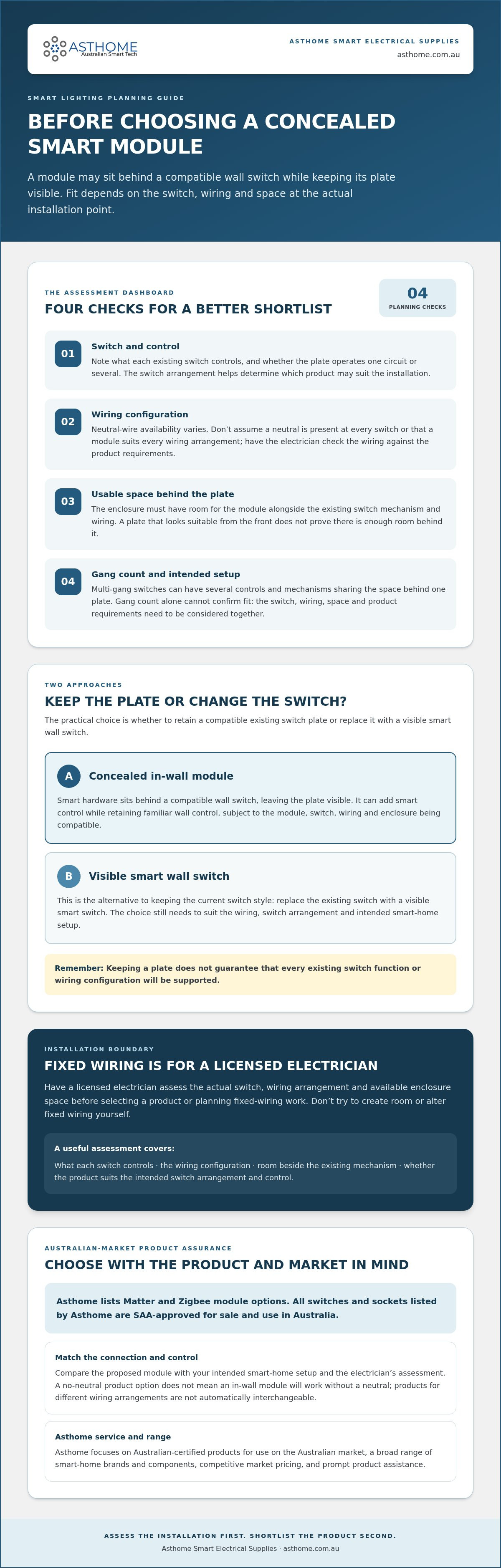
Fit depends on more than the module’s size. The electrician needs to assess the wiring configuration, switch arrangement and usable space behind the plate. A wall box might accommodate the existing switch but not leave enough room for an additional module and the wiring together.
Check the switch, wiring and available space
A licensed electrician can examine the existing switch and wiring, then assess whether the proposed module suits that installation. A shallow enclosure, crowded wiring or limited room around the switch mechanism can make a concealed installation impractical. Don’t try to create room or alter fixed wiring yourself. Assessment and installation should be handled by a licensed electrician.
Before the assessment, note which lights the switch controls and whether the plate operates one circuit or several. This gives the electrician useful context and helps avoid selecting a module based on appearance alone. Even a compact-looking product needs to suit the actual enclosure and wiring at the switch.
Account for neutral-wire and multi-gang requirements
Neutral-wire availability is another compatibility factor. Wiring configurations vary, so don’t assume a neutral is present at every switch or that one module type suits every installation. The electrician can identify the wiring configuration and compare it with the requirements of the product being considered. Choosing hardware before assessing the switch can lead to a poor fit.
Multi-gang switches need particular attention because several controls may operate separate lighting arrangements, while sharing the space behind one plate. Gang count alone cannot confirm whether a module will fit. The electrician needs to consider the existing mechanisms, wiring, space and product requirements together.
Asthome lists a no-neutral ENDURE switch as a separate product option. It is not a reason to assume an in-wall module will work without a neutral. Products intended for different wiring arrangements are not automatically interchangeable. Asthome’s Zigbee retrofit module guide offers broader context on retrofit choices and compatibility.
For a useful assessment, focus on a few practical questions:
- What does each existing switch control?
- What wiring configuration is present at the switch?
- Is there adequate space for the module alongside the existing mechanism?
- Does the proposed product suit the switch arrangement and intended control?
These are assessment points, not DIY instructions. Leave fixed-wiring checks and installation to a licensed electrician, and use the findings to guide product selection. Asthome stocks smart-home components, including switch-module options, and provides product assistance to help you compare them. Explore Asthome smart-home products as part of planning how to hide smart module in wall safely.
Hidden Smart Module vs Smart Wall Switch: Which Approach Suits Your Home?
Both approaches can add smart control to lighting, but they suit different priorities. A concealed module keeps the existing switch visible, while a smart wall switch replaces it with a different visible control. Compare the appearance you want, the wiring and switch arrangement, and the space available. Neither option is automatically the right choice for every home.
| Consideration | Concealed smart module | Smart wall switch |
|---|---|---|
| Appearance | The module is hidden behind a compatible switch plate. | The replacement switch and its faceplate are visible. |
| Existing plate | May allow you to retain the current plate, subject to compatibility. | Generally involves changing the visible switch. |
| Assessment needs | The electrician assesses the wiring, switch arrangement and space behind the plate. | The electrician assesses the wiring and suitability of the replacement switch. |
| Control approach | Adds smart control through hardware behind the existing switch. | Uses a smart switch as the visible wall control. |
If you’re weighing how to hide smart module in wall against a visible replacement, Asthome supplies Zigbee and Matter in-wall module options for the Australian market. All switches and sockets listed by Asthome are SAA-approved for sale and use in Australia. Explore Asthome’s smart-home range when comparing products for your project.
When a concealed module may be the better fit
A concealed module may suit a room where you want to keep the current plate, maintain a consistent look across rooms or retain a switch that complements the existing fittings. It can add smart control without making a different switch face part of the room’s design. The electrician still needs to assess the physical fit and wiring before a product is selected.
Asthome’s range includes Zigbee Smart Switch Modules and Matter devices. These categories can help you build a shortlist, but they do not guarantee that a particular module fits every switch. Match the exact product to your intended smart-home setup and the installation context.
When a smart wall switch may make more sense
A replacement smart wall switch may suit a renovation or room update where a different visible control is welcome. It may also suit you if keeping the current plate is not important. The choice comes down to the appearance you prefer and the installation context, not an assumption that one approach performs better in every home.
If you’re considering a Matter-based replacement, the Matter smart switch guide provides further context. Decide whether you prefer a concealed module or a visible switch, then have a licensed electrician assess the wiring and switch setup before you choose the product.
How to Plan a Safe, Concealed Smart Module Installation
Plan the installation before choosing a hiding place. Concealment should follow a suitable professional assessment, not an attempt to tuck a device into any spare space in the wall. A licensed electrician must handle fixed-wiring assessment and installation. Don’t remove a switch plate, handle wiring or install a device while power is applied.
A clear plan helps the electrician assess the proposed module against the actual switch and lighting setup. It also gives you a chance to discuss access once the plate is back in place. Prepare for the conversation with these steps:
- Identify the intended control. Note which light or lighting arrangement you want the module to control, and whether the switch is part of a multi-gang plate.
- Share the product details. Provide the electrician with the selected module’s exact product information and the smart-home setup you intend to use.
- Arrange a suitability assessment. Have the electrician assess the switch arrangement, wiring and proposed location before installation is planned.
- Discuss access and checks. Agree how the module will remain accessible for future servicing and how the electrician will check the installed setup.
Prepare the information for the electrician
Useful preparation means gathering clear information, not attempting DIY wiring. Describe the lights you want to control and your preferred smart-home setup. Bring the selected product information so the electrician can compare its requirements with the existing installation. This makes the assessment more focused and helps resolve compatibility questions before work begins.
If you haven’t chosen a module, keep the decision open until the electrician has assessed the location. The product’s requirements need to match the actual wiring arrangement. Don’t open the switch or touch conductors to try to identify the wiring yourself.
Plan concealment without losing access
Discuss the final position while planning the installation, including how the module can be reached if it needs attention later. A concealed device should not be permanently buried behind plaster or an inaccessible finish. The electrician can advise on a suitable installation approach and check that the plate can be refitted without compromising access or the intended function.
Leave installation and functional checks to the licensed electrician. Don’t energise, handle or reposition a device yourself during the work. The electrician can complete the fixed-wiring tasks and check the control arrangement. If the proposed location is unsuitable, use that assessment to consider another appropriate module or a visible smart switch.
Planning how to hide smart module in wall safely means treating access and professional assessment as part of the decision. To compare in-wall options before discussing product fit, explore Asthome’s smart module range.
Choose an Asthome In-Wall Smart Module for an Australian Installation
Once the electrician has assessed the switch, wiring and available space, compare suitable products against your intended smart-home setup. Asthome supplies smart-home hardware and electrical components for Australian customers, with a broad range of brands and competitive pricing across its range. In-wall options include the Matter Over Thread Dimmable In-Wall Switch Puk Module and Zigbee Smart Switch Modules. Use the product details to narrow your shortlist, then consider them against the installation assessment.
Match the module category to the smart-home setup
Matter and Zigbee are different smart-home technology categories. Your choice depends on the setup you intend to use and the specific product’s stated requirements. Don’t assume that a device will suit your existing equipment just because it uses a familiar protocol name. Share the exact product details with the licensed electrician so they can consider the module alongside the wiring and switch arrangement.
Asthome’s Zigbee retrofit guide provides broader context on Zigbee options in an Australian setting. Use it to inform your shortlist, then refer to the selected device’s product information and the electrician’s assessment for installation decisions. Zigbee devices require a Tuya Zigbee Gateway to function correctly, so include the gateway in your plans if you choose a Zigbee setup.
If keeping the existing wall plate is a priority, discuss an in-wall module with your electrician. If a replacement switch better suits the location or assessment, compare that option too. The practical choice needs to suit both your smart-home setup and the physical installation.
Find an Australian-market product through Asthome
Asthome focuses on electrical and smart-home products for the Australian market. This statement applies to those listed product categories. Check the specific product information when comparing other types of smart-home devices.
Choosing a suitable product is a shared planning process: you identify the control you want, provide the electrician with exact product information, and use their assessment to guide the installation choice. Asthome offers prompt product assistance, and verified licensed electrical professionals can access trade accounts.
Ready to compare options for your installation? Explore Asthome’s smart electrical range and shortlist an in-wall module to discuss with your electrician. A considered product choice is the practical next step in planning how to hide a smart module in the wall with fit, wiring and your intended setup in mind.
Turn Your Preferred Look into a Practical Plan
Before choosing a module, note what you want the finished switch area to look like and how you expect to use the lighting. This gives your electrician a clear starting point for discussing the installation and product suitability. If you’re still weighing how to hide smart module in wall, treat it as a design decision as well as a technical one. The approach should suit both the room and the existing switch setup.
A shortlist can help move that conversation forward. Asthome supplies smart-home products and electrical components to Australian customers, with prompt product assistance to help you compare options. Verified licensed electrical professionals can also access trade accounts.
Explore Asthome’s smart electrical range and shortlist an option to discuss with your electrician. With a clear plan and professional assessment, you can take the next step towards smart control that suits your home.
Frequently Asked Questions
Can a smart module be hidden behind any wall switch?
No. A switch that looks suitable from the front may have limited space behind its plate or a wiring arrangement that does not suit the module. Before deciding how to hide smart module in wall, have a licensed electrician assess the switch and intended lighting control. A shallow wall box, for example, may make concealment impractical even if the module appears compact.
Do I need a neutral wire for a smart module?
Requirements depend on the particular product and the wiring at the switch. Don’t assume a neutral wire is present or that a product described as “no neutral” is an in-wall module. Asthome lists a no-neutral ENDURE smart switch as a separate product option. Share the exact module details with a licensed electrician so they can assess the existing wiring and product requirements.
Can I install an in-wall smart module myself?
No. A licensed electrician should handle fixed-wiring assessment and installation. Don’t remove the switch plate, handle wiring or attempt to fit a module while power is applied. You can prepare by noting which light the switch controls and providing the electrician with the product information and your intended smart-home setup. Leave the electrical work and checks of the installed control arrangement to them.
Is a hidden smart module better than a smart wall switch?
Neither option is automatically better. A concealed module may suit a room where you want to retain the existing plate, such as one with matching switches. A visible smart wall switch may suit a room update if you are happy to change its appearance. Let your preferred look guide the discussion, then have a licensed electrician assess which approach suits the installation.
Will a Zigbee module work without a hub?
Asthome’s listed Zigbee devices require a Tuya Zigbee Gateway to function correctly, so include a gateway in your Zigbee setup. This requirement does not apply to Asthome’s separate WIFI Smart Socket, which uses Wi-Fi and does not require a gateway. Refer to the exact product information for the device you’re considering rather than transferring requirements between product categories.
Can a smart module fit behind a multi-gang switch?
It may be possible, but gang count alone cannot establish whether a module will fit. The electrician needs to assess the existing controls, wiring and space behind the plate, then consider the selected product’s suitability. Before the assessment, note what each switch controls. This gives the electrician useful context for planning the module and preserving the intended lighting control.
Are Asthome smart switches approved for use in Australia?
This statement applies to those listed categories, not every type of smart-home device. When comparing products, use the exact product listing in your discussion with a licensed electrician so the choice is specific to the hardware and intended installation.