

Why sacrifice your home's heritage style just to stop your smart lights from dropping out every time the microwave runs? You've likely felt the frustration of a congested Wi-Fi network or the headache of trying to cram bulky smart switches into a tiny Victorian-era wall box. It's a common pain for Aussie homeowners who want modern control without the "techy" look of plastic smart plates. Using a smart zigbee dimmer module is the "sneaky" way to achieve professional automation while maintaining your home's architectural integrity and local safety compliance.
Mastering the art of retrofitting doesn't have to be a gamble. This trade-led guide shows you how to get flicker-free dimming and rock-solid reliability while keeping your original switches exactly where they are. We'll show you how to build a robust mesh network using the latest Zigbee 4.0 standards, ensuring your setup is ready for your licensed electrician to install according to AS/NZS 3000 wiring rules. From managing neutral wire requirements in older Victorian homes to selecting SAA approved hardware, you'll learn exactly how to achieve a professional finish that provides total peace of mind.
Key Takeaways
- Learn to identify neutral wire requirements in your wall boxes and why SAA Approved hardware is critical for Australian safety and insurance.
- Discover how a smart zigbee dimmer module provides flicker-free control behind your existing switches without congesting your home Wi-Fi.
- Understand the mandatory legal requirement for licensed electricians to handle 240V work and how to safely isolate circuits at the MCB.
- Master the setup of a reliable mesh network using Matter-compatible gateways and specific pairing sequences for Australian modules.
- Gain trade-only insights on selecting professional-grade hardware that is tested on real Aussie job sites for long-term reliability.
What is a Smart Zigbee Dimmer Module and Why Use One?
A smart Zigbee dimmer module acts as a bridge between traditional electrical wiring and modern IoT functionality. This compact device, often referred to by tradies as an "in-wall puck," sits discreetly behind your existing wall switch. It transforms a standard light fitting into a sophisticated, dimmable smart light without requiring you to change your home's physical aesthetic. It's the professional way to add intelligence to your lighting circuits while keeping the tactile feel of a high-quality wall switch.
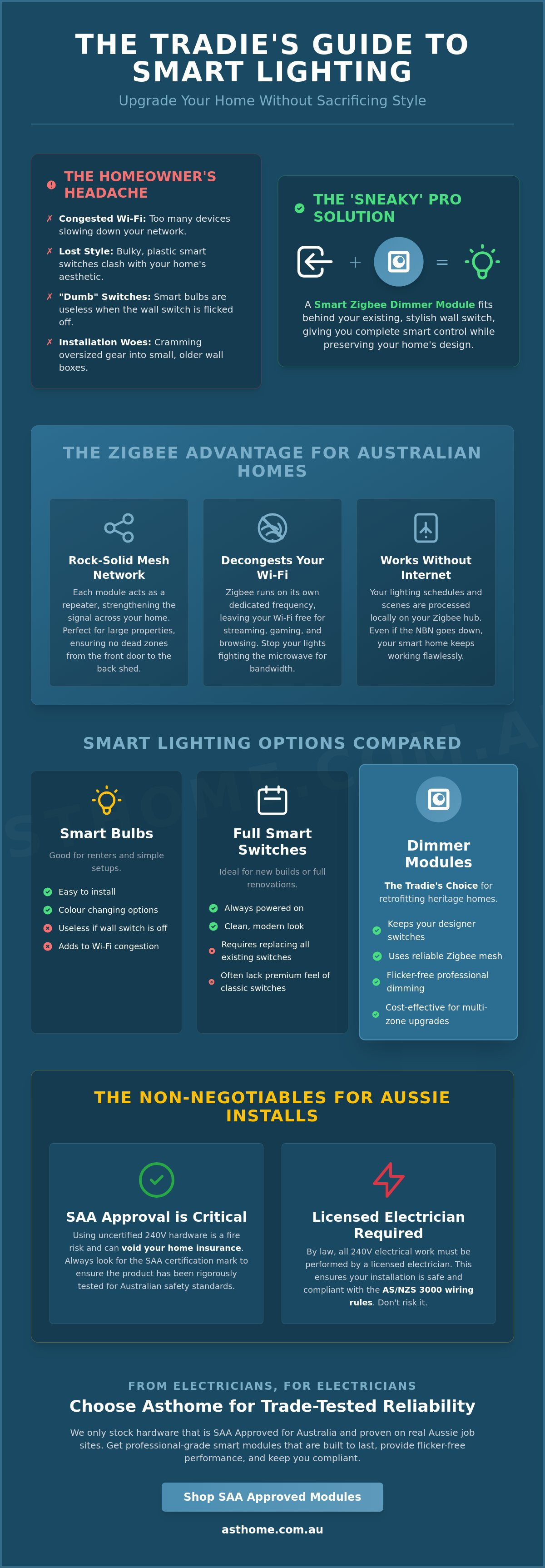
Most Australian homeowners have invested in specific designer switch plates, such as the Clipsal Iconic or the glass-finish Saturn range. Replacing these with generic, plasticky smart switches often ruins the architectural look of a room. By using a smart zigbee dimmer module, you maintain your existing hardware. Unlike smart bulbs, which become useless if someone flips the physical wall switch to "off," a module ensures your lights are always powered and responsive to both manual clicks and voice commands.
The Zigbee Advantage for Australian Homes
Reliability is the biggest concern for any smart home setup. If you have more than 20 smart devices, your standard ISP-provided Wi-Fi router will likely struggle to manage the traffic. What is Zigbee? It is a dedicated wireless protocol designed for low-power, high-reliability communication. It operates on a mesh network, meaning every mains-powered module acts as a repeater to strengthen the signal across your property. In a large Point Cook residence, for instance, a module in the kitchen helps pass the signal to the alfresco area, ensuring no dead zones. Because the control is local, your lighting schedules and dimming scenes will continue to work even if your NBN connection drops out.
Retrofitting vs. New Builds
For Victorian renovation projects, pulling new neutral wires through double-brick walls or tight ceiling cavities is often a logistical nightmare. A smart zigbee dimmer module is the most cost-effective way to upgrade multiple lighting zones without the expense of a full rewire. These modules are designed to fit into standard 35mm deep Australian wall boxes, making them an ideal choice for retrofitting older homes. While new builds might allow for more complex cabling, modules provide a "set and forget" solution that integrates seamlessly with existing infrastructure.
- Smart Bulbs: Convenient for renters, but they lose smart functionality when the wall switch is turned off.
- Full Smart Switches: Good for new builds, but often lack the premium feel of established Aussie switch brands.
- Dimmer Modules: The "sneaky" trade secret for professional automation that keeps your home looking exactly the way you designed it.
Choosing a module means choosing flexibility. You get the benefits of the latest Zigbee 3.0 standards, including lower latency and better battery life for connected sensors, without compromising on the electrical standards that keep your family safe.
Choosing the Right Module: Neutral Wires and SAA Compliance
Selecting a smart zigbee dimmer module involves more than just checking app compatibility. In the Australian electrical landscape, technical specifications and safety certifications are the difference between a reliable smart home and a potential fire hazard. You need to ensure the hardware matches your home's existing wiring and meets strict local standards before your sparky arrives for the install.
Compliance is the foundation of every trade-led project. While international marketplaces are flooded with cheap, uncertified gear, these devices often lack the internal protection needed for our 240V grid. Using non-compliant hardware can void your home insurance. If an electrical fault occurs and the investigator finds uncertified modules in the wall, your claim in Victoria or any other state could be rejected instantly. Every module we provide is SAA Approved for Australia, ensuring it meets the RCM requirements for local safety standards.
The Importance of SAA Approval
SAA Certification is non-negotiable. It proves the device has undergone rigorous testing to handle Australian voltage fluctuations and thermal loads. At Asthome, we live by the "From Electricians, For Electricians" ethos, which means we only stock gear we would trust in our own homes. You can easily identify the SAA mark on our hardware, giving you and your installer total peace of mind during the rino. For those looking for certified reliability, you can browse our full range of SAA approved smart modules to find the right fit for your project.
Neutral vs. No-Neutral Modules
The "No Neutral" dilemma is the most common hurdle in Aussie retrofits. Most older Victorian-era homes only have a "switch wire" and a "line wire" at the wall plate, lacking the neutral wire required to power a standard smart device. If your wall box doesn't have that extra blue wire, you'll need a no-neutral module. These clever devices draw a tiny amount of power through the light circuit itself to stay connected to the Zigbee mesh. In some cases, specifically with low-wattage LED globes, your electrician may need to install a bypass capacitor at the light fitting to prevent ghosting or flickering when the lights are off.
Newer builds are more likely to have a neutral wire at the switch. If you have this luxury, always opt for a neutral-wired module. They offer superior stability and act as stronger routers within your Zigbee network. Before the rino starts, ask your sparky to pull a switch plate and check the wiring. It only takes a second but saves a massive headache later.
Compatibility with your globes is the final piece of the puzzle. Most modern Australian LED downlights require trailing edge dimming for smooth operation. Ensure your module supports this to avoid the dreaded "flicker" at low brightness levels. Always check the minimum and maximum wattage loads. A single 7W LED might be below the minimum load for some modules, leading to strobing, while a massive chandelier might exceed the maximum capacity. Stick to the specs, and your automation will be as reliable as a standard mechanical switch.
How to Install and Retrofit Zigbee Dimmer Modules Safely
Safety is the absolute priority when upgrading your home. In Australia, any work involving 240V mains power is a restricted task. This means you must engage a licensed electrician to install your smart zigbee dimmer module. While international marketplaces might suggest DIY is an option, doing so in Australia is illegal, voids your insurance, and risks your safety. A professional installation ensures your home remains compliant with the AS/NZS 3000 wiring rules.
The process begins at the main switchboard. Your sparky will isolate the relevant lighting circuit by switching off the MCB (Miniature Circuit Breaker) and tagging it. This ensures the workspace is dead before the switch plate is removed. Once the plate is off, the module is wired into the circuit. This involves connecting the line, load, and neutral wires into the module's terminals. If you are using a no-neutral module, the wiring configuration changes slightly, often requiring a bypass at the light fitting to ensure stability.
Trade Tips for Tight Wall Boxes
Australian wall boxes, particularly in older brick-internal homes, are notoriously shallow. Fitting a "puck" style module plus the existing wiring into a 35mm cavity can be a squeeze. To prevent heat build-up or wire fatigue, your electrician should organise the cables neatly behind the switch. Using a deeper mounting block or a wall box extender can provide the extra clearance needed for a clean fit. If you are planning a larger upgrade, see The 2026 Guide to Smart Light Switches for Australian Homes for more hardware advice.
Configuring the Dimming Range
Physical installation is only half the job. Once the power is restored, the module must be calibrated for your specific lights. Most modern LEDs have a "cut-off" point where they start to flicker if the voltage drops too low. Your sparky must verify the dimming curve and set the minimum brightness level in the app before closing the wall plate. This prevents the annoying strobing effect often seen with cheap dimmers.
Calibration requirements vary depending on whether you are using CCT (Correlated Colour Temperature) adjustable globes or single-colour bulbs. Setting these parameters ensures a smooth, flicker-free experience from 1% to 100% brightness. Finally, the physical switch is tested to ensure it remains responsive and provides the same tactile feedback you expect from a premium Aussie switch plate. This methodical approach ensures your smart zigbee dimmer module performs reliably for years to come.
Integration: Connecting to Hubs and Home Assistant
Once your sparky has finished the physical install, it's time to bring your smart zigbee dimmer module online. Unlike Wi-Fi devices that clog your router, Zigbee modules require a dedicated gateway to bridge the gap between the mesh network and your home internet. You can choose between a standard Zigbee 3.0 bridge or a modern Matter-compatible hub. Pairing is usually a straightforward process. Most Australian modules use a "triple-click" sequence on the physical wall switch or a dedicated reset button on the puck to enter pairing mode. Once the LED indicator flashes, your hub should discover the device within seconds.
For users seeking total privacy and local-first control, Home Assistant (HA) is the gold standard. By using a Zigbee dongle with HA, you eliminate the need for cloud-based apps entirely. This ensures your lights stay responsive even if the manufacturer's servers go down. Once integrated, you can map your dimming curves and create complex automations. These can then be exposed to voice assistants like Alexa, Google Home, or Siri via HomeKit, giving you hands-free control over every lighting zone in your house.
Building Your Zigbee Mesh
Placement of your hub is critical, especially in larger Point Cook homes with multiple rooms or double-brick internal walls. While Wi-Fi signals degrade quickly through dense materials, every mains-powered smart zigbee dimmer module acts as a router. This means the more modules you install, the stronger and more resilient your network becomes. These modules pass signals along to battery-powered end devices like motion sensors or temperature sensors that might be further away from the hub. If you experience lag, it is likely due to interference from your 2.4GHz Wi-Fi router. Changing your Zigbee channel to avoid overlapping with your Wi-Fi frequency usually solves these connectivity issues instantly.
Future-Proofing with Matter
The smart home landscape is shifting toward universal compatibility. Choosing hardware that bridges to Matter is a strategic move for 2026. This allows your Zigbee devices to communicate seamlessly with Thread-based hardware and other ecosystems without needing multiple proprietary bridges. For a deep dive into how this affects your setup, read our guide on Matter Smart Switch Australia: The 2026 Guide to Future-Proofing Your Home. While Thread is gaining traction for battery devices, Zigbee remains the most mature and reliable protocol for high-density lighting setups in Australia. It offers the stability tradies demand and the flexibility homeowners need for long-term automation success.
Why Asthome is the Tradies Choice for Smart Modules
Asthome Smart Electrical Supplies isn't just another online retailer; we operate on a core ethos: "From Electricians, For Electricians." Every smart zigbee dimmer module in our catalogue has been rigorously tested on real Aussie job sites. We've seen how cheap imports fail under the thermal loads of a Melbourne summer or struggle with the signal interference found in modern high-density suburbs. Because we come from the trade, we only stock hardware that we'd be happy to install in our own homes. This practitioner-led approach eliminates the guesswork for you and ensures every install is a "one-and-done" job.
Maintaining your reputation as a reliable sparky depends on the quality of the gear you leave behind in the wall. An SAA Approved range is the only way to guarantee that your work meets the strict safety standards required by Australian law. We don't cut corners on compliance. Every module we sell carries the necessary certifications to keep your insurance valid and your clients safe. This commitment to quality has made Asthome Smart Electrical Supplies the go-to resource for professionals who value reliability over a slightly lower price tag on an uncertified marketplace.
Expert Support and Trade Pricing
We know that margins matter in a competitive market. That's why Asthome Smart Electrical Supplies offers dedicated trade accounts that provide discounted pricing for licensed electrical professionals. Whether you're doing a single-room rino or a full-home automation project, our bulk pricing ensures you stay profitable. Applying for an account is simple and gives you a direct line to technical support from people who actually know the AS/NZS 3000 wiring rules. We can help you troubleshoot dimming curves or mesh connectivity issues based on real-world experience, not just a script.
If you want a sneaky peak at our upcoming SAA certified Matter range, our team is already preparing the technical documentation to support your first installs. This new hardware will allow you to offer clients even more flexibility across different ecosystems while maintaining the rock-solid stability of a Zigbee backbone. We stay ahead of the tech curve so you don't have to spend your weekends researching the latest protocols. We're here to help you navigate the transition from traditional switches to advanced smart zigbee dimmer module setups without the stress.
Point Cook Local Pickup and Fast Shipping
Logistics can make or break a project timeline. For local Point Cook and Melbourne contractors, our Click and Collect service means you can grab what you need on the way to a site. If you're working elsewhere in Australia, our next-day dispatch policy ensures you aren't left waiting for parts while a job sits idle. We pride ourselves on a no-fuss return policy. If a module isn't right for the specific load you're working with, we'll help you swap it for the correct solution quickly. Our goal is to be your trusted expert partner, providing the reliable hardware and local knowledge you need to lead the smart home market.
Ready to upgrade your toolkit with professional-grade automation? Create a Trade Account today and save on your next smart lighting project with a partner who understands the Aussie trade.
Take Control of Your Smart Home Retrofit
Retrofitting a smart zigbee dimmer module is the most effective way to upgrade your lighting without losing the designer look of your original switch plates. By choosing SAA Approved hardware, you ensure your home stays compliant with local safety standards and protects your insurance. We've seen how a reliable Zigbee mesh network outperforms standard Wi-Fi, especially in larger Victorian residences where connectivity is key. Whether you're dealing with a no-neutral setup in an older home or building a new automation ecosystem, the right module makes all the difference.
At Asthome, we are based in Point Cook, Victoria, and our products are designed "From Electricians, For Electricians." We only stock gear that is SAA Approved for Australia because we know your reputation and safety are on the line. Licensed sparkies can also access trade accounts for discounted pricing on bulk projects. It's time to eliminate the guesswork and invest in hardware that actually works on real Aussie job sites. Shop SAA Approved Zigbee Dimmer Modules at Asthome today and get your project moving. We're here to support you with expert advice and fast local shipping. You've got the plan, now get the professional gear to match.
Frequently Asked Questions
Do I need a neutral wire for a smart Zigbee dimmer module?
You can purchase specific modules designed for circuits without a neutral wire. These are ideal for older Aussie homes where only a switch wire and line wire are present at the wall plate. If your home has a neutral wire, a standard smart zigbee dimmer module is the better choice. It provides superior stability and acts as a more effective repeater for your mesh network.
Is it legal to install a Zigbee module myself in Australia?
No, it is illegal for anyone other than a licensed electrician to install these modules. Any device connecting to 240V mains power must be fitted by a professional to comply with AS/NZS 3000 wiring rules. DIY electrical work is dangerous and will void your home insurance if a fault occurs. Always ensure your sparky provides a certificate of electrical safety for the work.
Will a smart Zigbee dimmer work with my existing Philips Hue hub?
Most Zigbee 3.0 modules will pair with a Philips Hue bridge because they share the same protocol. You can usually control them via the Hue app alongside your other lights. Keep in mind that third-party modules often won't appear in Apple HomeKit if they are bridged through Hue. You might need a Matter-compatible gateway if you want to use Siri for voice control.
What is the maximum load a Zigbee dimmer module can handle?
Most modules are rated for a maximum LED load of 150W to 250W. While this sounds low compared to old halogen ratings, a standard LED downlight only draws about 7W to 10W. This means a single smart zigbee dimmer module can safely control a circuit with roughly 15 to 20 lights. Always check the specific SAA approved rating on the device before installation.
Can I use a Zigbee dimmer module with non-dimmable LED globes?
No, you must use dimmable LED globes with any dimmer module. Attempting to dim a non-dimmable bulb will lead to aggressive flickering and will eventually burn out the driver inside the globe. It can also cause the module to overheat, potentially tripping the MCB or damaging the device permanently. Always verify your bulb compatibility before your electrician closes the wall plate.
What happens to my smart lights if the Wi-Fi goes down?
Your lights will continue to function perfectly via the physical wall switch and any local automations. Because Zigbee is a local mesh protocol, it doesn't rely on your NBN connection for basic operation. You only lose the ability to control lights remotely via your phone or voice assistant if the internet is out. This local reliability is why tradies prefer Zigbee over Wi-Fi.
Do Zigbee modules fit in standard Australian wall boxes?
These modules are specifically designed to fit behind a standard switch plate in a 35mm deep wall box. It is a tight squeeze in some older brick-internal walls. Your sparky may need to use a mounting block or organise the cables neatly to ensure the switch sits flush. Proper cable management is essential to prevent heat build-up behind the plate during operation.
What is the difference between Zigbee 3.0 and older versions?
Zigbee 3.0 is the latest unified standard that ensures better interoperability between different hardware brands. It offers improved security and better power management compared to older Home Automation or Light Link profiles. Using 3.0 hardware ensures your setup is future-proof and ready for modern Matter-compatible gateways. It is the gold standard for a reliable and secure smart home.