

What if a smart home recommendation started with the client’s everyday priorities, not a long list of gadgets? For electricians, upselling smart home packages to electrical clients can feel complicated when needs are unclear and compatibility questions risk turning a straightforward job into a bigger conversation. A practical approach is to listen for the problem first, then suggest only products that fit.
This guide shows you how to spot opportunities during routine electrical work, shape clear package options around client priorities and explain product choices without overwhelming anyone. You’ll also learn how to check compatibility before recommending hardware and keep the project scope clear. Package levels are scopes you define for each job, while Asthome supplies products rather than installation services or custom software.
Asthome offers smart switches, lighting, sensors, locks, curtain motors and power points, and states that all its products are SAA certified for the Australian market. We’ll cover practical product checks and trade account eligibility for licensed electrical professionals, subject to credential verification.
Key Takeaways
- Recommend an add-on when it answers a need the client has raised, such as lighting control, access or comfort.
- Build package options by clarifying the outcome, checking the site and confirming product fit before presenting choices.
- Keep upselling smart home packages to electrical clients straightforward: compare options by outcome, product category, site checks and ongoing expectations.
- Ask, summarise, recommend and confirm understanding. Explain the intended benefit before introducing protocols or technical details.
- Confirm product details and supply, then document the scope and agree next steps. Asthome supplies SAA-certified products for the Australian market; installation remains the electrician’s responsibility.
Where electrical clients are most open to smart home add-ons
Recommend an add-on only when it answers a need the client has stated. A renovation, lighting upgrade or access discussion can create a natural opening, but it isn’t a reason to run through a catalogue. Ask what the client wants to make easier, then consider whether a relevant product category could help. That keeps upselling smart home packages to electrical clients grounded in the job, not a generic pitch.
Smart home technology can cover control, convenience and accessibility. A foundational overview of home automation systems can help clarify the broad concept, but the practical conversation should start with this client’s priorities and project scope.
Which project moments can prompt a smart home conversation?
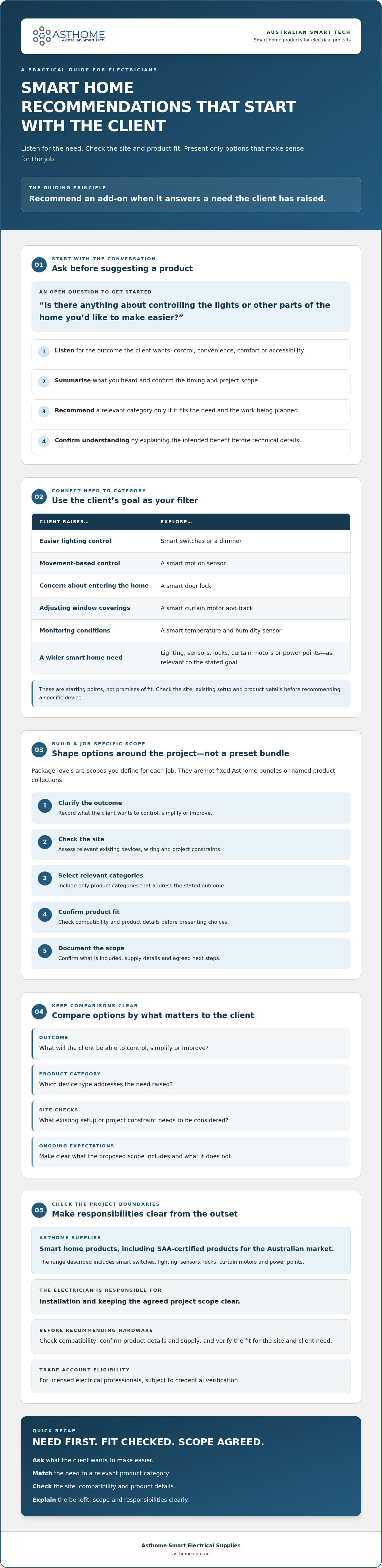
Use existing discussions as prompts, not assumptions. A switchboard conversation, lighting change or renovation may be a good time to ask whether the client wants simpler control, automation or more day-to-day convenience. Keep the question open: “Is there anything about controlling the lights or other parts of the home you’d like to make easier?”
Listen to the answer, then confirm timing and scope before suggesting extra devices. A client focused on finishing the current repair may not want to consider additions today. A renovation may allow more room to assess options, but any recommendation should still fit the work being planned.
How do you connect a client need to a product category?
Translate the stated outcome into a category for further assessment. A request for easier lighting control could prompt a discussion about smart switches or a dimmer. If the client raises movement-based control, explore whether a smart motion sensor is relevant. A concern about entering the home may make a smart door lock worth discussing; a desire to adjust window coverings may lead to a conversation about a smart curtain motor and track.
Comfort-related needs may also prompt questions about monitoring conditions, where a smart temperature and humidity sensor could be considered. These are starting points, not promises of fit. Check the site, existing setup and product details before recommending a specific device.
- Renovation: Ask what the client wants to control or simplify, and confirm what falls within the project.
- Lighting: Explore switch or dimmer options only after understanding the desired control.
- Access and convenience: Discuss a smart lock, curtain motor or sensor only when it addresses a stated goal.
- Accessible housing: Ask what support is needed and explore relevant options, including an NDIS SDA Compliant Smart Home Kit, without promising approval or outcomes.
A useful recommendation is specific and proportionate. If the need isn’t clear, ask another question or leave the product list for another time. That restraint builds trust and gives you a clearer basis for the package options you develop next.
How to build smart home package options around project needs
Build the scope from the client’s desired outcome, not from a pre-set bundle. Package levels are ways for you to organise and explain the work you’re proposing; they aren’t fixed Asthome bundles or named product collections. This keeps upselling smart home packages to electrical clients focused on fit, with each option shaped around the site, the client’s priorities and product details you’ve checked.
A Pacific Northwest National Laboratory report on contractor business models examines how contractors approach add-on opportunities during existing work. The project context differs, but the practical principle is relevant: connect an additional recommendation to the job and the customer’s needs rather than presenting it as an automatic extra.
What should an entry-level, expanded or project-specific scope include?
Use a simple sequence to develop each proposal. Treat the levels as adaptable scopes, not standard packages with guaranteed contents.
- Clarify the outcome. Record what the client wants to control, simplify or improve.
- Check the site. Review relevant existing devices, wiring and project constraints as part of your assessment.
- Select categories. Consider only product categories that address the stated outcome.
- Confirm fit. Check requirements and product information before including a particular item.
- Present options. Explain the difference between a focused scope, an expanded one and any project-specific alternative.
An entry scope could address one clearly defined priority with a suitable product category. An expanded option should add categories only where the client has identified another relevant use. Keep a project-specific scope flexible for site conditions, preferences and verified product suitability. Product education can help inform your assessment: see the Matter smart switch guide and Zigbee module retrofit guide.
How do you check product and ecosystem fit before quoting?
Before proposing a product, note the client’s existing platform and devices, along with how they prefer to control them. Check current product information for requirements. Don’t assume devices will work together just because they share a broad category or protocol. If an important detail isn’t clear, verify it before adding the item to the scope.
Also confirm Australian-market certification. Asthome states that all its products are SAA certified for the Australian market. For product details and category options, you can review Asthome’s smart home range as part of your selection process.
How to compare package options without adding avoidable complexity
Smart home upgrades don’t have to mean proposing every product category at once. A focused recommendation can be easier for a client to assess, while a broader scope may suit a project with several clear priorities. Compare the options by what they address and what the client will need to consider, not by implying that more devices mean a better result.
Use a simple comparison to make the differences visible. For example, a lighting-focused discussion might lead you to review the Australian smart light switch guide for category-level information. Confirm product requirements and site suitability before including a particular item.
| Comparison point | Focused upgrade | Broader scope |
|---|---|---|
| Client outcome | Addresses one stated priority, such as lighting control. | Addresses more than one client-identified use case. |
| Product categories | One relevant category, subject to product and site checks. | Additional categories only where they have a clear purpose. |
| Site checks | Show the checks needed for the proposed product and installation scope. | Identify any extra requirements that need assessment or confirmation. |
| Ongoing expectations | Explain what the client will control or manage after the work. | Clarify any additional devices, controls or product questions involved. |
How should clients compare a focused upgrade with a broader scope?
State what each electrician-defined scope includes and excludes. A focused option may be simpler to understand and manage; a broader one may involve more categories and product details for the client to consider. Neither is automatically the right choice. Present the difference plainly, then let the client decide whether to proceed with one option, stage the work or keep to the original job.
Staging can make the scope clearer if it suits the project and the client wants that approach. Record what’s being considered now and what would need review before any later stage. Don’t imply that future additions will be compatible or suitable without checking.
How can you reduce compatibility and support concerns?
Document known devices, the client’s preferred control approach and any requirements that still need confirmation. Avoid guessing about compatibility. If a product detail is unclear, verify it before promising an outcome or including it in the scope.
Be clear about responsibilities: Asthome supplies products, while you’re responsible for your own installation services. Asthome states that its products are SAA certified for the Australian market. This distinction helps clients understand who supplies and who installs the selected products.
How to present smart home recommendations and handle client questions
A clear conversation helps clients understand why you’re suggesting an addition and gives them room to decide. Keep it practical: explain the intended outcome first, then discuss product categories and technical details only as needed. This makes upselling smart home packages to electrical clients a useful discussion about the client’s priorities, not a pitch loaded with jargon.
What questions help uncover the client’s actual priorities?
Start with the task or issue they want to improve. Ask which room or daily routine is causing friction, who will use the system and what level of control they expect. Check what smart devices or platforms are already in the home before proposing additions. Their answers help you avoid recommending a product that doesn’t fit how they use the space.
Then summarise what you’ve heard. For example: “You’d like the hallway light to respond to movement, and you want to keep control simple. Have I got that right?” If the client wants more detail about the category, point them to Asthome’s motion sensor guide.
How do you explain value without overselling?
Use a four-step conversation to keep the recommendation relevant and easy to follow:
- Ask: Find out what the client wants to improve, who will use the system and what devices are already in place.
- Summarise: Repeat the priority in plain language and check you’ve understood it correctly.
- Recommend: Link one suitable product category to that need. Explain the intended outcome before introducing protocols or product details.
- Confirm understanding: Outline what’s included, what’s excluded and what still needs checking. Invite questions before agreeing the next step.
Be specific about the reason for each recommendation. A motion sensor may be worth discussing if the client has asked for movement-based lighting control; it isn’t a reason to suggest sensors throughout the home. Explain what you know, identify any product requirements that need verification, and avoid promising compatibility or results that haven’t been confirmed.
Clients may worry that an upgrade means more devices to manage. Acknowledge that concern directly. Explain that they can consider a focused option or, if the project and their preferences allow, stage additional choices for later assessment. The client doesn’t need to decide on every category at once.
For product questions you can’t resolve from the available information, avoid guessing. Asthome states that its products are SAA certified for the Australian market. Explore Asthome’s smart home products to review relevant categories as you prepare a clear, client-led recommendation.
How Australian electricians can source and support smart home packages
A sound product selection still needs a clear path from recommendation to the job. Before confirming a smart home scope, check current product information, verify supply and record what the client has agreed to. This follow-through keeps upselling smart home packages to electrical clients practical and helps prevent unconfirmed product details from becoming project commitments.
What should electricians confirm before finalising a product recommendation?
Use a short pre-order check. Confirm the selected categories, relevant product details and certification information. Check availability before committing to timing, and record any site or compatibility questions that still need an answer. If product requirements or suitability aren’t clear, verify them rather than making assumptions.
- Confirm product details: Review current information and requirements for the specific products being considered.
- Verify supply: Check availability before setting expectations with the client.
- Document scope: Record what the client selected, what’s excluded and what still needs confirmation.
- Agree next steps: Clarify who will follow up on outstanding checks and how the project will proceed.
Use current product information to clarify product details, while keeping project-specific site checks and installation decisions within your own scope. Asthome supplies products; it doesn’t provide electrical installation services.
How can a supplier relationship support repeat smart home work?
A supplier with categories across switching, dimming, lighting, sensors, access, curtain control and power points gives you options to consider as different client needs arise. Review the range against the job at hand rather than treating a broad catalogue as a reason to add more products. Product information can help with selection, but it doesn’t replace checking the site, confirming fit or documenting the agreed scope.
Licensed electrical professionals can apply for trade account pricing, subject to credential verification. Check eligibility and the verification requirements before building trade pricing into your purchasing plans. Keep the client’s product choice, confirmed supply and your installation responsibilities clear in your records.
For your next product selection, explore Asthome’s smart home range and trade options, and review the product information for items that fit the job.
Make the next recommendation client-led
Strong smart home proposals start with a need the client has raised. Match the outcome to suitable product categories, check site and product requirements, then present a focused scope alongside any relevant alternatives. Clear explanations of what’s included, what needs confirming and who handles each next step can make upselling smart home packages to electrical clients simpler and more professional.
Asthome offers smart home products and states that all its products are SAA certified for the Australian market. Licensed electrical professionals can apply for trade pricing through a verified trade account.
Explore Asthome’s smart home range and trade options to review product categories and compare options for your next job. Start with the client’s priority, confirm the details and build from there.
Frequently Asked Questions
How can electricians upsell smart home products without sounding pushy?
Make a recommendation only when it addresses a need the client has raised. Ask what they’d like to control or simplify, repeat their priority to check you’ve understood, then explain one relevant product category in plain language. Be clear about what’s included, what needs checking and what’s outside the scope. Give the client time to ask questions or decline. A useful recommendation supports their decision; it doesn’t pressure them to add products.
What smart home products are easiest to recommend to electrical clients?
The most suitable products are those that match a clear client priority and can be assessed for the site. A lighting-control request may prompt a discussion about a smart switch or dimmer; a request for movement-based control may make a motion sensor relevant. Smart locks, curtain motors and sensors may also suit specific needs. Check product requirements and existing devices before recommending an item, rather than assuming one category fits every job.
How do I create smart home package options for different client budgets?
Build electrician-defined options around scope, not fixed product bundles or assumed price points. Start with a focused option addressing one stated priority, then outline a broader or project-specific scope only if the client has identified additional relevant needs. Show what each option includes and excludes, what site or product checks remain, and what the client may need to manage. Confirm current product pricing and supply before preparing a quote, and let the client choose.
Can smart home products from different brands work together?
Sometimes, but don’t assume products from different brands will work together. Check the client’s existing devices and preferred platform, then review current product information for requirements and supported combinations. A shared protocol or standard alone shouldn’t be treated as a compatibility guarantee. If a detail is unclear, verify it before quoting or committing to a particular outcome. Keep any unresolved compatibility questions visible in the proposed scope.
What should electricians check before recommending smart home products in Australia?
Check current product information, site suitability, electrical requirements, compatibility and supply before making a project commitment. Confirm the product’s Australian-market certification details and ensure the proposed work fits your professional responsibilities and applicable requirements. Asthome states that all its products are SAA certified for the Australian market. Verify details for the specific product you’re considering, and check with the supplier if its requirements or suitability aren’t clear.
How can I explain Matter and Zigbee to a client in simple terms?
Describe Matter and Zigbee as different ways smart home devices communicate, without promising that every device using either will work with the client’s setup. Then bring the explanation back to their priorities: what they want to control, what devices they already have and how they prefer to use them. Check the specific product requirements and platform fit before recommending a device. Keep the technical detail brief unless the client wants to explore it further.
Can electrical contractors access trade pricing for smart home products from Asthome?
Licensed electrical professionals can apply for an Asthome trade account, with access to trade pricing subject to verified credentials. Eligibility isn’t automatic, so check the account requirements and complete credential verification before relying on trade pricing in a project quote. Asthome is an Australian online retailer supplying smart home products and electrical components. It supplies products, not electrical installation services.