

The era of choosing between Apple Home and Google Home is officially over. In 2026, building a matter smart home isn't just a tech enthusiast's hobby; it's the mandatory foundation for any modern Australian renovation. With the release of Matter 1.5 and strict Thread 1.4 hardware standards, the fragmentation that once plagued our industry has been replaced by a unified ecosystem that finally just works.
We know the frustration of finding a perfect smart switch only to realise it isn't SAA-certified or won't talk to your existing hub. It's valid to worry about tech becoming obsolete or your data being vulnerable to cloud-based security risks. You deserve a home that's secure, compliant, and easy to manage without needing a degree in systems engineering.
This analysis will show you how the Matter standard is revolutionising Australian living by providing local control and rock-solid reliability. You'll discover how to navigate the Cyber Security Rules 2025 that commenced in March 2026 and why SAA-certified modules are non-negotiable for your safety. We'll explore the essential hardware and protocols needed to future-proof your home against the evolving standards of the modern trade.
Key Takeaways
- Understand how Matter 1.5 has unified major ecosystems like Apple and Google to create a seamless, future-proof automation foundation for your renovation.
- Learn why local control and the Cyber Security Rules 2025 keep your matter smart home operational and secure without relying on the cloud or NBN.
- Compare Matter-over-Thread with Zigbee 3.0 to choose the right protocol for your specific hardware needs and network stability.
- Identify the mandatory SAA-certified modules and GPOs required to meet Australian safety standards and protect your property from illegal, uncertified tech.
- Master the planning process for your ecosystem by selecting the right primary controller and eliminating frustrating mesh network dead zones.
What is a Matter Smart Home in 2026?
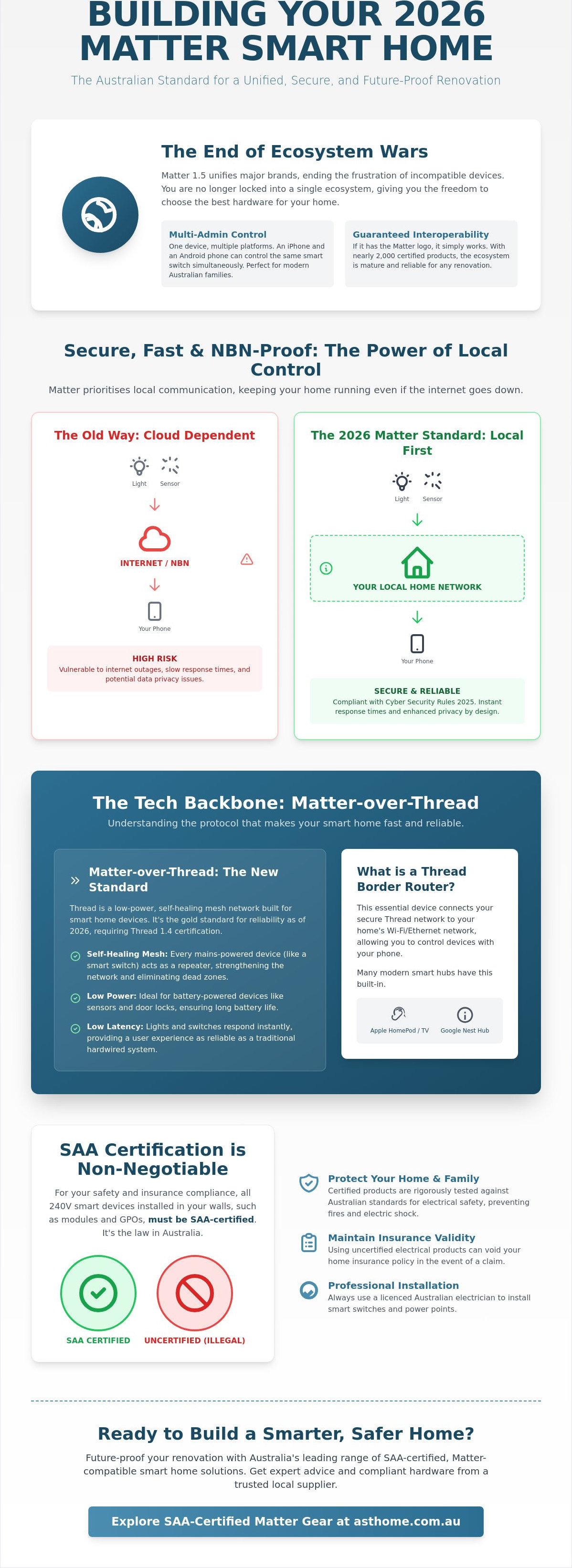
Matter has transitioned from a technical buzzword into the mandatory communication layer for every modern Australian residence. Backed by global leaders such as Apple and Google, the Matter (smart home standard) ensures that your hardware speaks a single, unified tongue regardless of the manufacturer. By mid-2026, the fragmentation that once defined the industry has been replaced by a reliable, cross-platform foundation. Homeowners are no longer forced to check for individual compatibility logos; they're simply looking for the Matter mark to guarantee a seamless, out-of-the-box setup. With the Australian smart home market projected to hit $2.5 billion this year, this shift toward a universal language is the primary driver of consumer confidence.
The core benefit for local adopters has been the total elimination of "hub fatigue." In previous years, a typical Australian smart home required a tangled mess of proprietary bridges and gateways plugged into the router just to manage basic lighting and security. A matter smart home streamlines this by using your existing network infrastructure to connect devices directly. This interoperability has become the leading trend for 2026 because it places the homeowner in control of their hardware choices. You're no longer dictated to by a single brand's ecosystem, allowing for a more flexible and modular approach to home automation that can grow as your needs change.
The End of Ecosystem Lock-in
The "Multi-Admin" feature is perhaps the most significant functional upgrade for local families. It allows a single device, like a smart switch or sensor, to be controlled simultaneously across different platforms. If you prefer using an iPhone while your partner uses an Android device, Matter ensures that both of you have equal, real-time control over your home's automation. This flexibility is essential for Australian households where device preferences are often mixed. You can share access with family members or even temporary guests without needing them to download a brand-specific app or create multiple cloud accounts. It’s about making the tech fit the family, not the other way around.
Why 2026 is the Year of Matter Maturity
We have reached a point where Matter is no longer considered "experimental" technology. The protocol has matured to include nearly 2,000 certified products, covering everything from basic globes to complex energy management systems. For new Australian builds and major renovations, installing Matter-ready hardware is now a standard trade practice rather than a niche luxury. This maturity results in near-instant response times and a level of stability that finally matches traditional hardwired systems. By choosing this standard, you're investing in a future-proof foundation that is designed to evolve alongside emerging industry standards while maintaining the reliability that Australian homeowners expect from their electrical installations.
The Tech Behind the Trend: Thread, Local Control, and Aussie Safety
The technical architecture of a matter smart home has evolved significantly with the release of Matter 1.5. While early smart devices relied heavily on congested Wi-Fi bands, the 2026 standard prioritises reliability through a combination of robust protocols and local processing. This shift ensures that your home automation remains responsive even when multiple family members are streaming 4K content or gaming. By decentralising the "brain" of the home, Matter creates a system that is both faster and more resilient than previous generations of smart technology.
Thread vs. Wi-Fi: Which Backbone is Best?
Thread has become the gold standard for low-power devices such as motion sensors and door locks. Unlike Wi-Fi, which can drain batteries quickly and struggle with range, Thread creates a dedicated network where every mains-powered device acts as a repeater. This strengthens the signal throughout your property. Thread is a low-latency, self-healing mesh network. As of January 1, 2026, new hardware must be Thread 1.4 certified to ensure maximum compatibility. To manage this network, you'll need a Border Router, typically found in devices like an Apple TV or HomePod. The Connectivity Standards Alliance has designed this system to be invisible to the user while providing enterprise-grade stability.
Local Control and Privacy
One of the most significant trends in 2026 is the move away from cloud-dependent ecosystems. In the past, if your NBN connection dropped or a manufacturer's server went offline, your "smart" home became quite dumb. Matter changes this by ensuring all commands are processed locally within your four walls. This is a massive win for regional Australians who may deal with intermittent internet connectivity. Because your data doesn't need to travel to a server in another country to turn on a light, the response is near-instant. This local-first approach also aligns with the Cyber Security (Security Standards for Smart Devices) Rules 2025, which commenced on March 4, 2026, to protect consumer privacy at a legislative level.
SAA Certification: Non-Negotiable for AU Sparkies
Safety is the primary concern for any professional electrical installation. While you might find cheap Matter devices on international marketplaces, using "grey market" hardware that lacks SAA certification is a serious risk. In Australia, any device connected to 240V mains power must comply with the AS/NZS 60335 series standards. Uncertified modules can void your home insurance and are illegal for electricians to install. Every Matter Smart Switch Module we provide undergoes rigorous testing to meet these local requirements. For homeowners prioritising safety, selecting SAA-certified smart modules is the only way to guarantee a compliant and secure installation that stands the test of time.
Matter vs. Zigbee: Why Point Cook Homeowners are Making the Switch
Choosing between Zigbee 3.0 and the newer Matter protocol is the most common question we get from homeowners in Point Cook and beyond. Zigbee has been the "gold standard" for years, offering a stable mesh network for everything from sensors to dimmers. However, as we move through 2026, the matter smart home is gaining massive ground due to its sheer simplicity. While Zigbee often requires a specific hub for each brand, Matter allows you to mix and match hardware from different manufacturers without "walled garden" restrictions. For a standard 4-bedroom Australian home reno, the decision often comes down to how much technical tinkering you want to do versus having a system that "just works" from day one.
The Case for Matter
Setup is where Matter really shines. Instead of holding down buttons and hoping for a pairing light to flash, you simply scan a QR code with your phone. This ease of use makes a smart switch australia easier to commission for both sparkies and DIY enthusiasts. Future-proofing is another major factor. By choosing Matter, you ensure your devices won't become paperweights if a manufacturer decides to shut down their specific cloud service. As noted by Forbes on smart home energy management, the shift towards these universal standards is also helping homes integrate with the wider energy grid to save on power costs. This native support is now built into almost every major Australian telco router and tech ecosystem, making it the most accessible path for modern living.
When to Stick with Zigbee
Despite the hype around new protocols, Zigbee 3.0 remains incredibly relevant for large-scale professional installs. If you're building a high-density network with over 50 sensors and switches, Zigbee's proven track record for low-power efficiency is hard to beat. The good news is that you don't have to choose one or the other. Many homeowners are adopting a "Best of Both Worlds" approach. By using a matter smart switch or a Matter-certified bridge, you can bring your existing Zigbee devices into your new ecosystem. This allows you to keep your reliable Zigbee 3.0 Smart Switch Modules while expanding your home with the latest Matter-over-Thread sensors. It’s a pragmatic way to upgrade without throwing away perfectly good gear.
From a cost-benefit perspective, Matter hardware sometimes carries a slight premium due to newer certification requirements. However, the time saved during installation and the reduced need for multiple proprietary hubs often offsets this initial cost. For a typical family home, the investment in a unified matter smart home foundation pays off through better reliability and a significantly higher resale value when it comes time to move on. You're building a system that any future buyer can easily understand and use, regardless of their phone preference.
Planning Your Matter Ecosystem: From Smart Modules to Universal Hubs
Building a successful matter smart home involves more than just unboxing a few devices. It requires a systematic approach that considers your home's layout, your family's device habits, and long-term accessibility. Unlike the haphazard setups of the past, a 2026 ecosystem needs a solid foundation. You must start by selecting a capable primary controller, mapping out your signal strength, and choosing hardware that integrates into your home's architecture rather than cluttering up your power points with messy adapters.
Selecting the Right Controller
Your "Primary Controller" acts as the central brain of your system. In 2026, the most popular choices for Australian households are the Apple HomePod (2nd Gen) or the Google Nest Hub (2nd Gen). Both devices serve as Matter controllers and Thread Border Routers. For Aussie power users who want total local control and advanced customisation, Home Assistant remains the peak choice. When selecting your hub, ensure it's Thread-enabled to take full advantage of the low-latency mesh network. Without a Thread-capable controller, you'll be forced to rely on Wi-Fi for every device, which can lead to network congestion as your automation system expands.
Once your controller is in place, you need to identify "Dead Zones." Australian homes, particularly those with double-brick internal walls or multiple storeys, can struggle with signal penetration. Because every mains-powered Matter device acts as a mesh repeater, you can strategically place a Matter Smart Switch Module in hallways or central rooms to extend the network. This self-healing mesh ensures that a sensor in the far corner of the garage or a smart door lock on the front gate stays connected by hopping through other devices back to the hub.
Integrated vs. Plug-in Devices
While smart plugs are a quick fix, they're often bulky and detract from a home's interior design. The trend for 2026 is moving toward integrated, in-wall modules that maintain a clean, high-end look. Adopting a smart home au planning approach means prioritising permanent, licensed electrical work. In-wall modules allow you to keep your existing designer light switches while adding full Matter compatibility behind the wall plate. This is particularly popular in kitchen renovations, where smart GPOs (General Purpose Outlets) are becoming the standard for managing small appliances and monitoring energy use without extra adapters.
Accessibility is another critical pillar of modern planning. For those requiring NDIS SDA (Specialist Disability Accommodation) compliance, Matter provides a robust framework for voice and sensor-based automation. An NDIS SDA Compliant Smart Home Kit can be integrated into the Matter ecosystem to provide automated lighting, curtain control, and entry systems that enhance independence. These systems must be reliable and easy to use, making the unified Matter standard the ideal choice for assisted living environments. If you're ready to start your build, you can browse our range of SAA-certified Matter hardware to ensure your project meets all local safety and compliance standards.
Future-Proofing with Asthome’s SAA-Certified Matter Solutions
Adopting a matter smart home strategy requires more than just picking hardware off a shelf. It's about ensuring every component meets the rigorous safety standards required for the Australian electrical grid. At Asthome Smart Electrical Supplies, we bridge the gap between cutting-edge global technology and local trade reliability. We are a business run by practitioners for practitioners. This means we understand the specific requirements of a 240V installation and the importance of hardware that fits behind a standard Australian wall plate without the struggle often found with oversized international modules.
Our Matter Smart Switch Modules are designed specifically for the unique conditions of the Aussie grid. While international versions might look similar, our stock is engineered to handle local voltage fluctuations and thermal requirements. This professional heritage ensures that your automation foundation is as solid as the wiring it sits on. By choosing a local Point Cook specialist like Asthome Smart Electrical Supplies, you aren't just buying a module; you're gaining a partner who speaks the language of the Australian trade and understands local licensing requirements.
The Asthome Smart Electrical Supplies Difference: SAA and Support
Peace of mind comes from knowing your hardware is 100% compliant. In Australia, SAA certification is a legal mandate for any smart device connected to permanent wiring. Using uncertified "grey market" gear can void your home insurance and put your property at risk. Every module we ship carries the necessary regulatory approvals, ensuring it meets the AS/NZS 60335 safety series. We provide peer-to-peer service that international retailers simply cannot match. If you have a technical question during commissioning, our local team is here to help. Plus, with fast shipping from our Point Cook warehouse, you won't be left waiting weeks for a critical part to arrive on-site.
- 100% SAA Certified: All mains-powered modules meet Australian safety standards and carry the RCM mark.
- Local Expertise: We provide technical support tailored to the needs of Australian electrical contractors and homeowners.
- Regional Reliability: Every product is tested for the local 240V environment to ensure long-term stability.
- Rapid Logistics: Direct shipping from our Victorian distribution centre to anywhere in Australia.
Get Started on Your Matter Journey
The transition to a unified smart home doesn't have to be complicated. You can start small with a single Matter Smart Switch Module or plan a full-scale rollout using our NDIS SDA Compliant Smart Home Kits. If you're a licensed electrical professional, we invite you to sign up for a trade account. This provides access to wholesale pricing and dedicated tech support to help you deliver better results for your clients. Whether you're a homeowner planning a reno or a sparkie looking for reliable gear, our team is ready to provide the advice you need. Browse our full range of SAA-certified Matter and Zigbee solutions today to secure your home's digital future with Asthome Smart Electrical Supplies.
Secure Your Home’s Digital Future Today
In 2026, the promise of a unified smart home has finally become a reality through the Matter standard. By prioritising local control and the robust Thread mesh protocol, you're building a system that is faster, more secure, and entirely independent of cloud outages. This shift marks the end of hub fatigue and ecosystem lock-in, allowing your family to use the devices they love without restriction. It’s about making technology work for you, rather than the other way around.
Investing in a matter smart home is about more than just convenience; it's about long-term property value and electrical safety. Every project deserves hardware that is 100% SAA-certified for our local 240V grid to ensure full compliance and peace of mind. From our local Point Cook support to dedicated trade accounts for licensed sparkies, we provide the expertise and professional-grade hardware needed to get the job done right the first time.
Future-proof your home with Asthome’s SAA-certified Matter range today. Let's build a home that is reliable, secure, and ready for whatever the next generation of technology brings.
Frequently Asked Questions
What is Matter and why is everyone talking about it in 2026?
Matter is a universal communication protocol that allows smart devices from different brands to work together seamlessly. In 2026, it's the dominant standard because it has moved from a technical promise to a mature ecosystem with widespread hardware availability. It simplifies the user experience by ensuring your lights, locks, and sensors speak the same language without needing a cupboard full of proprietary hubs.
Do I need to throw away my old smart home devices to use Matter?
No, you don't need to bin your existing gear. Many current Zigbee and Wi-Fi devices can be integrated into a matter smart home using a compatible bridge or hub. Many manufacturers have released firmware updates for older hardware, and bridges allow your reliable Zigbee 3.0 modules to appear as Matter devices in your preferred automation app.
Is Matter better than Zigbee for Australian homes?
Matter offers better interoperability across different phone brands, but Zigbee 3.0 remains a powerhouse for high-density sensor networks. For most Australian homes, a hybrid approach is best. Use Matter-over-Thread for new, high-visibility devices like smart switches and locks, while keeping Zigbee for large-scale sensor arrays where ultra-low power consumption is the priority.
Can I use Matter devices with Apple Home and Google Home at the same time?
Yes, the "Multi-Admin" feature is a core part of the Matter standard. It allows you to pair a single device with multiple smart home platforms simultaneously. This means you can control your kitchen lights from an iPhone while another family member uses a Google Nest Hub or an Android tablet without any lag or synchronisation issues.
Are Matter smart switches safe for Australian electrical standards?
Matter smart switches are only safe if they carry the SAA-certified mark or the Regulatory Compliance Mark (RCM). The Matter protocol itself is a communication standard, not a safety rating. For 240V permanent wiring in Australia, your modules must comply with AS/NZS 60335 standards to be legal for installation and to maintain your home insurance coverage.
What is a Thread Border Router and do I need one?
A Thread Border Router is a device that connects your Thread mesh network to your home's Wi-Fi or Ethernet. You'll need one if you want to use Thread-based Matter devices. Common examples include the Apple TV 4K, HomePod, or various Google Nest products. It ensures your low-power sensors stay connected to the rest of your home network without a dedicated bridge.
Does Matter work without an internet connection?
Yes, Matter is designed for local control. Unlike older cloud-dependent systems, Matter commands are processed entirely within your home network. This means your automations and switch controls will continue to work even if your NBN connection drops out or a manufacturer's server goes offline. It provides a level of reliability that was previously difficult to achieve.
Where can I buy SAA-certified Matter modules in Australia?
You can buy fully compliant, SAA-certified modules directly from our Point Cook warehouse. We specialise in hardware that meets Australian trade requirements, ensuring you get professional-grade gear with local support. Whether you're a DIY enthusiast or a licensed sparkie, we have the stock ready for immediate dispatch across the country to help you build a reliable matter smart home.