

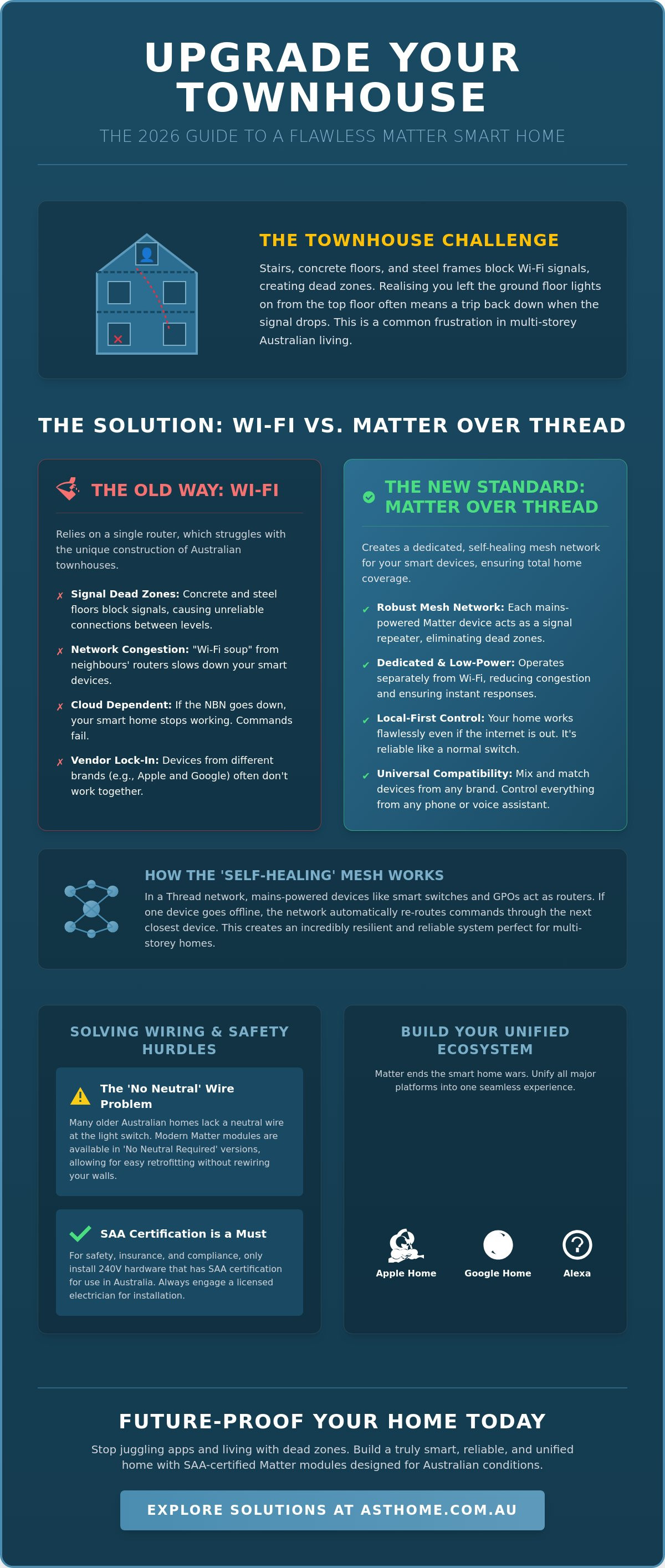
You have just reached the top floor of your three-storey terrace, only to realise the lounge room lights are still blazing on the ground level. You try to turn them off via your phone, but the signal drops out between the concrete floor slabs, forcing you to make the climb back down. It is a common frustration for many locals, but the arrival of matter smart modules for townhouses australia has finally provided a professional-grade solution to these multi-storey connectivity hurdles. By leveraging Thread mesh networking, these modules ensure your commands reach every corner of the home without relying on a single, overworked Wi-Fi router.
We understand that Australian townhouse living presents unique technical challenges, from the lack of neutral wires in older light switches to the "app fatigue" of juggling five different brands. You want a home that stays connected, regardless of how many stairs are in the way. This 2026 guide promises to show you how to build a unified, future-proofed ecosystem that solves signal drops and wiring limitations for good. We will explore the latest Matter 1.5.1 standards, explain the mandatory Cyber Security Rules 2025, and identify the SAA-certified hardware required to keep your GPOs and lighting responsive across every level of your property.
Key Takeaways
- Solve multi-level connectivity issues by leveraging the self-healing Thread mesh network built into modern Matter-certified hardware.
- Learn how to select the correct matter smart modules for townhouses australia to overcome the common "no neutral" wire limitation found in older Australian builds.
- Streamline your smart home by unifying Apple Home, Google Home, and Alexa into one responsive ecosystem without vendor lock-in.
- Protect your property and insurance status by prioritising SAA-certified hardware and coordinating with a licensed electrician for all 240V mains work.
- Identify the best hardware configurations for complex townhouse layouts, including 1-gang and multi-gang switch modules and smart GPOs.
Why Matter Smart Modules are a Game-Changer for Australian Townhouses
Matter smart modules act as the essential bridge between your home's traditional electrical wiring and a modern, automated future. For years, Australian homeowners were forced to pick a side in the "smart home wars." If you bought a switch that worked with Apple Home, it often wouldn't talk to your partner’s Android phone. The Matter smart home standard has effectively ended this era of fragmentation. By installing matter smart modules for townhouses australia, you are choosing hardware that speaks a universal language, allowing different brands to communicate locally without needing the cloud.
Local-first control is a massive win for reliability in the Australian market. We've all seen the NBN go down at the worst possible time. With older cloud-based systems, a lost internet connection meant your "smart" lights became dumb switches. Matter changes the game by prioritising local communication. Even if your external internet service drops out, your internal network remains operational. Your motion sensors will still trigger the hallway lights and your Smart Power Point (GPO) will still follow its schedule because the logic stays inside your four walls.
The Interoperability Advantage in 2026
Building a smart home shouldn't feel like signing a lifelong contract with a single tech giant. In 2026, the maturity of the Matter protocol allows you to mix and match hardware with total confidence. You can install our Matter Smart Switch Modules behind your existing wall plates and control them via Siri, Alexa, or Google Assistant simultaneously. This future-proofs your investment; if you decide to switch from an iPhone to a Samsung next year, your entire lighting rig won't need a tear-down. Commissioning is also significantly faster. You simply scan a QR code on the module and it's joined to your network in seconds, which is a huge time-saver for multi-storey townhouse setups with dozens of circuits.
Reliability Beyond Wi-Fi
High-density living in Australian suburbs often leads to "Wi-Fi soup." When twenty neighbours all have powerful routers blasting signals through thin walls, congestion becomes a nightmare for smart devices. Many matter smart modules for townhouses australia now utilise Thread, a low-power mesh network that operates separately from your main Wi-Fi traffic. This reduces the load on your townhouse wireless router and eliminates the lag often seen in cheaper Wi-Fi-only setups. Local execution means that when you tap a button, the light turns on instantly. There's no round-trip to a server in California or Singapore, just a direct, snappy response that feels as reliable as a traditional hardwired switch.
Matter over Thread vs. Wi-Fi: Which is Best for Multi-Storey Living?
Choosing the right transport layer for your smart home is the difference between a responsive system and a constant headache. Matter is the language, but it needs a road to travel on. In 2026, those roads are usually Wi-Fi or Thread. While Wi-Fi is fine for a single-level apartment, it often struggles to penetrate the concrete or steel-reinforced floors of a modern Australian townhouse. This is where matter smart modules for townhouses australia using the Thread protocol become essential. Thread is designed specifically for the smart home, offering a low-latency, low-power alternative that doesn't bog down your home office internet speed.
Mains-powered modules are the hidden heroes of this setup. Unlike battery-operated sensors that only "talk" when triggered, a hardwired Matter Smart Switch Module stays awake. It acts as a router within the mesh network, passing signals from the ground floor hub up to the third-floor master suite. This prevents the "dead zone" effect commonly found in stairwells or basement garages. However, there are still practical considerations for using Matter, especially regarding the initial setup and ensuring you have a compatible border router to bridge the network. For a truly reliable backbone, you should ensure every floor has at least one mains-powered device to relay the signal.
The Self-Healing Mesh Explained
Thread networks are "self-healing," which is a fancy way of saying they are incredibly resilient. If a module on the middle floor is switched off at the wall or fails, the network doesn't collapse. Instead, the signal automatically reroutes through the next closest device. This is a massive advantage for Australian builds with timber or steel frames that can sometimes reflect or absorb traditional wireless signals. Every time you install a new module, you aren't just adding a feature; you're strengthening the connectivity for every other device in the home. This decentralised approach means no single point of failure will leave your whole house in the dark.
Thread Border Routers in the Townhouse
To get your Thread-based modules talking to the internet and your phone, you need a Border Router. These aren't separate, clunky boxes anymore. In 2026, devices like the Apple TV 4K, HomePod, or certain Google Nest hubs already have this tech built-in. For a three-storey townhouse, we recommend placing your Border Router on the middle floor. This centralises the "brain" of the network, ensuring the mesh can expand vertically with minimal lag. If you are starting your build, choosing a Matter Smart Switch Module ensures you have the routing backbone needed for a reliable, multi-level smart home. Remember that while Wi-Fi modules are often cheaper, the long-term stability of a Thread mesh is worth the investment for high-density townhouse living.
The Townhouse Retrofit: Solving the "No Neutral" and Space Hurdles
Retrofitting a three-storey terrace isn't just a software configuration task; it's a physical challenge that happens behind the wall plate. Most Australian townhouses built before the mid-2000s use a wiring method where the neutral wire stays at the light fitting rather than the switch. This creates a significant hurdle for automation. When you're sourcing matter smart modules for townhouses australia, you need to know exactly what's behind your plasterboard before you commit to a purchase. Every piece of hardware must meet local safety standards, and all 240V mains work must be performed by a licensed electrician to remain AS/NZS 3000 compliant.
Managing the physical space inside a wall cavity is the next big hurdle. Aussie wall boxes are notoriously shallow, especially in high-density townhouse builds where every millimetre counts. Cramming a module, a switch mechanism, and several runs of 1.5mm TPS cable into a standard 1-gang or 4-gang plate is a tight squeeze. It's a job that requires a steady hand and an organised approach to cable management. Choosing hardware designed for these narrow constraints is the best way to avoid a messy, unsafe installation that puts pressure on your switch terminals.
Dealing with Limited Wall Box Depth
Organising your wiring is essential for a clean finish. Asthome smart switch modules are engineered with a compact footprint specifically for the narrow cavities found in Australian homes. If your wall boxes are particularly shallow, your sparkie might recommend using a deeper mounting block. This provides a few extra millimetres of clearance, ensuring the module has enough breathing room for heat dissipation and preventing the switch plate from bulging off the wall. It's a small adjustment that makes a massive difference in the final aesthetic of your townhouse renovation.
Neutral vs. No-Neutral Modules
Identifying your wiring is a quick job for a professional. If your switch only has an Active and a switched Load wire, you'll need a "No Neutral" Matter module. These are perfect for retrofits because they don't require expensive new cable runs through multiple floors. However, they do have limitations. For the best performance, especially regarding dimming stability, neutral-required modules are the gold standard. They provide a constant power supply to the module, which eliminates the flickering or "ghosting" often seen with low-wattage LED downlights. In no-neutral setups, installing a bypass capacitor at the light fitting is a practical way to keep your LEDs stable.
How to Install and Set Up Matter Smart Modules in Your Townhouse
Installing matter smart modules for townhouses australia involves two distinct phases: the professional electrical installation and the digital commissioning. In Australia, any hardware hardwired into your 240V mains must be installed by a licensed electrician. Before your sparkie arrives, ensure your Matter controller is powered on and connected to your network. This preparation allows for immediate testing as each circuit is energised, saving you from troubleshooting connectivity issues once the wall plates are screwed back on. Having your hub ready on the middle floor provides the best starting point for your Thread mesh to expand vertically.
Organising your townhouse levels requires a logical hierarchy within your smart home app. We recommend a naming convention that reflects the physical layout, such as "Gnd - Hallway" or "L2 - Master Suite". This structure makes voice commands more intuitive and prevents confusion when you're trying to toggle lights on a different floor. Under the Cyber Security Rules 2025, you should also check for firmware updates immediately after pairing. Ensuring your devices are running the latest Matter 1.5.1 revision provides the best security and performance for your multi-level ecosystem.
Step 1: Physical Installation
Wiring the module into a light circuit or Smart Power Point (GPO) requires precise cable management within the wall cavity. Your electrician will verify that every module carries the Regulatory Compliance Mark (RCM) and SAA certification. These marks are essential for compliance with AS/NZS 4268 and for maintaining your home insurance validity. Once the module is secured, test the manual switch operation immediately. If the physical button doesn't toggle the load, there is a wiring fault that must be rectified before you attempt the digital pairing process.
Step 2: Digital Commissioning
The Matter QR code is your digital key for the life of the product. We recommend sticking the spare QR code label inside the switch plate or into a dedicated home logbook; losing this code makes future re-pairing a difficult task. Open your preferred platform, whether it's Apple Home, Google Home, or Home Assistant, and scan the code to join the device to your Thread network. Matter’s Multi-Admin feature is a standout benefit here. It allows you to control the townhouse from multiple apps simultaneously, meaning one person can use an iPhone while another uses a Google Pixel without any conflict.
Step 3: Optimising the Mesh
Check the signal strength at the furthest points of your home, typically the basement garage or the top-floor balcony. If the response feels sluggish, adding a mains-powered "repeater" module on the middle storey will strengthen the Thread mesh. You can verify the speed of your local control by temporarily disconnecting your NBN; the modules should still respond instantly to your phone or sensors. For the most reliable multi-storey coverage, browse our range of Matter Smart Switch Modules to build a robust backbone for your automated home.
Choosing the Right Matter Hardware for Your Australian Build
Selecting the right hardware for a multi-level build requires more than just checking a compatibility list. For matter smart modules for townhouses australia, SAA certification is a non-negotiable requirement. Using uncertified gear from international marketplaces might save a few dollars upfront, but it can void your home insurance and fail local safety audits. Every module we provide is rigorously tested to ensure it handles the unique fluctuations of the Australian electrical grid and meets the strict AS/NZS standards required by law. If it doesn't carry the RCM mark, it doesn't belong in your wall.
Townhouses often feature complex lighting circuits, especially in open-plan living areas and stairwells. You need to decide between 1-gang and multi-gang modules based on the physical space available behind your switch plates. While a 1-gang module is simpler for a single light, multi-gang modules allow you to automate up to four separate circuits from a single wall box. This is a massive advantage in narrow townhouse hallways where wall space is at a premium. For Victorian electricians, having a local partner who understands these trade-specific requirements makes the difference between a smooth handover and a frustrating callback.
The Asthome Quality Standard
We are practitioners first. We know the frustration of a module that won't fit or a signal that won't jump floors. Our hardware undergoes rigorous testing for the Australian climate and electrical grid, ensuring long-term stability. We speak the same language as your sparkie, providing trade-focused support that simplifies the installation process. For a deeper dive into electrical ratings and communication protocols, read our Matter smart switch pillar. It provides the technical specs needed for a professional-grade installation.
Beyond Lighting: Expanding Your Townhouse Ecosystem
A truly smart townhouse goes beyond just flicking lights on and off. Matter 1.5.1 allows for seamless integration of Smart Curtain Motors and Tracks, which are essential for those hard-to-reach high-ceiling windows common in modern terrace designs. You can also install a Smart Power Point (GPO) in the home office to monitor energy consumption and automate standby power. This holistic approach ensures your home is efficient and easy to manage. To ensure you haven't missed a single detail in your planning, check out our smart home au checklist for a full townhouse audit. Building a unified ecosystem with Asthome means you're investing in a system that works together today and stays relevant well into the future.
Future-Proof Your Townhouse Connectivity
Building a reliable smart home across multiple levels no longer requires complex workarounds or proprietary hubs. By adopting the Matter protocol, you bridge the gap between traditional wiring and modern automation, ensuring your lighting and GPOs respond instantly without cloud lag. The transition to a self-healing Thread mesh network effectively ends the frustration of signal drops between concrete floors, providing a stable foundation for every device in your home.
Investing in matter smart modules for townhouses australia ensures your property remains at the cutting edge of the 2026 smart home standards. Every module we stock is SAA certified to meet local safety requirements, protecting your home and your insurance status. We offer trade accounts for industry professionals and provide local Victorian support and shipping to keep your project on schedule. Your townhouse is ready for a smarter, more efficient future; it just needs the right technical backbone to get there.
Shop SAA-Certified Matter Smart Modules for Your Townhouse
Frequently Asked Questions
Do I need a specific hub for Matter smart modules in Australia?
Yes, you require a Matter controller to manage your devices. This isn't a proprietary bridge but a device like an Apple TV 4K, HomePod mini, or a Google Nest Hub that supports the protocol. For a multi-level build, choosing a controller that also acts as a Thread border router is the best way to ensure your matter smart modules for townhouses australia stay connected across every floor.
Can I install Matter modules myself in my Melbourne townhouse?
No, you cannot perform the physical installation yourself. In Australia, all hardwired electrical work on 240V mains circuits must be completed by a licensed electrician. This is a legal requirement under AS/NZS 3000 standards. While you can handle the digital pairing and app setup, your "sparkie" must handle the wiring to ensure your home remains safe and your insurance stays valid.
What happens to my townhouse smart home if the Wi-Fi goes down?
Your home stays smart because Matter prioritises local control. Unlike older systems that rely on the cloud, Matter commands travel directly between your controller and the module. If your NBN service drops out, your internal schedules, motion sensors, and wall switches will continue to function perfectly. This local execution provides a snappy, reliable experience that doesn't depend on an external internet connection to turn on a light.
Do Matter modules work with older "no neutral" wiring commonly found in townhouses?
Yes, there are specific "No Neutral" versions of Matter modules designed for older Australian properties. These are ideal for retrofits where running new cables through multiple storeys is too difficult or expensive. You should check your light fittings first; some low-wattage LED downlights may require a small bypass capacitor to prevent flickering when used with no-neutral hardware. Your electrician can easily identify your wiring type during the initial site visit.
How many Matter modules do I need for a three-storey townhouse?
You should install at least one mains-powered module on every level to maintain a strong Thread mesh. While you only need one module per lighting circuit you wish to automate, having devices spread across all floors ensures the signal can hop vertically without interference. For a standard three-storey layout, starting with modules in the ground floor hallway, first-floor living area, and second-floor master suite creates a robust backbone for the rest of your home.
Is Matter better than Zigbee for Australian townhouse renovations?
Matter is the preferred choice for 2026 renovations because it offers superior interoperability. While Zigbee 3.0 is a proven and reliable standard, it often locks you into a specific manufacturer's hub. Matter allows you to mix and match hardware from different brands while controlling them all from a single app. If you are starting a new project, matter smart modules for townhouses australia provide a more future-proof investment that won't be sidelined by changing tech trends.
Are all Matter modules sold in Australia SAA certified?
Not all modules found online meet Australian safety standards. It is critical to verify that any hardware you purchase carries the Regulatory Compliance Mark (RCM) and SAA certification. Buying from international marketplaces often results in receiving gear that hasn't been tested for the Australian 240V grid. We only stock hardware that meets these local regulations, ensuring your installation is safe, legal, and compliant with your property's insurance policy.
Can I control my Matter devices from both an iPhone and an Android tablet?
Yes, this is one of the biggest advantages of the Matter standard. Through a feature called Multi-Admin, you can pair your modules with Apple Home and Google Home simultaneously. This means one family member can use Siri on their iPhone while another uses a Google Pixel or an Android tablet to adjust the same lights. There is no conflict between the systems, allowing everyone to use the interface they prefer.