

What if the module, not the switch, is the key to a smarter quote? Quoting a smart home installation for clients means accounting for more than hardware. Commissioning, hub setup and compatibility can all affect labour and your margin. Underestimate them, and a straightforward modular job can lead to avoidable call-backs.
Matter and Zigbee aren’t interchangeable answers for every project. The challenge is matching the client’s needs to compatible components, allowing time to set up and test the system, and specifying gear suitable for the Australian market. Safety and reliable operation start with choosing appropriately certified products.
This guide provides a repeatable framework for scoping modular smart home work, allowing for commissioning time and checking Matter and Zigbee requirements before you price. You’ll also see how Asthome’s SAA-certified product range and trade accounts for licensed professionals can help you source suitable modules. We’ll cover practical quoting considerations, from hub selection to the Matter Smart Switch Module as an option to assess for each project.
Key Takeaways
- Check for a neutral wire and assess connectivity across the property before finalising your scope and hardware list.
- When quoting a smart home installation for clients, allow for commissioning tasks such as hub setup, app pairing and scene configuration.
- Specify the communication protocol and select SAA-certified products suitable for the Australian market.
- Compare product costs and any applicable trade pricing when preparing your hardware list and margin.
- Compare Matter and Zigbee options against the client’s existing setup and chosen ecosystem.
The Evolution of Smart Home Quoting: Why Modular is the New Standard
Smart home quoting is shifting from one large, proprietary system towards practical combinations of connected devices. Modular technology uses individual modules, often fitted behind existing wall plates, to add smart control while keeping the installation adaptable. This can make a proposal easier to tailor: quote the controls the client needs now, then allow for compatible additions later.
That flexibility matters when you define the scope. Rather than assuming one hub or ecosystem will suit every project, compare suitable Matter and Zigbee components against the client’s requirements and existing setup. Staged work can give clients the option to begin with priority circuits and consider other areas later. Make clear what each stage includes, what hardware it depends on and what you would need to reassess before expanding the system.
For 2026 quotes, treat Matter compatibility as a question to investigate, not a promise that every device will work together. Confirm the specific product’s compatibility with the client’s preferred ecosystem and the other selected components. Asthome supplies SAA-certified Matter and Zigbee modules for the Australian market. For background on the broader field, see this overview of home automation.
Matter vs Zigbee: Choosing the Right Protocol for the Quote
Matter is designed to support interoperability across compatible smart home products, while Zigbee uses a low-power mesh approach. Neither protocol is the right fit for every job. Ask what the client already uses, then check the exact module’s compatibility with platforms such as Home Assistant or Apple Home before specifying it. Asthome’s Matter Smart Switch Australia guide offers a technical deep-dive.
The “Sparkie-First” Approach to Automation
Modular components can be an alternative to complex, closed systems. With compatible hardware and a clearly defined scope, some jobs may need less reliance on specialised programming on site. Commissioning and setup still need to be included in your quote. Asthome sells smart home components, including Matter and Zigbee modules, and offers trade accounts with discounted pricing for licensed electrical professionals.
Use a repeatable check before you price: identify the client’s ecosystem, confirm module compatibility, define which areas belong in each stage and specify SAA-certified gear. That structure makes quoting a smart home installation for clients more precise, while leaving room to scale the system without assuming every future device will integrate.
Conducting a Technical Site Audit: Identifying Infrastructure Constraints
A site audit can uncover details that make or break a smart home quote. Check the wiring, wall-box space, device locations and wireless coverage before settling the scope. A floor plan alone won’t tell you whether a switch module has the connections it needs or whether a hub can communicate reliably from its proposed location.
Start at each switch point. Confirm whether a neutral wire is present, particularly in older homes, and record any locations where it isn’t. Don’t assume a no-neutral module is suitable: check the specific product’s requirements before including it. Inspect the wall plate and box for available depth and space as well. Asthome’s Zigbee 3.0 smart switch module guide can help with product-specific retrofit considerations.
Check Wi-Fi and Zigbee coverage where devices and hubs are intended to sit, not just beside the router. Note weak or inconsistent areas and account for those constraints in the proposal rather than assuming connectivity will be uniform. In a townhouse, assess the layout and identify practical GPO locations for a Zigbee Gateway Hub and any sensors. Asthome sells SAA-certified smart home products for the Australian market, including Zigbee Gateway Hubs, Smart Motion Sensors and Smart Power Points (GPOs).
Retrofit vs New Build Considerations
For a retrofit, base the quote on what you find. Fishing or running additional wiring may affect labour, while a suitable module may offer another option if the existing wiring meets its requirements. In a new build, coordinate module depth and wiring needs with the wall-box design before installation. For kitchens and other high-use areas, identify GPO positions and specify suitable SAA-certified products. The National Electrical Code (NEC) is a US reference, not an Australian installation standard. Use relevant Australian requirements for local work.
NDIS and SDA Specific Requirements
For accessibility projects, confirm the client’s brief and the project’s applicable requirements before specifying equipment. Asthome sells an NDIS SDA Compliant Smart Home Kit, as well as Smart Curtain Motors and Tracks and Smart Door Locks. Check that each selected component suits its intended use and the agreed scope. For further planning prompts, consult the NDIS SDA smart home technology guide.
A clear audit makes quoting a smart home installation for clients more dependable. Document wiring findings, box constraints, signal observations and proposed device locations. To review Asthome’s product range, visit Asthome’s online store.
Calculating Hardware Costs and Labour Ratios for Smart Modules
A reliable quote separates hardware from labour. List each module, hub, sensor and related component against its intended location and function. Then add distinct allowances for installation, commissioning and handover. This makes the scope easier to explain and helps prevent app setup and scene configuration from disappearing into a vague fit-off allowance.
For hardware, check current product costs through your supplier and account for your own margin rather than assuming one markup suits every job. Asthome offers discounted trade pricing to licensed electrical professionals with verified trade accounts and sells SAA-certified products for the Australian market. Consider certification and product suitability alongside purchase cost, rather than selecting on price alone.
The Hidden Labour of Software Setup
Installation is only part of the job. As a planning allowance, include 15–30 minutes per module for setup, then adjust for the actual system and scope. Pairing devices, confirming operation and creating requested lighting scenes all take time. Allow separately for hub configuration and integration with the client’s chosen platform, such as Home Assistant or Apple Home, where applicable. Include client handover and app guidance as a defined, billable task so expectations are clear.
For example, a quote covering smart switching and motion-activated lighting should identify the Smart Motion Sensors, the modules or other devices involved, and the time allowed to configure and test the requested scene. Asthome’s Smart Motion Sensors guide can help inform product selection. Keep the sensor hardware and setup labour visible as separate quote items.
Trade Margins and Hardware Markups
Build your margin from your actual account cost, handling and business requirements. Don’t publish a blanket markup as though it fits every component or project. Licensed professionals with a verified Asthome trade account can access discounted trade pricing. Compare the available products against the project requirements, then calculate your quote using the costs that apply to your account.
For Zigbee jobs, don’t guess a hub-to-device ratio. Check the selected hub’s published capacity and product compatibility, then account for the property’s layout and observed signal conditions. There isn’t one universal ratio to apply to every installation. Confirm the proposed combination and allow commissioning time to test operation. This is more dependable than pricing from device count alone.
When quoting a smart home installation for clients, show hardware, installation, commissioning and handover as distinct parts of the job. That breakdown makes your labour visible, supports a considered margin and keeps the client clear on what’s included.
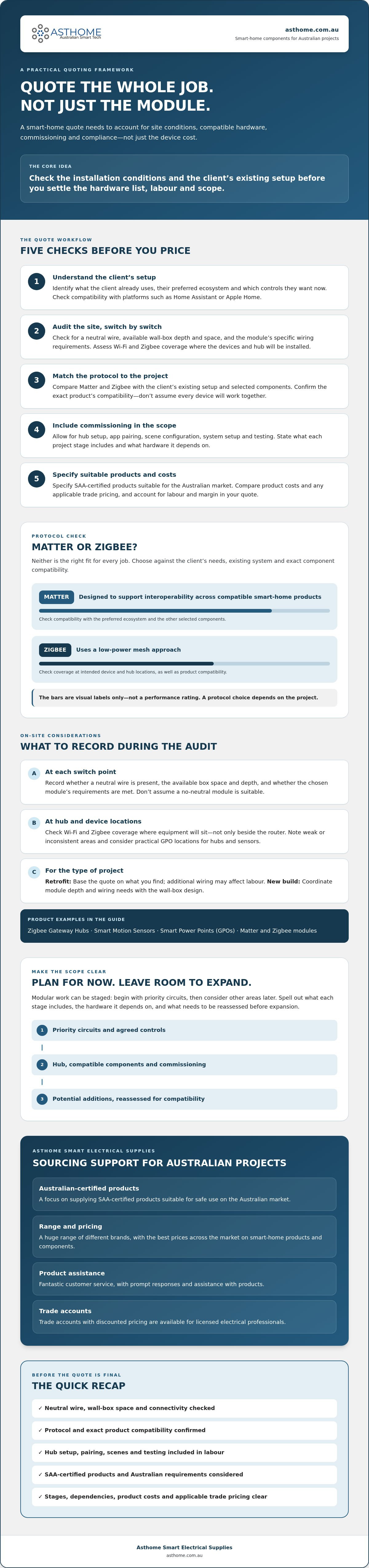
Structuring Your Quote: Compliance, SAA Standards, and Risk Mitigation
A clear quote records what you’ll supply, what you’ll install and what the client can expect at handover. For each device, name the product and protocol, such as Matter, Zigbee or Wi-Fi, and identify any hub or network dependencies. Include the SAA certification status of the specified electrical products. This helps clients understand that equipment is selected for the Australian market, rather than on purchase price alone.
Certification is an important product-selection and risk-management consideration, but don’t promise that mentioning SAA certification will protect a client’s insurance. Avoid making insurance or compliance guarantees. If a client supplies hardware, check its certification and suitability before agreeing to install it. If you can’t verify that it’s suitable for the Australian market, explain the concern and resolve it before including the product in the scope.
Compliance Documentation for the Client
Set out the records and handover documents you’ll provide, based on the work and applicable local requirements. Where a Certificate of Electrical Safety (COES) is required for the work, make its provision clear. For GPO products, identify the selected item and refer to relevant guidance, such as Asthome’s Power Point (GPO) standards guide. Precise documentation helps clients compare quotes on product suitability and scope, not just price.
Also define network responsibilities. For example: “Operation depends on the client-provided Wi-Fi network and its coverage, configuration and ongoing availability. Network issues outside the quoted scope may require separate investigation.” Tailor the wording to the actual system. This sets expectations without treating every connection issue as an installation defect.
Warranty and Post-Install Support
Separate hardware warranty information from any workmanship or labour terms you provide. Refer clients to the relevant product warranty, and clearly state what your quoted labour covers, how faults will be assessed and what falls outside the agreed scope. Don’t imply Asthome provides installation or labour warranties.
You could also decide whether ongoing smart home support suits your electrical business, but define any maintenance offer, inclusions and terms yourself. It isn’t an Asthome service. For product details, refer to the product information available through Asthome.
Before sending the quote, confirm the protocol, SAA-certified hardware, exclusions, network assumptions and documentation. This makes quoting a smart home installation for clients clearer for both parties. To browse smart home components for the Australian market, visit Asthome’s online store.
Scaling Your Business with Asthome Trade Accounts and SAA Gear
As your smart home work grows, a consistent way to source components can make product selection easier to manage. Asthome is an Australian online retailer specialising in smart home technology and electrical components, with an address in Point Cook, Victoria. Its product range includes Matter and Zigbee modules, smart switches and lighting solutions, with all products SAA certified for the Australian market.
Licensed electrical professionals with a verified trade account can access discounted trade pricing when preparing hardware costs. Check current account terms and product details as you build each parts list. Compare the product specifications with the client’s ecosystem and site conditions before adding components to your quote.
Future-Proofing Your Service Offering
Keep developing your product knowledge as client expectations and smart home options evolve. Matter compatibility can be useful to consider where it suits the client’s ecosystem and the specific devices selected. Asthome’s smart light switch guide provides further information to help compare options. Zigbee 3.0 modules offer another protocol to assess when planning a project.
For NDIS and SDA work, Asthome sells an NDIS SDA Compliant Smart Home Kit. Match any equipment to the project brief and confirm the requirements before specifying it. Asthome’s product range includes other smart home components that may suit specialised quotes, depending on the project scope.
Next Steps: Signing Up for a Trade Account
If you’re a licensed electrical contractor, review Asthome’s trade account information to check the current sign-up and verification requirements. Once verified, use the account to review available trade pricing and source components for upcoming quotes. Confirm product compatibility and SAA certification details before including items in your scope.
A clear product list, accurate costings and a repeatable compatibility check can support a more organised quoting process as your smart home work expands.
Explore Asthome Trade Account Options and browse smart home products for the Australian market.
Quoting a Smart Home Installation for Clients with Confidence
Strong smart home quotes start with a proper site audit, a clear scope and a realistic allowance for commissioning. Check the wiring and connectivity, confirm that selected devices suit the client’s ecosystem, and separate hardware, installation and setup in your pricing. These habits make quoting a smart home installation for clients more repeatable and help keep expectations clear.
Product selection matters just as much. Specify SAA-certified gear suitable for the Australian market, and confirm compatibility rather than assuming every Matter or Zigbee device will work together. Compare product details and account costs as you prepare your parts list.
Asthome sells smart home products and electrical components, including Matter and Zigbee modules, and offers discounted trade pricing to licensed electrical professionals with verified trade accounts. Its products are SAA certified for the Australian market. Review the product range and explore Asthome Trade Account options when preparing your next quote.
With a repeatable quoting process and suitable certified components, you can set out a clearer scope for your clients and your business. Keep checking compatibility, account for commissioning and make your next quote easier to assess.
Frequently Asked Questions
Do I need a special licence to quote smart home installations in Australia?
What is the risk of installing non-SAA certified smart switches?
Non-SAA-certified switches may not be suitable for use on the Australian market, creating safety and compliance concerns. Don’t assume that an overseas listing or a similar-looking product confirms certification. Check the specific product’s certification information before including it in a quote or agreeing to install client-supplied gear. Asthome states that its products are SAA certified for the Australian market. Avoid promising that certification alone guarantees insurance outcomes.
How much extra labour should I charge for commissioning a Matter hub?
There’s no universal commissioning charge that suits every Matter setup. Base your labour allowance on the actual scope: hub configuration, device pairing, compatibility checks, testing and client handover. A small, straightforward setup may take less time than a job involving multiple devices or troubleshooting an existing network. State what commissioning includes in the quote, and explain how additional work will be handled if the site conditions differ from what you assessed.
Can I install smart modules in homes without a neutral wire?
Possibly, but only if the selected module is designed for the wiring present and its product requirements are met. Check the switch point rather than assuming a neutral is available, especially in an older home. If there’s no neutral, verify the exact module’s specifications and suitability before quoting it. Don’t assume every smart module supports no-neutral installation. If the wiring or product requirements aren’t clear, investigate before confirming the scope.
Should I quote for the client’s existing Wi-Fi or suggest a dedicated hub?
Start by checking the client’s network, device locations and chosen ecosystem. Wi-Fi-connected products rely on the network conditions at their intended locations, while Zigbee products require a compatible gateway or hub. A dedicated hub isn’t automatically necessary for every system. Specify the actual devices and dependencies, assess coverage where they’ll be installed, and state any assumptions about client-provided Wi-Fi so the quote doesn’t promise performance you haven’t verified.
What happens if the client’s internet goes down after the installation?
What continues working depends on the particular devices, hub, network and automation setup. Don’t promise that every function will operate without internet access. Check product documentation and test the agreed functions during commissioning. In your quote or handover notes, distinguish internet-dependent features from any functions confirmed to work locally, and explain that outages or changes to the client’s network may affect operation. This helps set realistic expectations without assuming every device behaves the same way.
How do I handle NDIS SDA smart home quotes differently?
Build the quote around the project brief and the specific accessibility outcomes requested, rather than assuming one setup suits every resident. Confirm the required devices, functions, compatibility and responsibilities with the relevant project contacts before specifying equipment. Asthome sells an NDIS SDA Compliant Smart Home Kit, as well as products such as Smart Curtain Motors and Tracks and Smart Door Locks. Make inclusions and exclusions clear, and verify any project-specific requirements before finalising your quote.
Why is Matter considered better for quoting new builds in 2026?
Matter is designed to support interoperability among compatible smart home products, which can make it a useful option to consider for new builds where clients value flexibility across ecosystems. It isn’t automatically the best choice for every project, and compatibility depends on the specific products and setup. Check the client’s preferred platform and confirm device requirements before specifying a Matter Smart Switch Module. A clear protocol choice helps keep the scope practical and avoids promising universal compatibility.