

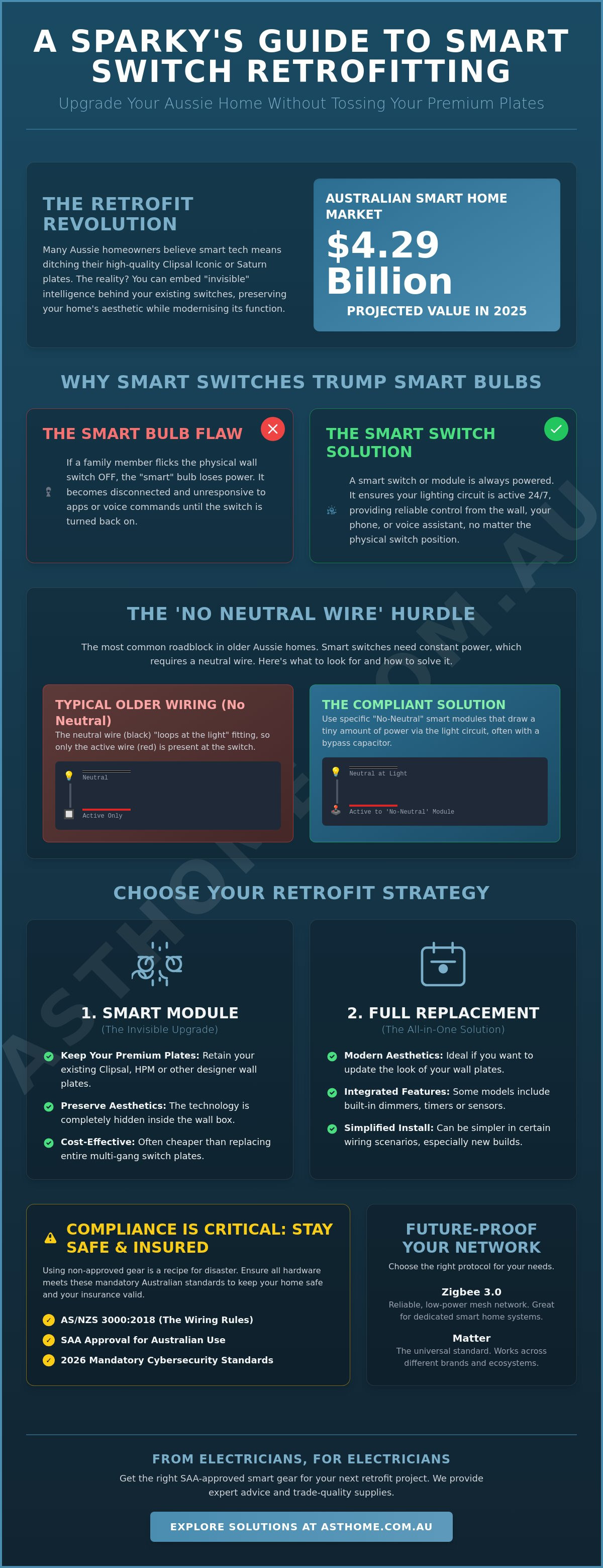
Your premium Clipsal Iconic or Saturn wall plates don't need to end up in a skip bin just because you're ready for a smarter home. Many homeowners believe that modernising their lighting means ripping out expensive hardware and risking their home insurance with dodgy, non-compliant gear. The reality is that retrofitting smart switches in australian homes has become a precision trade rather than a messy renovation. With the Australian smart home market hitting a $4.29 billion valuation in 2025, the focus has shifted toward "invisible" intelligence that respects your existing aesthetic.
We know the frustration of opening a switch bracket only to find the "no neutral wire" setup common in older Aussie properties. You want the convenience of Matter 1.5 protocols without the headache of a full rewire or breaching AS/NZS 3000:2018 standards. This guide provides a clear path to upgrading your tech while staying 100% compliant with the mandatory March 4, 2026 cybersecurity standards. You'll learn when to use discreet Zigbee modules behind your current plates and when a full switch replacement is the better move for your home.
Key Takeaways
- Discover how smart modules allow for retrofitting smart switches in australian homes while keeping your existing premium wall plates, such as Clipsal Iconic, completely intact.
- Overcome the common lack of a neutral wire in older Aussie properties using specific bypass modules and SAA-approved hardware.
- Ensure your installation meets the mandatory AS/NZS 3000:2018 standards and 2026 cybersecurity mandates to keep your home insurance valid.
- Master the site audit process to accurately measure wall box depths and gang requirements before you commit to any hardware.
- Future-proof your setup by selecting the right protocol for your needs, from the universal Matter standard to reliable Zigbee 3.0 mesh networks.
The Retrofit Reality: Why Smart Switches are the Heart of the Australian Home
Home automation has evolved beyond simple voice-activated speakers and multicoloured globes. While smart bulbs were the entry point for many, they create a fundamental conflict with your existing wall switches. If a family member flicks the switch off, the "smart" bulb loses its power and its connection. This is exactly why retrofitting smart switches in australian homes has become the preferred method for creating a truly intelligent environment. It ensures that your technology remains active 24/7, regardless of the physical switch position.
At Asthome Smart Electrical Supplies, we view lighting through a "From Electricians, For Electricians" lens. We understand that a home's electrical system needs to be bulletproof. Retrofitting isn't just about convenience; it's about building a robust infrastructure that integrates seamlessly with your existing wiring. By 2026, the shift toward professional-grade modules has allowed homeowners to enjoy the benefits of a connected home automation system without the instability of consumer-grade Wi-Fi globes. It's a permanent solution rather than a temporary fix.
Aesthetics vs. Automation: Keeping Your Clipsal or HPM Plates
Australian homes often feature high-quality fittings like Clipsal Iconic or HPM Excel Life. Replacing these with bulky, generic smart plates is a step backward in design and can even lower the perceived value of your renovation. Retrofitting allows you to keep these premium plates while tucking the intelligence into the wall box. It's a strategic move that preserves your interior styling while adding modern functionality. This "invisible" upgrade is often more cost-effective than replacing entire gangs, especially when retrofitting smart switches in australian homes across large open-plan living areas.
The Benefits of Switch-Based Control
Reliability is the core advantage of a switch-based retrofit. Physical switches offer a tactile backup that works even if your phone is charging or your internet service provider has an outage. It's a guest-friendly solution that doesn't require a manual for visitors or tradespeople. Beyond simple on-off control, modern modules offer circuit-level energy monitoring. This data is vital for managing high-draw areas and identifying efficiency gaps in your home's power consumption. It transforms your lighting from a passive utility into an active participant in reducing your quarterly electricity bills.
The Neutral Wire Hurdle and Australian Wiring Standards
The most common roadblock for retrofitting smart switches in australian homes is the missing neutral wire. In older properties, particularly those built before the early 2000s, electricians typically used a "loop at the light" wiring method. This means only the active wire runs down to the wall switch, while the neutral wire stays at the light fitting. Because smart switches are electronic devices that need constant power to stay connected to your network, they usually require that neutral wire to complete the circuit. Without it, the switch simply won't turn on.
For homes with this legacy setup, you don't need to pay for a full rewire. The "No-Neutral" solution involves using specific hardware designed to draw a tiny amount of power through the light fitting. This is often achieved using a bypass module installed at the load. These technical workarounds must strictly adhere to AS/NZS 3000:2018, known in the trade as the Wiring Rules. As we approach the November 12, 2026 deadline for the mandatory adoption of the updated standards, ensuring your hardware is compliant is more critical than ever.
Identifying Your Wiring: A Sneaky Peak Behind the Plate
If you take a sneaky peak behind your switch plate, you might see a bunch of red or white wires (actives) but no black or blue wires (neutrals) tucked into a connector. In a classic Victorian townhouse, it's almost certain you'll lack a neutral at the switch. Newer builds are more likely to have a neutral present, often because the electrician looped at the switch to make future automation easier. Regardless of what you see, you must engage a licensed sparky to confirm the configuration. They will check the relationship between your switch and the nearest GPO or lighting circuit to determine the best retrofit path.
Compliance and SAA Approval
Using non-approved gear from international marketplaces is a recipe for disaster. If a device isn't SAA Approved for Australia, it hasn't been tested against our specific voltage and safety requirements. Installing non-compliant hardware can void your home insurance instantly. If an electrical fire occurs and the investigator finds a module without a valid RCM or SAA mark, your claim will likely be rejected. Every SAA Approved smart module we supply is vetted by trade professionals to ensure it meets local safety standards. Don't risk your property for the sake of a cheap import that doesn't carry the necessary Australian certifications.
Module vs. Replacement: Choosing Your Retrofit Strategy
Choosing the right hardware is the most critical decision in retrofitting smart switches in australian homes. You'll generally face two paths: swapping the entire wall plate for a dedicated smart switch or installing a compact module behind your current "dumb" switch. While full replacements often offer a high-tech look with touch panels and LED indicators, modules are the preferred choice for those who want to keep their home's original aesthetic. They turn your existing premium plates into intelligent controllers without changing the way they look or feel.
Space is the biggest challenge for any sparky. In Australia, we typically work with standard wall brackets or plaster clips with 84mm mounting centres. Fitting a module into these spaces can be a tight squeeze. You must account for the depth of the module, the switch mechanism, and the bunch of wires tucked behind it. Choosing a slimline module is essential to ensure everything fits back into the wall box without forcing the plate or damaging the insulation on your cables. This methodical approach prevents common installation headaches and ensures the longevity of your hardware.
The Case for Smart Modules
Modules are the ultimate "behind-the-scenes" heroes. They are incredibly versatile, allowing you to convert standard toggles, dimmers, or even bell press mechanisms into smart devices. If you have a 4-gang plate in your lounge room, you can hide multiple modules behind it to control each circuit independently. This maintains a uniform look across your home. Another benefit is portability. Because the module is separate from the plate, a licensed electrician can remove it if you decide to move, letting you take your smart investment to your next property.
Matter and Zigbee: The Future of Connectivity
Zigbee 3.0 remains the workhorse of the industry because it creates a robust mesh network that doesn't clog your home Wi-Fi. It's reliable and handles large numbers of devices with ease. However, Matter 1.5 is the rising star for 2026. It allows for unified control across Apple Home, Google Home, and Amazon Alexa without needing a drawer full of different bridges. For a deeper look at this tech, check out our Matter Smart Switch Australia: The 2026 Guide to see how it fits into your future-proofing plans. Whether you choose the stability of Zigbee or the interoperability of Matter, both protocols provide a significantly better experience than standard Wi-Fi switches.
Step-by-Step: How to Plan Your Smart Switch Retrofit
Successful execution requires more than just buying a few modules; it requires a methodical approach to your property’s existing infrastructure. A disorganized rollout often leads to multiple call-out fees, which typically range from $80 to $130 across the country. By mapping out your requirements beforehand, you ensure that retrofitting smart switches in australian homes is a one-visit success for your electrical contractor. This professional standard is exactly what we champion at Asthome Smart Electrical Supplies.
The planning process follows a strict four-phase strategy. Phase one is the audit, where you document every switch gang and wall box depth. Phase two involves locking in your protocol; while Matter 1.5 is the emerging standard, Zigbee 3.0 remains the mesh workhorse for many. In phase three, you source your SAA-approved hardware from a reputable wholesaler to ensure full compliance. Finally, phase four is the physical installation. Engaging a licensed sparky who understands smart modules is essential to maintaining the safety and integrity of your home’s electrical circuits.
The Site Audit: What Your Sparky Needs to Know
Measuring the internal depth of your wall boxes is the most overlooked step in the audit. While standard Aussie mounting brackets are common, some older timber-framed homes have extremely shallow cavities that won't accommodate a standard module and a switch mechanism together. You also need to identify your specific loads. Switching a 10W LED downlight is vastly different from controlling a 1000W bathroom heat lamp or an inductive ceiling fan motor. Grouping these requirements room-by-room allows your sparky to work efficiently, potentially saving hours on labour costs, which currently average $105 per hour in states like Victoria and New South Wales.
Working with Your Electrician
Clear communication bridges the gap between traditional trades and modern technology. Some sparkies are hesitant about "smart" gear because of poor-quality imports, so show them the SAA approval marks on your hardware. Always insist on a Certificate of Compliance for Electrical Work (CCEW). In New South Wales, be aware that from July 1, 2026, all compliance certificates must be lodged digitally through the BCNSW eCert portal; handwritten forms will no longer be accepted. To streamline your project, suggest your contractor open a trade account at Asthome Smart Electrical Supplies. This gives them access to trade-only pricing and technical data sheets, ensuring they have the right information for a seamless, compliant installation.
Future-Proofing Your Home with Asthome Smart Electrical Supplies
The trajectory of the Australian smart home market points toward a valuation of up to $12.80 billion by 2034. This growth isn't just about gadgetry; it's about a fundamental shift in how we manage energy and security. When you're retrofitting smart switches in australian homes today, you must look beyond the immediate convenience. The hardware you choose needs to handle the protocol updates of the next decade. The Matter Smart Switch Module has become the cornerstone of this future-proofing strategy. By adopting Matter 1.5 standards, you ensure that your lighting control remains platform-agnostic, allowing for seamless transitions between Apple, Google, and Amazon ecosystems without hardware swaps.
Specialised requirements also demand professional solutions. We've seen a surge in demand for NDIS SDA Compliant Smart Home Kits, which provide essential autonomy for participants in Specialist Disability Accommodation. For these homes, retrofitting smart switches in australian homes is a matter of accessibility and safety. By integrating these modules with our smart curtain motors and motion sensors, we help create living spaces that respond intuitively to the user. This level of integration requires trade-certified gear that won't fail when it's needed most.
The Asthome Smart Electrical Supplies Advantage: From Electricians, For Electricians
Our commitment to the industry is rooted in our Point Cook headquarters, where we provide local technical support that understands the unique pressures of the Aussie trade. We don't just supply parts; we rigorously test our Zigbee and Matter modules against local thermal loads and voltage spikes. This "From Electricians, For Electricians" philosophy ensures that every piece of gear is optimized for our specific wiring rules. By building your ecosystem with Asthome Smart Electrical Supplies, you gain access to a cohesive range of smart GPOs, dimmable LED drivers, and sensors that work together out of the box.
Getting Started Today
Before you begin your installation, ensure you have a final checklist ready for your sparky. Verify your wall box depths, confirm your load types, and decide on your primary protocol. If you're managing multiple properties or large-scale renovations, setting up a trade account is the most efficient way to access discounted pricing and priority technical data. Start with a single room or a high-traffic area to experience the reliability of SAA-approved hardware firsthand. When you're ready to commit to a full-home upgrade, Browse our SAA-approved Smart Switch Modules to find the exact hardware needed for your specific wiring configuration. Investing in quality today prevents the costly rewires of tomorrow.
Take the Guesswork Out of Your Home Automation
Retrofitting smart switches in australian homes doesn't have to be a technical headache or a risk to your home insurance. By choosing SAA-approved in-wall modules, you maintain the premium look of your existing Clipsal or HPM plates while gaining the Matter 1.5 compatibility required for a 2026 smart home. It's the most reliable way to ensure your lighting works every time, even if the internet drops out. Always remember that your installation must meet AS/NZS 3000:2018 standards and be signed off by a licensed electrician with a valid certificate of compliance.
Our team in Point Cook is ready to help you navigate the technical specs of Zigbee and Matter protocols. We offer trade pricing for licensed sparkies and expert advice rooted in our "From Electricians, For Electricians" heritage. You can trust that every module we sell is strictly SAA Certified for Australian Safety Standards, giving you peace of mind in a high-stakes industry. Start your journey with hardware that is built for local conditions and future-proofed for years to come.
Upgrade your home today with Asthome’s SAA-approved Smart Modules and transform your living space with confidence.
Frequently Asked Questions
Do I need a licensed electrician to install smart switches in Australia?
Yes, you must hire a licensed electrician for any smart switch installation. Under the AS/NZS 3000:2018 standards, all mains voltage electrical work in Australia is restricted to qualified professionals. Your sparky must provide a Certificate of Compliance for Electrical Work (CCEW) to ensure the installation is safe and legal. DIY electrical work is illegal and can lead to significant fines or dangerous outcomes.
Can I retrofit smart switches if I don’t have a neutral wire?
You can definitely succeed at retrofitting smart switches in australian homes without a neutral wire by using specific no-neutral modules or bypasses. These devices draw a tiny amount of power through the light fitting itself to keep the smart tech active. This is a common solution for older Victorian era homes where only the active wire runs to the wall switch bracket.
Will my existing light switches still work if the internet goes down?
Your lights will still function via the physical wall switch even if your internet connection fails. Local protocols like Zigbee 3.0 and Matter 1.5 allow devices to talk to each other within the home without a cloud connection. You only lose remote app control and voice commands; the tactile switch remains 100% reliable for everyone in the house.
What is the difference between a smart switch and a smart module?
A smart switch is a complete replacement of your wall plate, while a smart module is a small device that sits behind your existing switch. Modules are the preferred choice for retrofitting smart switches in australian homes because they allow you to keep your premium Clipsal or HPM plates. This maintains your home's aesthetic while adding full automation behind the scenes.
Are smart switches compatible with all types of LED downlights?
Most smart modules are compatible with standard LED downlights, but you must match the dimming technology to your globes. Ensure your module supports trailing edge dimming if your LEDs require it for smooth operation. For non-dimmable LEDs, a standard smart relay module works perfectly for simple on/off control without any flickering issues.
How many smart switches can I have on one Zigbee gateway?
A standard Zigbee gateway hub can typically manage between 50 and 128 devices depending on the specific hardware model. Because Zigbee is a mesh network, every mains powered device, such as a smart GPO or switch module, acts as a repeater. This extends the signal range and improves the stability of your entire home network as you add more devices.
Does retrofitting smart switches void my home insurance?
Retrofitting smart switches will not void your home insurance as long as the hardware is SAA Approved for Australia and installed by a licensed professional. Using cheap, non-certified imports from overseas marketplaces is what puts your policy at risk. Always look for the Regulatory Compliance Mark (RCM) on your gear to ensure it meets local safety regulations.
What is Matter, and do I need it for my Australian home retrofit?
Matter is the universal smart home standard, with version 1.5 being the benchmark for 2026. It allows devices from different brands to work together seamlessly without specific hubs. You don't strictly need it for a functional home, but choosing Matter compatible modules is the best way to future-proof your setup against changing technology and ecosystem shifts.