

What if a suitable smart home product still leaves a gap in your compliance or insurance checks? Smart home electrical compliance Australia involves more than choosing connected hardware. Installers also need to confirm the requirements that apply to the work and understand what their insurance policy says.
It’s understandable to want clear answers before specifying or installing a smart switch, dimmer or other connected device. Requirements can vary between states and territories, while policy terms depend on the insurer and cover you hold. This guide explains what to check, what to ask your regulator and insurer, and which records to keep from product selection through to handover.
Managing risk means checking three distinct areas: product suitability and certification information, compliant installation work, and insurance cover. Asthome supplies smart home products for the Australian market and states that all its products are SAA certified. Check that information alongside the product details, but remember it doesn’t replace confirming suitability for the job or compliance of the installation. Asthome is a product supplier, not an electrical installer or insurance adviser.
Key Takeaways
- For smart home electrical compliance australia, check product suitability, installation requirements and insurance as separate parts of the job.
- Confirm which current standards and electrical safety requirements apply in your state or territory before work begins.
- Ask your insurer or broker how policy definitions apply to your work, and whether public liability, product liability or professional indemnity is relevant.
- Keep an ordered record of product details, site checks, testing and handover so key decisions are easier to trace.
- Check certification evidence, specifications, compatibility and supplier information when choosing products. Asthome supplies smart home products for the Australian market, but does not carry out installations.
Why smart home electrical compliance matters to Australian installers
Smart home electrical compliance in Australia involves three separate checks: whether a product suits the job, whether the installation follows applicable requirements, and whether the relevant insurance policy responds to the work. Smart controls add new functions, but they don’t remove ordinary electrical safety responsibilities. Check the current rules and guidance for the state or territory where you’re working.
Keep these checks distinct. Product certification or other compliance evidence relates to the product. It doesn’t prove that a particular installation is suitable or compliant. Correct installation doesn’t establish what an insurance policy covers, either. Standards Australia develops Australian Standards, but whether a standard applies to a specific job depends on the relevant requirements and circumstances. Standards Australia provides background on the organisation and its role.
What installer liability can involve
Installer liability is the potential responsibility for loss or damage connected with installation work. For example, a property owner might allege that an installation caused property damage, requires rework, or didn’t deliver the agreed outcome. An allegation doesn’t by itself establish responsibility or mean a claim will be covered. The facts, contracts, applicable law and policy wording all matter.
Keep clear records of the agreed scope, product selection, work completed, test results and handover. These records can help explain what was specified and done if an outcome is later disputed. For advice about a particular situation, speak with a qualified adviser rather than relying on a general guide.
Why smart home work adds checks
Connected modules, switches and controls still need to suit the intended installation. Confirm the product’s specifications and current certification information, then check compatibility with the installation and other equipment. A device communicating over Matter, Zigbee or Wi-Fi describes its connectivity. It doesn’t, by itself, establish electrical safety or confirm that installation requirements have been met.
Asthome Smart Electrical Supplies states that its products are SAA certified for the Australian market. Check the details for the specific product and its suitability for the job. Certification doesn’t guarantee that an installation is compliant, that insurance applies or that a claim will be accepted. Asthome supplies products, not electrical installation services.
For switch-specific considerations, see the Australian smart light switch guide. Use it for product context, then confirm the requirements that apply to your installation and location.
How Australian electrical compliance and smart product certification differ
For smart home electrical compliance in Australia, keep three questions distinct: what the product documentation supports, what the installation requires, and what an insurance policy says. Evidence in one area doesn’t settle the others. Requirements can vary by state or territory, so check current regulator guidance for the location and scope of work.
| Check | What it relates to | What to verify |
|---|---|---|
| Product documentation | The specific device and its documented suitability | Model identity, current certification information, ratings and intended application |
| Installation requirements | The work carried out at the site | Applicable state or territory requirements, current regulator guidance and relevant standards |
| Insurance policy terms | The cover provided under a particular policy | Definitions, exclusions and conditions with your insurer or broker |
AS/NZS 3000 may be relevant to electrical installation work. Confirm the current edition and its application to the specific job rather than relying on an old reference or assuming it applies in the same way everywhere. The EESS sets out essential safety requirements for electrical equipment. Use current official guidance to understand the product safety criteria relevant to your check.
What to check in product documentation
Start with the exact model being specified, not just a product family or a similar-looking device. Use current manufacturer or supplier records to confirm its certification information and intended application. Then compare the documented ratings and compatibility information with the job requirements. Don’t infer specifications from a device’s appearance, connectivity protocol or a similar model’s details.
Record the product identity and the documentation version you relied on. This gives you a traceable reference if the specification changes or questions arise at handover. Asthome states that its products are SAA certified for the Australian market. Check the current details for the specific product and confirm it suits the intended installation.
What product certification does not establish
SAA certification is a product-level check. It doesn’t replace installer competence, a site assessment or verification of the requirements applying to the work. Nor does it establish that an insurer will accept a claim, that every installation is compliant, or that a particular outcome is guaranteed. Those questions need separate checks, including a review of relevant requirements and policy wording.
If the work involves a power point, the Australian GPO standards reference guide may provide useful product context. For Australian-market smart home products and product information, browse Asthome’s smart home range.
Comparing insurance questions for smart home electrical installers
Insurance is a separate check in smart home electrical compliance australia. A product’s certification and a compliant installation don’t determine what an insurance policy covers. Policy labels can also mean different things between insurers, so treat public liability, product liability and professional indemnity as topics to discuss with your broker or insurer, not as universal requirements.
Describe the work you actually do, including whether you supply products, complete installations, use subcontractors, or provide design, specification, programming or advice. Ask for answers that refer to your policy wording and, where possible, request written clarification.
| Potential exposure | Question to ask | Policy wording to review |
|---|---|---|
| Accidental property damage associated with installation work | How does the policy treat damage connected with work at a customer’s property? | Definitions of covered work, exclusions, limits and notification timeframes |
| A concern involving a product you supplied or work you completed | Are supplied products, completed work and subcontracted work treated differently? | Relevant definitions, exclusions, conditions and any distinctions between these activities |
| An allegation of financial loss linked to design, specification, programming or advice | Would these activities fall within the policy, and how are alleged financial losses treated? | Professional services definitions, exclusions, limits and notification requirements |
Questions to ask about public and product liability
Give the insurer a clear example of your work, then ask how the policy treats accidental property damage associated with installation. Check whether supplying a smart home product, installing it and engaging a subcontractor affect the response differently. Ask which exclusions, limits and notification timeframes apply. Don’t assume a product-related concern or completed-work issue is covered simply because a policy has a familiar label.
When professional indemnity may need discussion
If your work includes design, specification, programming or technical advice, ask whether those activities fall within the policy’s definition of professional services. Clarify how alleged financial loss is treated and which exclusions apply. The answer depends on the policy wording and your circumstances. A broker or insurer can help assess whether a policy type is relevant. Don’t rely on a general guide to choose cover or a coverage amount.
Keep the questions, responses and applicable policy documents with your business records. That way, you can revisit the advice when your work changes or a policy is renewed. If you’re a verified licensed electrical professional, you can explore Asthome trade account information for access to trade account pricing on smart home products.
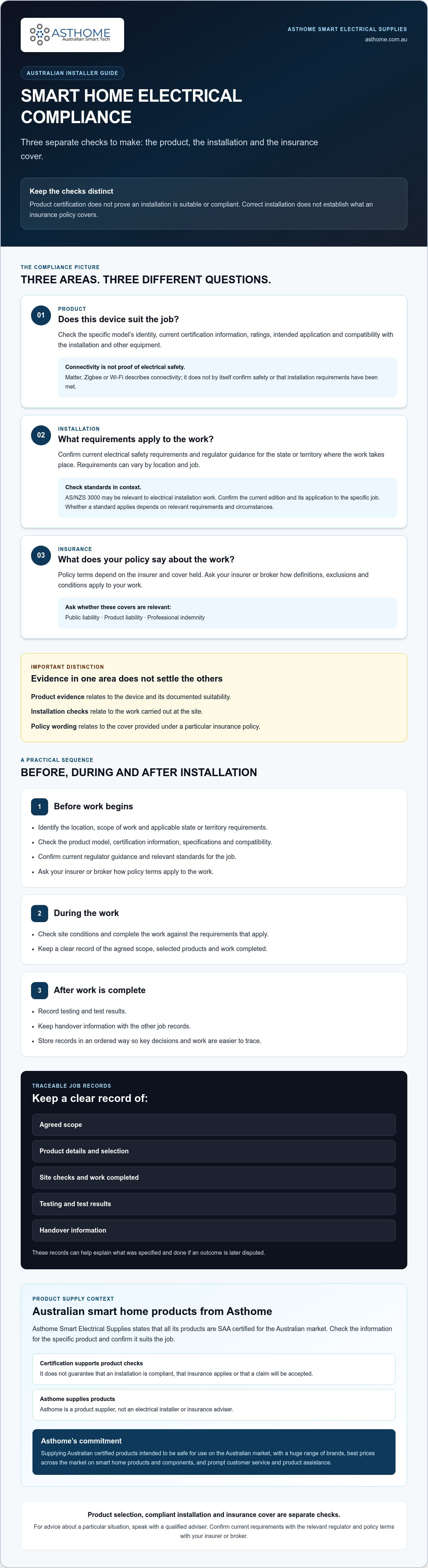
A practical compliance and insurance checklist before and after installation
A consistent job process makes it easier to identify what’s confirmed, what needs checking and what should be recorded. Use this checklist as a starting point for smart home electrical compliance australia, then confirm current requirements for your state or territory with its electrical regulator and qualified advisers.
Before work begins
- Confirm the scope. Agree with the client on the work, intended functions and expected handover. Note any design, specification or programming activities included in your role.
- Identify the product. Record the exact model and review current manufacturer or supplier documentation. Check the documented application, ratings and compatibility against the job rather than relying on a similar model’s details.
- Assess the site. Check the conditions relevant to the proposed work. If you find an issue that needs further assessment, clarify it before proceeding and document the decision.
- Check local requirements. Confirm the applicable standards, regulator guidance and any state or territory obligations for this work. Seek qualified advice where the requirement or its application isn’t clear.
- Review insurance scope. Describe the work accurately to your broker or insurer. Confirm relevant policy conditions, exclusions and notification requirements, and keep any written clarification with the job records.
Testing, handover and record keeping
- Record the work completed. Follow your established process to document the installation, relevant checks and any deviations from the agreed scope. Note unresolved issues and the actions taken or agreed.
- Complete and record applicable checks. Use the methods and documentation required for the specific work and jurisdiction. Don’t substitute a generic checklist for current regulatory requirements.
- Prepare the handover. Provide relevant product information and clear operating guidance. Explain any agreed follow-up actions and make sure the client understands what remains unresolved.
- Keep a traceable job file. Retain product records, installation and testing notes, handover details, client communications and relevant insurer correspondence. Follow verified legal and contractual retention requirements. Don’t assume one retention period applies to every job.
In short: keep routine job records consistently, then verify jurisdiction-specific duties, forms and retention periods with the relevant regulator or qualified adviser. A tidy file supports traceability, but it doesn’t replace compliance or determine insurance cover.
Asthome states that its smart home products are SAA certified for the Australian market. Check the current information for the product you’re specifying, then confirm its suitability for the job. Explore Asthome’s smart home products.
Choosing compliant smart home products and next steps for installers
Choose products by matching their documented specifications to the job, then verify current certification information and compatibility. Asthome’s range covers more than connected switch modules: it includes dimmers, Wi-Fi light switches, curtain motors and tracks, door locks, gateway hubs, sensors, LED drivers and smart power points. The range also includes an NDIS SDA Compliant Smart Home Kit. These product categories offer options to consider across different smart home projects, but no product should be assumed to suit every installation.
Supplier checks that support a documented job
Before specifying or ordering, confirm the exact product model and review its current certification details in manufacturer or supplier records. Check documented ratings, intended application and compatibility against the job requirements. Keep a copy or clear reference to the documentation used so the selection can be traced later.
Asthome states that all its products are SAA certified for the Australian market. Verify the current details for the specific item you’re considering. Compare product information and pricing for the options relevant to your job, and assess each item against its specifications and suitability rather than relying on general claims. Verified licensed electrical professionals can check eligibility for trade accounts.
A clear next step for installers
Match the device to the job using verified specifications, confirm compliance questions with the relevant state or territory regulator, and raise insurance questions with your broker or insurer. Keep the information you relied on with the job file. Asthome supplies products, not electrical installation services.
Ready to compare options for an upcoming job? Browse Asthome smart home products and check current product details before specifying or ordering. Verified licensed electrical professionals can also enquire about trade accounts.
Make your next smart home installation easier to verify
Strong smart home electrical compliance australia practice depends on keeping product checks, installation requirements and insurance questions distinct. Confirm current product documentation and suitability for the job, check the requirements that apply in your state or territory, and discuss your work with your insurer or broker. Keep clear records from specification through to handover.
Asthome states that all its products are SAA certified for the Australian market. Check the current documentation for the specific product you plan to use, as certification alone doesn’t confirm installation compliance or insurance cover. Asthome supplies smart home products, including Matter and Zigbee modules, but doesn’t carry out electrical installations. Verified licensed electrical professionals can enquire about trade accounts.
Explore smart home products from Asthome. Check the product information for your intended application and confirm each part of the job before specifying or ordering.
Frequently Asked Questions
Does SAA certification mean a smart home installation is compliant in Australia?
No. SAA certification relates to the product, not every part of the installation. Check the current certification information for the exact model, then assess whether the product suits the job and confirm the installation requirements that apply in your state or territory. Certification doesn’t establish installer competence, prove the work is compliant or guarantee insurance cover. Asthome states that its products are SAA certified for the Australian market, but check the current documentation for the specific product.
Do smart home installers in Australia need public liability insurance?
There isn’t one answer that applies to every installer and job. Requirements may depend on your state or territory, licence or contractor circumstances, contracts and site access conditions. Check with the relevant electrical regulator and review any client or site requirements. Ask a qualified insurance broker or insurer what cover is appropriate for your activities. Don’t rely on a general guide to establish whether a policy is legally required or suitable for your work.
Does public liability insurance cover damage caused by a smart switch installation?
It depends on the policy wording and circumstances, so don’t assume damage associated with a smart switch installation is covered. Ask your insurer how the policy treats accidental property damage arising from installation work, and whether completed work, products you supply or subcontracted work are treated differently. Request clarification about relevant exclusions, limits and notification timeframes. Keep the response with your policy records, and seek advice from your broker or insurer about your specific situation.
Can product liability insurance cover a fault in a smart home device?
It may be relevant to discuss, but whether a policy responds to a device fault depends on its wording and the facts of the claim. Ask your broker or insurer how the policy defines product-related claims, including any distinction between a product you supplied and work you performed installing it. Check exclusions, conditions and notification requirements. Product certification alone doesn’t determine insurance cover or guarantee that a claim will be accepted.
What insurance should an Australian smart home installer ask a broker about?
Ask whether public liability, product liability or professional indemnity is relevant to your actual work, rather than assuming a particular combination is required. Explain whether you install equipment, supply products, use subcontractors, or provide design, specification, programming or advice. Ask how the policy defines those activities, what exclusions apply and how alleged property damage or financial loss is treated. A broker or insurer can discuss your circumstances; this guide can’t recommend a policy type or coverage amount.
What records should an installer keep after fitting smart home electrical products?
Keep a clear job file with the agreed scope, exact product model, current product documentation used, work completed, relevant checks and test results, and any deviations or unresolved matters. Include client communications and handover information, such as product details and operating guidance provided. Retain records and insurer correspondence according to verified contractual and legal requirements that apply to your work. Confirm any required forms or timeframes with the relevant regulator or a qualified adviser.
Do electrical compliance requirements differ between Australian states and territories?
They can. Requirements and regulator guidance may depend on where the work is carried out, so confirm current information with the electrical regulator for the relevant state or territory. Check which standards and current editions apply to the specific work, rather than assuming a rule or reference is identical nationwide. If you’re unsure how a requirement applies, seek qualified advice before proceeding. This helps you assess the job against the right local requirements.