

What if smart home training is only half the job? Electricians need more than a vendor demonstration to deliver reliable projects. They also need practical experience and a clear understanding of the smart home supplies for electrical contractors that suit the system, the installation and the Australian market.
It’s understandable to be unsure where to start. Formal courses, product demonstrations and hands-on practice each build different skills, while Matter, Zigbee and Wi-Fi can raise questions about compatibility and system choice. This guide maps out a practical learning pathway, so you can compare training options against the capabilities smart home work demands.
You’ll also learn what to check before specifying products, including compatibility information and Australian-market safety and compliance details. We’ll look at examples such as Matter Smart Switch Modules, Zigbee 3.0 Smart Switch Modules, dimmers and sensors, and explain how a specialist supplier can help with product questions. Asthome Smart Electrical Supplies offers a broad range of smart home products and components, states its products are SAA certified for the Australian market, and provides verified trade accounts for licensed electrical professionals. Training builds capability; product literacy helps put it to work.
Key Takeaways
- Build on device configuration skills with the broader planning, installation and commissioning capabilities smart home projects require.
- Use a structured learning checklist covering electrical safety, system design, device compatibility and commissioning.
- Compare courses, product demonstrations, peer learning and supervised practice by their hands-on content, assessment and follow-up.
- Progress from foundational knowledge to supervised jobs, then review completed projects to identify skills to strengthen.
- When assessing smart home supplies for electrical contractors, check intended use, compatibility, product documentation and certification evidence before purchasing.
Why smart home installation training matters for Australian electricians
Knowing how to configure an app isn’t the same as being able to plan and deliver a smart home installation. Connected lighting, switches, sensors and controls bring extra considerations, from choosing devices that work together to commissioning the system and explaining its operation to occupants. The broader idea of home automation includes connected devices working together, not just individual gadgets responding to an app.
For electricians, smart home installation training can help bridge that gap. This guide compares learning pathways and the skills they can build; it doesn’t provide training or certify electricians. A useful goal is being able to assess a project, select compatible products, complete work within applicable requirements, then test and document the system clearly.
Which smart home skills are electricians looking to build?
Practical capability spans electrical work and connected-system tasks. These are related, but they aren’t interchangeable: electrical installation competence doesn’t automatically cover app setup, and app familiarity doesn’t replace the skills or permissions required for electrical work.
- Commissioning: Pair devices, configure intended functions and check that controls respond as planned.
- Network basics: Understand how devices communicate with a network or gateway, and recognise when a wireless connection may be affecting performance.
- Compatibility checks: Review product documentation and confirm that devices, gateways and the intended control platform are suitable for the proposed setup.
- Fault-finding: Work through likely causes across the device, gateway and wireless connection rather than assuming every issue is a wiring fault.
- Occupant handover: Explain everyday controls and provide clear records of relevant settings and system information.
These skills help electricians make better use of smart home supplies for electrical contractors, because product selection is only one part of delivering a functioning system.
What should a practical training outcome look like?
Look for demonstrable tasks, not a vague promise to become a smart home expert. A learner should be able to interpret product documentation, check compatibility, commission a suitable setup, test its operation and record settings for handover. Practice should also build a methodical approach to fault-finding, including identifying when an issue sits outside the electrical installation.
Keep the boundaries clear. Applicable qualifications and permissions depend on current requirements in the relevant Australian state or territory, so verify them locally before undertaking work. When selecting products, check the documentation and certification evidence for the specific item. Asthome is an Australian smart home supplies retailer, not a training or installation provider; its product assistance can help electricians with product questions.
What smart home installation training for electricians should cover
A practical curriculum should connect established electrical skills with the extra decisions involved in connected systems. Cover electrical safety and applicable requirements, then build through system design, device compatibility, commissioning and handover. Training should also teach learners to consult current standards, approvals and state or territory requirements rather than rely on memory or assumptions.
Product selection belongs in that process. Electricians need to read product documentation, locate ratings and installation instructions, and check certification evidence for the exact item under consideration. Category names alone don’t confirm that a product suits a particular installation or the Australian market. Treat each device as its own specification to verify.
Protocols, ecosystems and compatibility
Matter and Zigbee are different communication approaches, not guarantees that every device will work with every other device. Training should build a repeatable compatibility check: confirm the device’s protocol, the hub or gateway it requires, the available network and the intended platform. A Matter Smart Switch Module and a Zigbee 3.0 Smart Switch Module, for example, call for different compatibility questions. For a focused protocol overview, see this Matter smart switch guide.
System design should start with the project brief, not a preferred brand or protocol. Map the required functions, identify which devices need to communicate, and check the manufacturer’s documentation before specifying. Electricians developing their professional knowledge can also consult NECA, the peak industry body for electrical contractors in Australia, for information about its industry role and support.
Safety, product documentation and commissioning
Teach learners to find and interpret the information that supports a sound product decision. Check the exact product’s ratings, installation instructions, compatibility notes and certification evidence. Verify that the documentation is current and relevant to the Australian market; don’t infer suitability from a similar model or a broad product category.
- Before installation: Confirm the proposed device matches the project requirements and applicable local requirements.
- During commissioning: Test intended functions and connections, then record relevant settings and any key system details.
- At handover: Explain everyday operation to the occupant and leave clear records for future troubleshooting.
- When fault-finding: Follow a consistent sequence across the device, gateway, network and platform, documenting what has been checked.
These checks help turn smart home supplies for electrical contractors into a considered specification rather than a guess. Asthome says its products are SAA certified for the Australian market, but electricians should verify the evidence for the exact product. If you’re comparing categories or product information, explore Asthome’s smart home supplies and contact its team for product assistance.
How to compare smart home training options and providers
Different learning formats solve different gaps. A formal course may offer structured content and assessment, while a manufacturer or supplier demonstration can explain a particular product or platform. Peer learning draws on job experience; supervised project practice lets you apply skills to realistic installation and commissioning tasks. A demo can build product familiarity, but it doesn’t replace formal qualifications, required approvals or work permissions.
Compare the options against your current experience and the work you want to take on. Check that content is current, relevant to Australian work and clear about prerequisites. The table is a starting point: delivery and assessment vary between providers, so confirm what’s actually included.
| Learning format | Audience | Practical component | Assessment | Product neutrality | Follow-up support |
|---|---|---|---|---|---|
| Formal course | Those seeking structured foundations or broader knowledge | Check whether exercises include design, commissioning or troubleshooting | Ask how learning is assessed and what evidence you receive | Confirm whether content covers multiple systems or centres on a particular platform | Check access to updated materials or further support |
| Manufacturer or supplier demonstration | Electricians with a defined product or system question | May focus on setup and product operation; verify whether there’s hands-on practice | Ask if skills are assessed or the session is demonstration-only | Usually product-specific; clarify any limitations | Confirm whether product questions can be followed up |
| Peer learning | Electricians learning from colleagues’ job experience | Can share practical approaches and fault-finding lessons | Often informal; agree how to check understanding | Depends on the group’s experience and systems used | Depends on ongoing contact with peers |
| Supervised project practice | Learners ready to apply skills with guidance | Can involve realistic commissioning and troubleshooting tasks | Ask who reviews the work and how feedback is recorded | Depends on the project and specified products | Confirm whether review continues beyond the exercise |
Match the format to your next skill gap
If you’re new to connected systems, start with foundational learning that explains system design and compatibility. If you already understand the basics, choose a focused session for a specific platform or device. For hands-on development, look for realistic commissioning and fault scenarios, not just a product walkthrough. The right pathway depends on what you need to do next.
Questions to ask before enrolling or attending
Ask who delivers the learning and what relevant trade experience they bring. Confirm prerequisites, delivery format, assessment method, materials, updates and any product or platform limitations. If a provider claims recognition or compliance, ask how you can verify it independently. Also check whether the format offers evidence of learning or simply attendance.
Use these questions to assess whether training will help you specify and work confidently with smart home supplies for electrical contractors, while keeping product knowledge separate from formal trade requirements.
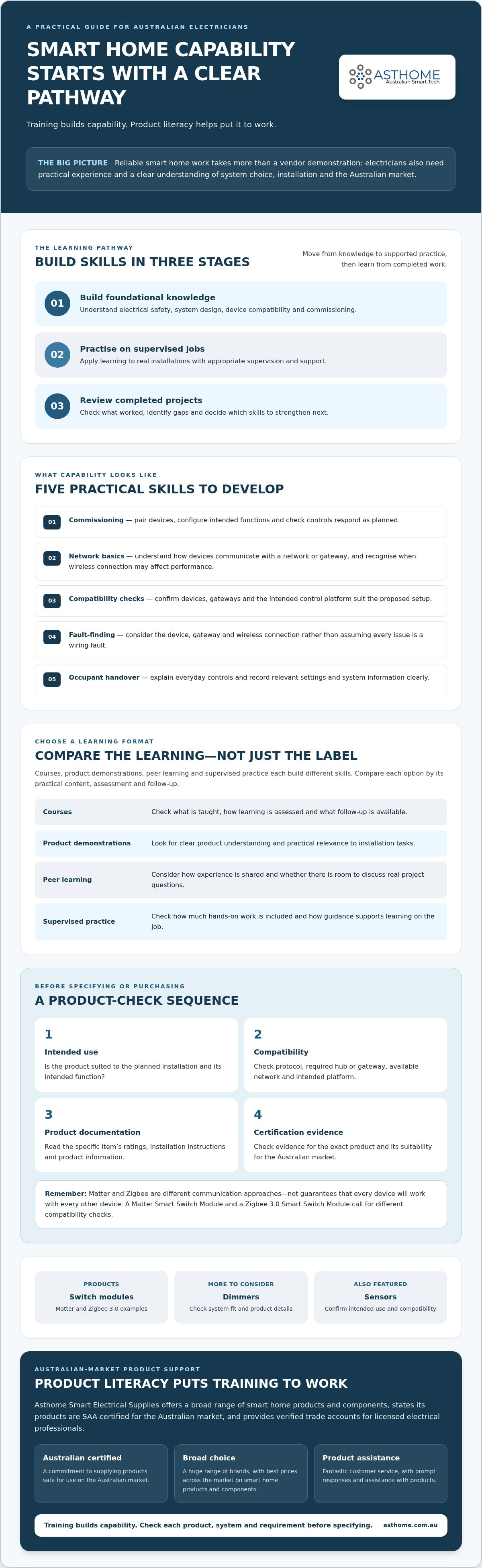
Build a practical smart home learning pathway around real jobs
Build skills in stages, using real project needs to decide what to learn next. A sample brief might be a household seeking connected lighting in a living area, with convenient control and a motion sensor. It doesn’t dictate a particular product or system. The task is to clarify the occupants’ needs, assess options and verify compatibility before proposing a design.
A step-by-step development plan for smart home work
- Set a baseline. Identify the types of jobs you want to handle, the skills you already use confidently and the technologies or tasks that are unfamiliar.
- Choose targeted learning. Match a course, product session or peer discussion to a specific gap, such as understanding a protocol or planning device interactions.
- Practise with documentation. Use suitable equipment and manufacturer information to compare supported functions, compatibility and installation requirements. Check certification evidence for the exact product, not just its category.
- Apply learning under supervision. Work through the project brief with appropriate oversight. Recheck product information as the design develops, then document commissioning and test the agreed functions.
- Review the job. Record troubleshooting steps, unresolved questions and customer feedback. Use those notes to set your next learning priority, and revisit them as products and systems change.
At every stage, return to the brief: does the proposed combination of devices, gateway and control platform meet the occupant’s needs? Keep a record of checks and decisions, including any points that need confirmation before work proceeds. That makes project review useful, rather than a quick look back once the job is finished.
Use smart home supplies as learning tools
Compare product categories to practise asking the right questions, not to assume they’re interchangeable. For example, review a Matter module, a Zigbee module and a smart light switch against the brief. Check each listing and its product documentation for supported functions, compatibility information and certification evidence. Asthome says its products are SAA certified for the Australian market; verify the evidence for the specific product you’re considering.
For category-focused reading, use Asthome’s smart light switch guide and Zigbee module retrofit guide as product-learning references. They can help you frame questions to check against current product documentation, rather than replace it.
Ready to compare product categories for your next learning project? Explore smart home supplies for electrical contractors from Asthome, an Australian retailer that offers product assistance and verified trade accounts for licensed electrical professionals.
Choose Australian-market smart home supplies and plan your next step
Start with the job, not the catalogue. Confirm what the occupant needs, how devices should work together and what to verify before specifying. Check the exact model and its documentation, as a product that suits a category may not suit every system or installation.
What to check when sourcing smart home supplies
- Intended use: Match supported functions to the project brief and occupant’s requirements.
- Compatibility: Check the device, hub or gateway, network and intended platform together.
- Product documentation: Review model-specific instructions, ratings, installation conditions and compatibility details.
- Certification evidence: Verify evidence for the exact product and its suitability for the Australian market.
- Supplier support: Ask for prompt product assistance if compatibility or listing details need clarification.
Keep a record of your checks and documents. It gives you a useful reference for commissioning, handover and future troubleshooting.
How Asthome Smart Electrical Supplies can support product selection
Asthome Smart Electrical Supplies is an Australian smart home supplies retailer, not an installation or training provider. Its range spans different brands and includes Matter and Zigbee modules, smart switches, lighting products and other connected devices. Asthome Smart Electrical Supplies states its products are SAA certified for the Australian market; verify the evidence for each product. When sourcing smart home supplies for electrical contractors, finding competitive rates is essential to protect project margins.
Licensed electrical professionals can access discounted pricing through verified trade accounts. Asthome Smart Electrical Supplies also highlights prompt customer service and product assistance. Explore Australian-market smart home supplies and trade account options.
Turn smart home knowledge into confident project work
Smart home capability grows through a mix of relevant learning, hands-on practice and careful review. Choose training that matches the skills you need, then apply it to real project tasks such as checking compatibility, interpreting documentation, commissioning devices and handing over clear records. Keep verifying current requirements and product details as systems evolve.
Choosing smart home supplies for electrical contractors calls for the same considered approach. Check the intended use, supported systems and certification evidence for the exact product. Asthome states its products are SAA certified for the Australian market, and electricians should verify product-level evidence before specifying. Licensed electrical professionals can access verified trade accounts, and Asthome highlights prompt customer service and product assistance for questions.
Ready to review product options and trade account access? Explore Australian-market smart home supplies and trade account options. Take the next step at your own pace, and keep building practical skills job by job.
Frequently asked questions
Do electricians need specific training to install smart home devices?
It depends on the work and the applicable state or territory requirements. A short product course doesn’t automatically change an electrician’s existing scope or authorisations. Before starting, check current regulator guidance, relevant qualifications and the device instructions. Training can build knowledge of protocols, commissioning and troubleshooting, but it isn’t a substitute for required electrical qualifications or approvals. Confirm what applies to the specific work and location.
What should smart home installation training for electricians cover?
Useful training connects system concepts with practical trade tasks. Look for coverage of protocols, device and hub compatibility, product documentation, safety, commissioning, fault-finding and customer handover. Practical exercises help show whether you can apply the material, rather than just recognise the terminology. Review the course outline and assessment details before committing, and look for specific learning outcomes instead of broad promises such as “smart home expert” or “future-ready”.
Is Matter better than Zigbee for smart home installations?
Neither is automatically the better choice for every project. The right fit depends on the devices, hubs, platforms and functions the customer needs, plus what the product documentation supports. Check compatibility across the specific products being considered; a protocol name alone doesn’t guarantee devices will work together. Good training teaches you how to assess those factors and verify a proposed setup, rather than recommending one protocol for every job.
Can a product demonstration count as electrician training?
A demonstration can help you understand a particular product’s features and setup, but it may not cover broader system design, electrical requirements or formal assessment. Ask who delivers it, which skills it teaches and whether you’ll get hands-on practice. Treat supplier demonstrations as product familiarisation unless the provider clearly documents a formal training outcome and any relevant recognition. A demonstration doesn’t replace qualifications or approvals required for the work.
How can electricians check whether smart home supplies are suitable for Australia?
Review the exact product listing and manufacturer documentation. Check its certification evidence, ratings, installation instructions and supported systems rather than relying on a similar model or general category claim. Asthome states its products are SAA certified for the Australian market, but electricians should still confirm evidence for the specific item they intend to specify. These checks help assess whether smart home supplies for electrical contractors suit the project and intended system.
Do smart home suppliers provide installation training for electricians?
Some suppliers may offer product information or demonstrations, but the format and learning outcomes vary. Ask whether a session covers general installation skills or focuses on a particular product, and confirm whether it includes hands-on work or assessment. Asthome is an Australian smart home supplies retailer that offers product assistance. It isn’t an electrical installation or training provider, so check with each supplier directly about any learning options they offer.
Can electricians get trade pricing on smart home supplies?
Asthome offers discounted pricing through verified trade accounts for licensed electrical professionals. Check directly with the retailer for current eligibility, account requirements and terms. Compare products on their documentation, compatibility and certification evidence as well as purchasing arrangements. Trade account access doesn’t mean training, installation support or other services are included, so confirm what the supplier provides. Contact Asthome’s customer service for product assistance or questions about its trade account options.