

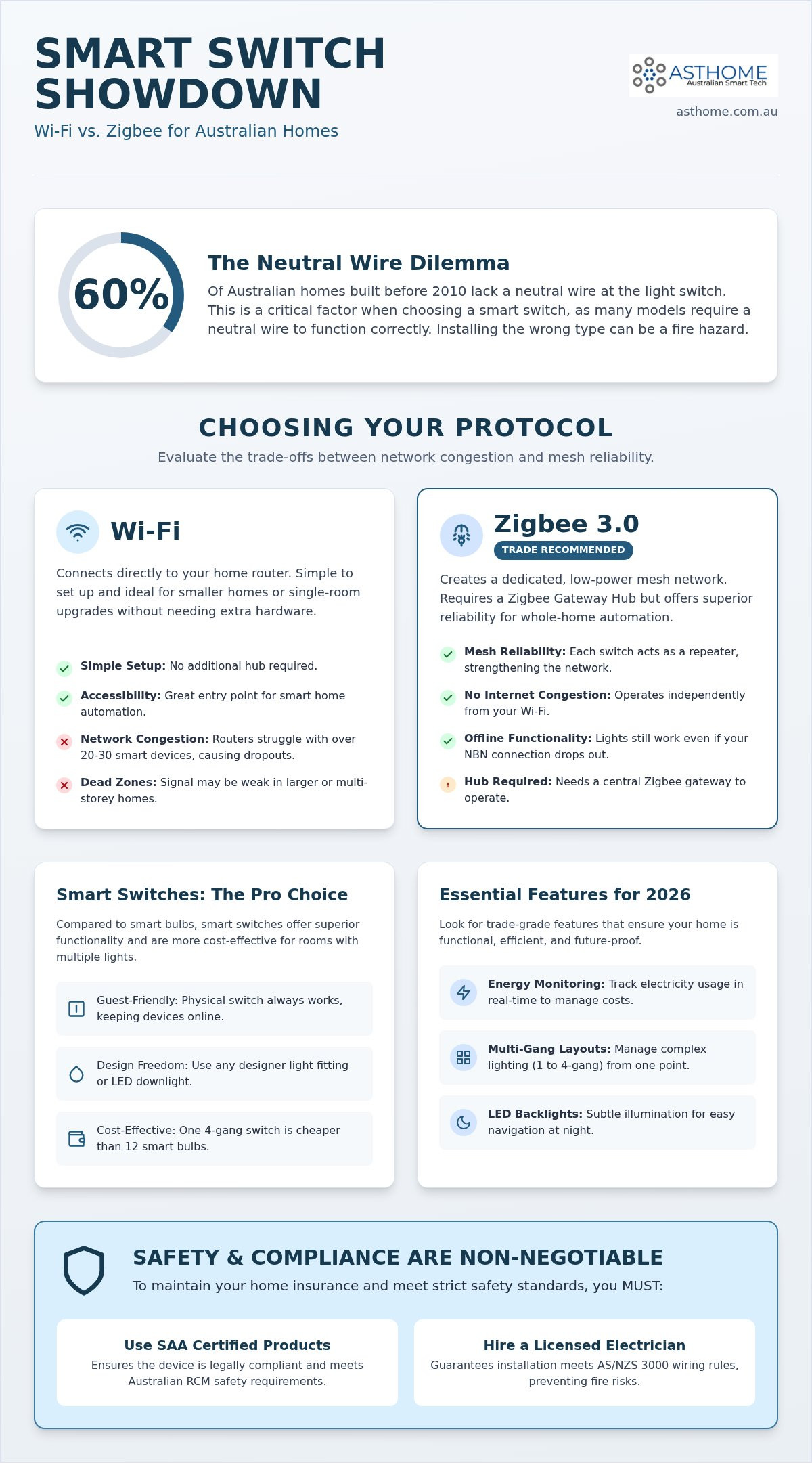
Roughly 60% of Australian homes built before 2010 don't have a neutral wire at the light switch. If you've ever felt the headache of trying to figure out which zigbee vs wi-fi smart switch australia option works with your existing wiring, you aren't alone. It's a high-stakes choice for any homeowner. Installing unapproved imports doesn't just risk a fire; it can actually void your home insurance under the latest 2026 cybersecurity and safety rules. You need a solution that is safe, legal, and reliable.
This guide will simplify your selection, ensuring your lighting remains fully functional even when the NBN fails. We'll help you master the technical differences between these protocols so your home meets AS/NZS 3000 standards while remaining future-proof. We'll compare the mesh stability of Zigbee 3.0 against the convenience of Wi-Fi, explain the neutral wire dilemma, and show you how to integrate Matter-ready modules into your Apple or Google Home ecosystem without congesting your network.
Key Takeaways
- Understand why SAA certification and hiring a licensed electrician are non-negotiable to maintain your home insurance and meet strict AS/NZS 3000 safety standards.
- Evaluate the technical trade-offs of a zigbee vs wi-fi smart switch australia setup, focusing on network congestion and mesh reliability for larger Australian homes.
- Identify the correct hardware for your specific wiring, whether you have a modern neutral wire or a common "no-neutral" active-only circuit found in older builds.
- Discover how Matter-certified modules and Zigbee 3.0 gateways create a future-proof ecosystem that ensures your lighting works even if the NBN connection drops out.
- Learn how smart switch retrofits enhance independence in NDIS Specialist Disability Accommodation (SDA) and help manage high-density lighting in modern townhouses.
What is a Smart Wi-Fi Light Switch and How Does it Work?
A smart Wi-Fi light switch is a specialised electrical relay designed for local compliance. It replaces your standard wall plate to enable remote control via smartphone or voice. Unlike smart bulbs, the switch controls the physical circuit. This allows you to use any designer light fitting or LED downlight without losing smart functionality. When you toggle the switch via an app, the internal relay physically opens or closes the circuit, just like a manual flick of the wrist.
Australian models typically use the 2.4GHz frequency. This choice is deliberate; 2.4GHz waves penetrate brick and plasterboard walls more effectively than 5GHz alternatives, which is vital for the solid construction of many local homes. When debating zigbee vs wi-fi smart switch australia, it's essential to understand that Wi-Fi models connect directly to your home router. This makes them an accessible entry point for smart home automation without the need for additional hardware.
While Wi-Fi is popular for its simplicity, those looking for advanced low-power mesh networks often research the Zigbee protocol. However, for a single room upgrade or a small apartment, a Wi-Fi switch provides a robust, hub-free solution that works straight out of the box. It offers the immediate gratification of smart control with minimal technical overhead.
Smart Switches vs Smart Bulbs: The Pro Choice
For homeowners in Point Cook or similar growing suburbs, smart switches are the superior choice for open-plan living areas. Consider the cost-efficiency. Replacing one 4-gang switch is far more affordable than replacing twelve individual smart bulbs in a large kitchen and dining zone. Switches also keep your home "guest-friendly." If a visitor uses the physical button, the circuit stays active and the device remains online. Smart bulbs, by contrast, become unresponsive the moment someone flicks the manual wall switch off.
Essential Features for 2026 Australian Homes
Modern hardware must offer more than just simple on and off toggles. To get the most out of your zigbee vs wi-fi smart switch australia investment, look for these trade-grade features:
- Energy monitoring: Track Victorian electricity usage in real-time to manage rising utility costs and identify power-hungry appliances.
- Multi-gang configurations: Available in 1-gang to 4-gang layouts to manage complex lounge and kitchen lighting from a single wall point.
- Customisable LED backlights: These provide subtle illumination for easy navigation at night, ensuring you aren't fumbling in the dark.
Choosing a switch that includes these features ensures your home remains functional, efficient, and aligned with modern living standards.
Choosing Your Protocol: Wi-Fi, Zigbee, or Matter?
Deciding between a zigbee vs wi-fi smart switch australia setup involves weighing up long-term network stability against initial simplicity. Wi-Fi switches remain a popular entry point for simple retrofits because they connect directly to your 2.4GHz router band. You don't need extra hubs, and setup is usually instantaneous. However, there's a limit to this convenience. Most standard ISP-provided routers begin to drop connections once you exceed 20 or 30 active smart devices. This is a common bottleneck in modern Australian households where every family member has multiple personal devices already competing for bandwidth.
For comprehensive whole-home setups, Zigbee 3.0 is the trade-recommended standard. It requires a Zigbee Gateway Hub, but the benefits are significant. It operates on a mesh network where each mains-powered switch acts as a signal repeater, increasing reliability across larger floor plans without slowing down your internet speed. Before purchasing any hardware, always verify that it carries the correct Australian electrical safety certification. This ensures the device meets local RCM requirements and is legally compliant for installation. For a broader look at the current market, check out The 2026 Guide to Smart Light Switches for Australian Homes.
When to Choose Zigbee for Stability
Double-storey townhouses in Point Cook often suffer from Wi-Fi dead zones due to the density of building materials and floor slabs. If your router is downstairs in the study, a Wi-Fi smart switch in the upstairs master ensuite might struggle to stay online. Zigbee solves this by hopping the signal through other switches along the way, creating a self-healing network that remains stable even if one device is obstructed. It's the most reliable way to manage 30+ smart devices without causing your Netflix stream to buffer. For specific technical advice on these setups, refer to our Zigbee 3.0 Smart Switch Module Australia: The 2026 Retrofit Guide.
The Matter Revolution in Point Cook
Matter is the universal 2026 standard that is fundamentally changing the zigbee vs wi-fi smart switch australia debate. It eliminates app fatigue by allowing devices from different manufacturers to communicate without proprietary bridges. Victorian families can now control their lighting through Apple Home, Google Home, or Samsung SmartThings simultaneously. This interoperability is a massive win for households where different family members use different phone ecosystems. The Matter Smart Switch Module from Asthome Smart Electrical Supplies represents the ultimate future-proof choice for those starting a renovation. It offers the local control speed of a dedicated protocol with the universal compatibility of the Matter 1.6 standard. Choosing Matter-ready hardware today ensures your smart home system won't be obsolete by next year.
The Neutral Wire Dilemma: Retrofitting in Australian Homes
Most smart switches require a constant power source to keep their internal radios active. In the context of zigbee vs wi-fi smart switch australia, this usually means your wall plate needs a neutral wire, which is typically blue in local builds. However, many older Australian homes were wired with a simple switch-wire configuration. This setup only brings the Active and Switch wires to the wall, leaving the neutral wire at the ceiling rose or light fitting. If your home lacks this third wire, your smart home journey becomes slightly more complex.
You essentially have two paths. The first is to hire a licensed sparky to pull a new neutral wire to each switch point. This is the cleanest solution but adds to your initial installation cost. The second path is to use "No-Neutral" hardware. These switches are designed to leak a minuscule amount of current through the load to stay powered. While convenient, this can cause modern low-wattage LEDs to flicker or ghost. To prevent this, your electrician will need to install a capacitor at the light fitting to bypass the extra current. Following Australian government advice on smart homes ensures you're making these choices with both energy efficiency and safety in mind.
Identifying Your Existing Wiring
Checking your wiring is the first step in any Point Cook retrofit. When your electrician opens the wall cavity, look for a bundle of blue wires connected with a connector strip; that's your neutral. Modern Victorian builds are generally smart-ready, meaning they include neutrals at every gang by default. Safety Warning: Always isolate the mains power at your switchboard before any inspection. Even if you aren't touching wires, 240V systems are lethal. Identifying your wiring early helps you decide whether to invest in high-end Zigbee 3.0 gear or stick with simpler Wi-Fi modules.
Smart Modules: The Retrofit Secret
If you love your current designer wall plates, you don't have to bin them. Smart switch modules can be installed deep inside the wall box, sitting behind your existing dumb switches. This is a game-changer for those who want the power of a zigbee vs wi-fi smart switch australia setup without changing their home's interior style. When you're upgrading a power point elsewhere in the room, ask your contractor to peek at the lighting circuit. It's often cheaper to run a neutral wire while other electrical work is already being performed. While no-neutral modules are a valid shortcut, a wired neutral remains the professional choice for long-term reliability.
Installation and Compliance: Why SAA Certification and Licensed Sparkies Matter
In Australia, the law regarding electrical work is non-negotiable. You cannot legally install 240V smart switches yourself. Hiring a licensed contractor is mandatory for any mains-wired automation. Whether you have settled on a zigbee vs wi-fi smart switch australia option or you are just starting your research, a professional must sign off on the wiring. This isn't just red tape; it is about life safety and ensuring your home meets the AS/NZS 3000 wiring rules.
SAA certification is the benchmark for Australian safety. It proves hardware meets the rigorous AS/NZS 60669.2.1 standards. Cheap imports from overseas lack these protections and pose a major fire risk. If uncertified gear causes a fire, your Victorian home insurance will likely be voided. Most reputable sparkies will refuse to touch gear without a valid SAA mark or Regulatory Compliance Mark (RCM). They have a license to protect, and you have a home to secure. You can shop SAA-certified smart switches at Asthome Smart Electrical Supplies to ensure your hardware is fully compliant with local regulations.
The Victorian Certificate of Electrical Safety (CES)
Once the job in Point Cook is done, your electrician must issue a Certificate of Electrical Safety (CES). This confirms the work meets all legal requirements. It is your insurance policy's best friend. Trade accounts at Asthome Smart Electrical Supplies help Victorian sparkies source compliant gear quickly. This keeps your project on track and within the law while maintaining a clear digital paper trail for your property records.
Step-by-Step Selection for Compliance
To ensure your installation is seamless, follow this trade-grade checklist:
- 1. Count your gangs: Match the buttons on your new smart switch to your existing wall plate layout.
- 2. Confirm your neutral wire: Have your sparky check for a neutral wire before you order your hardware.
- 3. Verify the SAA number: Ensure the product listing includes a valid Australian certification number.
- 4. Pick your protocol: Choose between a zigbee vs wi-fi smart switch australia setup based on your total device count and router location.
Following these steps ensures your smart home is modern, legal, and fully insured. It eliminates the risks associated with non-compliant imports and keeps your family safe.
Smart Solutions for Point Cook: From Townhouses to NDIS SDA
Point Cook townhouses often utilize 4-gang switches to manage expansive open-plan kitchen, dining, and lounge zones from a single wall point. When deciding on a zigbee vs wi-fi smart switch australia solution for these high-density layouts, the focus shifts to how the hardware integrates with other environmental sensors. Pairing your switches with motion sensors allows for hands-free bathroom and hallway lighting, which is a major quality-of-life upgrade for busy families and overnight guests. Asthome Smart Electrical Supplies provides specialised support for Victorian NDIS participants and SDA builders to ensure these complex integrations are safe, compliant, and easy to use across both residential and commercial applications.
Accessibility via NDIS SDA Technology
Voice-controlled lighting is a fundamental part of NDIS SDA smart home technology, particularly in the High Physical Support category. For many residents, the ability to command their environment via voice or tablet is life-changing, reducing the need for constant physical assistance. We focus on ensuring hardware offers tactile feedback and high-contrast plates for vision-impaired users, bridging the gap between mechanical reliability and digital convenience. These smart switches work alongside automated curtain motors and climate sensors to create a truly accessible environment that meets the latest 2026 NDIS quality controls. This level of automation provides residents with genuine independence and privacy in their daily routines, which is the ultimate goal of any SDA build.
Modernising Your Point Cook Interior
Modernising your home doesn't mean sacrificing style for the sake of technology. You can choose between sleek glass-touch plates for a minimalist look or traditional mechanical-feel smart buttons that provide a familiar tactile click. Matching your smart hardware to your home aesthetic is simple with our range of trade-grade Black, White, and Silver finishes. This ensures your high-tech upgrade blends perfectly with your existing decor rather than looking like a generic add-on. Whether you are retrofitting a single room or outfitting a new multi-storey build, the right finish makes all the difference. To find the right fit for your project, Browse SAA-Certified Smart Wi-Fi Light Switches at Asthome Smart Electrical Supplies. Our team is dedicated to providing Point Cook homeowners with the best in local, trade-grade electrical solutions.
Secure Your Smart Home Future
Mastering the zigbee vs wi-fi smart switch australia choice ensures your home is efficient, safe, and ready for the Matter 1.6 standard. Your protocol selection depends entirely on your floor plan and whether your electrician finds a neutral wire at the wall plate. While Wi-Fi provides a straightforward entry point for single-room retrofits, Zigbee 3.0 delivers the mesh stability needed for larger properties or NDIS SDA environments where reliability is critical.
Safety remains our core priority. We are 100% Australian owned and operated in Point Cook, and every product in our range is NATA accredited lab tested and SAA Certified. This commitment to quality protects your Victorian home insurance and ensures your hardware meets AS/NZS 3000 standards. We also provide trade pricing for licensed Australian sparkies, supporting the professionals who keep our local industry running with peer-to-peer reliability.
Start your renovation on the right foot. Shop SAA-Certified Smart Wi-Fi Light Switches at Asthome Smart Electrical Supplies and invest in a system that's built for the long haul. Your future-proof home is just one compliant installation away.
Frequently Asked Questions
Do smart light switches work with my existing LED downlights?
Yes, smart switches work with standard LED downlights by managing the electrical circuit rather than the bulb itself. This allows you to keep your existing designer fittings while adding automation. If you plan to use a smart dimmer module, ensure your LEDs are specifically labelled as "dimmable." Non-dimmable LEDs can hum or flicker when the voltage is varied by a smart relay.
Can I legally install a smart Wi-Fi light switch myself in Australia?
No, you cannot legally install any mains-wired smart switch yourself in Australia. All 240V electrical work must be performed by a licensed electrician to comply with AS/NZS 3000 standards. DIY electrical work is a criminal offence in most states, creates a severe fire risk, and will void your home insurance. Your sparky must provide a Certificate of Electrical Safety (CES) once the job is done.
What happens to my smart lighting if the Wi-Fi or NBN goes down?
If your NBN fails, Wi-Fi switches lose remote app and voice control but still function via the physical wall button. Zigbee switches are superior in this scenario because they communicate locally with a gateway hub. This means your automated schedules, motion sensors, and internal links continue to work perfectly even without an active internet connection.
Does every smart light switch require a neutral wire in Victoria?
Most standard smart switches require a neutral wire to stay powered, but "no-neutral" models are available for older Victorian homes. If your wall cavity lacks a blue neutral wire, you can use a specialised no-neutral zigbee vs wi-fi smart switch australia module. These often require a small capacitor installed at the light fitting by your electrician to prevent LED ghosting or flickering.
Can I use a smart Wi-Fi switch to dim my lights?
Yes, you can dim your lights if you install a dedicated Smart Zigbee Dimmer Module or a dimmable Wi-Fi wall switch. A standard on/off smart switch cannot vary brightness. You must also verify that your LED downlights and drivers are compatible with digital dimming protocols to ensure a smooth transition without any visible stepping or strobing effects.
Are these switches compatible with Apple HomeKit and Matter?
Many modern switches are compatible with Apple HomeKit, and the latest Matter-ready modules offer universal support across all major platforms. The Matter 1.6 standard allows your hardware to work across Apple, Google, and Amazon ecosystems simultaneously. Choosing a Matter-certified module is the most effective way to future-proof your home against changing technology standards over the next decade.
Do smart switches actually help save money on my Victorian power bill?
Smart switches help reduce Victorian power bills by allowing you to set strict schedules and use energy monitoring features. You can ensure lights are never left on in empty rooms or set them to turn off automatically at sunrise. Real-time data tracking helps you identify which zones are consuming the most electricity, allowing you to adjust your habits during peak periods.
What is SAA certification and why is it mandatory for Australian switches?
SAA certification is a mandatory safety requirement proving hardware meets AS/NZS 60669.2.1 standards. It ensures the device won't overheat or cause an electrical fire under Australian voltage conditions. Installing uncertified switches from overseas is dangerous and illegal. Always look for the Regulatory Compliance Mark (RCM) on the product before your licensed electrician begins the installation process.