

Why does your high-end smart lighting still flicker like a faulty neon sign when you dim it below 10%? It's a frustrating reality for many Australian homeowners who find that even the most expensive setups struggle with low-level stability. Most people assume it's a simple wattage problem, but the truth is that achieving a smooth, professional finish in 2026 requires a precise match between your smart module's protocol and the dimming curve of your dimmable led driver.
We understand the headache of dealing with buzzing transformers or compatibility issues between Zigbee 3.0 modules and legacy hardware. This expert-led trade guide promises to help you find the perfect flicker-free solution for your project, ensuring a 1% to 100% dimming range and full compliance with AS/NZS 61347 safety standards. We will preview the top-rated drivers for Home Assistant and Apple Home integrations while navigating the latest March 2026 GEMS efficacy regulations to keep your smart home both efficient and secure.
Key Takeaways
- Learn how a high-quality dimmable led driver acts as the essential bridge between your mains power and smart modules to prevent annoying flickering at low levels.
- Master the "golden rule" of identifying Constant Voltage versus Constant Current to ensure your LED fittings and wiring distances are perfectly matched.
- Discover the latest 2026 high-efficiency models designed for seamless integration with Zigbee 3.0 and Matter protocols for reliable smart home operation.
- Eliminate light strobing by verifying load requirements and configuring your smart module to the correct Trailing Edge dimming mode.
- Understand why SAA-certified hardware is non-negotiable for meeting Australian building standards and ensuring long-term electrical safety in your home.
Understanding Dimmable LED Drivers: The Heart of Your Smart Lighting
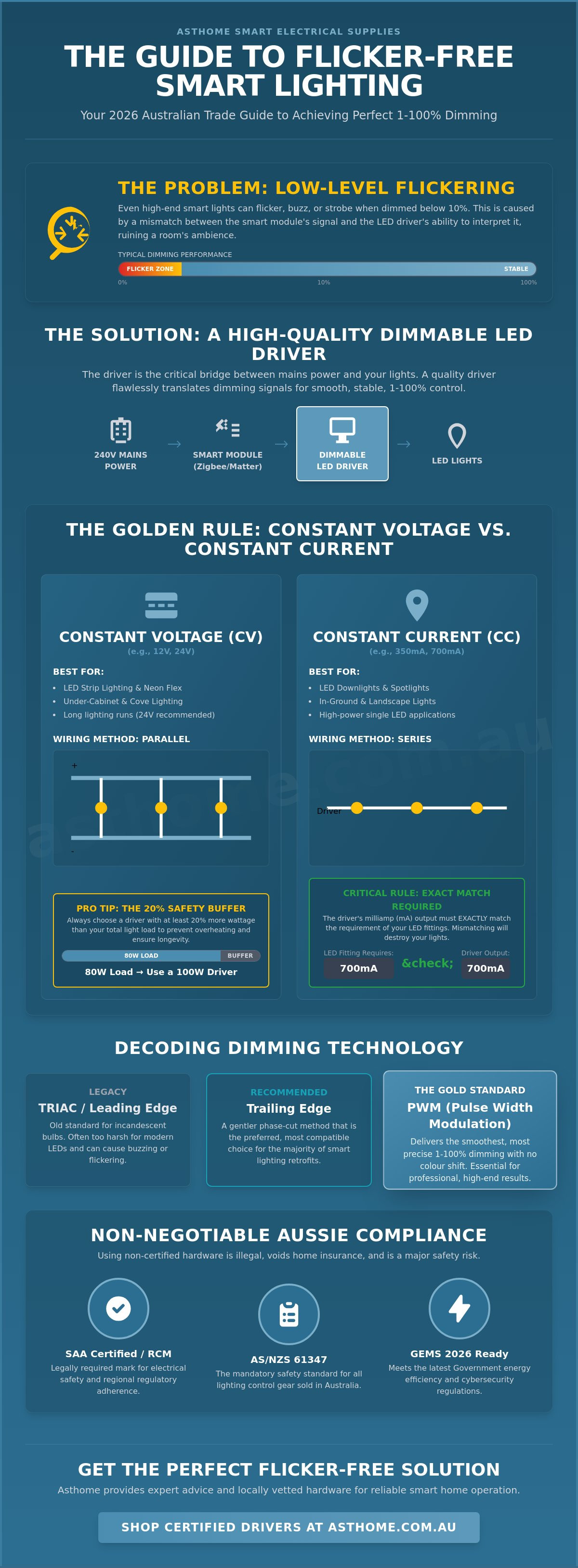
A dimmable led driver isn't just a simple power brick. It's the critical translator that manages the current flowing from your 240V mains to sensitive LED chips. Think of it as the heart of your smart lighting system. Without a driver that accurately understands dimming signals, your LEDs will simply strobe, buzz, or fail prematurely. Standard non-dimmable drivers are designed for binary on/off states. When you pair them with a smart light switch, the driver struggles to interpret the chopped voltage, leading to the dreaded flicker that ruins a room's ambience.
Safety isn't optional in the Aussie trade. Every driver must carry the Regulatory Compliance Mark (RCM) and meet AS/NZS 61347 standards. If you install a non-SAA certified driver, you're risking more than just a dead light. You're potentially voiding your home insurance. In 2026, compliance also includes mandatory cybersecurity protections for connected devices, making it even more vital to source hardware from trusted local suppliers who vet their stock for regional regulatory adherence.
Why Quality Drivers Matter for Aussie Homes
Our local power grid is notorious for 240V fluctuations that can cook cheap, imported components. A high-quality dimmable led driver features robust capacitors that smooth out these spikes. This prevents "ghosting," where your lights stay faintly lit even when turned off at the app. Long-term reliability also depends on thermal management. Victorian summers can push roof space temperatures to extremes. Pro-grade drivers use high-grade potting compounds and heat sinks to ensure they don't throttle or fail when the mercury hits 40 degrees.
TRIAC vs. PWM Dimming Explained
Most traditional dimmers use TRIAC (Phase-Cut) technology. Leading-edge dimming was the old standard for incandescents, but it's often too harsh for modern LEDs. Trailing-edge dimming is much gentler and is the preferred method for most smart retrofits. However, for the smoothest possible transition from 1% to 100%, Pulse Width Modulation (PWM) is the gold standard. PWM works by switching the LED on and off at incredibly high frequencies that the human eye cannot detect, allowing for precise control without colour shifting.
Asthome smart modules, like our Zigbee 3.0 or Matter units, are engineered to communicate flawlessly with these protocols. They ensure the signal sent to the driver is clean and consistent. Most cheap drivers use a linear dimming curve, which looks unnatural to the human eye. Pro-grade drivers use a logarithmic curve that matches how we actually perceive light changes. When your smart module and driver are in sync, you get that professional theatre-style fade without any stepping or annoying buzzing sounds.
Constant Voltage vs. Constant Current: Choosing the Right Match
Before you even think about mounting your new hardware, look at the label on your LED fitting. This is the golden rule of smart lighting. If you get this wrong, you'll likely destroy your gear before the first flick of the switch. Choosing a dimmable led driver requires knowing whether your lights need Constant Voltage (CV) or Constant Current (CC). Mixing these up is the number one cause of driver failure we see in Point Cook renos. It's a costly mistake that's easily avoided with a bit of technical due diligence.
The two technologies handle electrical loads very differently. Constant Voltage systems use parallel wiring, where each light sits like a rung on a ladder. Constant Current systems require series wiring, which connects the lights in a single continuous loop like a chain. This difference isn't just academic; it dictates how you run your cables and how many fittings a single driver can safely manage. Getting the wiring topography right is essential for maintaining the energy-efficient lighting technology benefits that modern LEDs provide.
When to Use Constant Voltage (CV)
CV is the standard for LED strip lighting, neon flex, and under-cabinet accents. While 12V was once the go-to, 24V is now the preferred choice for modern Australian homes. It handles longer wiring runs with significantly less voltage drop, ensuring the end of your kitchen strip is just as bright as the start. When calculating your load, always include a 20% safety buffer. If your LED strips pull a total of 80W, don't use an 80W driver. Step up to a 100W unit to prevent the driver from running at its absolute limit, which extends its lifespan through better thermal management.
When to Use Constant Current (CC)
CC is usually found in high-powered downlights and architectural spotlights. In these systems, the amperage is fixed while the voltage varies. If your fitting specifies 700mA, your driver must output exactly 700mA. Using a driver with a higher mA rating will "over-drive" the LED chips. This leads to immediate overheating and permanent damage. CC drivers are more sensitive to the number of lights on the circuit, so you must ensure the total forward voltage of your LEDs falls within the driver's rated range. If you're building out a new system, you can browse our SAA-certified dimmable drivers to find a unit that matches your specific milliamp requirements perfectly.
Top Dimmable LED Driver Solutions for 2026
Selecting a dimmable led driver in 2026 requires more than just checking the load. As Australian homes become more connected, the demand for high-efficiency hardware that operates 24/7 has spiked. Our latest roundup focuses on units that offer silent operation. We've eliminated any models that produce the annoying "transformer hum" often found in cheaper alternatives. For a clean finish, these drivers feature compact footprints designed to slide easily through standard 70mm or 90mm downlight cut-outs, saving you from cutting larger holes in your plasterboard.
Reliability is the cornerstone of a successful smart home project. We prioritise drivers with robust built-in protections against short circuits, over-voltage, and over-temperature. These features aren't just about longevity; they're about peace of mind. When your lighting is integrated with Home Assistant or Apple Home, you need a driver that responds instantly to every command without lagging or requiring a hard reset. This professional-grade reliability is what distinguishes our 2026 selection from generic retail stock.
Best Drivers for Smart Strip Lighting
If you're installing cabinetry lighting or coffered ceiling accents, 24V PWM drivers are the industry standard. They provide the most stable platform when paired with a smart zigbee dimmer module. The primary advantage here is the dimming curve. Modern PWM drivers allow for ultra-low "night light" settings. You can dim your strips down to 1% for late-night bathroom trips without any visible stepping or flickering. Your sparkie will also appreciate models with accessible terminal blocks and clear labelling, which speeds up the installation process and reduces the risk of wiring errors.
NDIS SDA Compliant Lighting Drivers
Specialist Disability Accommodation (SDA) has strict requirements for environmental control. Flicker-free lighting is essential to prevent sensory overload or triggers for residents with specific health conditions. The dimmable led driver units we recommend for NDIS projects feature high-frequency switching to ensure the light output is perfectly steady to the human eye. These drivers are the backbone of our NDIS SDA Compliant Smart Home Kit, supporting complex automation like circadian rhythm lighting. This tech automatically adjusts brightness and colour temperature throughout the day to support the body's natural sleep-wake cycle, providing a level of comfort and autonomy that standard lighting simply can't match.
Installation and Compatibility: Avoiding the "Flicker" Trap
Getting a flicker-free result in a residential retrofit depends on precise configuration. Even the best hardware will struggle if the basic electrical math doesn't add up. First, you must verify the minimum and maximum load of your dimmable led driver against your actual light fittings. If you're running a single 5W downlight on a driver with a 10W minimum load, the circuit will be unstable. This mismatch is a leading cause of strobing in Point Cook renos where homeowners downsize their lighting without updating the drivers. Second, ensure your smart module is set to Trailing Edge (TE) dimming. While some older drivers use Leading Edge, TE is the modern standard for LEDs and provides a much smoother dimming curve.
Australian homes face a unique challenge known as "ripple control" interference. Energy providers inject high-frequency signals into the grid to manage off-peak loads, which can cause LEDs to pulse or flicker at specific times of the evening. A pro-grade dimmable led driver often includes filtering to mitigate this, but you should also calibrate your software floor. Use your Apple Home or Home Assistant app to set a minimum dimming level of 5% or 10%. This prevents the module from sending a signal so low that the driver's internal circuitry becomes unstable, effectively bypassing the "flicker zone" altogether.
Common Compatibility Issues with Smart Switches
Smart modules and dimmers require a tiny amount of standby power to stay connected to your Zigbee or Matter gateway. In some circuits, this current can leak through the driver and cause your LEDs to glow faintly even when the switch is technically "off". This "ghosting" effect is often solved by installing a load corrector or bypass across the first light in the parallel circuit. This component absorbs the residual current, ensuring your bedroom stays pitch black when you call it a night. If you're seeing this issue, it's a sign that the driver's internal capacitors are being tickled by the smart switch's keep-alive signal.
Working with Your Licensed Electrician
Safety is the priority for any Aussie trade project. All 240V wiring must be performed by a licensed electrician. Don't risk your home insurance or your family's safety with DIY high-voltage work. We suggest providing your sparkie with the driver spec sheets before they arrive on-site. This allows them to verify the wiring topography and ensures there's adequate ventilation in your ceiling cavity. Drivers buried under thick insulation will overheat, leading to thermal throttling and a significantly shorter lifespan. If you're ready to upgrade, you can buy smart home modules that are specifically tested for compatibility with the Australian 240V grid.
Why Source Your Dimmable Drivers from Asthome?
Choosing the right supplier is just as important as choosing the right hardware. At Asthome, we operate with a core ethos of being a business run by practitioners for practitioners. Our Point Cook heritage means we aren't just shifting boxes; we understand the specific Victorian building standards and electrical challenges local sparkies face daily. Every dimmable led driver in our catalogue has passed a rigorous SAA certification process. This ensures that every product you install is fully legal for Australian use and compliant with the Regulatory Compliance Mark (RCM) standards mentioned earlier.
We're committed to future-proof technology. While other retailers might stock legacy hardware, we focus on the latest Matter and Zigbee 3.0 protocols. This ensures your smart home remains functional and secure as the industry evolves. Our professional-grade components are selected for their reliability and regional regulatory adherence, providing you with peace of mind in a high-stakes technical industry.
Expert Support for Point Cook and Beyond
We pride ourselves on providing peer-to-peer reliability. Whether you're a licensed contractor or a savvy DIYer planning a home automation project, our team offers technical support that goes beyond a simple sales pitch. We ship fast from our Point Cook warehouse to any corner of Australia, ensuring your project stays on schedule. If you're local, we invite you to visit our centre for a hands-on demo. It's the best way to see our flicker-free dimming solutions in action before you commit to a full house of gear.
The Asthome Trade Advantage
Local electrical contractors can access significant benefits through our Trade Account program. We offer wholesale pricing that helps you stay competitive on your next big residential or commercial project. For developers working on NDIS SDA housing, we provide bulk buy options to ensure consistency across large-scale builds. This supportive, community-minded approach is why fellow professionals trust us as their specialized resource for smart home hardware. Don't settle for generic imports that might fail a safety inspection. Browse our SAA-certified dimmable LED drivers today and get the professional finish your project deserves.
Future-Proof Your Smart Home Lighting
Achieving a perfect 1% dimming floor isn't just about the smart module; it's about the synergy between your tech and a high-quality dimmable led driver. We've covered how matching Constant Voltage or Constant Current ratings to your specific fittings prevents hardware failure and eliminates the dreaded flicker. By prioritising AS/NZS 61347 standards and ensuring your hardware is SAA certified, you protect both your property and your insurance coverage.
Asthome is a business run by practitioners for practitioners. We offer genuine Point Cook local support and exclusive trade discounts for our fellow professionals. Our range is curated to handle the unique demands of the Australian grid while integrating seamlessly with Matter and Zigbee 3.0 ecosystems. Don't settle for subpar imports that compromise your safety or your user experience.
Upgrade your lighting with our SAA-certified Dimmable LED Drivers and enjoy the smooth, professional finish your home deserves. Let's get your project sorted today.
Frequently Asked Questions
Is a dimmable LED driver the same as a dimmer switch?
No, these two components perform entirely different roles in your circuit. A dimmer switch is the control interface or smart module that sends a signal, while a dimmable led driver is the power supply that receives that signal and regulates the electricity for the LED chips. You need both a compatible switch and a driver to achieve smooth light control in a smart home setup.
Can I use a non-dimmable LED on a dimmable driver?
No, you cannot safely use a non-dimmable LED fitting with a dimmable power supply. Non-dimmable LEDs are designed for a binary on or off state. Attempting to dim them will lead to rapid flickering, buzzing, and eventual circuit failure. Always verify that your LED fitting is explicitly rated as dimmable before connecting it to any dimming hardware.
How do I know if I need a Constant Voltage or Constant Current driver?
Check the technical specifications printed on your LED fitting or strip label. If the label specifies a fixed voltage like 12V or 24V, you require a Constant Voltage driver. If it lists a milliamp rating such as 350mA or 700mA, you must use a Constant Current driver. Matching these correctly is vital for preventing immediate hardware damage and ensuring longevity.
Why are my LED lights flickering when I dim them?
Flickering is usually caused by a load mismatch or "ripple control" signals from the Australian power grid. If your total LED wattage is below the driver's minimum rated load, the current becomes unstable. High-quality drivers with built-in filtering can mitigate grid interference; however, calibrating your smart app to a 10% minimum floor often bypasses the flicker zone entirely.
What is the difference between TRIAC and DALI dimming?
TRIAC is an analogue phase-cut method commonly used in residential retrofits for leading or trailing edge dimming. DALI is a digital protocol that allows for individual control of every fitting on a network. While DALI is powerful for complex commercial builds, most Aussie smart homes rely on TRIAC-compatible modules for simplicity and cost-effectiveness during retrofits.
How many LED lights can I connect to a single 60W driver?
Calculate the total wattage of your lights and leave a 20% safety buffer for optimal performance. For a 60W driver, your total load shouldn't exceed 48W. This prevents the unit from running at its absolute thermal limit, which is especially important during hot Victorian summers. Overloading a dimmable led driver will cause it to overheat and potentially shut down.
Do I need a special driver to work with my Matter smart switch?
No, a specific Matter-branded driver isn't required, but you do need one that supports the dimming protocol of your module. Most Matter or Zigbee 3.0 modules use trailing edge dimming. As long as your driver is compatible with phase-cut trailing edge signals, it will integrate perfectly with your wider smart home ecosystem and gateway hub.
Are all LED drivers sold in Australia SAA certified?
No, and this is a major safety concern for the local trade industry. Many cheap drivers sold through international marketplaces bypass Australian standards. You must look for the Regulatory Compliance Mark (RCM) to ensure the product meets AS/NZS 61347 safety requirements. Installing non-certified gear can void your home insurance and create significant electrical fire risks.