

The best time to plan smart technology in a Federation home is during a renovation, while wiring and sensors can be incorporated before walls are closed. Modernising a Federation home with smart tech at this stage can reduce the need for later drilling or wall removal and help preserve the features that give the house its character.
You can add modern comfort without losing details such as decorative ceilings, timber joinery or leadlight windows. The key is to plan technology around the home, rather than making heritage features fit around it. This guide covers electrical upgrades, discreet smart controls, energy use and planning for future occupants. It also explains how smart switches, dimmers and curtain motors can support a considered renovation.
Key Takeaways
- Plan wiring and sensor locations during renovation to reduce the need for later drilling or wall work.
- Preserve Federation-era details by integrating contemporary controls discreetly and considering repairs before replacing original features.
- Plan smart technology around the connection between the house, verandah and garden, not just the rooms inside.
- Use smart lighting controls to switch lights off when nobody is home or dim them when daylight is sufficient.
- Choose flexible smart-home components that can support changing needs while keeping the home’s character at the centre of future upgrades.
Electrical upgrades and heritage-style switches
In a Federation home, plan electrical changes around original features and how each room is used. A kitchen, hallway and front verandah may each call for different lighting, controls and security devices.
Federation houses often retain leadlight windows, timber joinery and decorative ceilings. Mapping existing wiring and planned smart controls before work begins can help avoid later drilling or wall removal.
Sustainable upgrades and original features
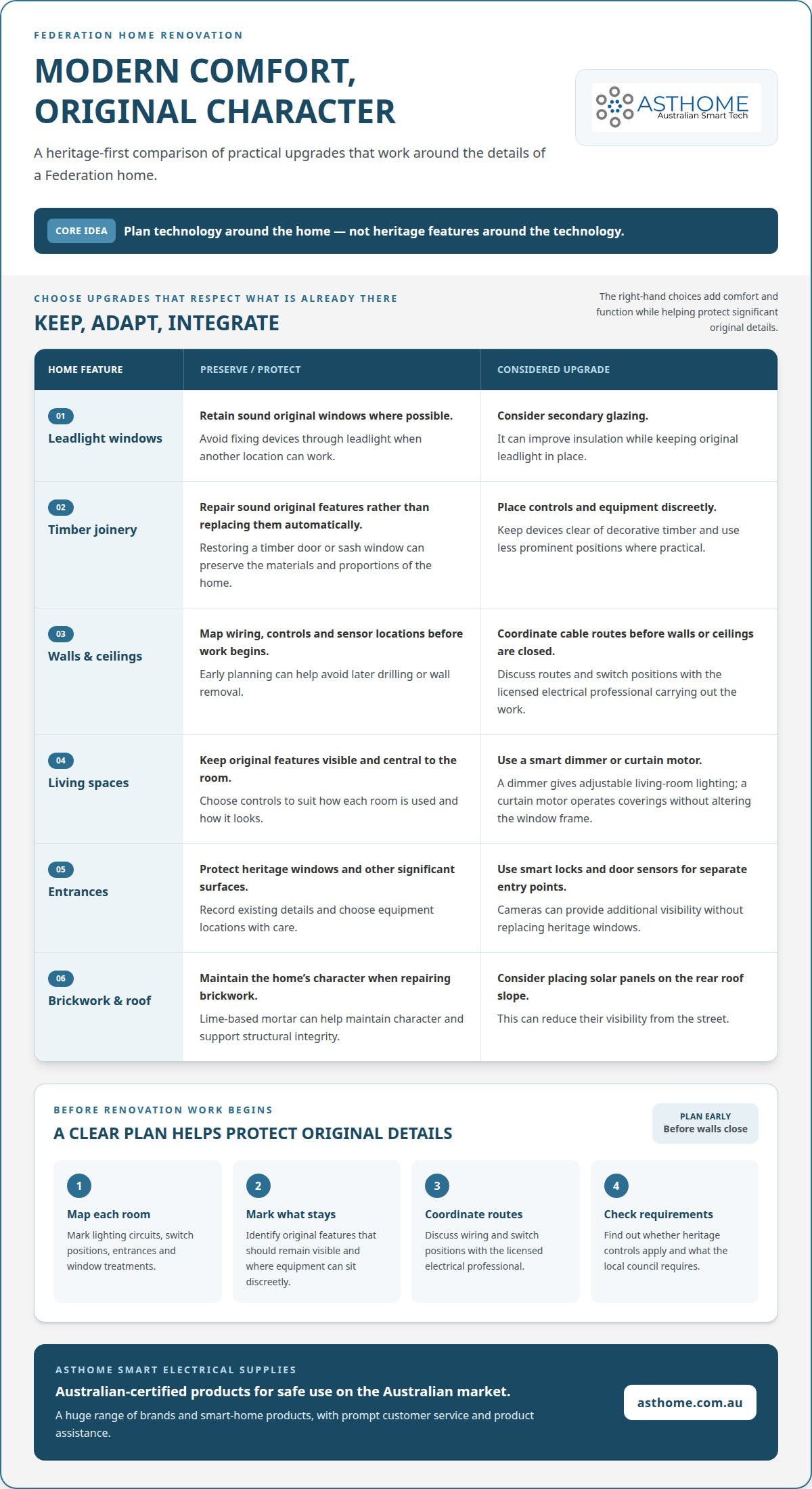
Sustainable upgrades can improve comfort and energy use while retaining sound original features. In a Federation home, this might mean improving insulation and repairing windows rather than replacing them automatically. Secondary glazing can improve insulation while keeping original leadlight windows in place. Restoring a timber door or sash window can also preserve the materials and proportions that shape the home’s character.
For brickwork repairs, lime-based mortar can help maintain the home’s character and support structural integrity. Consider placing solar panels on the rear roof slope to reduce their visibility from the street. Choose colours and textiles that complement existing timber, brick and stained glass. For instance, muted kitchen walls and natural-fibre curtains can sit comfortably alongside original joinery.
Planning and installing smart technology
Plan the location of controls, sensors and wiring before renovation work closes walls or ceilings. Early coordination can reduce the need for later drilling and help protect heritage surfaces. Start with a room-by-room plan: mark lighting circuits, switch positions, entrances and window treatments. Then identify which original features should remain visible and where equipment can be placed discreetly.
A smart dimmer, for example, can provide adjustable living-room lighting, while a curtain motor can operate window coverings without altering the window frame. Discuss cable routes and switch positions with the licensed electrical professional carrying out the work. Keep the equipment plan consistent with heritage constraints and the home’s layout.
What smart security suits multiple entry points and heritage windows? Smart door locks and door sensors can cover separate entry points, while cameras can provide additional visibility. Homeowners can check compatible smart security systems from a phone while away, without replacing heritage windows.
Before changing visible fittings, find out whether heritage controls apply to the property and what the local council requires for the proposed work. Record existing window forms and other significant details to guide decisions about discreet switch plates, sensor placement and exterior equipment. Avoid fixing devices through leadlight or decorative timber when another location can serve the same purpose.
Choose switches to suit each room’s function and appearance. A heritage-style plate can complement older finishes, while smart controls can go in less prominent positions. In a Federation layout, consider whether guests can easily find the main hallway and kitchen switches. Sketching routes before installation helps balance everyday convenience with a restrained visual result.
Why can renovating a Federation home be more complex than a modern property?
A Federation home may combine original windows and decorative timber with later additions, so renovation plans need to account for each layer. For example, bathroom changes or new smart controls can affect finishes worth retaining.
Preserving Federation-era character
Preserving Federation-era character means retaining significant original features while adding practical modern comforts. Those details give each home its architectural identity.
In New South Wales, heritage records frequently document original window forms as part of a Federation property’s significance. Retain sound leadlight windows where possible and consider secondary glazing for insulation. A fireplace can remain a room’s focal point while a gas fitting updates its use. These choices can improve comfort without treating original features as disposable.
Planning around existing character
Design the renovation around the home’s existing character, features and layout. This can help avoid changes that remove useful heritage details.
Start by recording the condition of original windows, fireplaces, joinery and bathroom fittings. Separate necessary repairs from changes that would alter visible features. A bathtub in good condition may be suitable for reglazing rather than replacement. If movement through the home feels restricted, widening a doorway or adding an opening may help without removing a wall. Heritage controls and council requirements can also affect proposed work.
How much does smart lighting, security and climate control cost? The total depends on the existing wiring, the number and type of devices, and the integration required. Adding climate controls alongside lighting and security changes the scope of the work.
Installing technology without damaging features
To install smart technology without damaging heritage features, plan device positions and cable routes around significant surfaces. Coordinating early can reduce unnecessary cuts to walls, ceilings and original timber.
Map each control, sensor and security device before work begins. Where practical, use existing cable routes or less prominent locations, and keep equipment clear of leadlight and decorative joinery. Smart locks and door sensors can cover multiple entrances, while cameras can provide visibility without being fixed to heritage windows.
Reversible and sympathetic smart upgrades
Reversible upgrades use fittings and installation approaches that can be removed with minimal impact on original features. This gives future occupants more flexibility as technology and household needs change.
Choose discreet switch locations and avoid cutting original features for convenience. Keep notes showing device positions and wiring routes, so later work can distinguish new additions from retained fabric. For visible changes, assess heritage and council requirements before proceeding. To compare smart switch options for a renovation plan, explore smart switch options.
Connecting the house, verandah and garden
A Federation property is more than its rooms: the verandah, garden and street-facing setting all shape its character. In Haberfield, the relationship between houses, gardens, street layout and planting contributes to the area’s Federation-era identity. Plan smart technology with those connections in mind, rather than treating indoor rooms as separate from outdoor spaces.
Start by considering how people move through the property. Trace a typical route from the kitchen to the verandah, then to the garden gate or outdoor seating. Note where lighting, security and appliance controls would be useful. Group connected indoor and outdoor areas by activity, such as entertaining on the verandah or entering through a side path.
Smart-home systems can let Australian homeowners manage lights, heating, security and appliances from a phone or tablet. If the house has several entrances, consider how the front door, side access and garden entrance fit into the security plan. The goal is to make access and daily routines easier to manage without letting equipment compete visually with Federation details.
The verandah often connects the house and garden. Consider how blinds or curtains affect light and privacy at adjoining windows, and how controls can support each room at different times. A family, for example, might prefer softer evening lighting in the living room while keeping the garden-facing space comfortable for entertaining. Grouping areas by activity can make controls more intuitive.
Garden layout matters too. Existing paths, mature planting and established sightlines can influence where outdoor lighting and security devices belong. In Haberfield, planting and street layout contribute to local character, so plan around these features rather than treating the garden as an empty space. Consider views from both the street and inside the house.
Use a simple property plan to coordinate the decisions:
- Mark the kitchen, main living areas, verandah and garden routes.
- Identify doors, windows and paths that shape daily access.
- Note where lighting, security or appliance controls would support those routines.
- Keep visible equipment and changes in context with the home’s exterior and planting.
This approach connects technology to how the property is used. It also broadens renovation planning: the house, verandah and garden work together, so smart controls should support that relationship rather than draw attention away from it.
The described heritage home provides music throughout the house without visible audio equipment. This offers a useful way to think about technology across connected spaces: the experience can extend from interior rooms to the verandah and garden without making equipment the visual focus. When planning audio, consider where listening should feel continuous and where quiet is preferable, then choose an arrangement that supports those intentions discreetly. Keeping the system unobtrusive leaves the focus on the home’s Federation details, planting and outlook, while making music part of everyday life indoors and outdoors.
Energy savings from smart technology
Energy improvements in a Federation home can combine smarter controls with better thermal performance. Smart lighting can turn off when nobody is home or dim when daylight is sufficient. Ceiling and underfloor insulation address heat transfer through the building fabric, while smart controls help manage lighting and heating. Each measure tackles a different part of household energy use.
Many families can save up to 10-20% on energy costs with smart technology. That figure is a potential outcome, not a saving every household will achieve. Results depend on existing energy use and how controls are used. In a Federation home, high ceilings and older windows can affect comfort, so pair control upgrades with suitable insulation measures.
Start with lighting routines. Identify rooms that are often left lit, such as a hallway, kitchen or front sitting room. Smart-home systems can turn lights off when nobody is home and dim them when natural light is sufficient. A living room beside a bright north-facing window, for example, may need less artificial light during the day. Dimming can reduce unnecessary lighting while keeping the room usable.
Heating controls call for a different approach. Smart thermostats can learn a homeowner’s preferred temperature and adjust automatically, aligning heating with household routines instead of leaving it at an unchanged setting. Consider when bedrooms, living areas and bathrooms are used. A schedule based on actual occupancy can help avoid heating empty rooms unnecessarily.
Insulation remains important because controls cannot prevent heat moving through an uninsulated ceiling or floor. Where appropriate, add ceiling or underfloor insulation to improve thermal performance. First note where the home feels cold or loses comfort quickly. Older windows also affect indoor conditions, so consider repairs or secondary glazing alongside insulation, retaining original leadlight where possible.
Use a simple review to connect the measures:
- List the rooms where lights are commonly left on.
- Note when daylight already provides enough illumination.
- Record household routines that affect heating use.
- Identify ceiling, underfloor or window improvements that could support comfort.
Once controls are in place, review how the household uses them. If lights remain on in an empty kitchen, adjust the routine. If heating runs while rooms are unused, revisit the thermostat schedule. Combining practical habits with insulation and responsive controls gives Federation homeowners a clearer way to manage energy use while preserving the home’s character.
Smart security systems can include cameras, door sensors and smart locks that homeowners can check from their phones while away. These can sit alongside lighting and heating controls as part of a connected approach to managing the home. Solar panels on the rear roof slope can reduce their visibility from the street while contributing to energy improvements. Consider their placement alongside other renovation work, keeping visible changes in mind. Controls, insulation and solar panels address different aspects of energy use, while security features enable remote checks when homeowners are away.
Future-proofing and potential resale appeal
Future-proofing a Federation home means choosing upgrades that suit current routines and remain practical as household needs change. A well-preserved home should feel functional, not dependent on one owner’s habits. Clear controls for lighting, heating and security, for example, can be easier for a new household to understand than complicated, highly personalised settings.
Resale appeal comes from the whole property, not one smart device. Federation homes date from the late 1800s and early 1900s, and their original features help define their character. Keep technology visually restrained, and prioritise useful improvements such as controllable lighting or security at key entrances. Smart technology alone does not establish a home’s market value.
Make future changes easier by documenting what has been installed. Keep a simple handover file recording device locations, control functions and wiring changes. A buyer or future occupant can then see which switches operate the hallway lights, how the front entry system works and which settings suit everyday use. Store this information with the renovation records.
Choose technology for straightforward functions rather than elaborate routines. A lighting control for a living-room circuit is easier to explain than a series of customised scenes. Group controls by familiar areas, such as the kitchen, bedrooms and verandah. Clear labels help occupants use the system without relying on the previous owner’s phone or instructions.
Keeping heritage character visible also helps the home feel cohesive. Retain original doors, windows and joinery where practical, and avoid placing conspicuous equipment over decorative features. A sensor positioned discreetly near an entrance, for example, can serve a practical purpose without dominating the front hall. Reversible choices leave future owners more flexibility for later updates.
Before the renovation is complete, review the home from a future occupant’s perspective:
- Check that switches and controls have clear, consistent labels.
- Document smart devices, their locations and their everyday functions.
- Keep instructions and renovation records together for handover.
- Confirm that visible equipment sits comfortably beside retained Federation details.
Australian homeowners can manage lights, heating, security and appliances from a phone or tablet, so plan how access will pass to a new occupant. Provide clear operating notes and control details for a practical handover. These steps help the next household use the technology while preserving the home’s original character.
For a renovation plan that includes smart power access, browse smart-home components and consider which functions suit the property’s layout.
Asthome Smart Electrical Supplies: Zigbee 3.0 Smart Switch Module
Asthome Smart Electrical Supplies offers the Zigbee 3.0 Smart Switch Module for Federation home projects that include smart lighting controls. Its smart-home range spans different brands and components, with best prices across the market on smart-home products.
For different lighting needs, options include the Wireless Smart Switch Module and Smart Zigbee Dimmer Module. Asthome focuses on supplying Australian-certified products suitable for use on the Australian market. Its customer service team provides prompt responses and product assistance as you consider options for your renovation.
Explore the smart-home range or contact Asthome Smart Electrical Supplies for help with product questions and your Federation home plans.
Shape your next smart-home upgrade
The next step in modernising a Federation home with smart tech is to turn your renovation priorities into a clear shortlist. Decide which rooms need simpler lighting control, where discreet switching matters and what should remain unchanged. Start with those priorities, not with adding devices for their own sake.
Asthome Smart Electrical Supplies offers the Matter Smart Switch Module, Zigbee 3.0 Smart Switch Module and Smart Zigbee Dimmer Module. For modernising a Federation home with smart tech, begin by matching each product category to a practical need, such as controlling a living-room light or adjusting brightness.
Keep the next decision manageable: start with one room or lighting need, then build from there. Contact Asthome Smart Electrical Supplies to discuss smart-home product options for your Federation home. A considered upgrade can respect the home’s heritage while making everyday living work better.
Frequently Asked Questions
Why Add Smart Tech During a Renovation?
Adding smart technology during a renovation lets you coordinate device positions and wiring before surfaces are finished. Decide where a smart control belongs while planning new lighting, for example, rather than cutting into a freshly painted wall later. Consider switch access alongside furniture placement and room use. Include planned controls in the renovation documents so electrical work and interior finishes can be coordinated.
How much does it cost to modernise a Federation home with smart lighting, security and climate control in Australia?
The total depends on the existing wiring, the number and type of devices, and the integration required. Adding climate controls alongside lighting and security changes the scope of the work.