

Strata approval can take 2-4 weeks for a minor renovation in NSW, while a major renovation typically takes 6-12+ weeks. Getting strata approval for smart home mods depends on how the work is classified and who needs to approve it.
It’s not just the device that matters. Installing a smart switch may involve wiring or cabling, while other work could affect common property or the building’s structure. Those details can change the approval pathway, and strata rules vary across Australia.
This guide explains how smart home modifications may be classified as cosmetic, minor or major renovations, who decides, and when an owners corporation can refuse an application. It also covers what can affect the process, from the scope of work to the approval route, so you can plan before work begins.
Key Takeaways
- Classify the proposed work by what it changes: wiring, common property, structure and waterproofing can affect the approval pathway.
- In NSW, minor renovations typically take 2-4 weeks for committee review, while major renovations typically take 6-12+ weeks.
- For structural renovation work in NSW, the owner must give the owners corporation 14 days’ written notice before work starts, according to NSW Government.
- In Victoria, work affecting common property or a building’s external appearance can require owners corporation approval, so the scope of work matters.
- Clear plans and details about the work can help the decision-makers assess the application and identify what may affect its timing.
Classifying smart home modifications as cosmetic, minor or major renovations
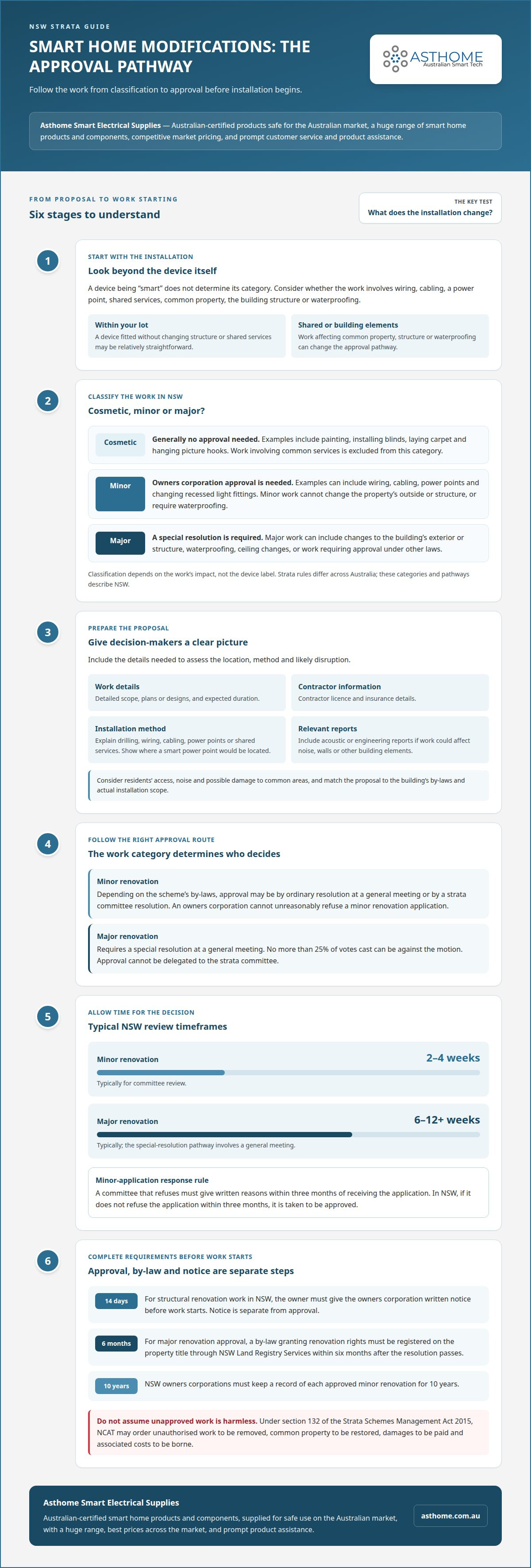
In Australia, approval depends on your state’s strata laws and the work’s effect on your apartment, common property and shared services. In NSW, cosmetic work generally needs no approval, minor renovations need approval, and major renovations require a special resolution.
A smart home modification may need strata approval if it involves wiring, cabling, power points, shared services, structural changes or waterproofing. Renovations and alterations in NSW are governed by the Strata Schemes Management Act 2015, scheme by-laws and reforms under the Strata Schemes Legislation Amendment Act 2025; other Australian states have their own rules.
Cosmetic, Minor and Major Categories
These categories depend on a renovation’s impact, not whether a device is labelled “smart”. In NSW, painting, installing blinds, laying carpet and hanging picture hooks are examples of cosmetic work, but work involving common services is excluded. Fitting a smart device without changing the apartment’s structure or shared services may be relatively straightforward, but the installation method matters.
Minor renovations can include installing wiring, cabling or power points, and changing recessed light fittings. Kitchen upgrades, hard flooring and recessed lighting are also NSW examples. Sections 109 and 110 of the Act and clause 28 of the Strata Schemes Management Regulation 2016 relate to minor renovations. They cannot change the property’s outside or structure, or require waterproofing.
Major work includes changes to the building’s exterior or structure, waterproofing, ceiling changes, or work requiring approval under other laws. Structural changes, waterproofing and work affecting common property can also point to this category. For a smart switch or lighting change, the key question is whether the work stays within your lot or affects shared building elements.
Major Renovations, Resolutions and By-laws
In NSW, a special resolution is the owners corporation’s required vote for major renovations. It must take place at a general meeting, and no more than 25% of votes cast can be against the motion. Major renovation approval cannot be delegated to the strata committee, so a committee decision alone is not enough.
Section 108 of the Act applies to major renovations and registering a major-works by-law. The approval requires a by-law granting renovation rights, registered on the property title through NSW Land Registry Services within six months after the resolution passes. A by-law records the agreed conditions for the work, making the approval pathway different from a minor renovation.
For an apartment owner, classification affects who decides and what must happen before work starts. A proposed smart home installation that changes common property or building structure may need the major-work process; a minor installation follows its own approval route. NSW owners corporations must also keep a record of each approved minor renovation for 10 years.
Can the owners corporation refuse my renovation?
Yes, but the decision depends on the work category, scheme by-laws and its effects. In NSW, an owners corporation cannot unreasonably refuse a minor renovation application.
Approval Documents and Supporting Proposals
A renovation proposal describes the work and gives the owners corporation information to assess it. For a strata application, include a detailed scope, plans or designs, the expected duration, and contractor licence and insurance details. These documents help owners assess the location, method and likely disruption, rather than considering only the device.
Explain whether installation involves drilling, wiring, cabling, a power point or shared services. For example, a smart power point proposal should show its location and outline the electrical work involved. Add relevant acoustic or engineering reports if the work could affect noise, walls or other building elements. Match the proposal to the building’s by-laws and the actual installation scope.
Minor renovations need owners corporation approval. Depending on the scheme’s by-laws, approval may come through an ordinary resolution at a general meeting or a strata committee resolution. A committee can refuse an application, but must provide written reasons within three months of receiving it. In NSW, if the committee does not refuse a minor renovation application within three months, it is taken to be approved.
Exempt Work and Unauthorised Renovations
Cosmetic work in NSW, such as painting, installing blinds, replacing carpet or hanging shelves, generally doesn’t need approval. That exemption does not cover structural alterations, waterproofing changes or work involving common services. A smart device installation is not automatically cosmetic; its physical installation and effect on the lot or shared building elements matter.
Starting work without required approval can lead to orders to remove or rectify it. Under section 132 of the Strata Schemes Management Act 2015, NCAT may order an owner to remove unauthorised work, restore common property, pay damages and bear associated costs. Unapproved work can also create disputes if it affects other residents or building services.
Consider residents’ access, noise and potential common-area damage in the proposal. If structural renovation work is planned in NSW, the owner must give the owners corporation 14 days’ written notice before work starts, according to NSW Government. Approval and notice are separate requirements. For a component-based proposal, smart home components can help define what the planned installation involves.
Victoria approval for work affecting common property or external appearance
In Victoria, owners corporation approval is required for maintenance or renovation work affecting common property. Rules differ across Australia, so the approval pathway depends on the state or territory and the work’s impact.
Work Affecting Lots and Common Property
Work inside a private lot differs from work that alters or affects shared building areas. This distinction matters because a smart device installed within an apartment can still involve common property, such as shared wiring or a building access system.
Victoria’s Owners Corporation Regulations 2018 model rule 4.3 prohibits an owner or occupier from damaging or altering common property, or a structure forming part of it. A device mounted on a shared entry or connected to shared equipment therefore raises different approval issues from a device installed wholly within a lot. The installation method and affected building elements matter.
External Appearance and Approval Conditions
External appearance is a separate consideration from whether equipment sits inside a lot. In Victoria, owners corporation approval is required for work affecting common property, while significant renovation work often requires a special resolution. A visible device or cabling on an exterior wall can raise both appearance and common-property concerns.
Approval conditions can set out how work must be carried out and how it affects shared areas. A proposal should explain the device’s location, mounting method, cabling route and any impact on other residents. Larger, more complex Victorian strata renovations can take several months, so a clear scope helps decision-makers understand the work involved.
Rules also vary between states and territories. In Tasmania, the Strata Titles Act 1998 is cited as the basis for model by-laws outlining requirements for lot improvements; work affecting common property requires approval by ordinary resolution. Victoria uses its owners corporation rules, while NSW applies its own strata legislation and scheme by-laws.
Devices affecting common property, including shared access equipment, require the relevant owners corporation approval in Victoria. A change involving shared Wi-Fi should also be described clearly, including whether it uses common equipment or affects other residents’ access. The physical installation and network impact are separate parts of the proposal.
There is no single Australia-wide exemption for cosmetic work. In NSW, painting, installing blinds, replacing carpets and hanging shelves are examples of cosmetic work that generally needs no approval. That category excludes structural alterations, waterproofing changes and work involving common services. In Victoria, assess the work against the owners corporation rules rather than assuming “cosmetic” means exempt.
Before work begins, set out the location, appearance and installation method in your proposal. For example, distinguish a device fitted within the apartment from one fixed to an exterior wall or shared entrance. This gives the strata manager and owners corporation concrete details to assess against the property’s rules.
Approval by ordinary resolution or strata committee
In NSW, minor renovation decisions may go to an owners corporation general meeting or, where the by-laws permit, the strata committee. The approval route determines who considers the application and can affect the timing.
Committee and General Meeting Decisions
An ordinary resolution is a vote at a general meeting, while a committee resolution is made by the strata committee when authorised by the scheme’s by-laws. For a minor renovation, an ordinary resolution passes when more than 50% of votes cast support it. The decision-making route matters because a committee can consider an application without waiting for a general meeting, if its authority allows.
Submitting an application does not itself secure approval. Owners need to consider the proposed work and the information provided, including its effect on the lot and other residents. If the by-laws do not authorise committee approval, the owners corporation must decide at a general meeting. Major renovations follow a separate approval pathway.
Response Deadlines and Automatic Approval
For a minor renovation application in NSW, a strata committee that does not refuse it within three months is taken to have approved it. This time limit clarifies the consequence of the committee not responding, but it is not a reason to start work before the approval position is clear.
If the committee refuses the application, it must give written reasons within three months of receiving it. Those reasons identify the committee’s concerns, which may relate to the proposed work’s effect on the building or residents. Keep the application and decision correspondence together so the scope and response can be read in context.
Approval Timelines and Processes
Minor renovation approval in NSW typically takes 2-4 weeks when strata committee review and approval are involved. The timing depends on the committee process and whether the application clearly describes the work. A general meeting route can involve a different wait, because the owners corporation must consider the motion at a meeting.
Before submitting, make the proposed scope easy to assess. Include plans or designs, the expected work duration, contractor licence and insurance details, and any relevant reports. For example, a cabling proposal should show its route and explain whether it affects shared building elements. Clear information gives the committee a practical basis for review.
Meeting schedules also shape the process. NSW strata schemes must hold at least one meeting each year, but that does not mean every application waits for an annual meeting. A general meeting may be convened to consider a motion, while a committee can decide sooner when the by-laws give it authority. The approval route and a complete application are key factors in timing.
Approval for changes affecting waterproofing or common property
Work involving waterproofing, structural elements or common property can change the approval pathway. The rules also differ by state, so both the scheme’s location and the installation scope matter.
By-laws, Safety and Common Property
By-laws set scheme-specific conditions for changes, including work affecting common property. In NSW, structural changes, waterproofing and work affecting common property are examples of major renovations. They require a special resolution and consideration of a by-law. In Queensland, a body corporate committee can approve a lot-owner improvement to common property only when its total cost is under A$3,000.
For Queensland improvements costing more than A$3,000, an ordinary resolution at a general meeting is required, including GST if applicable. A proposed smart device on a shared wall or connected to common wiring may therefore need a different decision from equipment contained within a private lot. The manager can help identify the relevant scheme process, while the application should describe the affected property and proposed work.
Responsibility for Wiring and Devices
Responsibility for common-property wiring or devices depends on what the installation affects and the scheme’s approval conditions. A device attached to shared wiring differs from one serving only a private apartment. The approval record and any applicable by-law can clarify responsibilities for maintenance, access and repairs.
If a proposed change could damage common property, for example, identify the affected component, wiring route and work boundaries in the application. NSW strata renovation work must comply with building codes and safety standards. Once approved, renovation work should be carried out by qualified tradespeople with appropriate insurance.
Installation Rules and Practicalities
Electrical, fire-safety, privacy and security considerations depend on the equipment and installation. Describe the device’s location, wiring, access and any effect on shared systems in the proposal. NSW building work must comply with building codes and safety standards; make clear whether the scope involves structural elements or waterproofing.
Approval timing depends on the category and decision process. Minor renovation approval in NSW typically takes 2-4 weeks with committee review; major renovation approval typically takes 6-12+ weeks. Major-work by-law drafting is estimated at about A$990 plus GST in 2026, while registering a by-law change costs A$182.73 under the 2026-27 fee schedule. These are approval-related costs, not device or installation prices.
Where work affects a wall or slab, an engineering report is estimated at A$600 to A$2,000 in 2026. These costs illustrate why the proposed work’s scope matters. For smart home components suited to an installation plan, explore smart home components.
Asthome Smart Electrical Supplies: NDIS SDA Compliant Smart Home Kit
Asthome Smart Electrical Supplies offers the NDIS SDA Compliant Smart Home Kit, along with smart home products and electrical components from different brands. Once your strata approval pathway is clear, you can explore products that fit your project’s planned scope.
For lighting, the range includes the Zigbee 3.0 Smart Switch Module, Smart Zigbee Dimmer Module and Smart Wi-Fi Light Switch (1/2/3/4 Gang). Asthome focuses on supplying Australian-certified products for safe use on the Australian market, with best prices across the market on smart home products and components.
For help understanding product options, Asthome’s customer service team provides prompt responses and assistance. Contact Asthome Smart Electrical Supplies when you’re ready to discuss the products that suit your smart home plans.
Plan your next smart home upgrade
Once you’ve outlined the proposed work, use that scope to narrow down equipment for your apartment and intended setup. Getting strata approval for smart home mods is one part of the project; choosing components that match your plan keeps product decisions focused.
Asthome Smart Electrical Supplies offers the Wi-Fi Smart Switch Module, Zigbee 3.0 Smart Switch Module and Smart Zigbee Dimmer Module. Asthome’s focus is supplying Australian-certified products intended for safe use on the Australian market, with product assistance to help you understand the options. Keep the proposed device and its installation details aligned with the information in your strata application.
For help with product options for your smart home plans, contact Asthome Smart Electrical Supplies. A clear scope and a considered product choice give you a practical foundation for the next stage of your upgrade.
Frequently Asked Questions
How long can renovation approvals take?
In NSW, minor renovation approval typically takes 2-4 weeks when a strata committee reviews it; major renovation approval typically takes 6-12+ weeks. The pathway matters: a committee decision differs from a general meeting and special resolution. A proposal involving a by-law also has registration steps after approval, so allow time for the full process before setting an installation date.
How Long Does Strata Approval Take?
There isn’t one timeframe for every Australian strata scheme. In NSW, a minor renovation application is taken to be approved if the strata committee doesn’t refuse it within three months. That is a statutory response period, not an estimate of the usual review time. The work category, decision-maker and scheme process all affect how long a decision may take.
How long does the approval process take?
In Victoria, minor renovation updates may be approved in a few weeks, while larger, more complex strata renovations can take several months. This distinction matters if your smart home proposal affects common areas or the building’s external appearance. A detailed scope gives the owners corporation a clearer basis for considering the work and its effect on the property.
What Approvals Are Needed?
The required approval depends on the work and your state or territory. In NSW, cosmetic work generally needs no approval, minor renovations need owners corporation approval, and major renovations require a special resolution and by-law process. In Victoria, owners corporation approval is required for work affecting common property. A device’s label alone doesn’t determine its category; its location and installation method matter.
What do I need to do?
Getting strata approval for smart home mods starts with defining the proposed change, including the device’s location and whether installation affects shared property, wiring or building access. Prepare an application that describes the work and supports the decision-makers’ assessment. Follow the route set by the scheme’s rules, and don’t schedule work until required approval and any applicable notice steps are addressed.
Do smart locks, video doorbells, sensors, and smart lighting need strata approval?
It depends on the installation and its impact. A sensor installed wholly within a lot may raise different issues from a video doorbell mounted at a shared entrance. A smart lock or lighting change could also affect common property or shared systems. Describe the device’s location, mounting and wiring in the proposal so the owners corporation can assess the actual work against the scheme rules.
How do I apply to my owners corporation or strata committee for approval?
The process of getting strata approval for smart home mods begins with the application procedure set by your strata scheme. Clearly describe the modification, its location, the work involved and any possible effect on shared property or services. If the by-laws allow committee approval for minor renovations, the committee may decide; otherwise, the owners corporation may consider the application at a general meeting.
What documents and technical details should a strata modification application include?
Include a detailed scope of work, plans or designs, the expected work duration, and contractor licence and insurance details. Add relevant acoustic or engineering reports if the proposal may affect noise, walls or building elements. For a smart device, show its proposed location and installation method, such as the wiring route or mounting point. These details help clarify the work being assessed.