

What if the device you installed to modernise your home was actually a silent "vampire" draining your wallet every night? With electricity prices across Victoria and the rest of Australia climbing in 2026, it's completely natural to worry about "phantom loads" created by always-on technology. You might be wondering exactly how much electricity do smart switches use and whether those tiny standby lights are secretly driving up your quarterly bill.
We understand that every watt counts when you're trying to manage a household budget. The good news is that for most Australian homes, the reality of smart automation is far more efficient than the myths suggest. This guide provides clear watt-hour data for standby modes and compares the power draw of Wi-Fi versus Zigbee 3.0 protocols. You will learn how modern automation actually lowers your overall energy consumption through precision scheduling and why choosing the right hardware is the key to genuine long-term savings.
Key Takeaways
- Understand the reality of "vampire loads" and why a minimal standby current is essential for maintaining a responsive smart home network.
- Get precise data on how much electricity do smart switches use, with high-quality Zigbee and Matter modules typically drawing between 0.2W and 0.5W.
- Compare the energy profiles of Wi-Fi versus Zigbee 3.0 protocols to select the most efficient communication standard for your specific installation.
- Discover the "Savings Paradox," where a negligible standby draw enables massive reductions in your quarterly bill through automated scheduling and dimming.
- Identify why SAA-certified hardware is critical for minimising parasitic power draw and ensuring your modules meet strict Australian safety standards.
The Reality of Smart Switch Power Consumption in 2026
In the trade, we often talk about "vampire loads" or standby power. This refers to the electricity a device consumes while it's technically switched off but still plugged into the wall. For a traditional "dumb" switch, the power draw is exactly zero because it's a simple mechanical break in the circuit. However, a smart switch is a different beast. To remain responsive to your smartphone or voice assistant, the internal radio must stay "awake" 24 hours a day. This leads many Victorian homeowners to ask: how much electricity do smart switches use, and will they blow out the quarterly budget?
While a smart module does require a constant trickle of energy, the amount is microscopic compared to the appliances they control. Modern SAA-certified modules are engineered for extreme efficiency, ensuring that the convenience of automation doesn't come at a high cost. We see many clients worry that "always on" equals "high consumption," but the reality is that these devices are designed to sip power, not gulp it. For a professional installer, the focus is always on the net benefit of the system rather than the negligible standby draw of a single module.
What is a Phantom Load?
A phantom load occurs because the internal components, specifically the radio chipsets, need a tiny amount of current to listen for incoming signals. Whether you use Wi-Fi, Zigbee, or Matter, these Smart plug communication protocols dictate how often the device "checks in" with your hub or router. To put this into perspective, a modern smart switch typically draws less power than the digital clock on your microwave or the standby light on a 10-year-old television. These micro-watts are the trade-off for being able to turn off every light in the house from your bedside table.
The Evolution of Smart Module Efficiency
Hardware has come a long way since the early, power-hungry Wi-Fi models of the 2010s. Those older units often ran warm to the touch, which was a clear sign of energy being wasted as heat. In 2026, the industry has shifted toward high-quality chipsets that prioritise thermal management and ultra-low idling states. At Asthome Smart Electrical Supplies, we prioritise these advanced components in our Zigbee 3.0 modules because they offer superior stability with a fraction of the energy waste found in "grey market" imports. Choosing trade-grade hardware ensures that your smart home remains a tool for efficiency, not a contributor to rising energy costs.
Breaking Down the Numbers: Watts, Kilowatts, and Your Bill
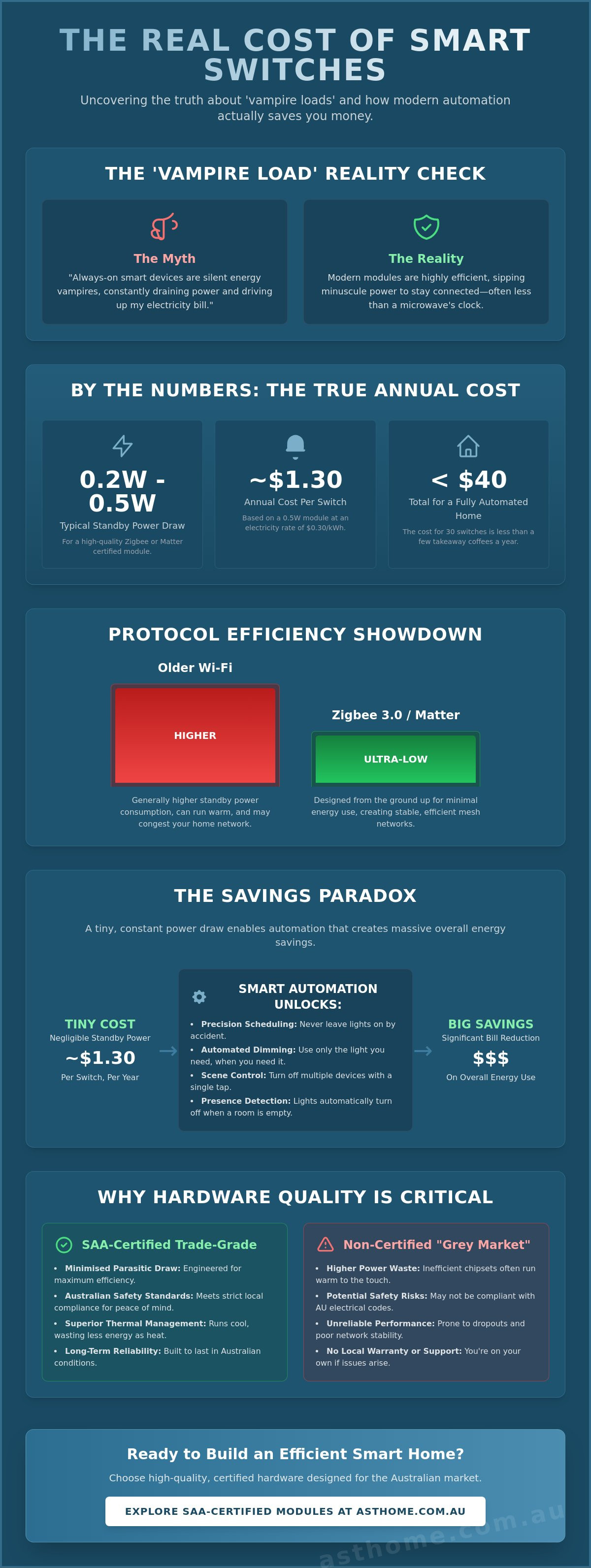
Hard numbers are the best way to settle the debate. When homeowners ask how much electricity do smart switches use, they are usually relieved to find the figures are negligible. Most modern trade-grade modules sit between 0.2W and 0.5W on standby. To put that into perspective, a single switch running at 0.5W for 24 hours a day, 365 days a year, consumes just 4.38 kWh annually. This is a tiny fraction of what a typical household uses for climate control or refrigeration.
In Australia, where residential energy rates often sit around 30 cents per kWh, that annual consumption works out to roughly $1.30 per year per switch. Even if you install 30 switches across a standard family home, your total annual cost for those "vampire" loads is less than $40. That is roughly the price of a few takeaway coffees. High-quality hardware keeps this standby power consumption as low as possible. It is a small trade-off for the security and convenience of a fully automated home.
Active Load vs. Standby Load
A common misconception is that power usage spikes significantly when the light is actually switched on. In reality, the smart module's own consumption barely changes. The internal relay uses a tiny pulse of energy only at the moment it changes state. Once the circuit is closed, the bulk of the energy shown on your bill is being drawn by the light globe itself, not the module. The switch simply acts as the intelligent gatekeeper. If you are looking to start your automation journey with efficient hardware, you can explore the range at asthome.com.au to find modules designed for the Australian market.
The Cumulative Effect in Large Homes
We often hear concerns about the "50 switch" scenario in larger 4-bedroom homes, such as those in growing suburbs like Point Cook. Even at this scale, the math remains in your favour. The total standby load of 50 modern smart units is still lower than leaving a single old-fashioned 60W incandescent bulb burning in a hallway. While the number of devices increases, their individual footprint remains tiny. The Total Home Impact of smart switches typically accounts for less than 1% of the average Victorian household's total electricity usage. This makes the question of how much electricity do smart switches use less about the cost of the switches and more about the massive savings they enable through better control.
Wi-Fi vs. Zigbee vs. Matter: Which Protocol is Most Efficient?
While the previous section established that standby costs are generally low, the specific protocol you choose dictates exactly where on that spectrum your home sits. The protocol is the "language" your switch speaks to your phone or hub. When asking how much electricity do smart switches use, the answer often depends on whether that device is shouting over Wi-Fi or whispering over Zigbee. Wi-Fi modules are typically the most power-hungry because they must maintain a constant, high-bandwidth connection to your home router. This high-power state is necessary for the device to remain visible on your network, but it adds up if you have dozens of units installed.
In contrast, Zigbee and Matter-over-Thread are designed from the ground up for the Internet of Things (IoT). These protocols allow devices to enter ultra-low-power idling states while still being ready to act in milliseconds. Academic research from MDPI has shown that implementing these types of intelligent systems can lead to energy savings of around 5% across a household. For Australians looking to future-proof their builds, Matter smart switches represent the current gold standard. They offer the speed of Wi-Fi with the energy efficiency of a dedicated mesh network.
Why Wi-Fi Switches Use More Juice
Wi-Fi is a "chatty" protocol. It was originally designed for moving large amounts of data, such as streaming video or browsing the web. When used for a simple light switch, it's a bit like using a semi-trailer to deliver a single envelope. This overhead results in a higher standby draw, often hovering around 1.0W or more for older or cheaper modules. We typically suggest Wi-Fi switches for small apartments or setups with only one to three devices. Beyond that, you risk "Wi-Fi clutter" which slows down your internet and increases your cumulative phantom load. Moving to a system with a dedicated gateway hub offloads this stress and keeps your main router free for actual data tasks.
The Efficiency of Thread and Zigbee Mesh
The technical secret behind the efficiency of Zigbee and Thread is mesh networking. Instead of every switch trying to reach a distant router, they talk to each other. This allows modules to stay in lower-power states because they only need to transmit signals over short distances to their nearest neighbour. It is the reason a high-quality Zigbee module can idle at roughly 0.3W while a Wi-Fi equivalent might use triple that amount. Thread, the backbone of the Matter standard, is specifically engineered for these energy constraints. For many Aussies, the question of how much electricity do smart switches use is actually a question of network architecture. Thread provides a robust, self-healing network that ensures your home stays smart without becoming a burden on your power bill.
Net Savings: How Smart Switches Actually Lower Your Bill
Focusing on the "Savings Paradox" is the best way to understand the value of home automation. You are essentially spending half a watt of standby power to save dozens of watts elsewhere. It is one of the most effective trades you can make for your home's energy efficiency. While we have already established how much electricity do smart switches use in their idling state, those figures are quickly eclipsed by the massive waste they prevent. A single porch light left on until mid-morning is a common sight in Australian suburbs, but a simple sunset-to-sunrise schedule ensures that the light never draws power during daylight hours.
Integrating motion sensors with your switches eliminates the "human error" factor entirely. We have all had the experience of discovering a bathroom or pantry light has been burning for hours because a family member forgot to flick the switch. By automating these high-traffic zones, you ensure the active load is only present when the room is actually occupied. This precision control turns your electrical system from a passive drain into an active, managed resource.
Automated Dimming and LED Longevity
Using smart dimmer modules provides a dual benefit for your quarterly bill. First, there is the direct energy reduction; running your LEDs at 80% brightness reduces the power draw on the LED driver by approximately 20% without a noticeable loss in visibility. Second, these professional-grade modules manage "inrush current," which is the initial surge of electricity that occurs when a circuit is closed. By softening this start, you protect the delicate internal circuitry of your LED globes. This leads to fewer replacements and significantly lower maintenance costs over the lifespan of your home's lighting system.
Remote Monitoring and "Away" Modes
The peace of mind provided by remote monitoring is difficult to quantify in dollars alone. Being able to check your smartphone from the office to see if the iron or kitchen lights were left on is a major advantage for busy Aussies. For longer absences, "Vacation Modes" simulate occupancy by toggling lights in a realistic pattern, providing security without the waste of running every outdoor light all night. Consider the ROI: leaving a single 60W outdoor floodlight on for just one weekend accidentally costs more than the entire yearly standby consumption of a modern smart switch. You can find the right tools to start saving on your energy costs at Asthome Smart Electrical Supplies today.
Selecting High-Quality Hardware for Maximum Efficiency
Choosing the right gear is the final piece of the energy-efficiency puzzle. While we've discussed the math behind standby loads, the real-world performance depends heavily on the build quality of the module. Many homeowners wonder how much electricity do smart switches use when they are poorly engineered. The answer is often higher than expected due to parasitic draw and heat waste. SAA certification is more than just a safety requirement; it is a sign of quality circuitry that manages power efficiently on the Australian 240V grid.
Grey market imports often bypass these rigorous standards. These units can run significantly hotter, which is a clear indicator of wasted electricity. At Asthome Smart Electrical Supplies, we test our modules to ensure they handle the specific voltage fluctuations found in local networks. This prevents the module from working harder than necessary to maintain a connection. Professional installation by a licensed sparky is also essential. Ensuring the neutral wire is handled correctly provides a stable path for the current, which maximises the module's efficiency and prevents flickering or phantom activity. When you calculate how much electricity do smart switches use, you must factor in the efficiency of the installation itself.
Professional installation ensures:
- Correct neutral wire connection for circuit stability.
- Proper placement to avoid signal interference.
- Full compliance with Australian electrical safety standards.
SAA Certification and Power Management
Certified modules must adhere to strict idle-power standards to earn their compliance status. High-quality heat-sinking in our products ensures that components stay cool even during peak summer temperatures. This longevity is a key part of the value proposition. Investing in trade-grade gear is always a better long-term move than relying on cheap DIY Wi-Fi plugs that may lack proper thermal management and draw more power than necessary.
Matter and Zigbee: The Professional Choice
For new builds and major renovations, we recommend Matter-over-Thread modules as the baseline. They provide the most efficient communication path available in 2026. We also offer trade accounts for electricians who want to provide these high-efficiency solutions to their own clients. Using local, certified stock eliminates the risk of call-backs and ensures the home's energy footprint stays as small as possible. Browse our SAA-certified Matter and Zigbee modules today to secure the most efficient hardware for your next project.
Future-Proof Your Home with Intelligent Energy Management
The data is clear. While it's vital to know how much electricity do smart switches use, the standby draw of 0.2W to 0.5W proves they aren't the energy vampires many fear. By shifting to Matter or Zigbee 3.0 protocols, you eliminate the high-bandwidth drain of older Wi-Fi models. These tiny standby loads enable massive reductions in your bill through automated dimming and precision scheduling. You're trading a few cents of standby power for dollars of active savings every month.
Choosing trade-grade hardware ensures your system meets the highest regional safety and efficiency standards. As a specialised NDIS SDA hardware provider, we understand the importance of reliability and low parasitic draw in every installation. Our range is SAA Certified for Australian Standards, giving you peace of mind that your smart home is built for the local grid. We also provide expert trade support and wholesale pricing to ensure professionals have the most efficient tools for their clients.
Take the next step toward a leaner, smarter property. Upgrade to ultra-efficient, SAA-certified smart modules at Asthome and start seeing the benefits on your next quarterly bill. Modernising your space has never been more attainable or energy-efficient.
Common Questions About Smart Home Energy Use
Do smart switches use electricity when the lights are off?
Yes, smart switches draw a tiny amount of electricity even when the lights are switched off. This is known as standby power or a "phantom load." The internal radio needs this constant current to stay connected to your network so it can receive commands from your smartphone or voice assistant. High-quality Zigbee or Matter modules typically draw between 0.2W and 0.5W in this state.
Will my electricity bill go up if I install 20 smart switches?
Your bill will technically increase, but the amount is almost unnoticeable for most Australian households. If you install 20 modules drawing 0.5W each, the total standby load is only 10W. This is roughly equivalent to leaving one single LED light bulb on. At average Victorian energy rates, 20 switches cost approximately $26 per year to run in standby mode.
Which smart switch protocol uses the least amount of energy?
Zigbee 3.0 and Matter-over-Thread are the most energy-efficient protocols available in 2026. These standards were engineered specifically for low-power communication. While a Wi-Fi switch might draw 1.0W or more to maintain its connection, a Zigbee module often sits at 0.3W. This makes mesh-based protocols the superior choice for large-scale home automation.
Can smart switches save me more money than they cost to run?
Yes, the savings gained through automation usually far outweigh the cost of the standby power. By using sensors and schedules, you ensure lights aren't left on in empty rooms or during daylight hours. When asking how much electricity do smart switches use, it is better to look at the net result. Saving just one hour of usage on a standard 10W LED bulb daily offsets the standby cost of multiple smart modules.
Do I need a special hub to keep energy usage low?
Using a dedicated Zigbee or Matter gateway hub is the best way to keep your home's total energy footprint low. Hubs allow your smart switches to use low-power radios instead of demanding a high-bandwidth connection from your Wi-Fi router. This architecture reduces the cumulative phantom load and prevents your home network from becoming cluttered and inefficient.
What happens to the power usage if my Wi-Fi goes down?
The power usage generally remains stable, though some lower-quality Wi-Fi modules may draw slightly more current as they repeatedly scan for a signal. Professional-grade Zigbee and Matter modules handle offline states much better. They continue to operate locally via the mesh network without any significant spike in energy consumption while waiting for the primary connection to return.
Are smart dimmers more efficient than standard smart switches?
Smart dimmers offer higher potential for savings because they allow you to reduce the active load on your LED drivers. Running your lights at 80% brightness reduces the electricity consumed by the globes by roughly 20%. This direct reduction in active power draw is a major advantage that standard on/off switches cannot provide, making dimmers a smart choice for living areas.
How does the power usage of a smart switch compare to a smart bulb?
Smart switches are significantly more efficient when controlling multiple lights on a single circuit. A smart switch draws about 0.5W to manage every bulb in a room. If you used individual smart bulbs instead, every single globe would have its own standby draw. In a room with six downlights, smart bulbs would use six times more standby power than one smart switch module. This is a key factor when calculating how much electricity do smart switches use across a whole house.