

Why should you replace your perfectly good designer wall plates just to gain a bit of automation? Many Australians assume that smart lighting requires a total hardware overhaul, but the most sophisticated upgrades are actually the ones you cannot see. When you install a zigbee 3.0 smart switch module australia behind your existing wall plate, you maintain your home's aesthetic while gaining professional grade control. It's the cleanest way to modernise your property without the "techy" clutter of mismatched switches.
We understand the frustration of dealing with confusing neutral wiring or the genuine fear that non-compliant gear could void your home insurance. You need a solution that is SAA-certified and reliable enough to penetrate thick double-brick walls without constant signal dropouts. This guide promises to simplify the retrofit process, helping you choose the right SAA-approved modules for a seamless, trade-quality installation. We will cover everything from wiring configurations to creating a robust Zigbee mesh network that keeps your home Wi-Fi fast and unclogged for the rest of the family.
Key Takeaways
- Keep your designer wall plates, such as the Clipsal Iconic range, while adding hidden automation that doesn't ruin your home's style.
- Learn how a zigbee 3.0 smart switch module australia builds a robust mesh network to bypass signal dropouts in tough double-brick Aussie houses.
- Protect your property and insurance by only using SAA-certified gear that meets strict Australian electrical safety standards.
- Save on your renovation budget by using retrofit modules for multi-gang setups instead of buying multiple expensive smart switches.
- Source your hardware from local specialists who provide trade-quality gear specifically tested for our regional power grids and building codes.
What is a Zigbee 3.0 Smart Switch Module?
A zigbee 3.0 smart switch module australia is a compact, high-tech relay designed to sit inside your wall cavity. Unlike a full smart switch that replaces your entire hardware assembly, these modules sit behind your existing Clipsal, HPM, or PDL plates. It's the "invisible" brain of your smart home. You keep the tactile feel and aesthetic of your preferred switches while gaining the ability to automate lighting via an app or voice control.
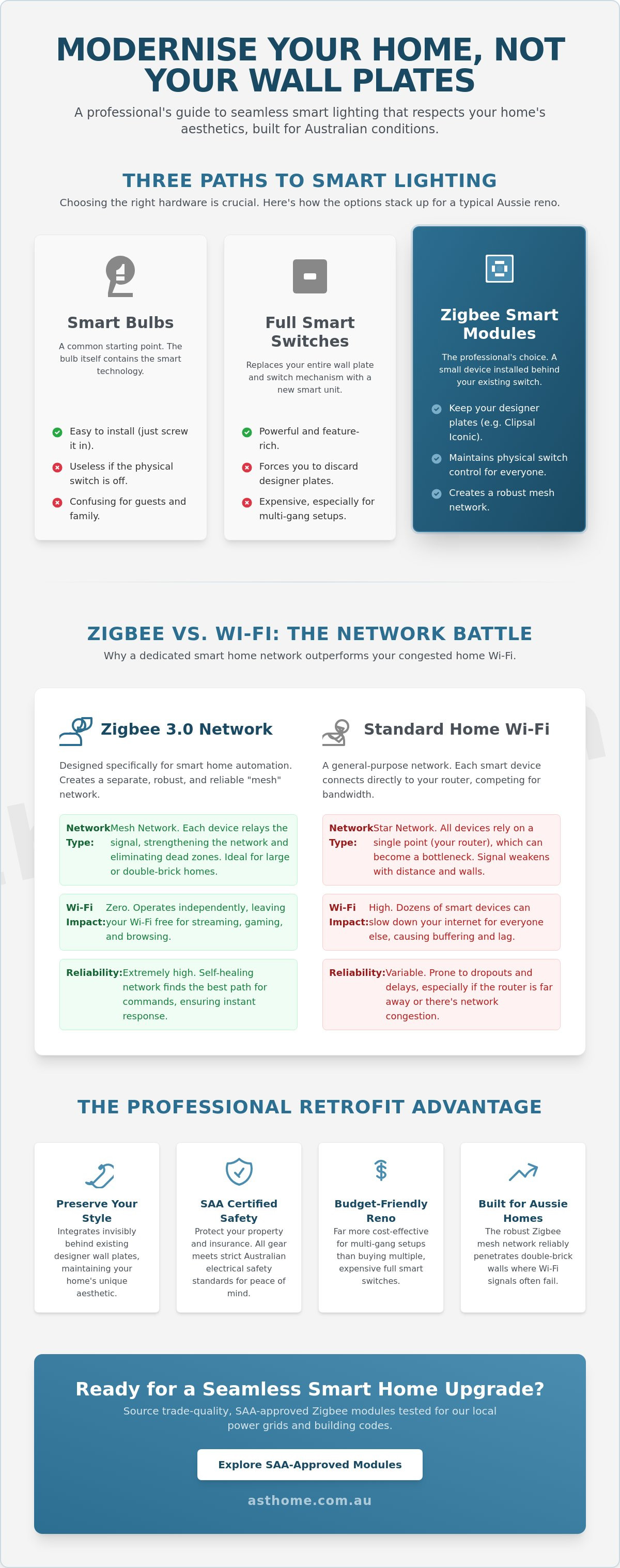
Understanding the hierarchy of smart lighting helps you choose the right hardware for your renovation. Smart bulbs are a common entry point, but they become useless the moment someone flicks the manual wall switch off. Full smart switches are powerful, but they often clash with the architectural style of premium Australian homes. The module offers a professional alternative. It provides permanent power to the smart chip while allowing the physical switch to function as a manual override. This ensures your home remains guest-friendly for those who aren't tech-savvy.
The Evolution to Zigbee 3.0
The Zigbee wireless protocol has matured significantly over the last decade. The 3.0 standard is the current industry benchmark because it unified previously fragmented profiles like Home Automation and Light Link into one cohesive language. This means better interoperability between different hardware brands. For the homeowner, it ensures that your modules work reliably with your chosen gateway. It also introduced advanced security protocols and improved energy management. This efficiency is vital when you start adding battery-powered sensors to your home mesh, as it extends their battery life considerably.
Why Aussie Homeowners are Moving Away from Wi-Fi
Residents in high-density suburbs or modern townhouses often face "Wi-Fi congestion." Every smartphone, tablet, and smart TV in your house competes for the same bandwidth. If you attempt to run thirty separate smart light switches on your standard home Wi-Fi, you'll likely see your Netflix stream buffer or your connection drop out. It's a common headache in newer developments where houses are built close together.
Zigbee operates on a completely separate mesh network. It doesn't clog your primary router or slow down your internet speeds. Because Zigbee was built specifically for low-data commands, the latency is incredibly low. When you trigger a scene or tap a button in your app, the lights respond almost instantly. This reliability makes it the preferred choice for professional-grade retrofits where performance cannot be compromised.
The Tech Behind the Mesh: How Zigbee 3.0 Works in Australia
Unlike your Wi-Fi router which struggles to push signal through a double-brick hallway, the Zigbee protocol thrives on density. Every mains-powered zigbee 3.0 smart switch module australia you install acts as a signal repeater. This creates a self-healing mesh. If one path is blocked by a heavy timber door or foil-backed insulation, the signal simply finds another route through a nearby module. This ensures that a command sent from your phone actually reaches the light in the back bedroom without delay.
The network is managed by a Zigbee Coordinator, commonly known as a hub. This device is the gatekeeper. It handles device pairing and manages the routing tables for every node in your home. By using modules as "Routers," you effectively extend your network's reach to every corner of the property. This is why Zigbee is far superior to Bluetooth or Wi-Fi for large Australian floorplans. It builds a dedicated, low-latency infrastructure that operates independently of your home internet traffic.
Building a Robust Zigbee Mesh in Victoria
Strategic placement is key for a reliable setup. In many Point Cook homes, the open-plan layout can create literal dead zones if your hub is tucked away in a metal data cabinet or behind a television. You should aim to have a "Router" device every five to seven metres to maintain a strong Link Quality Indicator (LQI). Understanding the difference between a Router (mains-powered) and an End Device (battery-powered sensors) is essential for a stable setup. If you find your connection is flaky, check out our Zigbee Mesh Network Dropping in Point Cook? 2026 Home Assistant Fix Guide for technical troubleshooting steps.
Choosing Your Control Centre
While a basic smart speaker can act as a coordinator, it often lacks the processing power for complex automations. Professional users in Australia typically opt for dedicated controllers like the Homey Pro or Home Assistant Green. These platforms offer better interoperability with various brands and allow for local control. This means your automated schedules still work even if your NBN connection goes down. For a deeper look at the best hardware for your setup, read our Smart Home Hub Australia: The 2026 Buyer’s Guide for Point Cook Homeowners. If you're ready to start building your mesh, you can browse our range of professional Zigbee hardware at Asthome Smart Electrical Supplies to find the right fit for your home.
Retrofit Modules vs. Full Smart Switches: Which is Best for Your Reno?
Choosing between a full smart switch and a hidden module usually comes down to one thing: your home's existing style. If you have already invested in premium wall plates like the Clipsal Iconic or Saturn series, swapping them for generic smart hardware feels like a step backward. A zigbee 3.0 smart switch module australia allows you to keep your designer plates while adding high-end automation. This "invisible" upgrade is often the preferred choice for high-end Victorian renovations where maintaining architectural consistency is a priority.
From a cost perspective, modules offer a clear advantage in multi-gang configurations. Replacing a four-gang switch with four individual smart switches is expensive and often physically impossible due to the width of the hardware. In contrast, a single multi-channel module or two double modules can often control the entire plate from within the existing wall box. This flexibility also means that if you move house or want to upgrade your tech in five years, you can simply swap the module without needing to patch or paint your walls.
Your electrician, or "sparkie," will also have a preference. Most professionals prefer modules because they use standard mechanical switch mechanisms that they've installed thousands of times. This reduces the risk of "dead on arrival" hardware issues and ensures that the manual override always works, regardless of the state of your home automation hub.
The Neutral Wire Dilemma in Australian Homes
The biggest technical hurdle in Australian retrofits is the neutral wire. Many older homes, particularly those built before the 2000s, only have a "loop-at-the-light" wiring configuration. This means there is no neutral wire behind the wall switch. You must identify if your home has a neutral before buying your gear. If you don't have one, you'll need a "No Neutral" module. These specific units often require a small bypass or capacitor installed at the light fitting to prevent your LEDs from flickering or glowing when they should be off. It's a small but critical detail that prevents a lot of post-installation frustration.
Multi-Gang Compatibility (1-Gang to 4-Gang)
Space is at a premium inside Australian wall boxes, especially in modern, narrow-wall townhouses. A standard zigbee 3.0 smart switch module australia is roughly the size of a matchbox, but fitting one behind a crowded 3-gang or 4-gang switch requires careful cable management. When planning your layout, consider using double-output modules to save space. These units allow you to control two separate light circuits from a single device, which is a lifesaver in cramped Victorian wall cavities where there is barely enough room for the copper, let alone extra hardware.
Compliance and Installation: SAA Standards for Australian Sparkies
Compliance is the bedrock of any professional smart home installation. In Australia, every mains-powered electrical product must be SAA-certified before it hits the shelves. This certification isn't just a sticker; it's a guarantee that your zigbee 3.0 smart switch module australia meets the strict AS/NZS 60669.2.1 safety standards. Importing cheap, uncertified modules from overseas marketplaces might save a few dollars upfront, but it creates a significant liability for your home and family.
If an uncertified device causes a fault or, in the worst-case scenario, an electrical fire, your home insurance provider has grounds to reject your claim. They view the installation of non-compliant hardware as a breach of policy conditions. It's a risk that simply isn't worth taking. By choosing local, SAA-approved gear, you protect your property and ensure that your home remains legally compliant. It also ensures the hardware is designed to handle the specific voltage and thermal conditions found in Australian wall cavities.
Australian law requires that all 240V electrical work be performed by a licensed electrical contractor. This isn't just about safety; it's about accountability. A professional installer will ensure the wiring is correct and the module is safely housed. Attempting a DIY install on mains wiring is illegal and dangerous. Always hire a qualified professional to handle the "hot" side of your smart home project.
Working with Your Electrician
When you brief your sparkie, explain that you are using retrofit Zigbee modules. These devices require a bit more room than a standard mechanical switch. We recommend ensuring your wall boxes have a minimum depth of 35mm to accommodate the module and the associated wiring loom. In Victoria, always insist on a Certificate of Electrical Safety (CES) once the job is done. This document is your proof that the work was performed to code and that the hardware used is compliant with state regulations.
NDIS and Assisted Living Applications
Zigbee technology is a game-changer for Specialist Disability Accommodation (SDA). Because Zigbee 3.0 is so reliable, it's the perfect backbone for voice-controlled lighting and automated environments for NDIS participants. Unlike Wi-Fi, which can be prone to interference, a Zigbee mesh provides the consistent uptime required for essential assisted living services. If you are managing a project for a participant, the NDIS SDA Compliant Smart Home Kit from Asthome Smart Electrical Supplies provides the certified reliability needed to meet strict accessibility standards while ensuring long-term peace of mind.
Building Your Point Cook Smart Home with Asthome Smart Electrical Supplies
Asthome Smart Electrical Supplies isn't just another online shopfront. We're a business run by practitioners for practitioners, rooted right here in the Western Suburbs. When you source a zigbee 3.0 smart switch module australia from us, you aren't getting a generic part from a massive overseas warehouse. You're getting hardware that has been rigorously tested for the Australian power grid and local climate. We've seen too many DIY enthusiasts and professionals alike struggle with sub-par gear that fails after six months. That's why we only stock SAA-certified products that we'd be happy to install in our own homes.
Our expertise isn't limited to just shifting boxes. We know the technical nuances of the Zigbee 3.0 protocol and how it interacts with the unique double-brick and timber-frame construction styles common in Point Cook. If you're planning a full-home automation project, having a local partner who understands the regional trade industry makes a world of difference. We provide the peace of mind that comes with local regulatory adherence and genuine technical support. It's about ensuring your smart home remains a functional asset rather than a technical headache.
Trade Accounts for Licensed Professionals
We know that Victorian sparkies need reliable gear that won't result in unpaid callbacks. Registering for a trade account with Asthome Smart Electrical Supplies gives you access to wholesale pricing and priority support. This is designed for professionals who manage large-scale residential projects or NDIS SDA builds. We provide full access to Matter and Zigbee technical documentation so you can get the job done right the first time. It's about building a community of pros who value quality over a quick fix. Our trade partners appreciate having a local contact who speaks their language and understands the licensing requirements of the Victorian industry.
Visit Our Point Cook Centre
There is nothing quite like holding the hardware in your hand before you commit to a major reno. Residents in Victoria can take advantage of our local pickup options, saving on shipping times and costs. It's a great opportunity to see the gear in person and chat with our team about your specific wiring needs. Whether you're a homeowner looking for a cleaner aesthetic or a contractor seeking reliable stock, we're here to help. Shop our SAA-certified Zigbee 3.0 Modules today and start building a smarter, more reliable home with gear that's built for the long haul.
Future-Proof Your Australian Home with Invisible Automation
Modernising your lighting shouldn't mean compromising on your home's aesthetic or electrical safety. By selecting a zigbee 3.0 smart switch module australia that carries full SAA certification, you ensure your property remains compliant and your insurance stays valid. These hidden modules are the most effective way to build a professional mesh network that bypasses Wi-Fi congestion while keeping your designer wall plates intact.
We provide specialised support for both homeowners and professionals, including trade pricing for licensed electricians and local shipping from our Point Cook centre. Our team understands the specific requirements of the Victorian building industry and the NDIS SDA standards. We're here to help you get the job done right the first time with hardware tested for our local conditions.
Ready to streamline your property? Upgrade your home with our SAA-Certified Zigbee 3.0 Modules and experience the reliability of a trade-quality smart home. It's time to enjoy automation that works as hard as you do.
Frequently Asked Questions
Do I need a neutral wire for a Zigbee 3.0 smart switch module in Australia?
It depends on the specific module version you purchase for your home. Standard modules require a neutral wire to provide permanent power to the smart chip, but "No-Neutral" versions are available for older Australian properties. These specific units often require a small bypass capacitor installed at the light fitting to prevent LED flickering. It is best to have your electrician check your switch wiring before you place an order.
Will a Zigbee 3.0 module work with my existing Clipsal light switches?
Yes, these modules are designed to be compatible with standard Australian mechanical switches, including the popular Clipsal Iconic and Saturn series. They sit discretely behind the wall plate and use the existing switch mechanisms as a manual trigger, maintaining your home's original aesthetic. This makes them a perfect choice for retrofitting modern homes without the need to replace expensive or custom designer hardware.
Can I install a smart switch module myself if I am handy with tools?
No, you cannot legally perform this installation yourself in Australia. All 240V mains electrical work must be carried out by a licensed electrical contractor under local state regulations. Attempting a DIY install is illegal, dangerous, and will likely void your home insurance policy. Always ensure your sparkie provides a Certificate of Electrical Safety (CES) once the job is finished to guarantee compliance.
What happens to my smart lights if the internet goes down?
Your manual wall switches and local automated schedules will continue to function normally without any interruption. Because Zigbee creates a local mesh network, your hub doesn't need an active internet connection to talk to your zigbee 3.0 smart switch module australia. Only remote app control from outside the home will be affected. This local reliability is a major advantage over cloud-dependent Wi-Fi systems.
How many Zigbee modules can I have on one network?
Most modern Zigbee 3.0 coordinators can handle between 32 and 50 direct connections, but the mesh can expand to support hundreds of devices. Since every mains-powered module acts as a repeater, the network grows stronger and more stable as you add more units throughout your property. This self-healing nature makes it ideal for large double-brick houses where a single Wi-Fi router often struggles to reach.
Is Zigbee 3.0 compatible with Matter-enabled hubs?
Yes, many Matter-enabled hubs can bridge Zigbee 3.0 devices into a Matter ecosystem for broader control. This allows you to combine the reliability of a zigbee 3.0 smart switch module australia with the universal interoperability that the Matter standard provides. It is a great way to future-proof your home while using the most stable wireless protocols currently available on the Australian market for professional retrofits.
Why should I choose SAA-certified products over cheaper overseas alternatives?
SAA certification is a mandatory legal requirement ensuring the hardware meets strict Australian safety and thermal standards. Cheaper overseas gear lacks this testing and poses a genuine fire risk in our unique climate. Using non-compliant hardware can lead to insurance claim rejections and serious legal issues if a fault occurs. Always look for the RCM mark to confirm the product is safe for local use.
Does a Zigbee module fit behind a standard Australian GPO or light switch?
Yes, but you need to ensure there is sufficient depth in your wall box. While these modules are compact, we recommend a minimum wall box depth of 35mm. This provides enough clearance for the module itself and the standard copper wiring found in most modern Australian residential builds. If your wall boxes are particularly shallow, your electrician may need to use a shallow mounting block or spacer.