

A light switch can be a barrier when it’s out of reach. NDIS SDA compliant smart home devices can help make everyday controls more accessible by connecting a hub with compatible devices for lighting, curtains and other home functions. The right setup depends on the person’s needs and how they use their home.
Disability home automation can support greater independence, but it is not a single device or a one-size-fits-all system. Voice commands, accessible switches and connected controls can each play a part, while a compatible hub can help devices work together.
This guide explains what disability home automation is, how hubs and connected devices can support daily routines, and what to consider when choosing a setup for an Australian home. It also explores the smart home systems and device types available in Australia, so you can understand how they may fit into an SDA environment and an individual’s functional needs.
Key Takeaways
- Explore how environmental controls can reduce reliance on fine motor movements for everyday tasks.
- See why disability home automation works best when it’s tailored to a person’s functional needs and routines.
- Understand the role of a hub, internet connection and compatible devices in bringing smart home controls together.
- Learn how different Australian smart home systems can support lighting, curtains and other household functions.
- Discover how Asthome’s smart home kit and device options may fit into an accessible home setup.
Environmental Control Systems for people with limited motor function
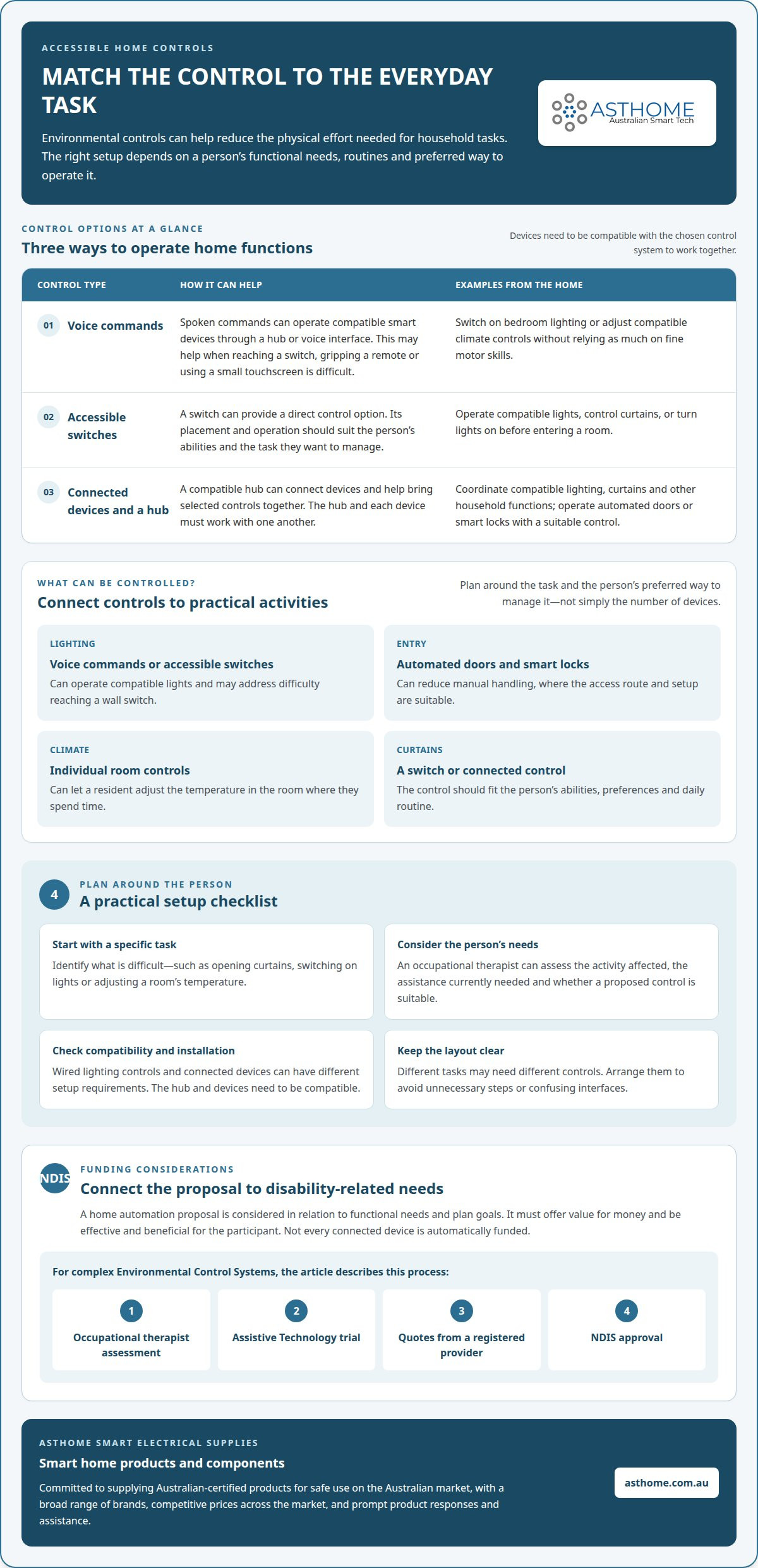
Environmental control systems connect household functions to accessible controls, reducing the physical effort needed for everyday tasks. For participants with limited motor function, lighting, doors and temperature controls may be operated through voice commands, switches or compatible devices.
Voice Control and Compatible Devices
Voice control lets a person use spoken commands to operate compatible smart devices through a hub or voice interface. This matters when reaching a wall switch, gripping a remote or using a small touchscreen is difficult.
For example, a participant could ask a connected system to switch on bedroom lighting or adjust compatible climate controls. Voice commands can reduce reliance on fine motor skills, but the devices must work with the chosen control system. A compatible hub can connect devices and make everyday controls more consistent.
Automated Home Controls
Automated home controls operate household functions through accessible switches, voice commands or connected devices. These may include automated doors, smart locks, lighting and climate controls, helping a person manage tasks without moving between controls.
A participant could use an accessible control to turn on lights before entering a room, or operate a compatible lock without handling a key. Automated doors can support movement between rooms or through an entrance. Smart air-conditioning with individual room controls can also let a resident adjust the temperature where they spend time, rather than relying on one control for the whole home.
Environmental Controls as Assistive Technology
Environmental controls are assistive technology when they help a participant manage disability-related barriers at home. In Australia, home automation can be a form of assistive technology for NDIS participants.
The key question is how a control supports a functional need. An occupational therapist can assess the everyday activity affected, the assistance currently needed and whether a proposed control is suitable. For example, an accessible lighting control may address difficulty reaching a switch, while a more complex system could coordinate several functions.
Planning should link each device to a specific task. A participant might need voice control for lights, a switch for curtains and a separate interface for room temperature. A clear layout helps avoid unnecessary steps or confusing controls.
Installation affects how the system works in practice. Wired lighting controls and connected devices can have different setup requirements, while compatibility between the hub and each device determines what can be controlled together. The arrangement should suit the home’s layout and the participant’s preferred way to operate it.
- Lighting: voice commands or accessible switches can operate compatible lights.
- Entry: automated doors and locks can reduce manual handling.
- Climate: individual room controls can help adjust a space to the resident’s needs.
What is Disability Home Automation?
Disability home automation connects household controls so a person can operate selected functions through accessible interfaces. In an SDA home, the setup should reflect residents’ functional needs, not simply add connected devices for convenience.
Automation Tailored to Disability Needs
Tailored automation matches controls to tasks a person finds difficult because of disability. The same device may suit one participant but add extra steps for another.
Planning can start with a specific activity, such as opening curtains, switching on lights or adjusting a room’s temperature. An assessment considers how disability affects the activity, what assistance is currently needed and whether a lower-cost assistive technology option could meet the need. The accessible control might be a voice interface, a switch or a mobile device, depending on the person’s abilities and preferences.
Convenience alone is not the funding test. A proposed support needs to relate to disability, help pursue plan goals, offer value for money and be effective and beneficial for the participant.
Automation in Specialist Disability Accommodation
Specialist Disability Accommodation (SDA) is purpose-built housing for people with high support needs. Smart home readiness means the home’s layout, power connections and control systems can support the resident’s identified requirements.
No single combination of devices makes every SDA home suitable for every participant. SDA design categories inform the accommodation’s intended support and accessibility features; automation needs still depend on the resident and daily activities. For example, automatic doors need a suitable access route and power connection. Endeavour Foundation SDA homes include easy-access power outlets to support setup of automatic blinds and lighting.
NDIS Funding for Home Automation
NDIS funding for home automation is considered in relation to a participant’s disability-related functional needs and plan goals. The proposal must also offer value for money and be effective and beneficial for that participant.
For complex Environmental Control Systems, the process includes an occupational therapist assessment, an Assistive Technology trial, quotes from a registered provider and NDIS approval. A funding request can describe the everyday activity affected, the assistance currently required and why the proposed controls suit that need. Not every connected device is automatically funded.
State-specific grants are separate from NDIS funding. The assessment described here focuses on the participant’s needs and goals, rather than a universal state grant for smart home technology.
Planning and Trialling Smart Technology
Planning and trialling connect a proposed system to a participant’s actual routines before selecting a complex setup. This helps establish whether the controls are accessible and address the functional difficulty.
A practical sequence is to identify the affected task, assess the person’s support needs, consider suitable lower-cost options, then trial complex technology and document its benefit. An occupational therapist’s assessment can explain how the system supports plan goals. For complex Environmental Control Systems, quotes from a registered provider are part of the process.
For an SDA property, responsibility for devices, repairs and upgrades should be agreed in the relevant housing and support arrangements. The plan should distinguish participant-specific assistive technology from controls forming part of the home, and identify who handles maintenance and future changes. A range of Australian smart home devices can help illustrate the types of controls available for an accessible setup.
Smart home hubs and internet-enabled devices
A smart home setup usually combines a stable Wi-Fi connection, a hub and compatible devices. The hub acts as a central point, allowing connected equipment to communicate and helping a resident manage everyday tasks through a suitable interface.
Compatibility matters. A hub may connect selected lights, sensors or locks, but devices need to work with that system to interact as intended. For a participant, this could mean managing several functions through one control instead of switching between separate apps or remotes. The right arrangement depends on the living environment, preferred controls and physical access needs.
Start with a specific everyday task. For example, a participant who finds reaching the front door difficult may benefit from a compatible smart lock or video intercom. A device that adds steps or relies on a difficult interface can create a new barrier, even if it is internet-enabled.
Smart locks, intercoms and video doorbells
Smart locks can provide an electronic way to operate a compatible door lock. Video doorbells and intercoms may let a participant see who is at the door, communicate with visitors and receive arrival notifications, depending on the system.
These functions can change how someone handles a visitor’s arrival. A resident could view a visitor and speak through an intercom before deciding whether to unlock the door. A smart lock may also work through a compatible interface, reducing the need to turn a key or reach a manual lock. The device’s role depends on the person’s access requirements and the home’s entry arrangement.
The funding category can depend on the proposed equipment and work. Smart locks may be funded as mid-cost Assistive Technology, while installation of wired video intercoms may be covered under Home Modifications. This distinction matters because a connected device and a wired alteration are different parts of a setup.
Privacy, connection and power considerations
Connected devices can involve account access, camera feeds, visitor notifications and household network settings. Consider who can view or control each function, what information an intercom displays, and how the resident can use essential controls if internet or mains power is interrupted.
For example, a door lock should have an access arrangement that suits the resident if its connected functions are unavailable. A video doorbell may also rely on the network for viewing or notifications. These are practical design considerations, not evidence that every device behaves the same way.
For NDIS participants, smart locks may be considered Assistive Technology when they address a disability-related need. A proposed device’s function, installation requirements and compatibility all affect how it fits into the home and the participant’s controls.
Independence, safety and reduced reliance on carers
Smart home technology can give a person more control over their environment by making everyday functions easier to operate. For someone living with disability, using voice commands or accessible switches to manage lights may reduce the need to cross a room or ask another person to operate a control. The value comes from matching each function to a task that matters in daily life.
Control can support choice as well as convenience. A resident who can operate lighting from bed, for example, can set up the room for their own routine. Voice commands may help someone who has difficulty using small switches, while a physical switch may suit someone who prefers tactile controls. The interface should work for the person using it, not simply be available on a phone.
Automation can also help residents adjust their surroundings. Smart home sensors can automatically dim lights and close curtains to help regulate light levels for people with light sensitivity. This may give residents more control when daylight or indoor lighting changes. Its usefulness depends on whether the sensor response suits the person’s preferences and the rooms they use.
For people with mobility impairments, voice commands or smart switches can operate lights and appliances without needing to get up and move around. A connected routine might let a resident switch on a light before moving through a room. This can reduce the physical effort involved in a regular task, while keeping controls within reach or accessible by voice.
Smart locks offer another example of a control that can fit into a daily routine. A compatible lock can be set to lock doors automatically at night, reducing the need for a resident to move through the home and secure each door manually. The resident’s access needs still determine which controls are useful, including how they operate the lock during ordinary entry and exit.
- Lighting: accessible switches or voice commands can operate compatible lights.
- Light levels: sensors can dim lights and close curtains in response to conditions.
- Entry routine: a smart lock can lock a door automatically at night.
These functions can reduce reliance on carers for particular control tasks, but they do not replace personal support where it is needed. The practical measure is whether the resident can carry out a valued task with greater control. An accessible light switch, for example, may help someone manage a room independently, while another person may need a different interface. Reviewing daily routines keeps automation focused on meaningful outcomes.
Smart home systems available in Australia
Australian homes can use Wi-Fi, Zigbee or Matter-based devices, depending on the products and control setup. For NDIS participants, comparing NDIS SDA compliant smart home devices means looking at accessible controls, compatible devices and everyday routines.
Smart home systems vary, so there is no single best option for every home. Compatibility, the resident’s preferred interface and the functions they need help determine which setup may support their quality of life.
Comparing Accessibility and Compatibility
Accessibility and compatibility describe how easily a person can use a system and connect it with suitable devices. This matters because a light, blind or lock only helps if its controls work for the resident.
Wi-Fi devices connect through the home network, while Zigbee setups use compatible devices and a hub. Matter is another standard to consider when reviewing device compatibility. These terms describe different approaches, not a guarantee that products across systems will work together. A participant’s intended controls, such as voice commands or an accessible switch, should guide the comparison.
For example, a resident who wants to adjust blinds and lighting may need compatible motors, lights and controls. A system that supports the required devices can make the home easier to manage. A simpler setup may also be easier to use than one requiring several apps or separate control points.
System Reliability
Reliability is how consistently a system’s controls work during ordinary use. It matters when a resident depends on connected lighting or other devices for everyday tasks.
A Wi-Fi setup relies on a stable Wi-Fi connection, while a hub-based arrangement also depends on compatible devices communicating with the hub. The home network, device compatibility and control method all affect how the system works. There is no universal reliability ranking for Wi-Fi, Zigbee or Matter, because performance depends on the products and configuration.
Plan around the functions that matter most. If a resident uses connected lighting each evening, for instance, consider how they will control it through the usual interface and what happens if the network is unavailable. Internet-dependent features and local controls may behave differently, so understand how each device operates.
Australian smart home options include connected lighting, blinds, sensors, hubs and security devices. NDIS SDA compliant smart home devices are most useful when selected for specific activities, rather than added without a clear purpose. A participant may use a voice interface for lights, a switch for blinds and a separate control for another function. That combination may suit their routine better than choosing a system by name alone.
For an accessible setup, map each required task to a device and control method. Then consider compatibility, network reliance and how the resident will operate the system. This keeps the focus on a comfortable living environment and useful controls, rather than features that do not support the participant’s goals.
Asthome Smart Electrical Supplies: NDIS SDA Compliant Smart Home Kit
Asthome Smart Electrical Supplies offers the NDIS SDA Compliant Smart Home Kit, alongside a broad range of smart home brands and components. Options include the Zigbee 3.0 Smart Switch Module, Smart Zigbee Dimmer Module and Smart Wi-Fi Light Switch (1/2/3/4 Gang), giving you products to consider for different control needs.
Asthome supplies SAA-approved smart home and electrical products for Australia, including smart switches, Zigbee and Matter-compatible modules, lighting solutions and specialised equipment for NDIS SDA homes. Its range gives electricians and households product options for building a setup around compatible devices and the resident’s needs.
Contact Asthome Smart Electrical Supplies to discuss its smart home products.
Choose the next control that matters most
Start with the change that would make a meaningful difference to daily life. It might be operating a light more easily, adjusting brightness or choosing a connected switch that fits the home’s control setup. A focused next step keeps decisions practical and centred on the participant’s priorities.
Asthome Smart Electrical Supplies offers the Matter Smart Switch Module, Zigbee 3.0 Smart Switch Module and Smart Zigbee Dimmer Module. These options give you different switch and lighting components to consider when planning NDIS SDA compliant smart home devices. Asthome is committed to supplying Australian-certified products that are safe for use on the Australian market, with customer assistance for product questions.
Consider which control or function to explore first, then look at how it could fit into the wider setup. Contact Asthome Smart Electrical Supplies to discuss smart home products and components for your project. A clear starting point makes it easier to build towards a home that better supports the way you want to live.
Frequently Asked Questions
What Evidence May Be Required?
Evidence can include an occupational therapist’s assessment, a description of the everyday task affected and an explanation of how the proposed technology addresses it. For a complex Environmental Control System, the process includes an Assistive Technology trial, quotes from a registered provider and NDIS approval. For example, evidence could explain how an accessible control helps a participant operate a household function linked to their disability-related needs.
What Is SDA?
Specialist Disability Accommodation (SDA) is purpose-built housing for people with high support needs. Its design can include accessibility features, while each resident’s individual requirements inform how they use the home. One resident may need different controls from another person in the same property. SDA describes the accommodation; smart home devices are equipment or controls considered in relation to a participant’s needs.
What is the NDIS and how does it fit in the picture?
The National Disability Insurance Scheme (NDIS) provides support for individuals with disability in Australia. Smart home technology may be considered when it relates to a participant’s disability-related needs and plan goals. For example, a proposed lighting control can be assessed by the activity it supports, the assistance currently needed and whether it offers value for money. The NDIS does not fund a device simply because it is connected technology.
Which smart home devices support NDIS-funded assistive technology in Australia?
Relevant device types can include internet-enabled hubs, accessible lighting controls, automated locks, curtains, climate controls, sensors and voice-activated appliances. The right choice depends on the functional task and the participant’s plan objectives. For example, a motion sensor could support a lighting routine, while a hub can connect compatible devices. Equipment and installation work may be considered differently, so the proposed function and setup matter.
Can NDIS funding cover smart lights, locks, blinds, sensors, and voice assistants?
Funding can be considered when a device addresses disability-related needs, supports plan goals, offers value for money and is effective and beneficial for the participant. Smart locks, removable blinds and voice controls may be treated differently from wired lighting or intercom installation. The purpose, equipment and required work shape the assessment. A familiar consumer device is not automatically an NDIS-funded support.
What evidence and assessment are needed to request smart home technology through the NDIS?
An occupational therapist’s assessment can describe the affected activity, how disability creates difficulty, current assistance needs and whether a lower-cost option could achieve the outcome. For complex Environmental Control Systems, the process includes an Assistive Technology trial, registered provider quotes and NDIS approval. A clear request links each proposed device to a practical task, such as operating a light without reaching a wall switch.
What are typical Australian prices for NDIS-relevant smart home devices and installation?
Costs depend on the number of controls and rooms, existing electrical infrastructure, compatibility, installation complexity, programming and training needs. A simple internet-enabled device differs from an integrated setup involving wiring and system commissioning. There is no single representative price for every home automation project. Project quotes can separate equipment, installation and electrical work, clarifying the proposed setup and its components.
Are there state-specific Australian rules or grants for accessible smart home technology?
State-specific grants are separate from NDIS funding. The funding assessment described here focuses on the participant’s needs and goals, rather than a universal state grant for smart home technology.