

What if the smart home system you installed to provide independence actually leaves a participant in the dark because of a dropped Wi-Fi signal or a switch that's too small to operate? It's a common frustration for SDA providers and sparkies who need to balance cutting-edge tech with strict Australian safety standards. You probably agree that reliability is non-negotiable, yet many ndis sda home automation products on the market lack the SAA certification or tactile feedback required for genuine accessibility.
This guide ensures you select hardware that's both compliant and functional. You'll learn how to identify tactile-friendly switches and SAA-certified modules that meet the NDIS SDA Design Standard while enhancing participant autonomy. We'll also look at how Matter 1.5 and Zigbee 3.0 protocols are future-proofing homes in 2026. By the end, you'll know exactly which hardware is legal for Australian trade installation and how to build a system that stays connected when it matters most.
Key Takeaways
- Learn why SAA certification is the non-negotiable legal baseline for all 240V hardware to protect your NDIS funding and insurance.
- Discover the technical differences between Zigbee 3.0 and the new Matter 1.5 protocol to ensure your smart home ecosystem remains interoperable.
- Understand why minimalist touch interfaces often fail in SDA environments and how Large Dolly switches provide the tactile feedback necessary for participant independence.
- Master the selection process for ndis sda home automation products by prioritising durable, trade-certified hardware over unreliable international imports.
- Identify the essential smart modules and curtain motors required to build a robust, NDIS-compliant smart home kit that withstands daily use.
Understanding NDIS SDA Home Automation Products in 2026
Specialist Disability Accommodation (SDA) isn't just about wider doorways and reinforced ceilings. In 2026, the focus has shifted toward how a home "thinks" and responds to its occupant. Unlike standard consumer electronics, ndis sda home automation products are built as permanent electrical infrastructure. These aren't just flashy gadgets. They are core components designed for accessibility, durability, and safety. This shift means that automation is now considered a fundamental part of the building's electrical system, much like the wiring or the switchboard itself.
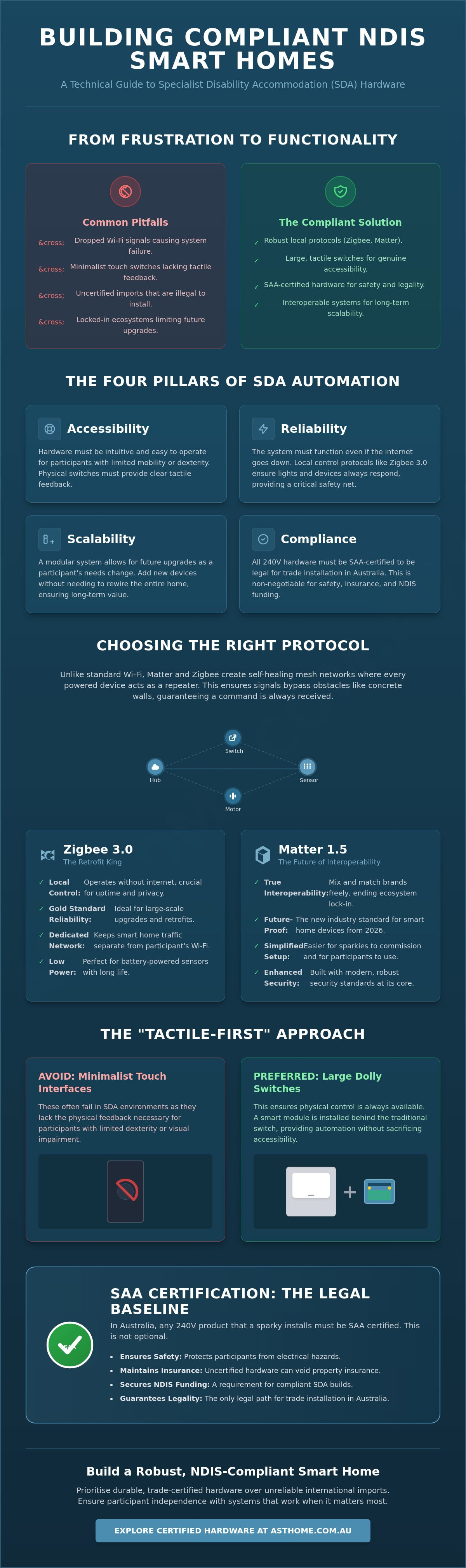
2026 is officially the year of "Matter" for NDIS participants. With the release of Matter 1.5 in late 2025, the industry has finally reached a point of true interoperability. For participants, this means they are no longer locked into a single brand's ecosystem. A smart curtain motor can now talk directly to a motion sensor or a gateway hub from a different manufacturer without needing complex software bridges. This reliability is a game changer for independence. It allows for a "Tactile-First" approach where smart modules are installed behind traditional switches. This ensures that physical control remains an option alongside voice and app commands, providing a safety net if technology fails.
The Four Pillars of SDA Automation
Building for SDA requires a methodical approach to hardware selection. Every device must stand up to four specific criteria to ensure it's fit for purpose:
- Accessibility: Can a participant with limited mobility or dexterity use the physical switch? The hardware must be intuitive and easy to reach.
- Reliability: Does the system work if the internet goes down? Local control protocols like Zigbee 3.0 ensure the lights stay on even during a Wi-Fi dropout.
- Scalability: Can you add more ndis sda home automation products as the participant's needs change? A modular system allows for future upgrades without rewiring the entire house.
- Compliance: Is the hardware SAA certified? In Australia, all 240V products must meet strict safety standards to be legal for trade installation.
SDA Categories and Automation Levels
The level of automation required depends heavily on the SDA design category. For "Improved Liveability" homes, the focus is often on basic smart lighting and climate control to simplify daily routines. In the "Robust" category, hardware must be durable and resistant to tampering. Smart modules hidden behind the wall plate are perfect here because they provide automation without exposing delicate electronics. For "High Physical Support" builds, the requirements are more complex. These properties often integrate assistive home automation technologies like smart door locks, automated curtain tracks, and full environmental control systems that can be operated through a single interface.
Choosing the Right Protocol: Matter vs Zigbee 3.0
Selecting the right communication protocol is a technical decision that impacts every aspect of an SDA build, from installation speed to long term maintenance. For ndis sda home automation products, the choice usually comes down to Zigbee 3.0 or the newer Matter standard. Both offer significant advantages over traditional Wi-Fi, which often struggles with signal dropouts and high power consumption in dense residential environments. Reliability isn't just a convenience feature here; it's a safety requirement for participants who rely on automation for daily tasks.
SDA units often feature reinforced concrete walls or fire rated partitions that act as barriers to standard wireless signals. Both Zigbee and Matter solve this through mesh networking. In this setup, every mains powered device, such as a Zigbee 3.0 Smart Switch Module, acts as a repeater. This creates a self healing web of connectivity throughout the home. If one path is blocked by a closed fire door, the signal simply finds another route. This ensures that a participant's command to operate a Smart Curtain Motor and Track always reaches its destination.
Zigbee 3.0: The Retrofit King
Zigbee 3.0 remains the gold standard for reliability in large scale SDA upgrades and retrofits. It operates on a dedicated Zigbee Gateway Hub, keeping smart home traffic entirely separate from the resident's Wi-Fi network. This is crucial for both privacy and uptime. If the internet goes down, the system continues to function because the logic is handled locally. It's the ideal choice for sensors and modules where battery life and consistent response times are the priority. For contractors, using a Zigbee 3.0 Smart Switch Module behind a standard wall plate is the most reliable way to add intelligence without changing the home's aesthetic.
Matter: The New Universal Standard
The Matter smart home protocol has quickly become the 2026 standard for future proof homes. Its primary benefit is interoperability. A Matter Smart Switch Module can be controlled natively via Apple Home, Google Home, or Alexa without needing brand specific apps or complex software bridges. This simplifies the setup for carers and allows participants to use whichever interface they find most accessible. Matter is designed to work over existing Thread or Wi-Fi networks, making it a flexible addition to modern electrical supplies. Matter is the 2026 standard for future-proof homes, ensuring that the hardware you install today won't be obsolete in three years.
For those looking to combine these technologies into a single, cohesive system, exploring an NDIS SDA Compliant Smart Home Kit is an efficient way to ensure all hardware is compatible and trade certified from day one.
The Large Dolly Advantage: Why Tactile Feedback Matters
Modern smart home design often leans toward minimalist glass touch panels. While these look sleek in a standard showroom, they are often impractical in an SDA environment. For a participant with limited dexterity, tremors, or vision impairment, a flat surface provides no physical target to hit. This is where ndis sda home automation products must prioritise the physical interface. Large Dolly switches provide a substantial surface area that is easy to locate and operate, even for those with significant motor skill challenges.
The importance of the "click" cannot be overstated. A mechanical switch provides immediate auditory and tactile confirmation that an action has been successful. This feedback loop is vital for accessibility. It tells the user the light is turning on or the door is unlocking without them needing to check a phone screen or wait for a visual cue. By pairing these traditional, tactile interfaces with a Zigbee 3.0 Smart Switch Module installed behind the wall plate, you get the best of both worlds: robust physical control and advanced automation.
Accessibility and Motor Skills
Large Dolly designs are specifically engineered to assist those who struggle with fine motor tasks. Instead of requiring precise pressure on a tiny button, these switches allow a participant to use their palm, the side of their hand, or even an elbow to toggle the power. Visual contrast also plays a major role in independent living. Choosing switch colours that stand out sharply against the wall helps low-vision participants navigate their home with confidence. For a deeper look at the various hardware styles available for trade installation, see The 2026 Guide to Smart Light Switches for Australian Homes.
Smart Functionality in a Traditional Form
You don't have to sacrifice the "home" feel of a property to make it smart. Using Large Dolly switches alongside Matter or Zigbee modules allows the residence to maintain a familiar, non-clinical aesthetic. This has a significant psychological benefit for participants in assisted living. Familiar hardware reduces the cognitive load required to manage the environment, making the technology feel like a supportive partner rather than a complex barrier. This approach ensures that ndis sda home automation products provide high-tech solutions through a low-stress, traditional form factor that any visitor or carer can also operate instinctively.
A Buyer’s Checklist: Safety, SAA, and Australian Standards
Compliance is the bedrock of any Specialist Disability Accommodation build. While it's tempting to source hardware from global marketplaces, installing non-compliant ndis sda home automation products is a massive risk. In Australia, any device that connects to the 240V mains power must carry SAA certification. This isn't just a recommendation; it's a legal requirement. If a fire or electrical fault occurs and the hardware lacks the proper Australian approvals, your insurance is likely void. Even worse, it could lead to the loss of NDIS SDA provider registration or a clawback of funding.
Every installation must be performed by a licensed electrician and adhere to AS/NZS 3000:2018, commonly known as the "Wiring Rules." A ruling on this standard was issued in May 2024, reinforcing the strict requirements for electrical safety in residential settings. When you choose trade-grade hardware, you ensure that the sparky can sign off on the job with a Certificate of Electrical Safety (COES). This documentation is vital for your SDA audit trail. It proves that the home is not only smart but also meets the rigorous safety benchmarks required for vulnerable participants.
Certification and Compliance
Identifying safe hardware is straightforward if you know what to look for on the packaging. The Regulatory Compliance Mark (RCM) is the primary indicator that a product meets Australian safety and EMC standards. For SDA providers, SAA certification is non-negotiable because it guarantees the device has been tested under local conditions. Using uncertified "cheap" imports risks the safety of the resident and the integrity of the building's electrical system. For a comprehensive look at regulatory requirements, check out our NDIS SDA Smart Home Technology Australia: The 2026 Resource Guide.
Installation Best Practices
Technical compatibility is just as important as legal compliance. Smart modules must be compact enough to fit within standard Australian wall boxes without crushing the wiring. This is a common pain point for installers. Additionally, many older SDA properties being retrofitted don't have a neutral wire at the switch. In these cases, "No Neutral" Zigbee or Matter modules are a lifesaver. They allow for full automation without the need for expensive and invasive rewiring. Always prioritising trade-grade hardware ensures long-term durability, reducing the need for disruptive maintenance visits that can be stressful for participants.
Ready to secure your project with certified hardware? You can browse our full range of trade-approved ndis sda home automation products to ensure your build is compliant from day one.
Top NDIS SDA Home Automation Products for 2026
By 2026, the standard for a high-performing SDA build is defined by how well the hardware serves the participant. Selecting the right ndis sda home automation products isn't just about picking the newest tech; it's about choosing hardware that works every time. This means prioritising tactile feedback, protocol reliability, and Australian safety compliance. The following products represent the most effective solutions currently available for trade installation in SDA environments.
Automating comfort and safety involves more than just lights. A Smart Power Point (GPO) allows for the remote control and monitoring of essential appliances, while a Smart Motion Sensor can trigger lighting paths for night-time safety. For environmental control, a Smart Curtain Motor and Track is a critical addition. It allows participants to manage privacy and natural light without physical exertion, which is essential in High Physical Support builds. These devices work together to create a home that is responsive, safe, and truly independent.
Standout Accessible Solutions
The Large Dolly range has become the tactile gold standard for 2026. These switches provide a massive, easy-to-hit target for participants with limited dexterity. When you pair these with a Zigbee 3.0 Smart Switch Module, you create a system that looks traditional but performs with modern intelligence. These modules are invisible once installed, tucked neatly behind the wall plate to provide reliable, local control. For those looking to future-proof their builds, the Matter Smart Switch Module offers the same discreet profile with the added benefit of universal interoperability across all major smart home platforms.
Trade Accounts and Professional Support
Successful SDA projects rely on a strong partnership between the provider and a specialised Australian supplier. We understand that electrical contractors and NDIS providers need more than just a box of parts. You need hardware that is trade-grade, SAA certified, and backed by professional expertise. Our business is run by practitioners who know the challenges of on-site installation and regulatory compliance. We offer dedicated trade accounts that provide licensed electricians with the technical support and reliable supply chain required for large-scale SDA projects. It's about ensuring every build is compliant, durable, and ready for the participant to move in.
Ready to equip your next project with the best hardware on the market? Browse our complete NDIS SDA Smart Home Collection here to find trade-certified solutions for every design category.
Future-Proofing Your SDA Build for Long-Term Independence
Selecting the right ndis sda home automation products is about more than just modern convenience; it's about building a foundation for permanent independence. By prioritising Large Dolly switches for tactile feedback and choosing robust protocols like Zigbee 3.0 or Matter 1.5, you ensure the home remains reliable and easy to navigate for years to come. You've already seen why SAA certification is the non-negotiable baseline for Australian trade installations, protecting both the participant's safety and your project's funding.
As an Australian-owned and operated trade supplier, we specialise in hardware that meets these exact standards. Every module and switch in our range is SAA certified for Australia, ensuring your sparky can sign off on the job with total confidence. Don't risk your build on uncertified imports. Instead, choose specialist NDIS SDA hardware designed by practitioners who understand the regional trade industry's unique requirements.
Ready to secure your project? Shop the NDIS SDA Large Dolly Collection today and build a smarter, safer home. We're here to help you get the job done right the first time.
Frequently Asked Questions
Are smart home products covered by NDIS funding?
Smart home products are generally funded by the NDIS if they're considered reasonable and necessary for your specific goals. This hardware often falls under the Assistive Technology budget or is included in the capital funding for new Specialist Disability Accommodation builds. You should consult your Support Coordinator or Plan Manager to ensure the selected ndis sda home automation products align with your current plan and support requirements.
Do I need a special electrician to install NDIS smart home devices?
You don't need a specialised technician, but you must use a licensed Australian electrician for any hardware that connects to 240V mains power. It's a good idea to choose a sparky who's familiar with smart modules and mesh networking. This ensures the installation is robust and they can provide the necessary Certificate of Electrical Safety (COES) required for your SDA compliance and insurance records.
What is the difference between Zigbee and Matter for SDA homes?
Zigbee 3.0 is a proven mesh networking protocol that relies on a dedicated gateway hub, keeping smart traffic off the resident's Wi-Fi. Matter 1.5 is the newer universal standard that allows devices from different brands to work together natively. While Zigbee is often the reliable choice for large-scale SDA builds, Matter is the 2026 standard for future-proofing and ensuring interoperability across Apple, Google, and Amazon platforms.
Can I still use physical switches if I install smart home automation?
Yes, keeping physical switches is actually recommended for accessibility and as a fail-safe. By installing smart modules behind the wall plate, the traditional switch remains fully functional. This setup allows participants to use the physical switch, voice commands, or an app interchangeably. It's a critical feature for ndis sda home automation products, ensuring the home remains usable even if the internet goes down or technology fluctuates.
Why is SAA certification important for smart switches in Australia?
SAA certification is a mandatory legal requirement for any electrical product used in Australian trade installations. It guarantees the hardware meets strict safety standards for local conditions. If you install uncertified international imports, you risk your insurance coverage and the safety of the participant. Always look for the Regulatory Compliance Mark (RCM) to confirm the product is legal and safe for use in your SDA property.
What are the best smart switches for people with limited hand dexterity?
Large Dolly switches are the best physical option for participants with limited dexterity, tremors, or muscle weakness. These switches provide a much larger surface area than standard designs, allowing them to be operated with a palm, side of the hand, or even an elbow. They offer clear tactile and auditory feedback, providing the participant with immediate confirmation that the light or device has been toggled.
How do smart curtain motors help NDIS participants?
Smart curtain motors enhance independence by allowing participants to manage privacy and natural light without physical effort. These can be triggered by voice commands, schedules, or light sensors. For residents with limited mobility, this removes the need to physically reach or pull heavy cords. It also assists with climate control by automatically closing curtains during the hottest parts of the day to keep the home comfortable.
Can I retrofit smart home technology into an existing SDA property?
You can certainly retrofit smart technology without needing to rip out walls or rewire the whole house. Wireless protocols like Zigbee 3.0 are ideal for retrofits because they don't require new data cabling. If your existing wiring lacks a neutral wire at the switch, "No Neutral" modules are available. This makes upgrading to modern automation simple, cost-effective, and far less disruptive for the participant currently living in the home.