

An Australian-certified smart device can still leave questions about cyber security unanswered. That distinction matters when weighing the risks of using non-certified smart devices: electrical faults, interference or weak security may be possible concerns, but certification isn’t a guarantee against every fault or online threat.
It’s reasonable to want confidence that a device is suitable for the Australian market and won’t put your home, privacy or network at unnecessary risk. Separate electrical safety approval from cyber security requirements, then check what a product’s claims and markings actually tell you.
This guide explains the realistic risks, what Australian certification does and doesn’t cover, and practical checks to make before buying or continuing to use a connected device. You’ll also learn why requirements can depend on the product and when it was made. Asthome Smart Electrical Supplies supplies Australian-certified smart-home products, including a broad range of brands and electrical components, with prompt product assistance to help you make an informed choice.
Key Takeaways
- The risks of using non-certified smart devices can include electrical, cyber security, privacy and reliability concerns, but missing certification alone doesn’t prove a device is faulty.
- Check electrical approval and cyber security separately. One doesn’t guarantee the other.
- Before buying or using a device, check its manufacturer, exact product identity, Australian approval information and documentation.
- Consider when a connected device was made, as cyber security requirements may depend on its age and product type.
- Australian-certified products are a sensible starting point. ASTHOME supplies a broad range for the Australian market, with responsive product assistance.
What does 'certified smart device' mean in Australia?
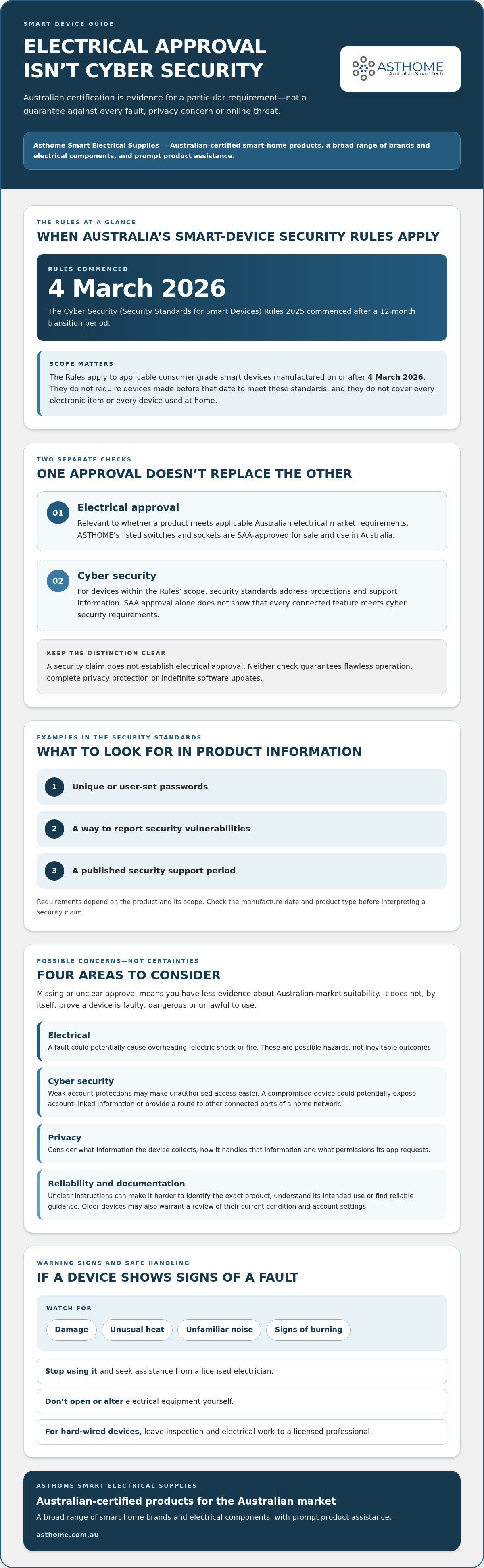
For a smart device, “certified” should point to evidence relevant to its Australian-market requirements. It isn’t one all-purpose badge covering every aspect of a product. Electrical safety approval and cyber security requirements address different risks, so satisfying one doesn’t automatically mean a device satisfies the other.
That distinction is useful when assessing the risks of using non-certified smart devices. Missing or unclear approval may leave you with more uncertainty about a product’s suitability for the Australian market, but it doesn’t prove the device is defective. Equally, electrical approval doesn’t promise perfect safety, privacy or ongoing software support.
ASTHOME’s listed switches and sockets are SAA-approved for sale and use in Australia. That approval is relevant to their Australian-market electrical status, not proof that every connected feature meets cyber security requirements. Smart products form part of the broader Internet of Things (IoT), where devices connect and exchange information, bringing separate security and privacy considerations.
Electrical safety approval and cyber security are different checks
Electrical approval concerns a product’s suitability as electrical equipment for the Australian market. Cyber security requirements address protections built into applicable network-connected products. For example, Australia’s smart-device rules cover matters such as unique or user-set passwords, a way to report vulnerabilities, and a published security support period. These are distinct checks, not interchangeable certificates.
Don’t treat SAA approval alone as evidence that a device meets every cyber security requirement. A security claim doesn’t establish electrical approval either. Look at each question separately, using product-specific information rather than relying on a broad “certified” statement.
What changed under Australia’s smart-device security rules?
The Cyber Security (Security Standards for Smart Devices) Rules 2025 commenced on 4 March 2026, after a 12-month transition period. They apply to applicable consumer-grade smart devices manufactured on or after that date, including many household products that connect to the internet or other networks. The Australian Government Department of Home Affairs provides guidance on the security standards.
The Rules don’t require devices manufactured before 4 March 2026 to meet these standards. Their scope also depends on the product: they don’t cover every electronic item or every device that might be used in a home. A product’s manufacture date and type matter when interpreting a security claim.
- Electrical approval: relevant to whether the product meets applicable Australian electrical-market requirements.
- Cyber security: relevant to protections and support information required for devices within the Rules’ scope.
- Product assurance: neither check guarantees flawless operation, complete privacy protection or indefinite software updates.
Think of certification as evidence for a particular requirement, not a blanket assurance. Confirm what the evidence applies to, then consider the separate electrical and cyber security questions before choosing a connected product.
What are the risks of using non-certified smart devices?
The risks of using non-certified smart devices depend on the product, its condition and how it connects to your home. If Australian approval information is missing or hard to verify, you have less evidence about its suitability for the local market. That uncertainty is a reason to look closer, not proof that the device is faulty, dangerous or unlawful to use.
Risks can be electrical, digital or practical. An older device, for example, may not fall under later security rules, yet still warrant a review of its manufacturer information, account settings and current condition.
Electrical safety and product-quality concerns
Without clear Australian product approval, you may have less assurance that the device has been assessed against relevant local requirements. A fault could potentially lead to overheating, electric shock or fire, but these are possible hazards, not inevitable results of unclear certification. The risk also depends on the product and how it’s used.
Take warning signs seriously. If a device is damaged, unusually hot, making an unfamiliar noise or showing signs of burning, stop using it and seek assistance from a licensed electrician. Don’t open or alter electrical equipment yourself. For hard-wired devices, leave inspection and electrical work to a licensed professional.
Unclear documentation can also make it harder to identify the correct product, understand its intended use or find reliable instructions. Keep the packaging and product details where possible, especially for devices already installed in the home.
Cyber security, privacy and device reliability
A connected device with weak account protections may be easier to access without permission. If an account is compromised, someone could potentially view information linked to that account or use the device as a route to explore other connected parts of a home network. These are possible outcomes, not a prediction that every device without clear certification will be hacked.
Privacy exposure depends on what information a device collects and how it handles that information. Before connecting a product, consider the permissions its app requests and whether the manufacturer explains its security support. If the support period or update process is unclear, it may be harder to know how long vulnerabilities will be addressed.
- Account security: weak or shared passwords can make unauthorised access easier.
- Privacy: unclear data practices can leave you less informed about what information the device or app collects.
- Reliability and support: poor instructions or limited support can make faults, setup issues and security updates harder to manage.
If an older product still works, don’t assume it must be discarded solely because its certification details are unclear. Review its condition, documentation and available security information, then weigh what you can verify against how the device is used. ASTHOME supplies Australian-certified smart-home products for the local market, including switches and sockets, with product assistance to help you make an informed choice. Explore Australian-certified smart-home products as a starting point for your next purchase.
How do Australian certification and security requirements compare?
Match the evidence to the question. Electrical approval relates to a product’s Australian-market electrical requirements. Cyber security compliance under the Cyber Security (Security Standards for Smart Devices) Rules 2025 is separate, and its scope depends on the device and its manufacture date. The Australian Government Department of Home Affairs provides guidance on the security standards.
| Check | What it relates to | What buyers should consider |
|---|---|---|
| Electrical approval | Applicable Australian electrical product requirements. | Look for product-specific Australian approval information. SAA approval is relevant to ASTHOME’s listed switches and sockets. |
| Cyber security Rules | Built-in security requirements for applicable consumer-grade smart devices. | Check whether the product falls within the Rules’ scope and whether its security information is clear. |
| Device age | The Rules apply to in-scope devices manufactured on or after 4 March 2026. | Use the manufacture date, not just the purchase date, when considering whether the Rules apply. |
| Buyer relevance | Electrical approval and cyber security address different concerns. | Consider both. Neither mark nor compliance statement guarantees a fault-free device or protection from every cyber attack. |
Which devices fall within the 2026 cyber security rules?
The Rules cover most applicable consumer-grade devices intended for personal, domestic or household use that connect to the internet or other networks. They apply to in-scope products manufactured from 4 March 2026, the commencement date. Some product categories are excluded under the official guidance, so don’t assume every electronic device in a home is covered.
Devices made before that date aren’t required to meet these standards under the Rules. That describes the Rules’ scope; it doesn’t, by itself, determine whether an older device is safe to use or suitable for your needs.
What certification can and cannot tell a buyer
SAA approval is an electrical-safety signal for applicable listed ASTHOME products, including switches and sockets. It isn’t a cyber security assessment. Likewise, a cyber security compliance statement addresses the Rules’ requirements for an applicable device, not its electrical approval. Treat each as evidence for a specific purpose, then assess the product details that matter to your setup.
This distinction puts the risks of using non-certified smart devices in perspective. Missing or unclear evidence can make it harder to judge a product’s suitability, but it doesn’t establish that a device has a defect or is automatically unlawful to use. Clear electrical approval and relevant security information can help you make a more informed choice, without promising perfect safety, privacy or ongoing support.
How can you assess a smart device before buying or using it?
A careful review turns vague product claims into evidence you can compare. Use the same checks before buying a device and when reviewing one already at home. The risks of using non-certified smart devices can’t be judged from a label alone, so consider the product identity, Australian approval information and security details together.
- Identify the exact product. Record the manufacturer, model number and, where available, manufacture date. Match these details across the device, packaging and instructions. If they differ or are missing, pause before relying on a general claim about the brand or product range.
- Review Australian electrical approval information. Look for product-specific approval details and make sure they relate to the model in front of you. Where relevant, the model can be checked against the EESS public database. ASTHOME’s listed switches and sockets are SAA-approved for sale and use in Australia.
- Read the supplied documentation. Check that instructions identify the manufacturer and explain setup and intended use clearly. Keep the manual, packaging and purchase details. Clear documentation makes it easier to identify the device and understand what to do if it develops a fault.
- Review cyber security information. Look for an explanation of password setup, how to report a security vulnerability and how long security support is intended to continue. For devices within the Rules’ scope, these details help you assess whether relevant security information is provided. Don’t assume an electrical approval covers these points.
- Consider the manufacture date and current condition. The cyber security Rules apply to applicable devices manufactured on or after 4 March 2026. For older products, don’t infer non-compliance from age alone. Review available support information and check for damage or unusual operation before continuing to use the device.
Match approval details to the product
A mark or approval statement is most useful when it can be connected to the exact model, rather than a similar-looking product or a broad brand claim. Compare the model details on the device with the paperwork and approval information. If the information is unclear, treat that as a reason to pause and investigate, not proof that the product is non-compliant.
Assess security information separately
Check whether the manufacturer explains how to set a password, report security issues and access support information. The Rules’ requirements depend on product type and manufacture date, so don’t assume they cover every connected device. A missing detail deserves further scrutiny, but doesn’t by itself establish a breach or prove the device is unsafe.
ASTHOME supplies Australian-certified smart-home products for the local market, with product assistance to help you assess your options. Explore Australian-certified smart-home products when you’re ready to compare devices.
Choose Australian-certified smart devices with confidence
Australian certification is a sensible starting point when choosing a connected product for your home. It helps you assess relevant local requirements, but it isn’t a catch-all guarantee. Keep the two checks in view: electrical approval relates to electrical safety, while cyber security requirements concern protections for applicable connected devices. Consider both, along with the product’s documentation and intended use.
This balanced approach puts the risks of using non-certified smart devices in perspective. Unclear approval details are a reason to pause and review the evidence, not automatic proof that a device is faulty. A clear approval mark, in turn, doesn’t guarantee privacy, fault-free operation or ongoing software support.
Why local product sourcing can make the decision clearer
Product information that addresses the Australian market can make it easier to assess a device’s suitability here. Look for details tied to the exact product, rather than relying on a general claim about a brand or an overseas mark alone. Local sourcing doesn’t guarantee electrical safety or cyber security, so assess each aspect separately.
ASTHOME supplies Australian-certified smart-home products for the local market, with a broad range of brands and electrical components. Its listed switches and sockets are SAA-approved for sale and use in Australia. That’s useful electrical approval information for those categories, not evidence that every connected feature has passed a cyber security assessment.
Find smart-home products suited to your next project
Start with the product category and the job it needs to do. If you’re comparing wall controls, an Australian smart light switches guide can help you consider the options. For protocol-specific research, a Matter smart switch guide is a useful companion. For homeowners expanding into larger connected energy hardware, platforms like chargingshop.eu demonstrate how modern electric vehicle chargers integrate smart networking with high-capacity electrical equipment. Then check the exact model’s Australian approval information and review its separate security details where applicable.
ASTHOME’s range includes smart switches and modules, dimmers, curtain motors, door locks, sensors, hubs and smart power points. Prompt product assistance can help you make sense of product information as you compare options. For hard-wired products, arrange installation through a licensed electrician rather than attempting electrical work yourself.
- Check the product identity: match the model across the device, packaging and documentation.
- Review electrical approval: confirm what the approval relates to, and don’t treat it as a cyber security guarantee.
- Review security information: consider password setup, vulnerability reporting and support details where applicable.
Ready to compare products for your setup? Explore ASTHOME’s smart-home and electrical range.
Make your next smart-home choice with confidence
Use your next purchase as a chance to build a more considered smart-home setup. Keep product details and documentation together, and review them when you replace a device or add one to your network. That habit makes it easier to assess suitability and support over time, rather than relying on a label or product claim alone. The same careful diligence applies across modern electrical equipment—whether you are configuring automated controls or exploring advanced home wellness technology from Pureffect, reviewing manufacturer documentation ensures long-term reliability.
The risks of using non-certified smart devices are best managed with clear, product-specific information and separate attention to electrical approval and cyber security. Verified licensed electrical professionals can also access ASTHOME trade accounts for their purchasing needs.
For your next project, explore ASTHOME’s Australian-certified smart-home products.
Frequently Asked Questions
Is it illegal to use a non-certified smart device in Australia?
Not necessarily. The term “non-certified” alone doesn’t settle whether a particular device is illegal to use. The answer depends on what approval is missing, the product type and which Australian requirements apply. The smart-device security Rules relate to applicable products manufactured from 4 March 2026; they don’t establish that every older device is illegal for household use. Check the exact product and relevant official guidance before drawing a conclusion.
What are the risks of using a non-certified smart device?
The risks of using non-certified smart devices can include less assurance about Australian electrical suitability, unclear security protections or difficulty getting useful product support. For example, if a connected sensor stops responding, incomplete instructions may make it harder to work out whether the issue is the device, its app or the network. These possibilities don’t prove a product is defective or compromised. Review the model-specific documents before deciding whether to buy or keep it.
Does SAA approval mean a smart device is cyber secure?
No. SAA approval relates to the electrical status of applicable products, not the strength of their account protections or the handling of connected data. An approved smart switch may still have security information you’ll want to review, such as how passwords are set and how long support is provided. Treat electrical approval and cyber security information as separate evidence. Neither promises protection from every fault or attack.
Do Australia’s smart-device security rules apply to older devices?
Devices manufactured before 4 March 2026 aren’t required to meet the security standards under these Rules. The Rules apply to most applicable household smart devices manufactured on or after that date, but product type matters too. If you bought a device after commencement, that doesn’t necessarily mean it was manufactured after commencement. Check the device or packaging for its manufacture date, then use the Australian Government guidance to assess the product’s scope.
Can a smart device be electrically approved but still have cyber security risks?
Yes. Electrical approval doesn’t show whether a connected product has strong digital protections. An electrically approved device might still provide limited information about password setup, security support or how to report a vulnerability. Those gaps don’t prove it has been compromised, but they can make its ongoing security harder to assess. Review the manufacturer’s information for the specific model, rather than assuming one approval covers every risk.
What should I do if I am unsure whether a smart device is safe?
Start by recording the manufacturer and model, then compare those details with the packaging, instructions and Australian approval information. Review the product’s security details and manufacture date as well. If you notice damage, unusual heat or signs of burning, stop using it. For a hard-wired device, don’t open or alter it yourself. Seek assistance from a licensed electrician. Unclear paperwork calls for further investigation, not an automatic verdict that the device is unsafe.
Ready to choose an Australian-certified smart-home product for your next project? Explore ASTHOME’s range or get prompt product assistance.