

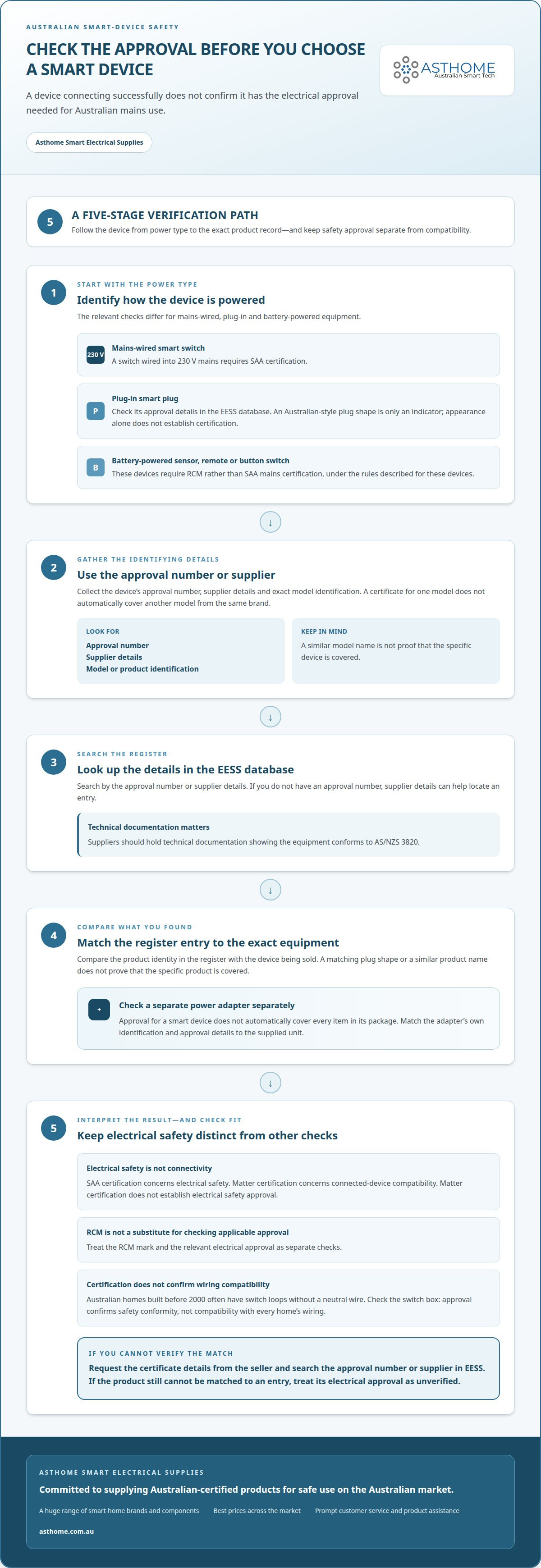
A smart switch can connect flawlessly and still lack the electrical approval needed for Australian mains use. To tell whether a smart device is SAA approved, search the EESS database using its approval number or supplier details. Smart switches wired into 230 V mains require SAA certification.
It’s easy to confuse electrical safety approval with universal connectivity standards, especially when both appear in product information. They address different questions: SAA approval relates to electrical safety, while connectivity certifications concern device interoperability and smart home integration.
This guide explains how to search the EESS register, which details to match and how to interpret the result. Here at Asthome Smart Electrical Supplies, we want to help you assess a smart device for the right reasons before choosing one for an Australian home.
Key Takeaways
- Search the EESS database by approval number or supplier details to look for a smart switch’s SAA approval.
- Keep electrical safety and Matter compatibility separate: Matter certification doesn’t establish electrical safety approval.
- Identify whether a device is mains-wired, plug-in or battery-powered, as the relevant compliance checks differ.
- Understand what the RCM mark indicates and why it isn’t a substitute for checking the applicable electrical approval.
- Learn what to look for when assessing imported switches and explore Australian-market smart switch options from Asthome Smart Electrical Supplies.
What about plug-in smart plugs and battery devices?
Plug-in, battery-powered and mains-wired devices don’t all follow the same checks. In Australia, start by identifying how the device is powered and what its certification covers.
Conformity with electrical standards
Conformity means electrical equipment meets the applicable Australian Standard or an adopted international standard. This matters because overseas approval alone doesn’t establish compliance with Australian electrical safety requirements. For switches and wall-mounted controls, AS/NZS 3820 and AS/NZS 60669 are associated with Australian safety certification. According to the Electrical Equipment Safety System (EESS), suppliers should hold technical documentation showing equipment conforms to AS/NZS 3820.
For a plug-in smart plug, check the product’s approval details in the EESS database using its approval number or supplier. The Australian-style plug shape, associated with AS/NZS 3112, is a useful indicator, but appearance alone doesn’t establish certification. Compare the product identity in the register with the device you’re considering. A similar model name or matching plug doesn’t prove that the specific product is covered.
Approval for smart devices and power adapters
SAA approval applies to the electrical equipment identified by its certificate, rather than automatically covering every item in a package. If a smart device comes with a separate power adapter, the device’s approval alone doesn’t show that the adapter is covered. Check the adapter’s own identification and approval details, and match them to the supplied unit before relying on the certification.
Wi-Fi or Bluetooth connectivity doesn’t replace electrical safety certification. Wireless equipment may have separate ACMA-related compliance obligations for radio or communications matters. Treat those as distinct from checks for electrical safety.
Under the rules described for these devices, battery-powered sensors, remotes and button switches require RCM rather than SAA mains certification. This distinction matters when comparing a battery sensor with a smart switch wired into household mains. SAA Approvals certifies electrical equipment to Australian and New Zealand standards to support compliance with legal requirements for manufacturing and selling electrical equipment in Australasia.
Security requirements are another separate layer. Australia’s mandatory minimum security standard for smart devices came into effect on 4 March 2026. Relevant requirements address matters such as product-specific passwords and security reporting, but they don’t establish electrical safety approval. The proposed Australian Security Labelling Scheme for Smart Devices is intended to help consumers compare security claims; its pilot begins in October 2026.
Finally, check the switch box before choosing a wired smart switch. Australian homes built before 2000 often have switch loops without a neutral wire. That can affect whether a particular switch is compatible, independently of its SAA certification. Approval confirms safety conformity, not compatibility with every home’s wiring.
Matter certification versus electrical safety approval
Matter certification and SAA approval answer different questions about a smart device. One concerns connected-device compatibility; the other concerns electrical safety.
Certificates for regulated electrical equipment
A certificate records that specified regulated electrical equipment has been assessed against applicable safety requirements. Its product details matter: a certificate for one model doesn’t automatically cover another model from the same brand. SAA Approvals issues certificates for regulated equipment shown to comply with applicable Australian or New Zealand safety standards. Those certificates are recognised in Australia and New Zealand.
According to the Electrical Equipment Safety System (EESS), suppliers should hold technical documentation demonstrating conformity with AS/NZS 3820. Match the certificate’s model or product identification to the device being sold. A Matter logo or a general statement about electrical certification doesn’t identify which equipment a certificate covers.
Requesting certificates from sellers
Request the certificate details for the exact device, including its model identification and approval number. Search these in the EESS database and compare the result with the product listing. If you don’t have an approval number, supplier details can help locate an entry. Confirm that the listed equipment matches the model being sold.
If a smart device sold in Australia has no verifiable approval, pause the purchase and request its certificate details from the seller. Search the approval number or supplier in EESS. If you still can’t match the product to an entry, don’t treat its electrical approval as verified.
The meaning of SAA certification
SAA certification is third-party certification of electrical equipment against applicable Australian or New Zealand safety standards. SAA Approvals is accredited by the Joint Accreditation Service of Australia and New Zealand (JAS-ANZ) as a third-party certification body for electrical equipment. The certification concerns safety conformity, not a smart device’s ability to connect with other products.
Matter certification concerns connected-device compatibility, while SAA certification addresses electrical safety. A device may have Matter certification and still need the relevant electrical approval for its power supply and intended use. Treat each claim separately and match approval details to the specific product.
SAA approval and RCM compliance
SAA approval and RCM compliance aren’t interchangeable. SAA certification is evidence of an electrical safety assessment for the equipment identified on its certificate. The RCM is a mark used for regulatory compliance, so seeing the mark alone doesn’t tell you which SAA certificate covers a particular device.
For electrical equipment, check the model and approval details rather than relying on a Matter mark, an RCM logo or a seller’s general claim. These indicators serve different purposes. A clear match between the product and its certificate is useful confirmation of electrical safety.
Risks of non-compliant imported switches
An overseas approval doesn’t necessarily show that a smart switch meets Australian electrical safety standards. A switch intended for Australian 230 V mains needs the relevant SAA certification. Without verifiable approval, its internal design and testing may not match local electrical conditions.
The risk isn’t about where a product was made. It’s whether the specific model has been assessed for the conditions it will face in Australia. Approval from another country doesn’t automatically establish compliance with Australian requirements. Check the details for the actual model, not just the brand or a similar-looking switch.
Defective wiring in an uncertified electrical product can increase the risk of fire, power surges and arc faults. These are practical safety concerns, not just paperwork issues. An electronic switch controls a mains circuit, so weak internal connections or unsuitable components can matter during normal operation.
Some imported smart switches use 0.5 mm² internal wiring rated for a 6 A continuous load. An Australian circuit can deliver 10-16 A. That comparison doesn’t prove every imported switch is unsuitable, but it shows why a product’s construction and certification must match its intended use. A wireless feature or Matter logo says nothing about the wiring’s capacity.
Voltage testing is another point to consider. Some imported smart switches are tested at 110 V or 220 V rather than 230 V. Testing at a different voltage doesn’t demonstrate that a particular model has been assessed for Australian mains conditions. Look for approval that applies to the exact product, rather than relying on a broad claim that it works internationally.
Before installation, use a practical sequence:
- Match the switch model and approval number to an EESS register entry.
- Check that the approval applies to the complete switch, not just a related model.
- Confirm its intended electrical use against the product’s documentation.
- Leave installation to a licensed electrician, particularly for a mains-wired device.
This process separates electrical approval from marketing claims. If the product details don’t match a verifiable register entry, don’t treat the switch as approved. A low price, familiar app or successful connection to a hub can’t replace evidence of electrical certification.
Australia’s smart-device security scheme addresses a different issue. Security labelling is intended to help consumers compare security claims; it doesn’t establish electrical safety. For a mains-wired switch, assess safety approval and security information separately.
For an Australian installation, the decision is straightforward: choose a switch with approval that can be matched to its exact model. Connectivity may make a device convenient, but electrical certification addresses whether it meets relevant safety requirements.
How do I verify an Australian RCM mark for a smart device?
Start with the product itself. Devices sold after 1 March 2013 should carry the RCM logo. Treat the mark as an initial check, then compare the product’s approval details with an entry in the EESS/RCM database. A logo alone doesn’t identify which model or certificate applies.
Search the EESS database using the product’s approval number or supplier. SAA Approvals certificates under the RECS scheme are uploaded to the EESS/RCM database. This lets you check whether the approval information corresponds to the device instead of relying only on a mark printed on its casing or packaging.
Use a consistent comparison:
- Locate the RCM logo on the device or its product information.
- Record the model name and any approval number shown for that product.
- Search the approval number or supplier in the EESS database.
- Compare the database entry with the model and supplier details on the device.
For example, if a smart switch carries an RCM logo, search its approval number or supplier. Check that the register result relates to that switch, not a different model from the same supplier. If the listing includes a model identifier, compare it with the product label and documentation. Similar branding alone doesn’t show that the entry covers the exact device.
The RCM mark and SAA approval relate to compliance checks, but they don’t mean the same thing. The RCM logo is a mark to look for on applicable devices. SAA certification concerns electrical safety approval for the equipment identified by its certificate. For a mains-wired smart switch, look for the RCM logo and check its approval details in EESS.
Keep the product information together while comparing details. A product listing may use a different name from the label, or the approval number may appear in supporting documentation. Match the supplier and model identifiers across those records. Don’t assume a mark on the package proves that every included component has the same approval.
If the database entry doesn’t clearly match the device, ask the seller for the approval number or supplier details associated with that exact model. Search those details in EESS. A verified match is more useful than a logo image or a broad compliance claim. Treat the RCM mark as one check, not a substitute for matching the product to its approval record.
Is SAA approval the same as RCM compliance in Australia?
No. SAA approval and the Regulatory Compliance Mark (RCM) are related, but they aren’t interchangeable. SAA certification applies to the electrical safety of equipment identified by its certificate. The RCM is a mark shown on products to indicate regulatory compliance. For an electrical smart device, one doesn’t replace checking the other.
Consider a mains-wired smart switch. Its SAA certificate relates to the switch’s electrical safety conformity, while the RCM logo is a separate visible mark on the product. Seeing the logo doesn’t show which safety certificate applies, so compare the switch’s model details with the EESS register entry.
Electrical products sold in Australia must be covered by an SAA certificate and labelled to show this. Devices sold after 1 March 2013 should carry the RCM logo. These checks concern different evidence: one is a certificate for identified equipment; the other is a mark on the device. Neither Matter compatibility nor a successful wireless connection establishes either point.
Use this sequence to assess a product:
- Find the RCM logo on the device or its product labelling.
- Record the device’s exact model and supplier details.
- Search the EESS database using the approval number or supplier.
- Compare the register entry with the model you intend to buy.
SAA Approvals certificates issued under the RECS scheme are uploaded to the EESS/RCM database. A search result is useful only if its equipment details match the product. A result for another switch from the same supplier, for example, doesn’t establish that your chosen model is covered.
Keep the product’s power components in view, too. A smart device supplied with a separate adapter includes more than one electrical item to identify. Certificate details must correspond to the equipment they cover. Don’t assume a mark or certificate for the main device automatically covers a separate adapter.
In practice, the RCM logo is a visible compliance indicator, while an SAA certificate provides product-specific electrical safety evidence. Check both where relevant, then match the certificate to the exact model. If the mark is present but the register details don’t line up, the logo alone doesn’t resolve the mismatch. This careful check separates labelling, safety certification and smart-home connectivity.
Asthome Smart Electrical Supplies
Asthome Smart Electrical Supplies supplies Australian-certified products that are safe for use on the Australian market, with SAA approval and the RCM logo. Its huge range includes smart-home products and electrical components from a variety of brands.
Options include Matter Smart Switch Modules, Zigbee 3.0 Smart Switch Modules, Smart Zigbee Dimmer Modules and Smart Wi-Fi Light Switches. Asthome offers some of the best prices across the market on smart-home products and components. Its fantastic customer service includes prompt responses and product assistance.
For product questions or help choosing components for your setup, contact Asthome Smart Electrical Supplies.
Choose your next smart-home device with confidence
Knowing how to tell if a smart device is SAA approved gives you a practical basis for choosing products for your home or project. Treat electrical safety, wireless compatibility and fit with your existing setup as separate decisions. Note the device model and intended use before comparing options, so your questions focus on the unit you plan to use.
This approach helps whether you’re considering a single control upgrade or planning a broader connected setup. Asthome Smart Electrical Supplies can assist with product questions and help you consider smart-home components in light of your requirements. Keep the device’s intended role and the information you’ve found about it at the centre of that discussion.
For help with your next product decision, contact Asthome Smart Electrical Supplies. A clear question about the device and how you plan to use it is a useful place to start. Take the next step with confidence and choose the smart-home equipment that suits your plans.
Frequently Asked Questions
Can I search the SAA register by company name?
Search the EESS database using supplier details or an approval number. To understand how to tell if a smart device is SAA approved, treat a company-name result as a lead, not confirmation for every product it sells. Match the listed equipment details to the device model. An entry for one smart switch, for example, doesn’t establish approval for another switch from the same supplier.
What is SAA approval?
SAA approval is third-party electrical safety certification for equipment assessed against applicable Australian or New Zealand standards. It applies to the product identified by the certificate, not automatically to every device from the same brand. A certificate for a particular switch model shouldn’t be assumed to cover another model or a separate power adapter. Check the equipment identification in the approval record.
What does SAA approval mean for electrical products in Australia?
For an electrical product, SAA approval indicates that the equipment identified by its certificate has been assessed against applicable safety requirements. The certificate distinguishes product-specific safety assessment from claims about wireless functions or smart-home compatibility. Matter certification describes connectivity, while SAA approval concerns electrical safety. Check the certificate’s model details to confirm it relates to the product being sold.
How can I check whether a smart device has a valid SAA approval certificate?
Find the device’s approval number or supplier details, then search the EESS database. This is the practical way to tell if a smart device is SAA approved: compare the register entry’s equipment identification with the model label and product documentation. According to the Electrical Equipment Safety System (EESS), suppliers should hold technical documentation demonstrating conformity with AS/NZS 3820. Assess a separate adapter against its own identification and documentation.
Where can I search the SAA certification database by brand or model number?
Search the EESS database by approval number or supplier details, then compare the result with the brand and model information on the device. A brand name alone may relate to several products, so it can’t establish that a specific model is covered. If the result doesn’t show the model number, use the supplier’s details to locate the relevant record and confirm the equipment identification.
What Australian electrical safety rules apply to smart devices and chargers?
Smart switches wired into Australian mains require SAA certification. Battery-powered devices such as sensors, remotes and button switches fall under different rules and require RCM, not SAA mains certification. Treat a charger or power adapter as a separate item when checking product documentation: approval for the smart device doesn’t automatically show that its adapter is covered. According to the Electrical Equipment Safety System (EESS), suppliers should hold technical documentation for AS/NZS 3820 conformity.
How can I tell if an SAA certificate or approval label is fake or expired?
Search the approval number or supplier in the EESS database and confirm that the listed product matches the exact model. If you can’t match it to an entry, don’t treat its electrical approval as verified.