

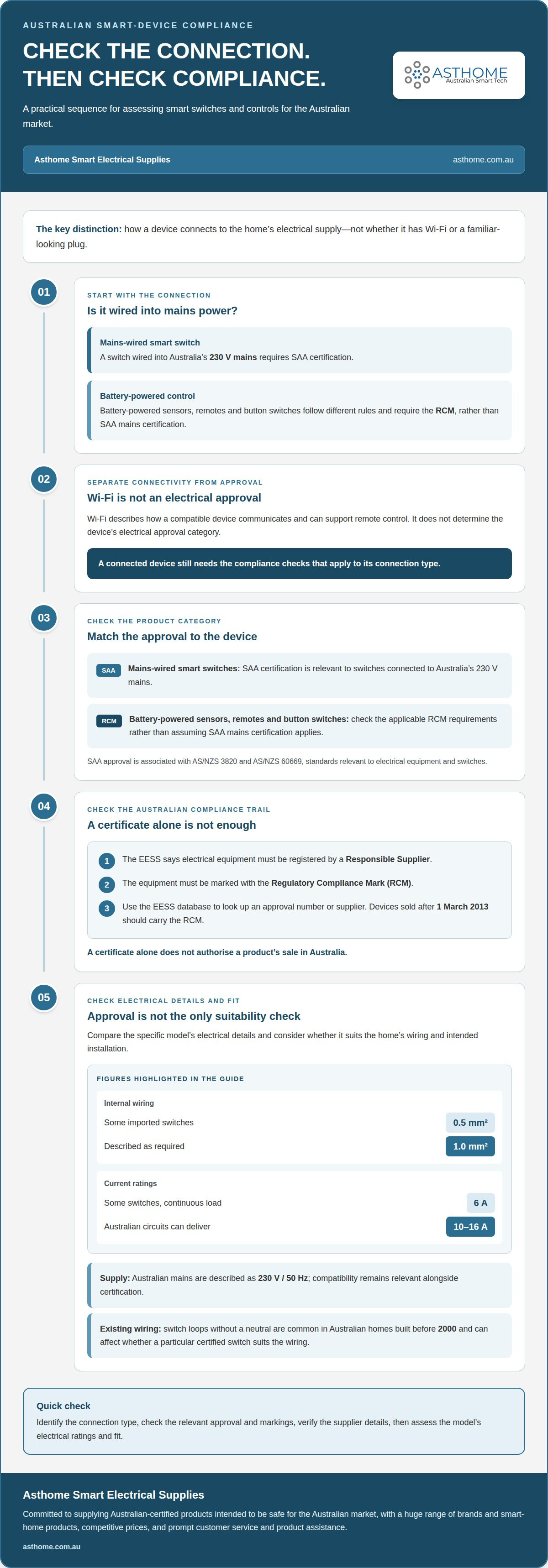
Asthome Smart Electrical Supplies is committed to supplying Australian-certified products that are safe for use on the Australian market. For homeowners looking to upgrade, the right approval depends on how a smart device connects: a smart switch wired into Australia’s 230 V mains requires SAA certification, while battery-powered sensors, remotes and button switches follow different rules and require the Regulatory Compliance Mark (RCM) rather than SAA mains certification.
Wi-Fi capability or a familiar plug doesn’t determine whether a device is approved. When choosing darwin SAA approved smart devices, the key distinction is the electrical connection and the compliance marking that applies to that product category.
This guide explains what SAA certification means for mains-wired smart switches, how Wi-Fi connectivity relates to approval, and what to understand about plug-in smart plugs and battery devices. You’ll also learn how the RCM and Australian equipment registration fit into the picture, helping you understand the requirements for each product.
Key Takeaways
- Assess Asthome smart switches by how they connect to the home. A switch wired into Australia’s 230 V mains requires SAA certification.
- Wi-Fi describes how a device communicates, not its electrical approval category. Asthome considers connection to mains power a key distinction when supplying products for Australia.
- Battery-powered sensors, remotes and button switches may be subject to different compliance considerations from mains-wired switches.
- According to the Electrical Equipment Safety System (EESS), electrical equipment must be registered by a Responsible Supplier and marked with the RCM; a certificate alone doesn’t authorise its sale in Australia.
- Asthome is committed to supplying Australian-certified products that are safe for the Australian market. Consider a smart device’s connection type and compliance markings together, rather than assuming one approval applies to every product.
What SAA certification means for Australian smart switches
For a switch wired into Australia’s 230 V mains, SAA certification is a relevant safety approval. SAA approval is associated with AS/NZS 3820 and AS/NZS 60669, standards relevant to electrical equipment and switches. Asthome is committed to supplying Australian-certified smart switches and products intended to be safe for the Australian market. When comparing devices, distinguish mains-wired products from battery-powered controls.
Technical suitability matters alongside approval. Some imported switches use 0.5 mm² internal wiring, compared with 1.0 mm² described as required. Some are rated for 6 A continuous load, while Australian circuits can deliver 10-16 A. These figures underline why Asthome focuses on certified products with suitable electrical ratings and construction, not just app or wireless features.
Importing or selling a smart switch in Australia involves more than holding a certificate. The Electrical Equipment Safety System (EESS) says electrical equipment must be registered by a Responsible Supplier and marked with the Regulatory Compliance Mark (RCM); a certificate alone doesn’t authorise its sale. The EESS also requires equipment sold in Australia to be electrically safe, including during transitional allowances. Asthome’s commitment is to offer products certified for the Australian market.
There isn’t one price for SAA-approved smart devices in Darwin. Cost depends on the device and its features, such as whether a switch also offers dimming. Asthome offers a huge range of smart home products and components across different brands, with competitive prices. A brand name alone doesn’t establish approval, so assess the specific model and its compliance details.
A non-approved switch raises questions about its electrical safety and suitability for Australian conditions. Wireless functions don’t establish that a device’s electrical design is appropriate. For Darwin homes, don’t treat an app connection or brand name as evidence of compliance. Check the specific model’s approval and electrical details; Asthome can provide prompt customer service and assistance with its products.
Darwin residents can source compliant products through local electrical retailers or Australian online suppliers. Compare the product’s model and compliance details, and use the EESS database to look up an approval number or supplier. Devices sold after 1 March 2013 should carry the RCM. These checks help buyers assess SAA-approved smart devices for Darwin, while Asthome’s certified offering supports choosing products intended to be safe for the Australian market.
Australian electrical safety certification is administered through the EESS in 2026. Australian mains are described as 230 V / 50 Hz, so compatibility remains relevant alongside certification. Switch loops without a neutral are common in Australian homes built before 2000, which can affect whether a particular certified switch suits existing wiring.
Victoria's Electrical Safety Act 1998 is an example of state legislation governing installation of uncertified switches. The potential saving from buying an uncertified mains-wired switch is AU$10-30 per device, but that saving should be weighed against the compliance issue. Australian GPOs use 84 mm vertical mounting centres, a fitting detail that may matter when assessing an intended replacement.
Wi-Fi-connected devices
Wi-Fi lets compatible home devices communicate over a network and supports remote control. In a Darwin home, this can mean adjusting lighting, appliances or cooling through a connected system. Asthome focuses on supplying Australian-certified products that are safe for use on the Australian market.
Start with the task when choosing a device. A Wi-Fi light switch can provide app control for connected lighting, while a smart power point can connect a plug-in appliance to a smart-home setup. Asthome offers a wide range of brands and smart-home products and components at competitive prices. The exact function depends on the device, so match it to the appliance or light you want to control.
Scheduling is another practical use. Home automation can switch lights or appliances off when they’re not needed, or turn them on at a planned time. For example, a lighting schedule can help manage lights around regular household routines. Motion sensors can also trigger automation, prompting a linked device to respond to activity in the home.
Wi-Fi-connected controls can also help manage comfort. Remote control lets occupants adjust heating or cooling before arriving home. Retrofit controllers can provide app control and scheduling for most existing split air-conditioning systems without replacing the unit. This may suit households that want scheduled control while keeping their current split system.
Smart air-conditioning controls may also support solar-aware scheduling. A system can be set to run when solar power is being produced. This is a control option, not a guarantee of energy savings. The outcome depends on the household’s equipment and power-use patterns.
Separate network function from electrical installation. Wi-Fi describes how a compatible device communicates; it doesn’t explain how the device connects to the home’s electrical supply. Wireless features don’t replace the need to consider the product’s electrical category and Australian compliance requirements. Asthome’s commitment to Australian-certified products helps customers choose products intended to be safe for the Australian market. This distinction helps when selecting a mains-connected switch or plug-in product.
Plan the setup around the devices you want to control. List the lighting, appliances or cooling functions, then identify which need remote access, schedules or motion-triggered automation. This gives you a clearer basis for choosing between a smart Wi-Fi light switch and other connected equipment. Asthome’s smart Wi-Fi light switch is one option for Wi-Fi-based lighting control. Asthome also offers prompt customer service and assistance with its products.
Which smart devices require SAA approval in Australia?
The key distinction is whether a device connects directly to mains power or runs on batteries. A smart switch wired into a home’s 230 V mains requires SAA certification. Wi-Fi, Zigbee or another communication method doesn’t change that electrical connection. A wireless switch can still be a mains-wired electrical device. This distinction informs Asthome’s commitment to supplying Australian-certified products that are safe for the Australian market.
Battery-powered sensors, remotes and button switches belong to a different category. They require the Regulatory Compliance Mark (RCM), rather than SAA mains certification. A battery motion sensor and a wall switch wired into mains power, for example, shouldn’t be assessed as the same type of product. Their smart-home roles may overlap, but their power sources differ.
Plug-in smart devices need a separate look. A smart plug connects to a power point, so it’s not a battery device. AS/NZS 3112 is the plug standard associated with Australian smart plugs. That standard relates to the plug connection; it doesn’t, by itself, establish a product’s full electrical compliance. Consider the product’s electrical connection and compliance marking together.
A practical way to sort devices is to group them by how they receive power:
- Wired switches: SAA certification applies to smart switches wired into Australia’s 230 V mains.
- Plug-in devices: Consider the mains connection and the AS/NZS 3112 plug standard associated with Australian smart plugs.
- Battery devices: Sensors, remotes and button switches require the RCM rather than SAA mains certification.
This distinction matters even when two products perform similar tasks. A battery button switch may trigger a smart light, while a mains-wired switch controls the electrical circuit. The first is battery-powered; the second is mains-connected. Likewise, an app or Wi-Fi feature describes control, not the device’s power category.
In Darwin, assess the product’s actual design, not just its packaging. Identify whether it is wired, plugged in or battery-powered, then consider the relevant marking and product details. The Electrical Equipment Safety System (EESS) states that electrical equipment sold in Australia must be electrically safe. Its requirements show why a wireless feature alone doesn’t determine compliance.
When choosing between a wall switch and a plug-in control, start with the intended function and connection. A switch wired into mains has different requirements from a battery remote. An Australian-style plug connection doesn’t make a smart plug equivalent to either. Classifying the device correctly helps focus attention on the compliance requirements for that product type and supports Asthome’s focus on Australian-market safety.
How can I check whether a smart device is SAA approved?
When checking a smart device, use a sequence of checks rather than relying on the product description alone. Asthome is committed to supplying Australian-certified products that are safe for the Australian market. First, identify how the device connects to power. A smart switch wired into mains needs SAA certification; battery-powered remotes and sensors follow a different compliance pathway. This distinction helps you focus on the markings and records relevant to the device.
Look at the product and its packaging for the Regulatory Compliance Mark (RCM). Devices sold after 1 March 2013 should carry the RCM. The mark relates to Australian regulatory compliance, but it isn’t a substitute for identifying the product’s applicable approval details. A Wi-Fi switch and a battery remote may both be smart devices, yet their electrical categories differ.
Next, find the approval number or supplier details associated with the product. The Electrical Equipment Safety System (EESS) database lets buyers search by approval number or supplier. Use details for the specific device, not just the brand. A manufacturer may sell several models, so check that the model identification matches the product you’re assessing.
- Classify the device: note whether it is mains-wired, plug-in or battery-powered.
- Inspect its markings: look for the RCM on the product or packaging.
- Find its identifier: record the approval number or supplier information shown for that model.
- Search the EESS database: use the approval number or supplier to look up the relevant record.
A certificate alone doesn’t settle every part of the sale process. The Electrical Equipment Safety System (EESS) says electrical equipment must be registered by a Responsible Supplier and marked with the RCM; a certificate alone doesn’t authorise its sale in Australia. The EESS also requires equipment sold in Australia to be electrically safe. These checks concern Australian compliance, not whether an app or wireless connection works. Asthome’s commitment is to supply products that meet Australian requirements and are safe for use on the Australian market.
For example, assess a mains-wired smart switch as a mains-connected device, even if its packaging highlights Wi-Fi control. A battery sensor isn’t a mains switch simply because it controls lighting. For a plug-in device, consider the plug connection and applicable compliance details together. Each product type has a different power connection, so account for its category when checking compliance.
Keep the model name, approval number, supplier details and RCM marking together when reviewing a product. This creates a clear trail from the physical device to the EESS lookup. If the product information describes a different model from the one you plan to buy, use the details for the intended model. This helps assess Australian compliance without confusing connectivity features with electrical approval.
Where can I find SAA-approved smart devices in Darwin?
Darwin residents can explore Asthome’s range of smart devices and components, with products selected for the Australian market. Asthome is committed to supplying Australian-certified products that are safe for use here. When choosing a device, match it to its intended use and Australian compliance requirements: a mains-wired switch and a battery sensor, for example, follow different compliance pathways.
When browsing Asthome’s range, start by identifying the product type you need. Check the model details and information about its Australian compliance status. Mains-wired and battery-powered smart devices may fall into different compliance categories, so check the requirements for the specific product. This distinction helps you compare devices with the right power connection.
Shopping online gives Darwin buyers access to Asthome’s range, including products from different brands. Before ordering, note the exact model and supplier, then search the EESS database using its approval number or supplier details. Match the database entry to the specific product rather than relying on a brand name or a general claim about a product range.
The Electrical Equipment Safety System (EESS) says electrical equipment must be registered by a Responsible Supplier and marked with the RCM. A certificate alone doesn’t authorise its sale in Australia. Asthome’s focus on Australian-certified products helps customers make informed choices, alongside checking these details and any claims about Wi-Fi, app control or smart-home compatibility.
Compare products by function as well as compliance. For instance, a plug-in smart device serves a different role from a wall switch wired into mains. AS/NZS 3112 is the plug standard associated with Australian smart plugs. A battery remote or sensor is another category again. Asthome offers a broad range of smart-home products and components, with competitive prices across the market. Keeping product types separate makes it easier to choose a device for the lighting or appliance you want to control.
Installation is separate from where you buy the product. In Darwin, home technology such as smart controls must be installed by a licensed electrician. This is particularly important for mains-wired switches, which connect to household electrical wiring. Choose the product first, then have its installation handled by an appropriately licensed professional. Asthome can also provide prompt customer service and assistance with products.
For online browsing, explore smart home devices and components suited to connected lighting and home control. Use the product’s model and compliance details as part of your selection, and keep the distinction between mains-wired, plug-in and battery-powered devices clear.
Asthome Smart Electrical Supplies
Asthome Smart Electrical Supplies focuses on Australian-certified products that are SAA-approved and carry the RCM logo for the Australian market. Its smart-home range includes the Zigbee 3.0 Smart Switch Module, Smart Zigbee Dimmer Module, Smart Wi-Fi Light Switch (1/2/3/4 Gang) and Smart Curtain Motor and Track.
With a huge range of brands and smart-home products, Asthome aims to offer the best prices across the market. Product assistance can help you choose components suited to your smart-home requirements.
Contact Asthome Smart Electrical Supplies for assistance with smart-home products and components.
Choose your next smart-home upgrade with confidence
Choose based on the control you want at home and the product that suits it. When comparing darwin SAA approved smart devices, consider Australian compliance alongside each device’s role in your setup. Browse Asthome’s smart switches and modules to find a product that fits your needs.
Asthome Smart Electrical Supplies focuses on supplying Australian-certified products intended for the Australian market. Its range includes the Universal Smart Switch Module, Zigbee 3.0 Smart Switch Module and Smart Zigbee Dimmer Module. Product assistance can help you consider which option fits your smart-home requirements.
Whether you’re planning a new lighting control or reviewing a smart-home component, take the time to choose a product that aligns with your needs and relevant Australian requirements. Contact Asthome Smart Electrical Supplies to discuss smart-home products and components.
With a clear plan and the right product information, you can make your next upgrade with confidence.
Frequently Asked Questions
What about plug-in smart plugs and battery devices?
Plug-in smart plugs and battery devices fall into different product categories. For a smart plug, consider its mains connection and the Australian plug standard, AS/NZS 3112. Battery-powered sensors, remotes and button switches require the RCM rather than SAA mains certification. For example, a battery remote used to trigger a plug-in device shouldn’t be assessed as though both products have the same power source.
What does SAA approval mean for smart devices in Australia?
SAA approval indicates that a product has been certified for relevant Australian electrical safety requirements. For smart switches, the associated standards include AS/NZS 3820 and AS/NZS 60669. Approval relates to the electrical product, not its app, Wi-Fi connection or automation features. A connected switch still needs to be considered according to its electrical design and intended use in an Australian home.
Do Wi-Fi smart plugs and smart switches need SAA approval?
Wi-Fi connectivity alone doesn’t determine the approval pathway. A smart switch wired into mains should be assessed according to its electrical design and compliance details, regardless of its connection method. A plug-in smart device should be assessed as a mains-connected product, with AS/NZS 3112 relevant to its plug connection. Check the device category and its compliance details rather than treating all Wi-Fi products alike.
Are SAA approval and the Australian RCM mark the same thing?
No. SAA certification and the RCM relate to compliance, but they aren’t interchangeable. The RCM is a compliance mark; the Electrical Equipment Safety System (EESS) says electrical equipment must also be registered by a Responsible Supplier. A certificate alone doesn’t authorise its sale in Australia. For a mains-wired smart switch, consider its SAA certification alongside applicable registration and marking requirements.
Which smart device brands sold in Australia have SAA approval?
A brand name alone doesn’t establish SAA approval. Check the specific model’s approval and electrical details, since products from the same brand can have different connections and compliance details.