

A safety certificate and the RCM mark serve different roles. Understanding SAA certification for electronics starts with the product: regulated electrical equipment needs evidence that it meets the applicable Australian or New Zealand safety standard, while the RCM supports broader compliance requirements for products supplied in Australia.
It’s easy to assume that every electronic product needs the same approval. In Australia, the requirement depends on the product and its risk classification. Some electrical equipment must have safety certification, while other products may have different compliance obligations. The RCM mark has been used uniformly for relevant electronic and electrical products sold in Australia since 1 March 2016.
This guide explains what SAA approval means, which types of electrical products may require certification, and how certificates relate to the RCM. It also outlines the checks that help you understand whether a product’s approval applies to its model and brand. Asthome Smart Electrical Supplies focuses on supplying Australian-certified products that are safe for the Australian market, with a broad range of smart home products and components, the best prices across the market and prompt product assistance.
Key Takeaways
- SAA approval relates to electrical safety, while the RCM addresses broader compliance requirements. Knowing the difference helps you interpret product markings.
- Certification depends on the product and its risk classification. Learn which equipment may fall into mandatory categories and what standards can apply.
- An approval certificate is tied to the products it covers, including their model variations and brand names.
- Overseas approvals or CE documentation don’t replace the Australian approval requirements for electrical products sold here.
- Use the article’s practical checks to understand how certificates, product details and RCM requirements fit together before choosing electrical equipment.
Electrical product certification for Australia and New Zealand
For imported electronics in Australia, regulated electrical equipment must be proven electrically safe and comply with AS/NZS 3820. Whether a product needs mandatory certification depends on its risk classification and product category.
Applicable Australian Standards
Compliance involves assessing equipment against the applicable Australian or New Zealand safety standard, not relying on a general claim about quality. An endorsed test report from an accredited laboratory must cover the relevant standards for an electrical safety approval application. Check that the report identifies the specific product and standard; a report for a similar item may not apply.
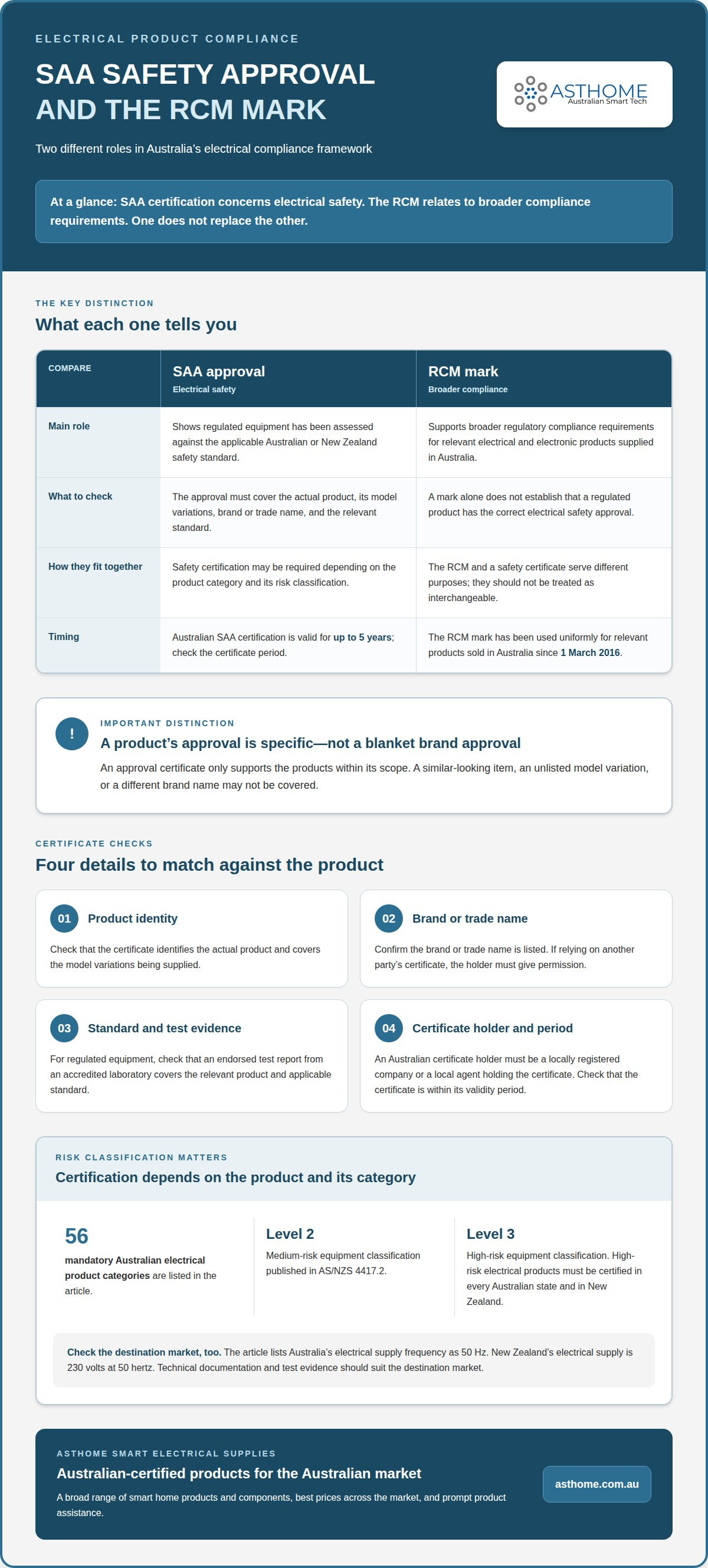
SAA Approvals is accredited by the Joint Accreditation Service of Australia and New Zealand (JAS-ANZ) as a third-party certification body for electrical equipment. It issues certificates for regulated equipment shown to meet the safety requirements of the applicable Australian or New Zealand standard. Australian SAA certification is valid for up to 5 years, so the certificate period matters when assessing approval status.
Imported electronics requirements
Importers must ensure electrical equipment sold in Australia is electrically safe and complies with AS/NZS 3820. For regulated products, the approval process includes an endorsed test report from an accredited laboratory. An Australian certificate holder must be a locally registered company or a local agent holding the certificate. These requirements make the responsible local certificate holder part of the compliance chain.
Approval must match the goods supplied. Australian product approval certificates must list the covered model variations and brand or trade names. If a business sells an item under another party’s certificate, the model and brand must be registered on it, and the certificate holder must give permission. Product changes or differences between shipments can affect whether the approval covers the item being sold.
Non-compliant selling risks and penalties
A product outside an approval’s scope cannot rely on that certificate as evidence of compliance. Differences in model, brand or design can break the link between the tested item and the goods supplied. Defective wiring in an uncertified product can increase the risk of fire, power surges and arc faults. Treat product identity and certificate coverage as safety checks, not paperwork details.
Australia and New Zealand share certification arrangements, but their electrical supply specifications should be considered separately. The listed Australian electrical supply frequency is 50 Hz. New Zealand’s electrical supply is 230 volts at 50 hertz. A product’s technical documentation and test evidence should suit the destination market, rather than simply carrying a certificate or specification from another country.
The RCM and an SAA safety certificate serve different compliance purposes. Electronic and electrical products sold in Australia had to use the RCM mark uniformly from March 1, 2016. The RCM relates to broader regulatory compliance, while SAA certification concerns electrical safety. A mark alone does not establish that a regulated product has the correct safety approval.
Risk classification helps determine the route. AS/NZS 4417.2 publishes product risk classifications for medium level 2 and high level 3 equipment. High-risk electrical products must be certified in every Australian state and in New Zealand. Mandatory Australian electrical products span 56 categories, so identify the product category and applicable standard before relying on a general certification claim.
Certificates of Approval and Certificates of Suitability
These certificates record electrical safety approval, but their scope is specific to the product. Check the scheme, certificate details and product identity together.
Recognised external approval schemes
A recognised external approvals scheme allows certificates from an accepted certification body to be used within the relevant regulatory framework. SAA Approvals is gazetted by NSW Fair Trading as a Recognised External Approvals Scheme and accepted by Queensland’s Electrical Safety Office as a Recognised External Certification Scheme.
Queensland Government accreditation also allows SAA Approvals to issue certificates under the RECS scheme. Household product certificates are covered by its membership of that scheme. These arrangements explain how an external approval can be recognised, but the certificate still needs to match the actual equipment.
SAA Approvals’ JAS-ANZ accreditation applies to certificates issued for Australia and New Zealand. This provides a trans-Tasman certification pathway, but the certificate still needs to cover the product and applicable standard for its destination market. It is not a general approval for every product made by a brand.
Electrical safety approval
For regulated electrical equipment, the certificate is evidence that the product has been shown to meet the applicable Australian or New Zealand safety standard. The application process includes a completed application form, test report, installation instructions and payment. The test report must be endorsed by an accredited laboratory and cover the applicable standards.
Certificate scope matters. Australian approvals must list all model variations and brand or trade names. A product family may include up to 20 technically similar products tested together on the same report. If a business uses another party’s certificate, its brand and model must be registered on that certificate, and the holder must give permission.
Before relying on an approval, compare the certificate’s listed brand and model with the product documentation. Check that the intended market and product family match the certificate. A change to the product or its identifying details can affect whether the approval applies.
For example, a certificate covering one model of a household electrical product does not automatically cover another model or brand. The certificate holder must ensure imported and sold products match the approved item. Product changes must be assessed and added to the approval where needed.
That’s the practical value of reading the certificate itself, rather than relying only on a supplier’s general claim. For product context, browse smart home electrical products intended for the Australian market.
Examples of products requiring mandatory certification
Mandatory certification depends on an electrical product’s category and risk classification, not simply its use of electricity. Australia’s mandatory electrical product requirements cover 56 categories, so identify the applicable category before relying on a general approval statement.
Examples include equipment covered by specific standard references. The mandatory-product information lists home-appliance references 60335-2-9, -14, 15, -23, -80, and lamp reference 60598- 2-4. These identifiers help narrow down which technical requirements apply. Match the product’s intended function to the relevant standard, rather than treating every appliance or light fitting as equivalent.
Risk classification also matters. AS/NZS 4417.2 publishes product classifications for medium level 2 and high level 3 equipment. High-risk electrical products must be certified in every Australian state and in New Zealand. A product’s category and classification therefore shape the approval route and the evidence required for sale.
Not every electrical product falls into a mandatory certification category. That distinction doesn’t remove the requirement for imported and sold electrical equipment to be proven electrically safe and comply with AS/NZS 3820. A product outside mandatory certification still needs appropriate safety evidence; the applicable obligations depend on its classification and intended supply.
RCM requirements are another part of the assessment. Electrical products for household use, or sold online to individuals without a registered ABN, must meet RCM requirements detailed in AS/NZS 4417.2. The RCM relates to regulatory compliance, while an SAA certificate concerns electrical safety. One should not be assumed to replace the other.
Before buying, look for SAA Approval where the product category requires it. Compare the approval details with the item’s brand and model. A certificate for one declared model does not automatically cover another product in the same range. Product variations and trade names need to be included in the relevant approval.
Use the product’s technical information to establish what it is, how it is intended to be used and which standards apply. SAA Approvals says applicants must submit a completed application form, a test report, installation instructions and payment. The report should come from an accredited laboratory and cover the applicable Australian standards. Together, these documents connect the product assessed with the certificate issued.
For a practical check, note the product category, model number, brand and standard reference, then compare each detail with the certificate. If the product is sold under another party’s approval, its brand and model must be registered on that certificate, with the holder’s permission. This helps distinguish approval evidence for the actual product from a broad or unrelated claim.
Electrical equipment safety compliance
Electrical safety compliance is more than a mark on an enclosure. For equipment imported and sold in Australia, the product must be proven electrically safe and comply with AS/NZS 3820. This links the manufacturer’s design, test evidence, approval and supplied item. If any link differs, a document alone may not demonstrate that the equipment being sold matches the assessed product.
Start with the test report. It should cover the exact equipment and applicable Australian standards, not just a similar product from the same manufacturer. An endorsed report from an accredited laboratory supports an electrical safety approval application. Compare the model and brand in the report with the product documentation, packaging and approval certificate. These identifiers connect the test evidence to the item supplied.
Imported documentation needs careful interpretation. CE documentation is not recognised by Australian law as a basis for compliance. Approvals from other countries also do not replace the approval certification required for electrical products sold in Australia. Overseas reports may form part of product records, but do not alone establish the Australian approval required for regulated equipment.
Keep the approval aligned with what is actually imported and sold. Certificate holders must ensure products match the approved item, check each shipment, and have product changes assessed and added to the approval certification. A change to a model, brand or design can affect whether the certificate covers the goods. Shipment controls and version records are therefore part of practical safety compliance, not just administration.
- Identify the product: record its brand, model and product configuration.
- Match the evidence: compare those details with the test report and certificate.
- Control changes: have product variations assessed and added to the approval where required.
The RCM is another compliance element, but it is not a substitute for electrical safety approval. Household electrical products, including those sold online to individuals without a registered ABN, must meet RCM requirements detailed in AS/NZS 4417.2. The RCM indicates broader regulatory compliance, while safety certification addresses the product’s electrical safety. Assess both obligations for the relevant equipment.
Different marks also refer to different compliance areas. SAA certification concerns safety regulations; C-Tick relates to EMC and radio products, while A-Tick relates to telecommunications products. A C-Tick or A-Tick mark alone does not show that electrical safety requirements are met. Match each compliance document and mark to its purpose, product identity and applicable Australian requirement.
Product integrity matters because defective wiring in uncertified equipment can increase the risk of fire, power surges, arc faults and other serious consequences. For Australian electrical equipment, traceable test evidence, accurate approval details and controlled product changes work together to support safety compliance.
What are the risks and penalties for selling non-compliant electronics in Australia?
Selling electrical equipment without the required safety evidence creates two clear risks: the product may not meet Australian requirements, and it may cause harm. Electrical equipment imported and sold in Australia must be proven electrically safe and comply with AS/NZS 3820. Defective wiring in an uncertified product can increase the risk of fire, power surges, arc faults and other serious consequences.
A certificate provides no protection if it does not cover the item being sold. A different model, brand or product variation may fall outside the approval’s scope. If the manufacturer changes a product, the change must be assessed and added to the approval certification where required. The certificate holder must ensure imported and sold goods match the approved item.
A general supplier statement is not the same as product-specific evidence. A safety certificate for one model, for example, does not establish approval for a different model simply because both share a brand. The model and brand must be included on the applicable certificate. If a seller uses another party’s certificate, the relevant brand and model must be registered, and the certificate holder must give permission.
RCM obligations are separate from electrical safety approval. Household electrical products, including products sold online to individuals without a registered ABN, must meet RCM requirements detailed in AS/NZS 4417.2. Using an RCM mark doesn’t replace a required safety certificate. Nor does overseas approval or CE documentation replace approval certification required for electrical products sold in Australia.
Practical consequences for a seller include being unable to rely on the certificate as evidence for the product, and supplying equipment that may not meet safety requirements. The facts here do not establish a specific penalty amount or a uniform penalty for every case. The applicable consequence depends on the circumstances and the relevant obligation, so avoid assuming a certificate for a related item resolves the issue.
Reduce avoidable compliance gaps with a repeatable product-control process:
- Record the product’s brand, model and approved configuration.
- Match those identifiers against the certificate and supporting test report.
- Keep shipment checks aligned with the approved product.
- Have product changes assessed and reflected in the approval certification.
- Assess RCM requirements separately from electrical safety approval.
These checks matter for smart home equipment as well as household appliances. A Smart Power Point (GPO), for example, is electrical equipment, so its exact product identity and applicable compliance evidence matter. Choose products intended for the Australian market, and browse Asthome’s Australian-certified smart home products for locally focused options.
Asthome Smart Electrical Supplies
Asthome Smart Electrical Supplies helps Australian buyers find smart home products suited to the local market. Its focus is supplying Australian-certified products for safe use in Australia, alongside a broad range of brands and components. Its fantastic customer service provides prompt responses and assistance with products as you consider your options.
The range includes smart switches, dimmers and curtain motors for different home automation needs. Certification remains specific to each item, so assess the product details and applicable approval rather than assuming one certificate covers an entire category.
If you’re weighing up smart home products for an Australian setup, contact Asthome Smart Electrical Supplies for product assistance.
Make your next product decision with confidence
Understanding SAA certification for electronics can help you make a more informed choice when adding smart technology to an Australian home. Consider product suitability alongside safety evidence, and check how each item fits your planned setup. This practical approach helps you narrow your options without treating a certification mark as a substitute for product-specific information.
Asthome Smart Electrical Supplies focuses on Australian-certified products for the local market. Its range includes the Matter Smart Switch Module, Zigbee 3.0 Smart Switch Module and Smart Zigbee Dimmer Module, alongside products from a broad selection of brands. If you’re comparing smart home components or need help with product information, contact Asthome Smart Electrical Supplies for assistance. Take your next step with a clearer view of the product and the documentation that supports it.
Frequently Asked Questions
What is SAA approval?
SAA approval commonly means electrical safety certification issued by SAA Approvals, not approval issued by Standards Australia. SAA Approvals is a third-party certification body accredited by the Joint Accreditation Service of Australia and New Zealand. Its certificates apply to regulated electrical equipment assessed against the relevant Australian or New Zealand safety standard. The product details on the certificate define what the approval covers.
Who should get accredited?
For product certification, the applicant needs an eligible local certificate holder: an Australian-registered company or a local agent holding the certificate. This is different from SAA accreditation for renewable-energy work. In Australia, individuals designing or installing grid-connected PV systems, grid-connected battery systems or standalone power systems need SAA accreditation to be eligible for Small-scale Technology Certificates. The required pathway depends on the activity.
What is SAA certification for electrical and electronic products in Australia?
Understanding SAA certification for electronics means recognising it as product safety certification for regulated electrical equipment. The assessment considers evidence that the item meets its applicable Australian or New Zealand safety standard. An approval identifies the products and brand names it covers; it does not generally approve every item from a manufacturer. Check the certificate’s scope against the specific product or model.
Is SAA certification mandatory for electronics sold in Australia?
Not every electronic product follows the same certification route. Mandatory safety certification applies to regulated electrical equipment, and the applicable category and risk classification determine the requirements. Australia’s mandatory electrical product categories include 56 categories. Electrical equipment sold in Australia should still meet applicable safety requirements, even when mandatory certification does not apply.
What is the difference between SAA approval, RCM marking, and EESS registration?
Understanding SAA certification for electronics also means distinguishing safety certification from broader regulatory compliance. SAA approval concerns electrical safety, while the RCM mark relates to broader compliance and does not replace a required safety certificate. Certificates issued under the RECS scheme are uploaded to the EESS/RCM database. These terms describe connected but distinct parts of the compliance process, so a mark or database entry is not the certificate itself.
Which electronics and electrical products require Australian electrical safety approval?
Products in mandatory electrical equipment categories require the relevant certification, with the product’s risk level influencing the route. The category references include some household appliances and lamps. For example, the mandatory-product references include lamp standard 60598- 2-4. Identify the equipment’s intended function and category first; a broad label such as “smart device” alone doesn’t determine whether safety certification is mandatory.
How do manufacturers apply for SAA certification in Australia, step by step?
Manufacturers or applicants prepare an application for the relevant product, provide supporting evidence and submit the required materials. First, identify the product and applicable standard. Then obtain an endorsed test report from an accredited laboratory, prepare installation instructions and complete the application form. Submit the form with the report, instructions and payment. The certificate holder must be an Australian-registered company or local agent.
What documents and product samples are needed for SAA certification?
The application documents include a completed application form, an endorsed test report, installation instructions and payment. The test report must cover the applicable Australian standards. Product identity also matters: model variations and brand or trade names need to align with the approval. A product family may contain up to 20 technically similar products tested together on the same report. Prepare documentation that clearly identifies each model and brand.