

Asthome is committed to supplying Australian-certified products that are safe for the Australian market. The right choice depends on your windows, light preferences and how you want the system to work: smart blinds can suit a compact window, while smart curtains may better fit a living space.
Both bring motorised control to your home, but differ in installation, power and everyday use. Blinds offer precise light control and take up little space; curtains add fabric coverage and can help with insulation. Neither is automatically the better choice for every room.
This guide compares installation and power options, features, light control, space use, safety and product choices for Australian homes. You’ll see what matters when choosing between blinds and curtains, including when a mix of both could suit different rooms.
From motorised tracks to smart-home controls, the goal is to help you make a practical choice that suits your windows and daily routine.
Key Takeaways
- Plan power and motor placement early, especially if window-treatment wiring needs to be in place before a false ceiling is closed.
- Consider whether scheduled or remote curtain operation, insulation and sun protection suit the way you use each room.
- Choose blinds when precise light adjustment, a compact fit or access to a hard-to-reach window is a priority.
- Factor cordless operation into your choice for homes with children or pets, and consider a mix of blinds and curtains across different rooms.
- Explore Asthome Smart Electrical Supplies’ Smart Curtain Motor and Track alongside its smart-home components, with a focus on products suited to the Australian market.
Installation and power options
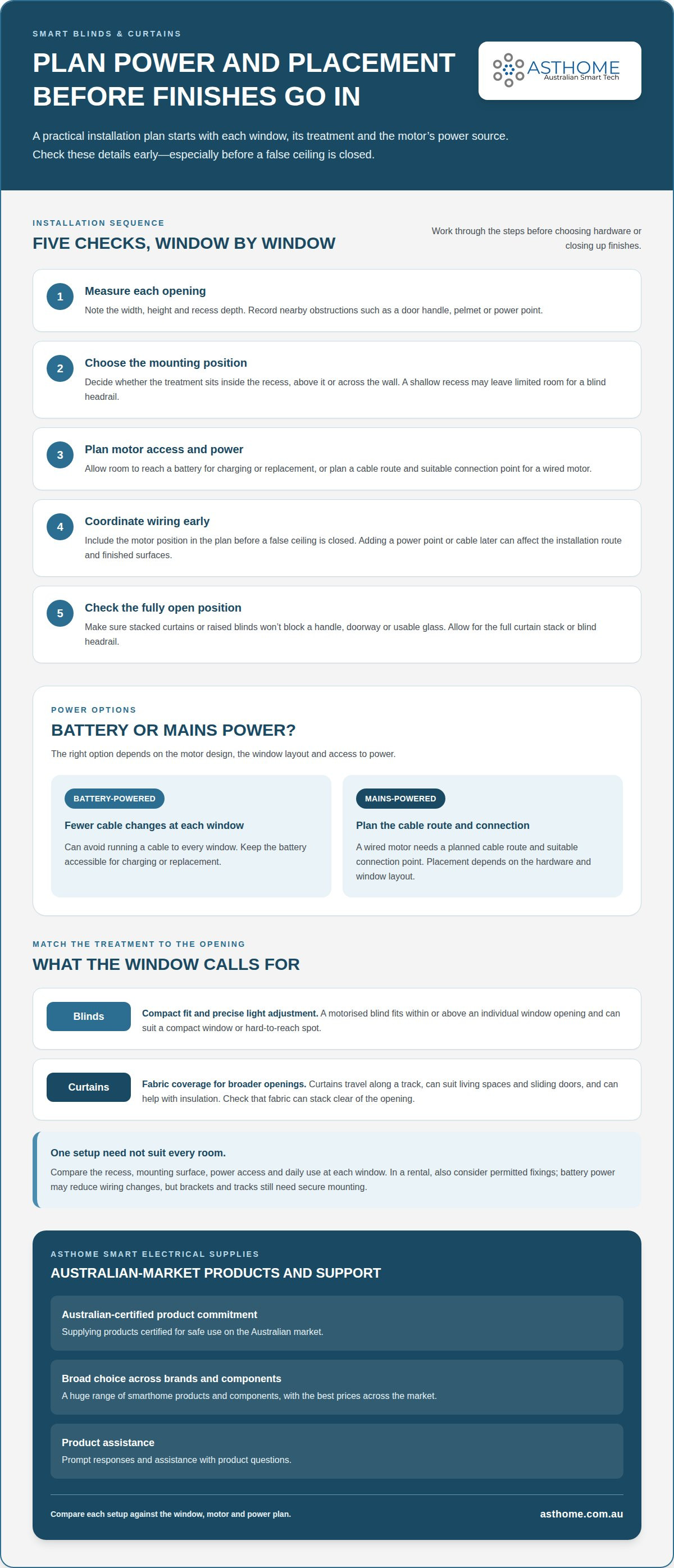
Start with the window, the treatment and the power source. A motorised blind fits within or above an individual window opening, while a curtain motor moves fabric along a track. Asthome’s smart-home range includes products and components to compare for these setups, with a commitment to supplying Australian-certified products safe for the Australian market. For a new build or renovation, plan where the motor and wiring will go before finishes are installed. Wiring for motorised window treatments needs to be planned before a false ceiling is closed. Adding a power point or cable later can affect the installation route and finished surfaces.
Power choices depend on the motor design. Some systems use batteries, while others connect to mains power. Battery operation can avoid running a cable to each window, but the battery needs to remain accessible for charging or replacement. A wired motor needs a planned cable route and suitable connection point. For example, a living-room curtain track may need power near one end, while a blind motor may sit within the window recess. Exact placement depends on the hardware and window layout.
Before choosing, map each opening and note practical constraints. Record whether the window has a recess, nearby power, a pelmet or a door handle that could obstruct movement. For a sliding door, allow for the full curtain stack or blind headrail when the treatment is open. A wide opening may also need a motor and track arrangement suited to its span. Don’t assume one motor configuration will work for every window. Compare suitable options from Asthome’s range, checking that the product is Australian-certified for use on the Australian market.
For large windows and sliding doors, curtains can suit broad openings because fabric travels along a track, while blinds offer a more compact fit. In a rental home, the choice depends partly on permitted fixings and power access. A battery-powered treatment may reduce wiring changes, but brackets and tracks still need secure mounting.
Use this sequence to plan the installation:
- Measure each opening: note its width, height, recess depth and nearby obstructions.
- Choose the mounting position: decide whether the treatment sits inside the recess, above it or across the wall.
- Plan motor access: allow room to reach a battery or connect the motor to its power source.
- Coordinate wiring early: include the motor position before a false ceiling is closed.
- Check the open position: make sure stacked curtains or raised blinds won’t block a handle, doorway or usable glass.
These checks help identify installation conflicts before the hardware goes up. A curtain track above a sliding door, for instance, needs clearance for the fabric to stack without obstructing the opening. A blind fitted inside a shallow recess may have limited room for its headrail. Power access, mounting surface and daily operation all shape the choice. Compare these details window by window, and use Asthome’s product information to help assess suitable Australian-certified options rather than choosing one treatment for the whole home.
Motorized curtain features
A motorised curtain track moves fabric across a window without manual drawing. Asthome’s range of smart-home products and components includes options for controlling curtains with a remote or connected system, helping you manage privacy and daylight throughout the day. Choose products certified for the Australian market, such as a setup that closes curtains during strong sunlight to help protect furniture and flooring from UV damage.
Scheduling adds another layer of control. Set curtains to open in the morning and close in the evening, or choose times that suit how you use the room. Asthome’s motorised curtain options can also open and close at set times to simulate occupancy while you’re away, giving the home a lived-in appearance without manual operation.
Smart-home integration can make operation more convenient. Depending on the system, motorised curtains can be controlled by voice through Google Home or Amazon Alexa. Smartphone apps for iOS and Android can connect curtains to smart-home systems for remote operation. Asthome offers a range of brands and components; check that your chosen products are Australian-certified and suitable for use on the Australian market.
Fabric brings a useful functional choice. Curtains can help maintain indoor temperature through insulation, potentially reducing reliance on air conditioning in summer and minimising heat loss in winter. Heavier or lined curtains add a more substantial fabric layer than a bare window, while the track lets you move them clear when you want daylight or an open view. Asthome’s range helps you compare options at competitive prices.
Choose automation features with the room in mind. A living room may benefit from scheduled evening closure for privacy, while a sun-exposed room may need daytime closure to protect furnishings. In a bedroom, timed opening can let in morning light without manual operation. Asthome can assist with product questions and help you choose Australian-certified options that suit your setup.
For a practical setup, match the controls to your household routine:
- Set a schedule: choose opening and closing times for everyday light and privacy.
- Use voice control: operate curtains through Google Home or Amazon Alexa integration.
- Choose remote access: use a compatible smartphone app for operation away from home.
- Consider sun exposure: schedule closure during peak sunlight to help protect furniture and flooring.
- Factor in insulation: select curtain fabric that suits the room’s comfort needs.
Automation works best when each action has a clear purpose. For instance, a living-room schedule can close curtains during strong afternoon sun, then reopen them later for an evening view. Remote app control offers another option when plans change. If a motorised track suits your room, explore motorised curtain track options from Asthome’s range, and contact the team for prompt product assistance. Check that products are Australian-certified and safe for the Australian market.
Blind light control and space efficiency
Motorised blinds from Asthome suit rooms where daylight needs frequent adjustment or window space is limited. Asthome focuses on supplying Australian-certified products that are safe for use on the Australian market. You can change a blind’s position to manage incoming light while keeping the area around the opening clear.
Light control
Motorised blinds offer precise light control, so you can adjust coverage as sunlight changes. For example, lower a blind to reduce glare on a home-office screen, then raise it to restore the view. This makes them useful in rooms where daylight needs vary throughout the day. Consider which parts of the window need coverage and how light affects tasks such as reading or working. Asthome’s range lets you compare options for your room.
A hard-to-reach window is another practical case. Motorised operation lets you adjust a blind without reaching over furniture or moving a ladder into position. In a living room, the same control can help manage glare on a television while preserving daylight elsewhere. The key question is whether regular, precise adjustment matters more than covering the window with fabric.
Space efficiency
Blinds take up little space, making them practical when furniture, doorways or narrow wall areas sit close to a window. A roller blind, for example, raises into a compact position above the glass rather than stacking fabric beside it. This can help a small room feel less crowded and leave more wall space for shelves or furniture. Explore Asthome’s product range to compare suitable options.
Check the window recess and surrounding space before choosing a blind. A treatment fitted within the opening can keep the wall clear, while one mounted above it may cover more of the window. Consider nearby handles, joinery and the way a door opens. These details determine where the blind can sit and how it will operate.
Use these checks to decide whether motorised blinds suit a particular room:
- Track the light: note where glare falls on screens, desks or seating.
- Check access: identify windows that are awkward to reach by hand.
- Review the surrounding space: consider furniture, door swings and nearby wall storage.
- Choose the coverage: decide whether the blind should sit within the recess or above it.
For a compact study with a desk beneath the window, a blind can preserve usable wall and floor space while allowing light adjustments. For a tall window above a stairwell, motorised control can make operation more practical. Compare each room’s light conditions and layout rather than applying one solution throughout the home. Asthome supplies Australian-certified products for the Australian market, helping you compare options with assistance from its customer service team.
Cordless operation for child and pet safety
Loose operating cords can be a concern in homes with young children or pets. A cordless motorised blind avoids loose cords at the window, which may be worth considering where children play nearby. Asthome supplies Australian-certified smart home products for the Australian market, so check the certification and suitability of each product for your window and household. This doesn’t make every part of the window treatment inaccessible, so also consider the controls, furniture placement and how people use the room.
Look at each window from a child’s or pet’s level. Check whether a bed, cot, sofa or chair is close enough to invite climbing or curious contact with the blind. For example, a low lounge beside a living-room window may make the blind easier to reach. Consider the blind’s bottom rail and movement, as well as whether furniture could obstruct its operation.
Motorised control changes how a treatment operates, but the control method still matters. A wall switch, remote or app creates a different interaction from a manual cord. Keep handheld controls out of reach if children may press buttons or change a schedule. In a family room, a preset routine can reduce the need to operate a window treatment manually throughout the day. Asthome’s customer service team can provide prompt assistance with product questions.
Curtains need their own assessment. The track, fabric and operating controls determine what can be reached around the window. A curtain that stacks beside a sliding door, for example, may put fabric within a pet’s reach. Consider whether the open curtain invites play or blocks access to the doorway. Compare complete installed setups, not just blinds against curtains.
Use a room-by-room review to make the choice practical:
- Look for reachable cords: identify any loose operating cords around blinds or curtains.
- Review nearby furniture: note beds, chairs or sofas that provide access to the window.
- Consider the controls: choose where remotes or wall controls will be used and stored.
- Observe pet movement: consider whether fabric or a moving blind could attract attention.
- Test the routine: think through how the treatment opens and closes during everyday family activity.
A cordless blind may suit a child’s bedroom where avoiding loose cords is a priority. A motorised curtain may still suit a living room if its track, fabric and controls fit the household routine. Assess each opening individually. Asthome offers a range of smart home products and components at competitive prices, with Australian-certified options for the local market. The most practical choice is one that addresses reachable cords and access points while working smoothly for daily use.
Smart blinds and curtains product range
Asthome’s range includes different smart-home brands and components, so a room-by-room mix can be more practical than choosing one treatment for every window. For example, motorised roller blinds can serve individual windows, while lined curtains on a motorised track may suit a living room used in the evenings.
Start by identifying what each window needs, then compare suitable options in Asthome’s range. A roller blind provides a compact covering for a single window, while curtains offer fabric coverage across a wider opening. A living room may benefit from curtains that close for privacy, while a study may need a blind that can be adjusted during screen use. Matching the treatment to the room helps you choose products suited to your daily routine.
For insulation and energy efficiency, lined curtains are a practical option because curtains can help maintain indoor temperature. They may reduce reliance on air conditioning in summer and minimise heat loss in winter. The result depends on the fabric, lining, window and how you use the curtains.
Maintenance and repair costs depend on the fabric, track or blind mechanism, motor and work required. Fabric care follows its cleaning requirements, while tracks and moving parts may need attention if movement becomes uneven. Durability also depends on materials, use and upkeep, so costs vary between setups.
In Australia, the cost of smart blinds or curtains depends on window dimensions, materials, motor arrangement, power option and installation requirements. A single window and a wide living-room track need different components, so compare the full specifications rather than a product label alone. Asthome is committed to supplying Australian-certified products that are safe for the Australian market.
Build your product choices around the window types and room routines, using Asthome’s range to compare suitable products and components:
- Individual windows: consider motorised roller blinds where compact coverage and scheduled operation are useful.
- Living-room openings: consider lined curtains on a motorised track for evening privacy and insulation.
- Different exposures: use the treatment that best suits each room’s light and comfort needs.
- Everyday upkeep: factor fabric care and access to moving parts into the selection.
A mixed setup can balance function across the home. Motorised roller blinds on timers can manage routine opening and closing at individual windows, while lined curtains on a living-room track provide a different feel in the evening. Asthome’s range gives you options to match products to actual use instead of forcing every opening into one format.
Before selecting products, group windows by purpose: privacy, sun exposure, insulation or convenient operation. Match the blind or curtain to that priority, then consider its maintenance needs and check that products are Australian-certified for the local market. Asthome’s customer service team can provide prompt responses and product assistance as you compare options. A consistent smart-home routine can include different window treatments, provided each suits its opening and intended use.
Asthome Smart Electrical Supplies: Smart Curtain Motor and Track
Asthome Smart Electrical Supplies offers a Smart Curtain Motor and Track, alongside a broad range of smart-home products from different brands. Its range includes the Zigbee 3.0 Smart Switch Module, Smart Zigbee Dimmer Module and Smart Wi-Fi Light Switch. Asthome aims to offer the best prices across the market on smart-home products and components.
Products are approved for sale and use in Australia with SAA, and carry the RCM Logo with a registration number to reference. Asthome also provides prompt customer responses and assistance with products, helping you understand the options for your smart-home setup.
For help with smart curtain and smart-home product options, contact Asthome Smart Electrical Supplies.
Plan your smart window setup
Choosing between smart blinds and smart curtains is a useful starting point. Next, map the rooms where automated window coverings would make the biggest difference, then consider how they fit into your wider smart-home setup. A staged approach lets you plan around each room’s priorities instead of treating every window the same.
Asthome Smart Electrical Supplies offers the Zigbee 3.0 Smart Switch Module and Smart Zigbee Dimmer Module. Its focus is supplying Australian-certified products that are safe for use on the Australian market, with customer assistance to help you understand product options. These components can be considered alongside a smart curtain setup as you plan your home.
For help exploring suitable smart-home products, contact Asthome Smart Electrical Supplies. A clear plan for your rooms and priorities is a practical next step towards a setup that feels right for your home.
Frequently Asked Questions
Ready to Transform Your Home with Smart Curtains & Blinds?
Start with one room where automated window coverings could solve a daily problem. A west-facing living room, for example, may need easier control of afternoon sunlight, while a bedroom may benefit from scheduled opening. Note the room’s main priority, then choose a treatment and control method to suit it. You can expand the setup later, using different window coverings in different rooms.
What About Control Options?
Control options can include schedules, smartphone apps and voice commands, depending on the motor and smart-home system. For example, a household might use a daily schedule for regular opening, then use an app when plans change. Voice control through Google Home or Amazon Alexa can be convenient when your hands are occupied. Check that the motor’s controls suit the devices and routine already used at home.
What are the main differences between smart blinds and smart curtains?
Blinds use a fitted covering that raises, lowers or adjusts across a window; curtains move fabric along a track. This affects their appearance and the space they use beside an opening. A narrow study window may suit a blind, while a broad lounge opening may work well with curtains. Your choice can also reflect fabric preference, window shape and the space needed when the treatment is open.
Which option provides better light control and privacy?
Neither option suits every room. Blinds allow precise adjustment of coverage, which can help manage glare while keeping a view. Curtains provide broad coverage when drawn, making them useful when evening privacy matters. In a media room, consider how the treatment reduces unwanted light on the screen. For street-facing windows, consider how fully it covers the glass after dark.
Are smart blinds or curtains easier to install and retrofit?
The easier retrofit depends on the existing window, mounting surface and available power. A blind may suit an opening with enough space for its headrail; a curtain needs a track and room for fabric to move. In a rental, fixing restrictions can shape the choice as much as the window itself. For a renovation, plan motor placement and wiring before finishing ceilings or walls.
What power options do smart blinds and curtains use, and how often do batteries need charging?
Motorised window coverings may use battery power or a mains connection, depending on the product. Battery charging frequency varies with the motor, battery capacity and how often the covering moves, so there’s no single interval for every setup. A living-room treatment used on a frequent schedule, for example, may need attention sooner than one used occasionally. A mains-powered option avoids routine battery charging but needs suitable power access.