

Your Point Cook home isn't truly smart if you're still toggling between ten different apps just to dim the lights and check your sensors. Finding the right smart home hub is the difference between a seamless automation experience and a frustrating technical headache. You've likely felt the sting of devices dropping off the Wi-Fi or the confusion of trying to make Matter 1.5 and Zigbee 3.0 gear play nice together. It's a common pain for homeowners who want reliability but feel buried in technical jargon.
We agree that technology should simplify your life, not complicate it. This guide cuts through the noise to show you how to unify your interface, ensure every module is SAA-approved for Australian safety, and keep your data local for maximum speed and privacy. We'll compare the heavy hitters of May 2026, including the A$699.00 Homey Pro and the A$279.00 Aqara Hub M3, to help you build a future-proof system that just works. From Electricians, For Electricians; we're here to help you get the electrical brain of your home right the first time.
Key Takeaways
- Learn why a dedicated smart home hub acts as the essential central nervous system for your Point Cook property, preventing the Wi-Fi congestion common in modern townhouses.
- Decode the technical differences between Zigbee 3.0 and Matter 1.5 to choose the most reliable protocol for your sensors and switch modules.
- Understand the critical role of SAA certification in protecting your Victorian home insurance and ensuring all in-wall hardware meets Australian safety standards.
- Compare high-performance 2026 hardware like the A$699.00 Homey Pro and the A$279.00 Aqara Hub M3 to find the right fit for your automation level.
- Discover how to unify your home by installing smart modules and GPOs behind existing wall plates for a streamlined, single-interface control system.
Beyond the Speaker: Why Your Point Cook Home Needs a Proper Smart Home Hub
Point Cook's modern estates, like Upper Point Cook or Saltwater Coast, often feature high density living where dozens of Wi-Fi networks compete for the same airwaves. If you rely solely on Wi-Fi for every smart light and GPO, your network will quickly become congested. This leads to lag, dropped connections, and "device offline" errors. A dedicated smart home hub acts as a traffic controller. It moves low bandwidth devices like sensors and switches onto a separate frequency, such as Zigbee or Matter, leaving your Wi-Fi free for streaming and gaming.
While many people start with a smart speaker, a speaker is primarily an interface, not a coordinator. A true home automation system requires a hardware brain that manages logic and device communication independently of your router. It's the difference between a receptionist and a CEO. The hub organises your mesh network. It ensures that a motion sensor in the hallway triggers the light instantly, without waiting for a round trip to a server in Virginia or Singapore. This hardware coordinator is the central nervous system that keeps your home's vitals running smoothly.
The Problem with App Fatigue
Most Australian homeowners start their journey with one brand of bulbs, another brand of plugs, and perhaps a third for the door lock. This leads to a cluttered smartphone screen filled with ten different apps. A proper hub consolidates these protocols into a single interface. You can create complex "Scenes" that span across brands. Imagine a "Leaving Home" button that locks your smart door lock, closes the smart curtains, and kills all the lights at once. You can't do that effectively when your devices live in isolated digital silos. Consolidating your tech reduces digital clutter and makes the system usable for everyone in the family.
Local vs. Cloud Control
Speed is critical in a smart home. When you walk into a room, you want the light on before you've taken two steps. Cloud based systems often have a noticeable delay. More importantly, if your NBN connection goes cactus, a cloud reliant home stops working. Local processing ensures your automations stay active even if the internet is down. It also keeps your data private. Victorian families deserve to know that their daily routines aren't being uploaded to a third party cloud. Using SAA approved hardware with local control provides the ultimate peace of mind for both safety and security. It's about building a home that's reliable, fast, and stays inside your four walls.
Zigbee, Matter, or Wi-Fi? Decoding the Protocols for AU Tradies
Choosing a protocol is the most critical decision you'll make when setting up your smart home hub. In the Australian market, three main contenders dominate: Wi-Fi, Zigbee 3.0, and the newer Matter standard. Wi-Fi is fantastic for high-bandwidth tasks like 4K security camera feeds. However, it's a poor choice for a house full of 50 light switches. Each Wi-Fi device competes for an IP address on your router, which leads to instability. For a reliable, professional-grade install, you need to look at protocols designed specifically for low-power automation.
Future-proofing your home means selecting a hub that is protocol-agnostic. By May 2026, the industry has moved toward multi-protocol hardware that can talk to everything at once. This avoids the "paperweight" scenario where an older hub can't communicate with your new hardware. A high-quality smart home hub should act as a bridge, allowing your existing Zigbee sensors to work alongside the latest Matter-enabled devices without missing a beat. This flexibility is what separates a basic gadget from a serious trade solution.
The Rise of Matter in Australia
Matter 1.5, released in February 2026, has finally delivered on the promise of universal compatibility. It is an open standard for smart home technology that allows products from different brands to work together locally. The introduction of Matter smart switches has been a game-changer for Victorian homeowners. These devices often use Thread, a mesh protocol that is faster than Zigbee and more reliable than Wi-Fi. If your current hub doesn't support Matter 1.4 or 1.5, you're missing out on the improved battery life and expanded device categories that the Connectivity Standards Alliance has worked to perfect.
Why Zigbee 3.0 Still Reigns for Mesh Networks
While Matter is the shiny new toy, Zigbee 3.0 remains the reliable workhorse for trade installs. It creates a "self-healing" mesh network. If one smart switch in a large Point Cook home fails, the signal simply reroutes through another device to reach the hub. This reliability is why we stock a massive range of Zigbee 3.0 modules. Zigbee is also incredibly efficient. A battery-powered motion sensor can last up to two years on a single coin cell because the protocol uses very little energy. It's the perfect match for Asthome’s range of SAA-approved in-wall modules that fit right behind your existing GPOs. You can view our full range of Zigbee components to see how they integrate into a professional mesh setup.
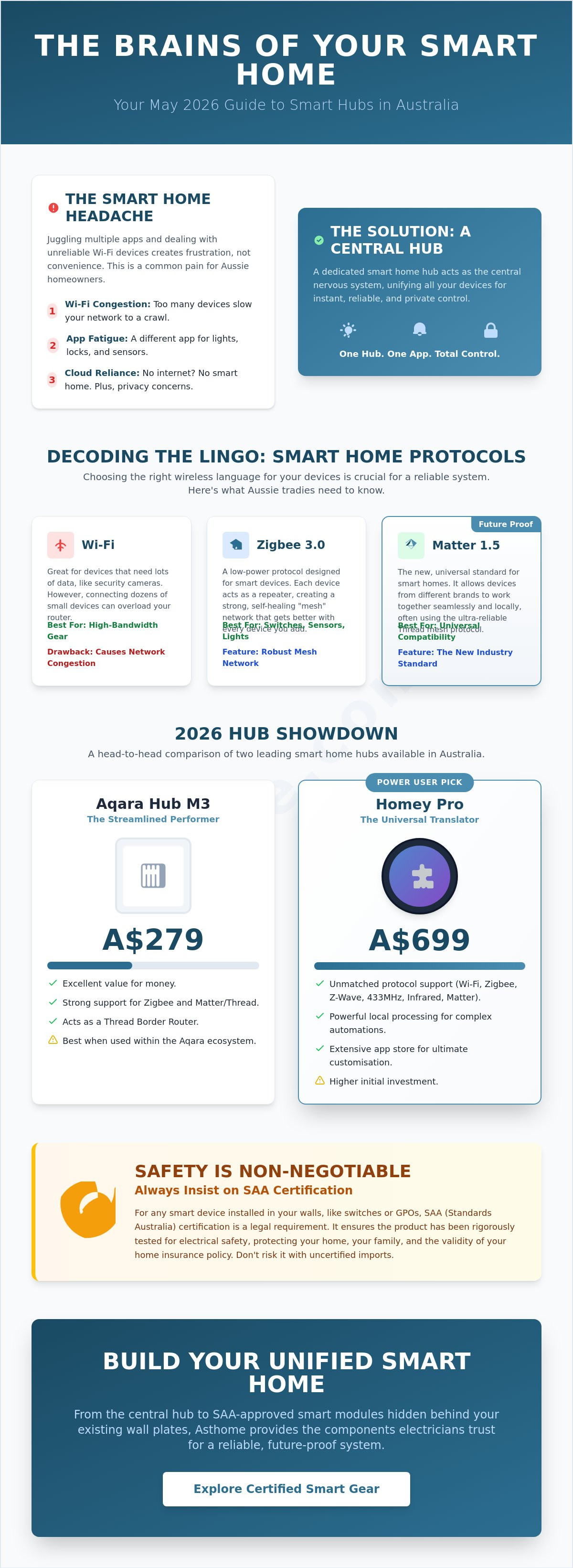
Top Smart Home Hubs in Australia for 2026: A Comparative Analysis
Selecting the right hardware depends on whether you want a basic voice interface or a comprehensive smart home hub that manages every GPO and sensor in your property. We categorise users into three groups. Casual users typically stick to Apple HomePod or Google Nest for simple voice commands. Enthusiasts look for local control and multi-protocol support, often choosing the Aqara Hub M3. Professional users, or those with large Point Cook homes, require a robust coordinator like the Homey Pro to manage thousands of data points without lag.
Leading smart speaker platforms, including Apple and Google, have improved their Matter 1.5 support as of February 2026. However, they still struggle with deep Zigbee 3.0 integration. If you're installing in-wall modules behind your light switches, a generic smart speaker often won't suffice. You need a device that prioritises the Australian certification of electrical equipment to ensure your entire ecosystem remains compliant and safe. A dedicated hub provides the stability that a standard Wi-Fi router simply can't match when your device count climbs above thirty.
The Homey Pro: Australia’s Premium Choice
For those who want a "set and forget" experience, the Homey Pro (2026 version) is the gold standard. Retailing at A$699.00, it supports over 50,000 devices from more than 1,000 brands. This Homey Australia Guide explains why it's the top pick for serious automation. It uses a visual "Flow" programming system. You don't need to be a coder to create complex routines. It handles Zigbee, Z-Wave, Matter, and Thread simultaneously, making it the most versatile smart home hub on the Australian market today.
Dedicated Zigbee Gateways
You don't always need to spend A$700 to get a reliable system. A dedicated Zigbee Gateway Hub is a cost-effective solution for targeted automation, such as managing all your lighting and motion sensors. The Aqara Hub M3, priced at A$279.00 in May 2026, is a powerhouse that supports up to 127 devices. Keeping your lighting infrastructure on a separate gateway from your entertainment system is a smart move. It ensures that even if your kids max out the Wi-Fi bandwidth with gaming, your light switches and safety sensors remain responsive and reliable.
Safety and Standards: Why SAA Certification is Non-Negotiable
A smart home hub is often viewed as a harmless piece of consumer electronics, similar to a tablet or a speaker. However, when that hub starts controlling in-wall modules, GPOs, and hardwired dimmers, the safety stakes rise dramatically. In Australia, any device that connects to your mains power must be SAA approved. This isn't just a suggestion; it's a legal requirement. As of November 2024, the application fee for a new SAA certification was A$770.00, reflecting the rigorous testing these products must undergo. If you buy a cheap gateway from an overseas marketplace that lacks this certification, you're introducing a potential fire risk into your home's electrical system.
Victorian insurance companies are notoriously strict about compliance. If a fire starts behind a wall plate and the investigator finds non-approved hardware, your claim could be rejected instantly. Our "From Electricians, For Electricians" philosophy means we only stock gear that we'd trust in our own homes. We understand that reliability and safety go hand-in-hand. While the smart home hub itself might sit on a shelf, the modules it orchestrates are buried in your walls. Always ensure your hardware carries the Regulatory Compliance Mark (RCM) to stay on the right side of the law. This protects your property and gives you peace of mind that your automation won't lead to a catastrophe.
Compliance in Point Cook New Builds
New builds in Point Cook must adhere to strict Victorian building codes. This is especially true for NDIS SDA (Specialist Disability Accommodation) compliant kits, which require high-reliability hardware for essential accessibility. When you're choosing gear for a new home, don't settle for "compatible" labels. Look for the physical RCM mark on the back of the device. This tiny logo proves the item has passed Australian safety tests. Using certified gear ensures your new home is future-proofed and legally compliant from day one. It's the only way to guarantee your smart home meets the standards expected by local inspectors.
The Electrician’s Choice
Trade-grade gear is built to last. While consumer-grade plastic might yellow or crack over time, professional modules are designed for longevity. The reliability of SAA-approved smart light switches is unmatched in the local market. SAA certification is the gold standard for AU electrical safety, ensuring every component meets rigorous national standards to prevent fire and shock hazards. For any hardwired components, you must hire a licensed sparky to perform the installation. This protects your warranty and your family. You can browse our full range of SAA-approved smart hardware to find trade-quality solutions that won't compromise your safety.
Building Your Ecosystem with Asthome: From Hub to GPO
Your choice of smart home hub should match the scale of your property. For a standard three-bedroom home in Point Cook, a single Zigbee Gateway Hub is often sufficient to manage your lighting and climate sensors. However, if you're fitting out a large double-storey residence in Sanctuary Lakes, you'll need the increased processing power of a high-end coordinator to maintain a responsive mesh network across multiple levels. Selecting the right brain for your home ensures that every command is executed without delay, regardless of how many devices you add over time.
The beauty of the Asthome Smart Electrical Supplies ecosystem lies in its invisibility. You don't need to replace your designer wall plates to get smart functionality. Our Matter and Zigbee 3.0 switch modules are designed to sit neatly behind your existing fittings. This allows you to maintain your home's aesthetic while gaining full automation control. Once your hub is established, you can expand your system with smart motion sensors and temperature probes to automate your heating and cooling. This modular approach lets you build a sophisticated smart home hub environment at your own pace, ensuring every addition is SAA approved for Australia.
We invite you to take a sneaky peak at our trade-focused resources if you're planning a larger installation. Our team understands the specific requirements of the Australian electrical grid and the importance of local compliance. From Electricians, For Electricians; we provide the technical support you need to move beyond basic gadgets and into professional-grade automation. Whether you're starting with a single smart GPO or a full NDIS SDA compliant kit, we have the hardware to make it happen.
The Asthome Smart Electrical Supplies Advantage
We provide local support based right here in Point Cook, Victoria. You aren't dealing with an overseas call centre; you're talking to experts who know the local market. We offer fast shipping across Australia for all in-stock items, ensuring your project stays on schedule. Our advice is grounded in practical trade experience, helping you avoid common pitfalls like protocol interference or network congestion. We're committed to providing the most reliable smart solutions for Victorian homeowners.
Trade Accounts and Bulk Orders
Licensed electricians can access exclusive wholesale pricing through our dedicated trade portal. We provide project-based quotes for new developments and multi-residential builds across Victoria, ensuring you get the best value for high-volume installs. Our trade partners benefit from priority support and early access to the latest Matter 1.5 hardware. Register for an Asthome Smart Electrical Supplies Trade Account today to streamline your next smart home project with trade-grade, SAA-approved gear.
Future-Proof Your Point Cook Home Today
Building a reliable automation system requires more than just buying the latest gadgets. It's about selecting a smart home hub that unifies your Matter 1.5 and Zigbee 3.0 devices into a single, responsive interface. By prioritising hardware with SAA certification, you protect your property and ensure your insurance remains valid. We've seen how local processing and protocol-agnostic hubs, like the A$699.00 Homey Pro, eliminate app fatigue and network congestion in modern Victorian estates.
At Asthome, we provide the trade-grade gear and expertise needed to get it right. Our philosophy is "From Electricians, For Electricians," which means every module we sell is SAA Certified for AU Standards. You don't have to navigate these technical decisions alone. With our Point Cook local support and fast shipping across Australia, your upgrade is in safe hands. It's time to stop fighting with multiple apps and start enjoying a home that works for you. Shop our SAA-Approved Smart Home Hubs and Gateways and take the first step toward a smarter, safer lifestyle today.
Frequently Asked Questions
Do I really need a smart home hub if I only have two lights?
You don't strictly need a hub for just two Wi-Fi based lights; however, you'll be limited to basic app control. If those lights use Zigbee or Matter protocols, a hub is required to translate their signals into something your phone understands. Most Point Cook homeowners find that their system grows quickly, and starting with a hub prevents the Wi-Fi congestion that occurs once you add more than ten devices to your router.
What is the difference between a Zigbee hub and a Matter controller?
Zigbee is a specific wireless language used by low power sensors and switches, while a Matter controller is a device that manages the new universal standard for cross brand compatibility. Many 2026 model hubs act as both, allowing your older Zigbee 3.0 gear to communicate with new Matter 1.5 hardware. Choosing a multi protocol smart home hub ensures you aren't locked into a single manufacturer's ecosystem.
Will a smart home hub work if my NBN goes down?
Yes, your automations will continue to function if your hub supports local processing. High quality hardware like the Homey Pro or Aqara M3 executes logic within the device rather than relying on a distant server. This means your motion sensors will still trigger your hallway lights even if your NBN connection is cactus. Cloud reliant systems, by contrast, will stop working the moment your internet drops out.
Can I use a US-spec smart home hub in an Australian power point?
You should never use imported US-spec hubs as they lack mandatory SAA certification for our 230V electrical grid. Using non-approved hardware can void your Victorian home insurance and presents a genuine fire risk. Always check for the Regulatory Compliance Mark (RCM) on the base of the unit. This ensures the device meets the safety standards required for the Australian market.
Is the Homey Pro worth the extra cost for an Australian home?
For power users with over 50 devices, the A$699.00 investment in a Homey Pro is often justified by its massive compatibility list. It supports more than 50,000 products across Zigbee, Z-Wave, and Matter. If you only intend to control a few light switches and a door lock, a more affordable smart home hub like the A$279.00 Aqara Hub M3 provides excellent reliability without the premium price tag.
How many devices can a single Zigbee gateway hub handle?
Capacity depends on the specific hardware, but a trade grade hub like the Aqara M3 can manage up to 127 devices. Because Zigbee creates a mesh network, every mains powered switch you add acts as a repeater. This strengthens the signal throughout your home, making it far more reliable than Wi-Fi for large Point Cook properties with multiple rooms and levels.
Do I need an electrician to set up my smart home hub?
You can plug in the hub and configure the software yourself; however, you must hire a licensed sparky for any in-wall components. This includes smart GPOs, light switch modules, and hardwired dimmers. Any work involving 230V wiring is a restricted trade in Australia. Hiring a professional ensures your installation is safe, compliant, and won't jeopardise your home's electrical safety certificate.
Which hub is best for Apple HomeKit users in Australia?
The Aqara Hub M3 is a standout choice for HomeKit users because it bridges a wide variety of Zigbee sensors directly into the Apple Home app. It allows non-HomeKit devices to appear alongside your native Apple gear. This setup provides a seamless interface on your iPhone or Mac while keeping all your automation logic local for maximum speed and privacy within your Victorian home.