

The success of your smart home isn't found in a sleek app interface; it's decided by the cable management hidden behind your plasterboard. You've likely felt the frustration of trying to jam a Zigbee 3.0 module into a shallow wall box only to find zero room left for the cables. It's a common headache when planning smart switch wiring australia, especially as you try to navigate the 200 plus changes in the current AS/NZS 3000:2018 standards.
This guide shows you how to correctly house and protect your setup using SAA-certified conduit for a safe, compliant, and future-proof result. You'll learn why the choice between 20mm and 25mm conduit matters for your 2026 compliance deadlines and how to prepare for Matter 1.5 hardware. We'll help you achieve a clean, organised wiring layout that meets Victorian and Australian safety codes while leaving plenty of space for the next generation of smart tech.
Key Takeaways
- Learn why physical cable management is the backbone of a reliable smart home and how you'll avoid the "crammed wall box" trap.
- Discover when to use rigid PVC for straight runs and when corrugated conduit is essential for navigating through noggins and studs.
- Master the 40% fill rule to ensure your smart switch wiring australia project has enough room for heat dissipation and future Matter upgrades.
- Understand why SAA-certified gear and a licensed electrician are non-negotiable for insurance and safety under the latest AS/NZS 3000:2018 rules.
- Identify the best conduit sizes to future-proof your installation for complex multi-gang switch setups and next-gen modules.
Smart Switch Wiring Australia: Why Physical Infrastructure Matters
Smart switch wiring is about more than just choosing between Zigbee or Wi-Fi. It's the physical integration of smart modules like Matter or Zigbee into your home's 240V mains. While DIY forums often focus on software and app interfaces, the real hurdle for successful smart switch wiring australia is managing the physical cable infrastructure hidden behind the wall plate. Without a solid foundation, even the most expensive smart switch will eventually fail due to poor connectivity or physical stress.
Mechanical protection is the backbone of any reliable installation. Using high-quality conduit is essential for several reasons:
- It prevents mechanical stress on cable terminations and module terminals.
- It protects cables from rodents or sharp building materials inside the wall cavity.
- It enables easy cable replacement or upgrades without needing to cut into your plaster.
A well-organised run allows you to pull through new cables or replace modules as 2026 tech evolves. Without this infrastructure, you're looking at a messy, unreliable system that's difficult to maintain. Thinking about your physical cable paths now saves you from expensive remedial work later when you want to add more sensors or upgrade your gateway.
The 'Extra Bulk' Problem in Australian Renovations
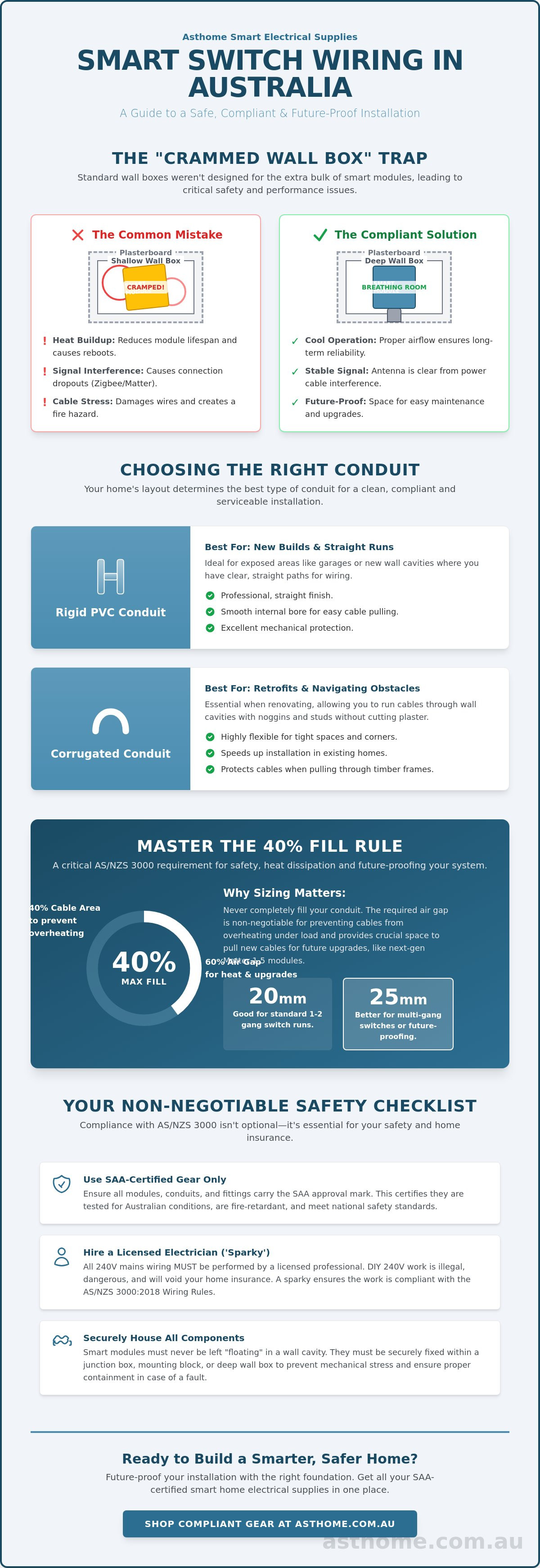
Standard Australian wall boxes weren't designed for the digital age. A traditional light switch is thin, but adding a Matter smart switch module adds significant depth to the assembly. Shoving these into a cramped space creates two major issues: heat and interference. When you pack wires too tightly, you lose airflow. This heat buildup can shorten the lifespan of your module's capacitors or cause the device to reboot unexpectedly.
Signal drops are also common when power cables are pressed hard against the module's internal antenna. To solve this, savvy renovators use junction boxes or deep mounting blocks to create "breathing room." This extra space is vital for long-term performance and ensures your smart switch wiring australia project remains stable under load.
Meeting the AS/NZS 3000 Wiring Rules
Compliance isn't just about passing a site inspection; it's about fire safety and protecting your home insurance. The AS/NZS 3000 standards, commonly known as the Wiring Rules, require specific cable support and enclosure methods. You can't just leave a smart module "floating" loosely in a wall cavity. This is a common mistake that leads to serious compliance failures.
Proper home wiring requires that all 240V components are securely housed and protected from external damage. Using SAA-certified enclosures and conduit ensures that the materials are tested for Australian conditions and are fire-retardant. If a fault occurs, a certified enclosure helps contain it, preventing a small spark from turning into a house fire. Don't cut corners with uncertified gear from international marketplaces; stick to SAA-approved components to keep your home safe and your compliance paperwork in order.
Rigid vs Corrugated Conduit: What's Best for Your Smart Reno?
Choosing the right housing for your cables is just as critical as the smart modules themselves. When you're planning smart switch wiring australia, the physical layout of your home determines whether you'll reach for rigid pipe or flexible corrugated conduit. Both have specific roles in a compliant AS/NZS 3000 installation; using the wrong one can make your sparky's job a nightmare and potentially compromise the safety of your setup.
Medium Duty (MD) grey PVC is the industry baseline for most Australian indoor smart home projects. It's tough enough to handle being behind plaster while remaining easy to cut and join. To keep everything organised, you'll need a suite of matching fittings. Junction boxes provide the necessary space for module housing, while elbows and couplings ensure your runs stay secure and continuous from the switchboard to the wall plate.
Rigid Conduit for Clean, Professional Installs
Rigid PVC is the best choice for new builds or exposed areas like garages and workshops. Using 20mm Rigid Conduit for your primary light switch runs creates a professional, straight finish that's easy to secure with saddles. The biggest advantage of rigid pipe is its smooth internal bore. This allows cables to slide through with minimal friction, which is vital when you're pulling multiple 240V lines into a single switch location.
If your smart home project extends to the garden, ensure you select UV-stabilised rigid conduit. This prevents the PVC from becoming brittle and cracking under the harsh Australian sun. It's the perfect solution for housing wiring for smart motion sensors or outdoor dimmable LED drivers where the installation is visible and needs to withstand the elements.
Corrugated Conduit for Tricky Retrofits
Retrofitting smart tech into an existing home usually means working around noggins, studs, and old insulation. This is where 25mm Corrugated Conduit becomes a lifesaver. Its flexibility allows it to snake through tight wall cavities without the need for complex elbow joints. This is particularly important for NDIS SDA home upgrades, where installers often need to add extra sensors or automated curtain tracks to existing rooms with minimal structural disruption.
While corrugated conduit is easier to route, it can be harder to pull cables through because of the internal ridges. A seasoned trade tip is to always use a 'draw wire' or 'snake'. By pulling the draw wire through first, you can then attach your electrical cables and pull them back through the flex without them getting snagged on the corrugations. If you're starting a new project, you can explore our range of SAA-certified conduit and fittings to find the right fit for your specific wall type.
Sizing Your Conduit: Fitting Matter and Zigbee Modules
Getting the physical dimensions right is where many DIY-led smart switch wiring australia projects run into trouble. Trade professionals follow the 40% fill rule; this means your cables should never occupy more than 40% of the conduit's internal cross-sectional area. While a single twin-and-earth cable might look lonely in a 20mm pipe, adding a neutral wire and the pigtail connectors for a smart module quickly eats up that "empty" space. Leaving 60% of the pipe empty isn't just for ease of pulling. It's critical for heat dissipation when multiple circuits are under load.
Managing the mess of active, neutral, and load wires requires a disciplined approach to cable organisation. When you're retrofitting, you're often dealing with stiffer, older cables that don't bend as easily as modern TPS. Upsizing to 25mm conduit is the best choice for housing Zigbee 3.0 smart switch modules in 2026 because the extra internal diameter provides the essential clearance needed to tuck away wire connectors and the module body without putting strain on the terminals. This extra five millimetres of breathing room can be the difference between a clean click-in and a forced, unreliable fit.
Planning for Data and Power Separation
As smart homes become more complex, you'll likely find yourself running low-voltage data lines alongside your 240V mains. Under Australian standards, these shouldn't share the same small conduit. If you're running cables for a gateway hub or a wired sensor network, keep them in their own dedicated runs. You can use junction boxes to bridge different conduit paths, keeping your smart switch wiring australia tidy and compliant. Always leave a nylon draw-string in your 25mm runs. It's a five-second addition that makes adding a second load wire or a dedicated neutral for a future-gen Matter device incredibly simple.
External Conduit Needs for Smart Security
Security tech needs just as much protection as your indoor switches. When you're installing a motion sensor on an exposed brick wall or under an eave, the wiring is vulnerable to UV damage and moisture. Using External Conduit Junction Boxes is the standard way to maintain a high IP rating and prevent water from tracking down the cable into the device. In Victorian climates, where driving rain and morning frost are common, sealing your conduit entries with appropriate glands or silicone is a non-negotiable step to prevent moisture ingress from frying your smart sensors.
Compliance and Safety: The Licensed Sparky's Checklist
The legal reality of smart switch wiring australia is straightforward: if it involves 240V mains power, you must use a licensed electrician. While the software side of a smart home is often DIY-friendly, the physical connection behind the wall plate is strictly regulated. Under the current AS/NZS 3000:2018 standards, unlicensed electrical work isn't just dangerous; it's a criminal offence that can lead to massive fines and void your home insurance. When a sparky signs off on your installation, they provide a Certificate of Electrical Safety (CES) or a CCEW, which acts as your legal proof of compliance.
Safety starts with the gear you choose. Buying non-compliant modules or fittings from international marketplaces is a significant risk. These products often lack SAA certification or the Regulatory Compliance Mark (RCM) required for the Australian market. If a fault occurs and the device isn't certified, your insurer has every right to reject a fire claim. You should also verify your neutral wire requirements early. Most modern smart switch modules require a dedicated neutral at the switch to power the internal radio. If your home uses older "loop-at-the-light" wiring, your electrician will need to pull a neutral wire through your conduit to make the system functional.
Earthing protocols are another critical safety pillar. If you're using metal mounting blocks or faceplates for a premium look, these must be correctly earthed to prevent the chassis from becoming live during a fault. Even with plastic enclosures, ensuring the earth continuity remains unbroken across the circuit is a fundamental requirement of the Wiring Rules.
AS/NZS 3000: The Wiring Rules Explained
Often called the 'Sparky’s Bible', AS/NZS 3000:2018 (including Amendments 1, 2, and 3) dictates how enclosures must be installed. For smart home projects, fire-rating is a major focus. If your conduit passes through a fire-rated wall or a different building zone, it must be sealed with compliant fire-stopping materials. You also need to ensure your switchboard is clearly labelled. Every smart circuit should be identifiable so that future contractors can safely isolate the 240V supply before working on the modules.
Trade Accounts and Professional Gear
We understand that practitioners need reliable gear that meets local standards without the retail markup. Victorian sparkies can access specialised trade pricing by creating an account with us. This ensures every component from our conduit collection is SAA-certified and ready for a professional install. By using trade-grade gear, you can confidently issue compliance certificates, knowing the hardware won't let you down during a technical audit or a safety inspection. Browse our professional conduit and fittings to stock up for your next compliant smart home project.
Essential Conduit and Fittings for Your Smart Home Project
Selecting the right hardware is the final step in securing your smart switch wiring australia project. For Point Cook renovators working on modern townhouses or established family homes, the choice of conduit and fittings isn't just about aesthetics; it's about long-term structural integrity. SAA-certified grey PVC remains the industry standard for Victorian homes because it offers the perfect balance of flexibility and impact resistance. It won't become brittle in the cold or warp under the heat of a typical Melbourne summer.
When you're housing modules, the choice of junction box is critical for a clean finish. A 1-way junction box is ideal for the end of a run, providing a tidy enclosure for a single switch. In contrast, 2-way boxes are essential for passthroughs where you're daisy-chaining multiple smart switches or power points along a single circuit. Don't overlook the smaller components like screw adaptors and lock rings. These are vital for creating a secure, rattle-free connection between your conduit and the mounting block, ensuring that your modules stay protected from dust and debris for years to come.
Standout Products for Smart Wiring
Our External Conduit 2 Way Junction Boxes are a top pick for outdoor sensor arrays, providing a weather-tight seal that stands up to driving rain. For indoor runs, Grey MD Conduit Bends are vital for ensuring smooth 90-degree turns. This is especially important for data lines where sharp angles can cause signal attenuation or physical damage to the cable jacket. If you're working on larger Point Cook townhouses, our Grey Conduit Couplings make extending long runs across multiple rooms a simple, reliable process that keeps your cable management consistent.
Buying Guide for Smart Home Infrastructure
Planning a 3-bedroom smart reno requires a disciplined checklist to avoid mid-job delays. You'll generally need a mix of 20mm and 25mm conduit, at least a dozen junction boxes, and a bulk pack of couplings and saddles. You can access trade-level pricing on our full range of professional conduit and fittings by registering your business details on our portal. This ensures you're using practitioner-grade gear that meets every local safety standard.
One final trade tip: always buy 10% more conduit than your initial measurements suggest. Between waste, offcuts, and the occasional mistake during a tricky bend, having that extra length on hand prevents a frustrating trip back to the supplier. Getting your smart switch wiring australia right the first time means having the right gear in the right quantity before your electrician starts the rough-in.
Future-Proof Your Smart Home Infrastructure Today
A reliable smart home isn't built on apps alone; it's built on the groundwork you lay before the first module is even unboxed. Successful smart switch wiring australia depends on having the physical space and mechanical protection required by the latest AS/NZS 3000:2018 standards. You now understand why 25mm conduit is the gold standard for housing Matter modules and how the right fittings prevent moisture ingress in our local climate.
By prioritising SAA-certified gear and professional cable management, you're ensuring your home remains safe, compliant, and ready for the next decade of tech evolution. Ready to start your rough-in? You can Shop SAA-Certified Conduit and Fittings at Asthome to secure high-quality hardware that's tested for the Australian market. We ship directly from our Point Cook local warehouse, and licensed sparkies can access trade accounts for practitioner-only pricing.
Don't leave your installation's reliability to chance. Get the physical infrastructure right today, and your smart home will perform flawlessly for years to come.
Frequently Asked Questions
Do I need a neutral wire for smart switch wiring in Australia?
Yes, most modern smart switch modules require a neutral wire to maintain constant power for their internal radios. While some "no-neutral" switches are available, they often lead to flickering lights or compatibility issues with low-wattage LEDs. In many older Australian homes with "loop-at-the-light" wiring, your electrician will need to pull a neutral wire through the conduit to the switch location to ensure reliable operation and full compliance.
What size conduit is best for smart home modules?
Use 25mm conduit for any location where you plan to house smart modules like Matter or Zigbee 3.0. While 20mm is standard for basic light circuits, the extra 5mm in a 25mm pipe provides the necessary internal volume to meet the 40% fill rule. This extra space is vital for heat dissipation and makes it much easier for your electrician to tuck away the module and pigtail connectors safely.
Is it legal to install my own smart switches in Victoria?
No, it is strictly illegal to perform any 240V electrical work yourself in Victoria or anywhere else in Australia. All smart switch wiring must be completed by a licensed electrician who can issue a Certificate of Electrical Safety (CES). DIY electrical work voids your home insurance and carries heavy legal penalties, as all work behind the wall plate is considered regulated electrical work under Australian law.
What is the difference between grey and orange conduit?
Grey conduit is for general purpose above-ground use, while orange conduit is specifically for underground installations. Grey PVC is UV-stabilised and medium-duty, making it the industry standard for running smart switch wiring australia through wall cavities or along external eaves. Orange conduit is heavy-duty and highly visible, designed to withstand the pressure of being buried and to alert future excavators of live power lines.
Can I run smart home data cables in the same conduit as power lines?
No, you should never run low-voltage data cables like Ethernet or sensor wires in the same conduit as 240V mains power. AS/NZS 3000 requires physical separation to prevent electrical interference and the risk of high voltage jumping to your data lines. For a compliant smart home, use separate conduit runs to keep your digital signals clean and your hardware safe from power surges.
What does SAA certification mean for my home insurance?
SAA certification proves that your electrical components meet Australian safety standards and are legal for sale and use. If you install non-compliant gear from overseas that causes a fire, your insurer is likely to deny your claim. Using SAA-certified conduit, fittings, and modules ensures that your installation is covered under your policy and meets the strict safety requirements of the Australian market and local regulations.
How do I fit a smart module into a shallow wall box?
The best solution is to install a deep mounting block or a rendered wall box with extra depth during the rough-in stage. If you're stuck with a shallow box, your electrician may need to use a junction box in the ceiling or wall cavity to house the module. This allows them to run only the switch lines to the wall plate, preventing heat buildup and physical stress on the wire terminations.
What is the best way to future-proof my home's wiring?
Install 25mm conduit with a nylon draw-string and ensure a neutral wire is present at every switch location. This setup allows you to easily pull through new cables or upgrade to next-gen Matter devices without cutting into your plaster. Planning for extra space in your smart switch wiring australia project today saves you significant labour costs when new smart home protocols or hardware requirements emerge in the future.