

Did you know that as of May 2026, a standard wall socket is no longer just a place to plug in your kettle; it is a regulated data point that must meet strict new safety benchmarks? You're likely feeling the pressure of keeping up with the latest AS/NZS 3112:2025 standards while trying to decide if a smart power point en (enabled) module is the right call for your Point Cook new build. It's a lot to manage when you're also worrying about the mandatory cybersecurity rules that came into full effect this March. We understand the need for gear that doesn't just look good but actually protects your insurance and your family.
We've built this reference guide to clear the confusion and give you total confidence in your hardware choices. You'll learn exactly how the updated AS/NZS 3112 standards impact your socket selection and how to properly 'enable' smart functionality using SAA-certified Zigbee 3.0 or Matter modules. We will also provide a room-by-room breakdown of required outlet counts, from the kitchen to the home office, to ensure your property is fully compliant and future-proofed against the next decade of electrical shifts.
Key Takeaways
- Master the AS/NZS 3112:2025 requirements to ensure your wall outlets meet mandatory Australian safety and shutter specifications.
- Identify why SAA certification is essential for Australian electrical safety and how it protects your property insurance.
- Learn how to upgrade a standard GPO to a power point en (enabled) system using SAA-certified Zigbee 3.0 or Matter modules.
- Plan your electrical layout with precision by following our 2026 outlet count recommendations for high-demand zones like kitchens.
- Source hardware with confidence by choosing practitioner-led brands that prioritise local Victorian safety standards and trade reliability.
What is an Australian Power Point (GPO)? Basics and Standards
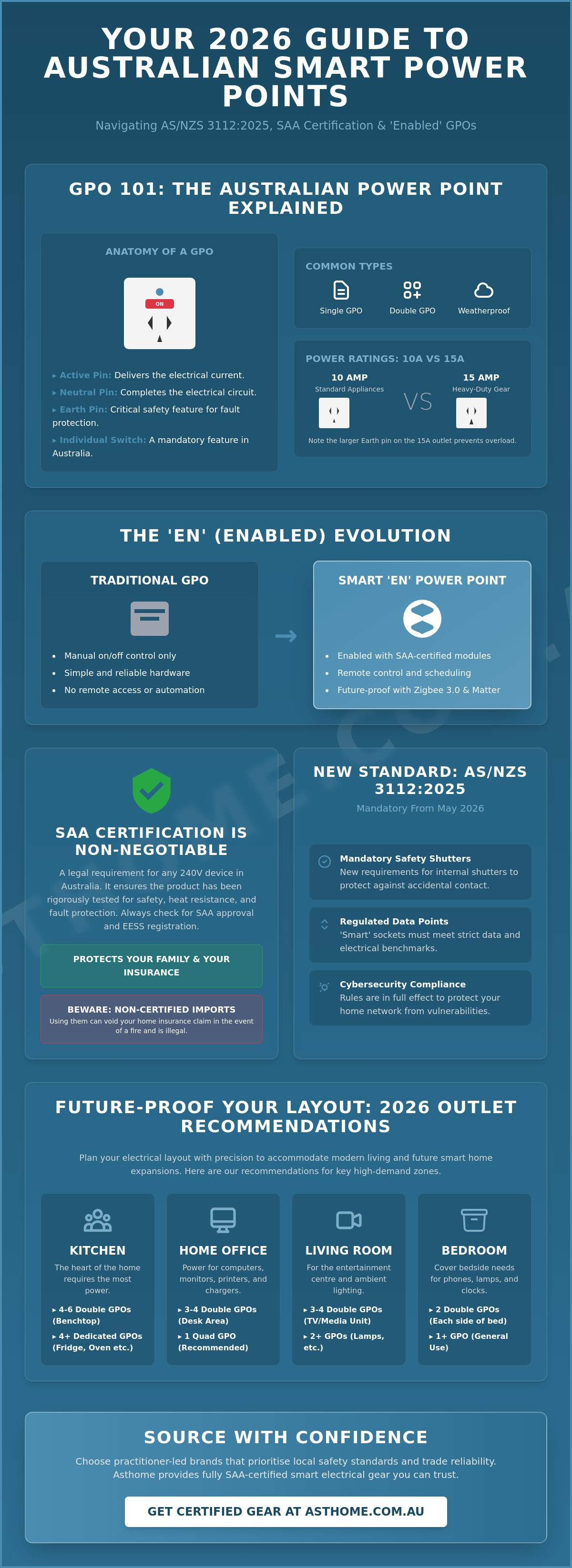
In the Australian electrical trade, we don't just call them wall sockets. The technical term is a General Power Outlet, or GPO. This is the standard interface for delivering 240V AC power across the country. Whether you're a seasoned sparky or a homeowner planning a renovation, understanding the basics of these units is the first step toward a safe and compliant home. Every GPO sold and installed in Australia must adhere to the AS/NZS 3112 standard. This regulation defines the specific physical dimensions and safety requirements for the three-pin plug configuration used nationwide.
Standard GPOs come in several common formats to suit different applications:
- Single GPO: A single socket outlet, often used for dedicated appliances like fridges or washing machines.
- Double (Twin) GPO: The most common choice for living rooms and bedrooms, providing two outlets on a single wall plate.
- Weatherproof (IP-rated): These feature specialised seals and covers to prevent dust and water ingress, making them essential for outdoor decks or garden lighting.
You also need to distinguish between 10A and 15A outlets. Most household appliances use a standard 10A circuit. However, heavy-duty equipment like large air conditioners or workshop welders require a 15A GPO. These units feature a larger earth pin to prevent 15A plugs from being inserted into lower-rated 10A sockets, ensuring the circuit isn't overloaded.
Anatomy of a Standard Australian Outlet
Your typical GPO relies on three pins for operation: the Active, Neutral, and Earth. The Earth pin is a critical safety feature that provides a path for fault current, preventing electric shock if a device fails. Unlike many international designs, Australian outlets always include individual switches for every socket. This allows you to physically isolate the power at the wall without unplugging the device. For a modern Point Cook home, finishes usually range from durable, UV-stabilised polycarbonate to premium brushed stainless steel that matches contemporary kitchen appliances.
GPO vs. Power Point: Clearing Up the Lingo
While homeowners usually ask for a "power point," your electrician will almost always write "GPO" on the quote. Both terms refer to the same hardware, but the terminology is shifting as technology advances. With the rise of the power point en (enabled) era, we are seeing more "smart" GPOs that integrate Zigbee or Matter modules directly behind the plate. To be clear; this guide focuses on the electrical hardware that powers your home, not the presentation software used in boardrooms. Choosing the right "en" hardware ensures your home is as intelligent as it is safe while staying fully compliant with local regulations.
Understanding SAA Certification and Australian Safety Compliance
SAA certification isn't just a badge of quality; it's a legal barrier that keeps your home safe. In Australia, any electrical accessory that connects to the 240V grid must undergo rigorous testing to receive this approval. When you're looking for a power point en (enabled) solution, you'll likely find heaps of cheap alternatives on international marketplaces. These devices often skip the SAA process to keep prices low. Buying them is a massive gamble. If a non-compliant module causes a fire in Victoria, your insurance provider can legally void your entire claim. You're left with the bill and a dangerous property.
We take these risks seriously because we're a business run by practitioners for practitioners. Every smart power point and module we sell is fully registered with the Electrical Equipment Safety System (EESS). This registration confirms that the hardware meets the latest 2026 safety benchmarks for insulation, heat resistance, and fault protection. Integrating a power point en module into your home should provide convenience, not a safety hazard. By choosing certified gear, you ensure that your smart home upgrade remains a valuable and safe asset.
The Legal Requirement for Licensed Installation
It's vital to remember that DIY electrical work is illegal in Australia. In Victoria, any work behind the wall plate must be done by a licensed electrician. This includes the installation of smart modules or new GPO units. Once the job is complete, your sparky will provide a Certificate of Electrical Safety. This document is your proof of compliance for future home sales or insurance audits. Our trade accounts are designed to help licensed pros access the specific, compliant hardware they need to get the job done right.
AS/NZS 3000: The 'Wiring Rules' Reference
The AS/NZS 3000 standard, commonly known as the 'Wiring Rules', dictates exactly where your outlets can be placed. These rules are particularly strict for 'wet areas' like kitchens, bathrooms, and laundries. You can't simply install a socket wherever it's convenient; it must be a safe distance from sinks and taps to prevent water contact. In the modern, open-plan townhouses found across Point Cook, these rules are essential for planning kitchen islands and butler's pantries. If you want to ensure your layout is both functional and legal, explore our trade-ready range of certified hardware today.
The 'En' (Enabled) Evolution: Traditional GPOs vs. Smart Power Points
The shift from a traditional socket to a power point en (enabled) system is the biggest change to Australian walls since the introduction of the AS/NZS 3112 standard. In 2026, 'enabled' refers to hardware that integrates smart modules or chips to allow for remote control, scheduling, and automation. You have two main ways to achieve this. You can replace the entire wall plate with a dedicated smart GPO, or you can retrofit a smart module behind your existing hardware. Both paths require a licensed sparky, but they offer very different benefits for your home layout and aesthetic.
One of the most practical perks of the 'en' era is live energy monitoring. With electricity prices continuing to fluctuate, seeing exactly how many watts your aircon or dryer pulls in real-time is a game changer for Aussie households. This data allows you to identify energy-hungry appliances and automate them to run during off-peak periods or when your solar system is at peak production. If you're looking for the top tier of connectivity, the Matter smart switch is the pinnacle. It removes the traditional 'walled garden' problem, letting your devices talk to each other regardless of whether you use Apple Home, Google Home, or Alexa.
Zigbee vs. Matter: Which 'En' Protocol is Best?
Zigbee 3.0 is a trade favourite because it's incredibly reliable. It uses a dedicated mesh network that doesn't bog down your home Wi-Fi, which is vital when you have dozens of connected devices. Matter is the new universal standard everyone is moving toward. It's built for cross-brand compatibility and speed. Residents in new Point Cook developments are increasingly choosing Matter because it future-proofs the home. It ensures that any new smart kit you buy three years from now will work seamlessly with your current power point en setup.
Retrofitting with Smart Modules
Retrofitting involves placing a smart switch module inside the wall box behind your existing traditional power point. This is a brilliant move if you've already invested in expensive designer faceplates and don't want to swap them for a generic smart look. You keep the tactile feel of your current switches while 'enabling' all the modern features. This is often the preferred method for NDIS SDA compliant homes. It allows for advanced automation and voice control to improve resident independence without changing the familiar physical interface of the home.
Planning Your Layout: How Many Outlets Do You Need?
Planning your electrical layout is about more than just matching the furniture. In 2026, the average Australian home requires roughly 30% more outlets than architects typically suggest. When you map out your power point en (enabled) ecosystem, you need to account for both fixed appliances and the growing fleet of rechargeable tech. If you're building a new home in Point Cook or renovating an existing property, under-planning now leads to a mess of dangerous power boards later. You want a home that flows logically with your daily habits.
The kitchen remains the highest demand zone in any modern build. Between air fryers, coffee machines, and smart fridges, a compliant kitchen in 2026 should feature between 8 and 12 power points. This is where retrofitting smart modules pays off. By 'enabling' these sockets, you can automate your kettle to boil via a schedule or monitor the energy draw of your dishwasher. Home offices are the second most intensive area, requiring 6 to 10 outlets to handle dual monitors, sit-stand desks, and high-speed chargers. Don't forget your garden; outdoor smart power points are now essential for managing garden automation and festoon lighting safely.
Room-by-Room Power Point Checklist
- Master Bedroom: Aim for 4 to 6 outlets. Use GPOs with integrated USB-C ports next to bedside tables to eliminate bulky adapters for phone and watch charging.
- Lounge Room: Install 6 to 8 outlets. We recommend using 4-gang plates behind the entertainment unit to manage your TV, soundbar, and consoles without clutter.
- Garage: Don't just settle for one. You need high-amp outlets for workshop tools and dedicated circuits to prep for future EV charging requirements.
NDIS SDA Specific Requirements
NDIS Specialist Disability Accommodation (SDA) has strict rules for GPO placement to ensure accessibility. Outlets must be installed at heights that are easy to reach, usually between 600mm and 1100mm from the finished floor level. Automated GPOs play a massive role here. They allow participants to control appliances via voice commands or motion sensors, which significantly boosts independence. We specialise in NDIS-compliant smart home kits designed to meet these exact regulatory standards while providing a seamless user experience. To ensure your project meets every safety benchmark, browse our SAA-certified smart modules today.
Sourcing Quality Hardware: Why Asthome is the Choice for Trade and Retail
Choosing where you buy your electrical gear is just as important as the installation itself. We founded Asthome because we saw a massive gap in the Australian market. Most retailers sell generic products, but they don't understand the technical rigour required for a compliant Australian installation. As practitioners, we've been on the tools. We know that a power point en (enabled) setup needs more than just a Wi-Fi connection; it needs to survive the local climate and meet the strict AS/NZS 3112:2025 standards. We only stock gear we would trust in our own homes.
Our commitment to SAA certification and local Victorian safety standards is non-negotiable. Every item in our catalogue, from Matter modules to Zigbee hubs, undergoes thorough testing to ensure it meets the Cyber Security Rules 2025 that became mandatory in March 2026. We pride ourselves on being a modern electrical wholesaler that bridges the gap between traditional trade reliability and cutting-edge smart tech. For our neighbours in Point Cook, this means you get fast shipping and expert technical advice from people who actually know how a switchboard is wired.
Trade Accounts for Victorian Sparkies
We support our fellow sparkies with specialised trade accounts that offer wholesale pricing on our entire range of smart gear. Whether you're wiring a single townhouse or a multi-unit development, you can access technical data sheets and bulk Matter or Zigbee 3.0 modules directly through our portal. Our online ordering system is streamlined for efficiency. It allows you to get your project-based supplies delivered to the site without the usual wholesaler run-around. We provide the documentation you need for your Certificate of Electrical Safety, ensuring your business stays compliant and professional.
Retail Support for Point Cook Renovators
You shouldn't need an electrical engineering degree to upgrade your home. We provide no-jargon advice for Point Cook homeowners who want to modernise their properties safely. Our curated kits take the guesswork out of common smart home setups. They include everything you need to get started with a power point en system that works correctly the first time. You can visit us locally in Point Cook for a face-to-face chat or shop our full range online with the confidence that you're buying trade-grade hardware backed by local support.
Future-Proof Your Home with Certified Smart Tech
Building or renovating in 2026 requires a sharp focus on both physical safety and digital security. You now understand how the AS/NZS 3112:2025 standards and the latest cybersecurity rules have redefined the Australian wall outlet. Prioritising SAA-certified hardware is the only way to protect your property's insurance and your family's safety. Transitioning into a power point en ecosystem isn't just about convenience; it's a practical strategy to manage rising energy costs and future-proof your home against upcoming regulatory shifts.
We combine expert trade knowledge with Point Cook local support to ensure you get the right gear for the job. Every product we stock is registered with the EESS and meets mandatory Australian standards, which eliminates the guesswork for you. Whether you're a sparky sourcing bulk Zigbee modules or a homeowner planning a butler's pantry, we provide the hardware that practitioners trust. Our commitment to quality means you don't have to choose between advanced automation and local compliance.
Ready to start your project? Upgrade your home with SAA-certified Smart Power Points from Asthome. Your smarter, safer home is just a few clicks away.
Frequently Asked Questions
What is the difference between a GPO and a power point in Australia?
A GPO, or General Power Outlet, is simply the technical trade term for what most homeowners call a power point. They refer to the exact same hardware on your wall. While your sparky will use the acronym GPO on their quotes and technical drawings, it's perfectly fine to use either term when discussing your home renovation or electrical layout.
Can I install a smart power point module myself in Victoria?
No, it's illegal to perform any electrical work behind a wall plate in Victoria. You must engage a licensed electrician to install smart modules or new GPO units. Once the installation is complete, your electrician will provide a Certificate of Electrical Safety. This document is essential for maintaining your home insurance validity and ensuring the work meets the AS/NZS 3000 Wiring Rules.
Are all smart power points sold online safe for Australian homes?
Definitely not, as many products found on international marketplaces don't meet Australian safety standards. You must look for the Regulatory Compliance Mark (RCM) and SAA certification. Using non-compliant hardware is dangerous and can void your property insurance if a fire occurs. We only stock gear that is fully registered and approved for use on the Australian 240V grid.
What does SAA certification mean for electrical outlets?
SAA certification indicates that a product has been independently tested and meets the rigorous safety requirements of the Australian and New Zealand standards. It ensures the hardware can handle the local voltage and current without overheating or failing. For a power point en (enabled) module, this certification also covers the safety of the integrated smart components and insulation.
How many power points should I have in a standard kitchen?
A standard modern kitchen in 2026 should have between 8 and 12 power points to accommodate the high density of modern appliances. You'll need dedicated outlets for fixed gear like the fridge and dishwasher, plus several double GPOs along the splashback for kettles, air fryers, and mixers. Planning for a few extra points now prevents the need for messy and unsafe power boards later.
What is an 'en' (enabled) smart power point and how does it work?
A power point en system is a standard outlet that has been 'enabled' with smart technology via an integrated chip or a retrofit module. It works by communicating with a Zigbee hub or Wi-Fi network, allowing you to set schedules and monitor energy draw through an app. This setup gives you total control over your appliances without needing to physically touch the wall switch.
Do smart power points work if the Wi-Fi or Zigbee hub goes down?
Yes, your smart outlets will continue to function as normal manual sockets even if your internet or hub fails. You can still use the physical switch on the wall plate to turn your devices on and off. While you'll temporarily lose the ability to use app-based automation or voice commands, the basic electrical functionality of the GPO remains completely unaffected.
Can I use a 15A appliance in a standard 10A power point?
No, a 15A plug features a larger earth pin that physically prevents it from being inserted into a standard 10A socket. This is a critical safety feature designed to prevent you from drawing too much current through a circuit that isn't rated for it. If you have high-draw equipment like a large welder or air conditioner, you must have a dedicated 15A circuit and GPO installed.