

Your garden is the most hostile environment in your home for electronics, yet most smart solutions are built for climate-controlled living rooms rather than the harsh Australian sun. You've likely felt the frustration of a Wi-Fi signal that drops out at the back fence or the constant worry that a summer storm might cause a short circuit in your festive lights. Finding a trade-quality outdoor smart power point australia homeowners can trust means looking past the marketing fluff to find hardware that actually survives the elements.
We know that navigating IP ratings and SAA certification feels like a chore, but getting these details right is the difference between a seamless alfresco area and a costly electrical fault. This guide helps you master safe, compliant garden automation for everything from pool pumps to deck lighting. You'll learn how to slash your electricity bills with smart scheduling and gain total peace of mind using hardware that meets the latest AS/NZS 3000:2018 standards and 2026 cybersecurity rules. It's time to move beyond flimsy plug-ins and build a robust, professional-grade outdoor network that works every time you tap your phone.
Key Takeaways
- Replace clunky mechanical timers with trade-quality smart interfaces to gain precise, remote control over your pool pumps and garden lighting.
- Learn how to select a trade-grade outdoor smart power point australia that balances UV stability with mandatory SAA safety certifications.
- Discover why retrofitting your existing weatherproof switches with Matter or Zigbee modules provides a more robust, "invisible" solution than standard plug-in adapters.
- Optimise your garden automation project by conducting a signal strength audit and wattage check before mounting any permanent hardware.
- Ensure your home remains safe and insurance-compliant by understanding the mandatory role of a licensed electrician in every outdoor automation install.
What is an Outdoor Smart Power Point? Automating the Aussie Backyard
An outdoor smart power point is essentially a trade-grade General Purpose Outlet (GPO) engineered to survive the elements while housing an integrated home automation system controller. It's a significant step up from the standard weatherproof sockets found on most Aussie patios. Instead of just providing raw power, these units allow you to switch, schedule, and monitor devices remotely. You're effectively taking the intelligence of your indoor smart home and wrapping it in a rugged, UV-stabilised shell.
For decades, the "utetimer" was the go-to for garden lighting and basic automation. These mechanical dial timers were frustrating to program and often failed when moisture crept into the casing. Today, we've shifted toward app-controlled interfaces. This transition allows for sophisticated automation that responds to local weather data or sunset times, rather than a rigid mechanical clock that loses time every time the power flickers. It's a more reliable way to manage a outdoor smart power point australia homeowners can depend on year-round.
The benefits extend far beyond simple convenience. A professional backyard automation setup provides practical advantages that save money and improve safety. Consider these core applications:
- Automated Security: Link your outdoor floodlights to motion sensors or specific schedules to deter intruders while you're away.
- Pool Pump Efficiency: Schedule heavy-draw equipment to run during off-peak electricity windows or peak solar generation times to slash your energy bills.
- Energy Monitoring: Use real-time data to identify power-hungry appliances, like old pond pumps or fountain motors, before they spike your quarterly statement.
The Evolution from Mechanical Timers to Smart Modules
Manual dial timers are a weak link in any electrical setup. In high-humidity regions like North Queensland or during the relentless damp of a Victorian winter, these mechanical components often seize or corrode. Smart technology removes the moving parts. By using a digital interface, you can adjust your garden maintenance routines from your lounge via Home Assistant or Apple HomeKit. It creates a genuine "set and forget" environment where your garden lighting and irrigation thrive without manual intervention.
Smart Plugs vs. Permanent Smart GPOs
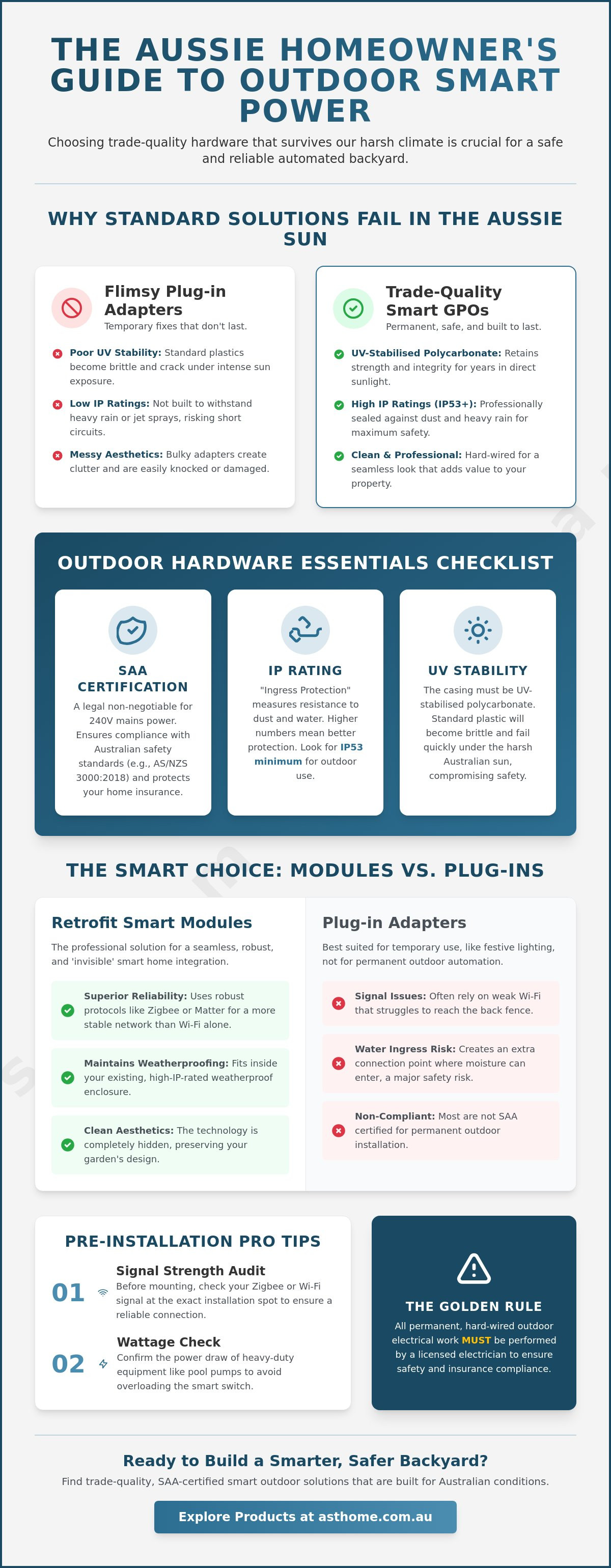
Choosing between a portable plug and a permanent fixture depends on your long-term goals. Portable smart plugs are fine for temporary jobs, like powering a short-term Christmas display or a temporary bug zapper. However, they often lack the robust UV stability and high-level IP ratings required for permanent exposure to the Australian sun and rain. They also tend to look messy, protruding from the wall in a way that's easy to knock or damage.
A permanent, hard-wired outdoor smart power point australia offers a much cleaner aesthetic. It eliminates the clutter of stacked adapters and significantly reduces the risk of water ingress at the plug interface. For homeowners wanting a professional, seamless look that adds value to the property, integrated smart power points represent the gold standard in both safety and reliability.
Choosing the Right Hardware: IP Ratings, UV Stability, and SAA Standards
Selecting hardware for an outdoor smart power point australia requires more than just checking the price tag. You're dealing with 240V mains power in a wet environment. This makes SAA certification your first priority. It's not just a label; it's a legal requirement that ensures the product complies with Australian electrical safety standards. Installing non-certified gear can void your home insurance and, more importantly, put your family at risk. Every component we recommend undergoes rigorous testing to meet these regional safety benchmarks.
The Australian climate presents a unique challenge: extreme UV radiation. Standard plastics become brittle and crack within eighteen months of exposure to our sun. You must look for UV-stabilised polycarbonate housings. This material maintains its structural integrity even when temperatures exceed 40°C. If the casing cracks, water ingress is inevitable, which leads to short circuits and tripped RCDs. Don't settle for generic imports that aren't built for our local conditions.
IP44 vs. IP66: What Does Your Garden Actually Need?
IP ratings tell you exactly how much punishment a device can take. IP44 is the entry-level standard for covered areas like alfresco patios or verandahs. It protects against splashes from any direction and solid objects larger than 1mm. If your power point is mounted on an exposed garden wall or near a pool where it might face heavy rain or high-pressure hose cleaning, you need IP66. This higher rating ensures the internal components remain bone-dry even during a tropical downpour. For maximum longevity, try to mount hardware under eaves or within dedicated weatherproof enclosures whenever possible.
Connectivity: Beating the "Wi-Fi Dead Zone"
Wi-Fi is convenient but has a limited reach. Brick walls and distance often turn your backyard into a dead zone. If you're automating a large estate or a shed far from the house, Zigbee 3.0 modules are the superior choice. Unlike Wi-Fi, Zigbee creates a mesh network where each device passes the signal to the next. This extends your range without needing expensive repeaters. As we move through 2026, the Matter protocol is also becoming the industry standard, offering universal compatibility across different brands. If you're unsure which protocol fits your layout, browsing the technical specs at asthome.com.au can help you find a trade-quality outdoor smart power point australia solution that stays connected.
How to Automate Your Outdoor Space: A Step-by-Step Guide
Successful garden automation requires a methodical approach. You aren't just plugging in a lamp; you're integrating high-voltage equipment into a digital ecosystem. Following a structured installation process ensures your outdoor smart power point australia setup remains reliable through every season. Start by auditing your total power load. A heavy-duty pool pump draws significantly more current than a string of festive LEDs. Check the wattage of every device you plan to connect. Most smart GPOs are rated for 10A, so ensure your combined load doesn't exceed the hardware's capacity.
Before any permanent mounting occurs, test your signal strength at the exact installation point. Use your smartphone or a Zigbee gateway to verify the connection is stable. If the signal is weak, consider a mesh-capable module to bridge the gap. Once the location is confirmed, the hardware must be installed within a compliant weatherproof housing. Adhering to Safe Work Australia electrical safety guidelines is vital here; particularly regarding the use of RCD protection in wet environments. After the physical install, configure your schedules using local Australian sunrise and sunset times. This ensures your lights and pumps react to the actual daylight cycle rather than a static clock.
The final step involves linking your power points to reactive sensors. This moves your backyard from simple "timed" power to true automation. For example, your garden path lights can trigger the moment your smart gate opens, providing immediate visibility and security.
Automating Garden and Security Lighting
Effective lighting automation relies on grouping zones. You can create an "Entertaining" scene that activates the deck lights, dims the garden spots, and turns on the water feature with one tap. Integrating motion sensors is a professional way to deter intruders. These sensors trigger your outdoor smart power point australia to flood the area with light if movement is detected after midnight. If you want to set the mood, use dimming modules to transition from bright security lighting to a soft alfresco glow as the evening progresses.
Pool Pumps and Water Features
Water management is where smart scheduling pays for itself. You can program heavy loads like pool pumps to run exclusively during off-peak electricity windows. This simple change can slash your quarterly energy bills by hundreds of dollars. Many smart modules also offer energy monitoring. This data is invaluable for preventative maintenance; a sudden spike in power draw often indicates a pump motor is straining or about to fail. For social events, set up a "Party Mode" via voice command to instantly activate fountains, pond aerators, and decorative waterfalls without leaving the BBQ.
Electrical Safety and Compliance: Protecting Your Home and Insurance
The number one fear for many homeowners is the risk of an electrical fire during a heavy downpour. It's a valid concern. Water and electricity are a dangerous combination, but the real hazard often isn't the rain itself. It's the use of substandard hardware. In Australia, the law is clear: any permanent electrical wiring must be performed by a licensed electrician. This isn't just about safety; it's about legal liability. If you DIY a permanent outdoor smart power point australia installation and a fault occurs, you aren't just risking a fine. You're risking your life and the structural integrity of your home.
Grey imports from international marketplaces often bypass SAA certification to keep costs low. These devices might look identical to local models, but they frequently lack the internal shielding and component quality required by Australian wiring rules (AS/NZS 3000). If an uncertified device causes a fire, most Australian insurers will void your policy immediately. The role of a modern electrical wholesaler is to bridge this gap, ensuring that every product sold is fully compliant with regional safety anchors. This provides a paper trail of compliance that protects your property and your insurance coverage.
Heat Management in 40-Degree Summers
A 40-degree summer day is a torture test for smart electronics. Internal relays generate their own heat during operation; when combined with high ambient temperatures and direct sunlight, cheap plastics can warp or melt. This is why fire-retardant casings are a critical specification for any outdoor smart power point australia. You should also practice "derating" your equipment. This means you shouldn't run a smart plug at its maximum 10A capacity for extended periods when it's exposed to high heat. Leaving a safety margin reduces the stress on the internal circuitry and prevents premature relay failure.
Overload Protection and Heavy Appliances
Outdoor radiant heaters and heavy-duty pool pumps often push the limits of a standard circuit. Many flimsy plug-in adapters are only rated for light loads and can overheat when forced to power a 2400W heater. Dedicated smart GPOs are engineered with more robust terminals and better heat dissipation than portable alternatives. Always check the wattage of your appliance against the smart point's limit, which is usually 10A. Additionally, ensure your outdoor circuits are protected by a high-quality Residual Current Device (RCD). This safety switch is your final line of defence, cutting power in milliseconds if it detects a leakage to earth.
Don't risk your home's safety with uncertified gear. Browse our range of SAA-certified smart power points to ensure your installation remains compliant and fully insured.
Retrofitting for Success: Why Smart Modules Beat Plug-in Adapters
While many retailers push bulky, plug-in adapters as an entry point to garden automation, they often create more problems than they solve. These external units clutter your alfresco area and can compromise the weather seal of your existing outlets. The professional alternative is a retrofit approach using "invisible" smart modules. By installing Matter or Zigbee modules behind your current weatherproof faceplates, you maintain the original aesthetic of your home while adding high-level intelligence. This is the cleanest way to achieve a high-performance outdoor smart power point australia setup without sacrificing style or safety.
One of the most significant advantages of this retrofit method is the retention of manual override. If your Wi-Fi signal drops out or you've left your phone inside, you can still walk up to the wall and flick the physical switch. This redundancy is essential for outdoor environments where connectivity can be temperamental. Additionally, using Matter smart switches ensures that your outdoor automation remains platform-agnostic. Whether your family uses iPhones, Androids, or smart speakers, everyone gets universal control without the "walled garden" limitations of older technology.
The Professional Edge: Trade Accounts and Support
For large-scale outdoor projects or new builds, the cost of individual smart points adds up quickly. Licensed sparkies and installers can access specialized trade accounts to secure wholesale pricing on bulk orders. Because we are a business run by practitioners for practitioners, we provide peer-to-peer technical support that goes beyond a standard retail helpdesk. We understand the specific nuances of Australian wiring requirements and can assist with complex mesh networking layouts. This level of trade-focused support is why builders and renovators prefer modules; they deliver a seamless, high-end finish that stands up to professional scrutiny.
Future-Proofing Your Outdoor Space
Investing in "cheap" tech is a trap that often leads to higher costs down the line. Generic smart plugs frequently suffer from UV failure or app obsolescence within a few years. By choosing trade-quality hardware today, you are preparing your home for the next decade of connectivity standards like Thread and Matter. These protocols are designed for longevity and cross-brand interoperability. When you build your outdoor smart power point australia network on a foundation of SAA-certified modules, you aren't just buying a gadget; you're installing a permanent asset. Upgrade to trade-quality hardware today and ensure your garden automation remains robust, responsive, and reliable for years to come.
Build a Smarter, Safer Backyard Today
Automating your garden shouldn't be a gamble with your home's safety or insurance. By choosing hardware with the correct IP ratings and mandatory SAA certification, you ensure your alfresco area remains functional through heatwaves and storms. Transitioning from temporary plug-ins to professional retrofit modules provides a cleaner look and the reliability of manual overrides. It's the most effective way to manage a high-performance outdoor smart power point australia network while slashing your energy bills through intelligent scheduling.
As an Australian owned and operated business, we prioritise peer-to-peer service and trade-quality reliability. Our range of Matter and Zigbee modules is engineered to meet strict AU standards; this gives you peace of mind in every installation. Don't settle for gear that can't handle the sun. Shop SAA-Certified Outdoor Smart Solutions at Asthome and take the first step toward a fully automated, future-proof backyard. Your garden is ready for an upgrade; let's get it sorted.
Frequently Asked Questions
Can I leave my outdoor smart plug out in the rain?
Yes, provided it carries an appropriate Ingress Protection rating and is correctly installed. An IP44 rating is sufficient for covered patios or under eaves, but fully exposed areas require IP66 to prevent water ingress during heavy downpours. Always ensure the device is SAA certified to meet Australian safety standards before exposing it to the elements.
Do I need a licensed electrician to install a smart outdoor power point?
Yes, you must hire a licensed electrician for any permanent wiring or GPO replacement. While simple plug-in adapters are DIY-friendly, installing a hard-wired outdoor smart power point australia is a regulated task under national wiring rules. This ensures your installation is safe, compliant, and won't void your home insurance policy.
What is the difference between IP44 and IP66 for Australian backyards?
IP44 protects against water splashes from any direction, while IP66 is dust-tight and protects against powerful water jets. IP44 is the standard for protected alfresco areas or verandahs. If the point is mounted on a garden post or an exposed wall where it might face driving rain, IP66 is the necessary choice for long-term safety.
Will an outdoor smart plug work with my pool pump?
Yes, but you must check the pump's power draw against the smart point's rating, which is typically 10A (2400W). Because pool pumps have high startup currents, they can stress internal relays. We recommend using a permanent smart GPO rather than a portable adapter to handle these heavy inductive loads reliably.
Do I need a hub for my outdoor smart power points?
It depends on the protocol you choose. Wi-Fi models connect directly to your router, but Zigbee or Matter devices require a gateway hub to function. We recommend a hub-based system for garden automation because it provides a more stable mesh network that reaches distant pool sheds or back fences more effectively than standard Wi-Fi.
Can I use a smart plug with an outdoor patio heater?
You can, but only if the heater's wattage is below 2400W. Many radiant patio heaters draw a full 10A, which can cause cheap, low-quality smart plugs to overheat. For high-draw heating appliances, a trade-quality outdoor smart power point australia with robust internal components is much safer and more durable than a flimsy temporary adapter.
What happens to my outdoor automations if the Wi-Fi goes down?
Your pre-set schedules will usually continue to run, but you'll lose the ability to use app controls or voice commands. If you use a Zigbee gateway, your local automations will stay active even without an internet connection. Choosing retrofit modules is a smart move here, as they allow you to use the physical wall switch as a manual backup.
Are smart plugs safe to use in extreme Australian heat?
Trade-quality smart points are safe if they feature UV-stabilised polycarbonate and fire-retardant casings. During a 40-degree summer day, internal components can face significant thermal stress. It's best to mount your hardware in a shaded spot and avoid running appliances at maximum capacity during the hottest part of the day to prevent the internal relays from failing.