

The best smart dimmer isn't actually a switch. In 2026, the most reliable way to upgrade your lighting is with a high-performance module that hides behind your favourite designer plates while supporting the latest Matter protocols. Choosing the right smart dimmer switches involves more than just picking a brand. You need gear that handles Australian 240V mains without the dreaded LED flicker or buzzing.
You've likely felt the frustration of "smart" lights that pulse at low levels or the confusion of "No-Neutral" wiring requirements in older Aussie homes. It's a high-stakes choice. Since the Cyber Security (Security Standards for Smart Devices) Rules 2025 came into effect on March 4, compliance is no longer optional. This guide ensures you find SAA certified solutions that keep your insurance valid and your family safe.
We'll show you how to achieve professional-grade, flicker-free dimming through Matter and Zigbee 3.0 technologies. From rotary mechanisms to in-wall modules, you'll learn which hardware integrates best with Apple Home, Google, and Alexa while meeting every Australian standard and ensuring a seamless install for your licensed sparky.
Key Takeaways
- Learn why Matter is the 2026 universal standard for Apple Home and Google, while Zigbee 3.0 remains the rock-solid mesh choice for larger Aussie homes.
- Discover how to select smart dimmer switches that match your specific LED drivers to eliminate frustrating light flickering and buzzing at low levels.
- Understand the technical benefits of using hidden in-wall modules to maintain your home's aesthetic while gaining full automation and remote control.
- Check the essential SAA certification and RCM requirements to ensure your smart home setup meets Australian safety standards and protects your insurance.
- Explore how modern dimming technology can reduce household energy consumption and significantly extend the lifespan of your LED downlights.
Why Smart Dimmer Switches are Essential for Australian Homes in 2026
Lighting in Australian homes has moved far beyond the basic toggle switch. We've shifted from simple illumination to creating fully automated environments. A smart dimmer switch isn't just a gadget; it's a critical piece of infrastructure that provides remote, voice, and scheduled control over your light intensity. Understanding how dimmer switches work helps you realise they've transitioned from simple analogue resistors to sophisticated digital controllers. These devices allow you to manage the atmosphere of every room from your phone or via a simple voice command to your home assistant.
Australian households are increasingly focused on energy efficiency. By using smart dimmer switches, you can extend the life of your LED downlights significantly. Reducing the power load on your LEDs by even a small margin can lower the operating temperature of the driver. This prevents premature failure. It's a practical win for your wallet and reduces the maintenance cycle of your home's electrical system.
In growth corridors like Point Cook, residents are prioritising smart lighting in new builds. It's no longer an afterthought. Modern homeowners want their houses to work for them. They're looking for systems that are SAA compliant and ready for the 2026 cybersecurity standards. This local shift reflects a broader national trend where "smart" is the new standard for luxury and convenience.
Creating the Perfect Ambience
Your lighting should adapt to your lifestyle. Circadian lighting is a major trend in 2026. This involves automatically shifting from bright, cool morning light to warm, amber hues in the evening to help regulate sleep. You can also integrate your dimmers with a Smart Motion Sensor. Imagine lights that dim automatically when you start a movie or brighten safely when motion is detected in a hallway at night. For security, a 'Leave Home' routine can randomise your smart dimmer switches, making it look like someone is always in.
Boosting Your Property Value
In the Victoria real estate market, smart electrical infrastructure is now a top-tier selling point. Buyers have moved past standalone gadgets; they want integrated smart home systems that feel like a permanent part of the build. Professional-grade hardware, such as a Matter Smart Switch Module or a Smart Zigbee Dimmer Module, offers a level of reliability that consumer-grade kits can't match. Having a fully compliant, SAA-certified system gives prospective buyers peace of mind that the home is safe, insured, and future-proofed.
Choosing Your Protocol: Matter vs. Zigbee vs. Wi-Fi
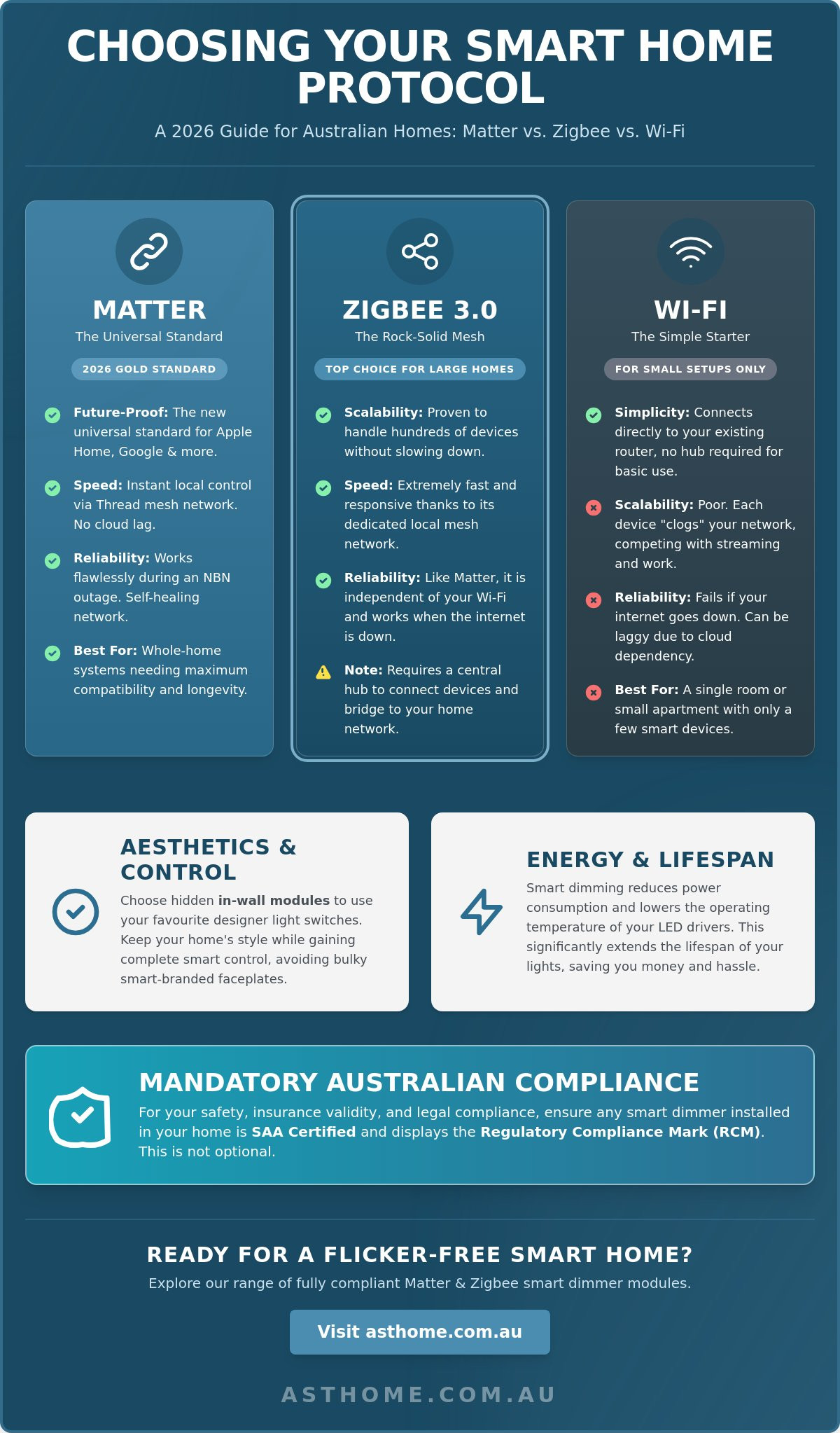
Selecting the right communication protocol for your smart dimmer switches is the most critical technical decision in your home automation journey. It dictates how fast your lights respond, how many devices your network can handle, and whether your system stays functional during an NBN outage. In 2026, the landscape has matured. We've moved beyond simple Wi-Fi toggles to sophisticated mesh networks that offer professional-grade reliability.
Wi-Fi remains a popular entry point because it connects directly to your existing router. It's a solid choice for a single-room setup or a small apartment. However, Wi-Fi is prone to "clogging" your home network. Every smart switch you add competes for bandwidth with your streaming services and work-from-home video calls. If you plan to automate an entire four-bedroom home, a Wi-Fi-only approach often leads to laggy performance and dropped connections.
Interoperability is the goal for any modern Australian home. Your lighting shouldn't exist in a vacuum. It needs to communicate seamlessly with your sensors, hubs, and voice assistants. To ensure your hardware is legally compliant and safe, it must meet Australian electrical safety standards. Always verify the Regulatory Compliance Mark (RCM) before your electrician begins the install.
Why Matter is the 2026 Gold Standard
Matter 1.5, released in late 2025, has effectively ended the era of "walled gardens." By choosing a Matter Smart Switch Module, you're future-proofing your investment against brand-locking. Matter allows direct device-to-device communication over Thread. This means your lights dim instantly because the signal doesn't need to travel to a cloud server and back. New Thread 1.4 border routers, mandatory since January 2026, ensure your mesh remains stable across different manufacturers. For a technical deep dive, see our guide on Matter Smart Switch Australia: The 2026 Guide to Future-Proofing Your Home.
The Case for Zigbee in Complex Setups
Zigbee 3.0 remains the preferred choice for large-scale Australian builds. It creates a dedicated mesh network where every powered device, such as a Smart Zigbee Dimmer Module, acts as a signal repeater. This architecture is incredibly robust. A standard Zigbee gateway hub can typically manage up to 128 devices, with professional hubs supporting over 200. Crucially, Zigbee offers local control. If your internet goes down, your programmed schedules and sensor links keep working. Learn more in our Zigbee 3.0 Smart Switch Module Australia: The 2026 Retrofit Guide.
If you're ready to build a reliable foundation for your lighting, starting with a dedicated Zigbee Gateway Hub is the most logical first step for a stable, high-capacity system.
Smart Modules vs. Full Smart Switches: Which is Best?
Deciding between a hidden module and a complete wall plate replacement is the next logical step after choosing your protocol. This choice determines your home's aesthetic and how much of your existing hardware you can keep. While both options deliver the core functionality of smart dimmer switches, they serve different architectural needs. One disappears into the wall, while the other becomes a focal point of your room's design.
Smart modules, like the Smart Zigbee Dimmer Module, are compact units designed to sit inside the wall box behind your current switch. This approach is the favourite of interior designers and architects. It allows you to maintain a consistent look across the home by using standard Australian faceplates from brands like Clipsal or HPM. You get the high-tech dimming and automation without the "techy" look of a plastic glass panel that might clash with your decor.
Full smart switches, such as the Smart Wi-Fi Light Switch (1/2/3/4 Gang), replace the entire wall assembly. These units often feature touch-sensitive surfaces, LED backlighting, and sleek glass finishes. They are ideal for modern renovations where you want to signal that the home is a premium, automated space. From a cost perspective, modules are often more efficient for multi-gang setups because you only pay for the smart guts, not the expensive decorative housing for every single circuit.
The Retrofit Advantage of Modules
The primary benefit of a module is the retrofit capability. If you love the feel of your current tactile rockers, a Matter Smart Switch Module allows you to keep them. This ensures a manual override that feels "normal" for guests or kids who don't want to use an app. These units are engineered to fit into standard Australian 35mm deep wall boxes. Your sparky simply wires the module between the existing switch and the light load. It’s a clean, non-destructive way to upgrade without tearing out perfectly good hardware.
When to Choose a Full Smart Switch
Full smart switches shine in new builds or when you need to manage four or more circuits from a single point. A 4-Gang Smart Wi-Fi Light Switch provides a centralised control hub that looks far more organised than four individual toggle switches. They are also the best choice if you prefer a touch interface over a physical button. If your home lacks deep wall boxes, a full switch replacement is often easier to install because the electronics are built into the faceplate itself, rather than tucked behind it.
Technical Checklist: SAA Certification and Compatibility
Installing smart dimmer switches in an Australian home requires more than just a Wi-Fi connection. Our 240V mains power is unforgiving. Before you commit to a purchase, you must verify that the hardware is engineered specifically for local conditions. This means checking for SAA certification, identifying your wiring topology, and calculating the total load of your lighting circuits. Skipping these steps often leads to hardware failure, flickering lights, or worse, legal complications with your insurer.
Identifying your wiring is the first practical step. Most modern Australian homes include a neutral wire (usually blue) at the switch, which provides constant power to the smart module. Older homes often use a "two-wire" system without a neutral. If your wall box lacks that blue wire, you'll need a specific No-Neutral module. Additionally, you must check the load ratings. Most smart dimmer switches have a maximum wattage limit. If you're dimming a large chandelier or a dozen high-output downlights, ensure the total wattage doesn't exceed the dimmer's capacity.
The Danger of Non-Compliant Hardware
Cheap gear from overseas marketplaces often lacks SAA certification. In Australia, this isn't just a quality issue; it's a legal one. If a non-certified module causes an electrical fire, your insurance company has clear grounds to reject the claim. You'll also run into the "Electrician's Veto." A licensed sparky risks their licence by installing uncertified gear and will likely refuse the job. Look for the Regulatory Compliance Mark (RCM) or an SAA approval number on the housing to ensure the product meets AS/NZS standards.
Solving the LED Flicker Mystery
LED flickering at low dimming levels is usually a compatibility mismatch. Most modern LEDs require trailing edge dimming to operate smoothly. If your dimmer uses an older leading edge protocol, your lights will pulse or buzz. Minimum load requirements also play a role. If your total circuit load is too low, the dimmer can't maintain a stable current. To achieve a professional, flicker-free result, we recommend pairing your modules with a dedicated Dimmable LED Driver. This ensures the electronic handshake between the switch and the bulb is perfectly synchronised.
Protect your home and ensure your installation meets all legal requirements by choosing from our range of SAA-certified smart dimmer solutions.
Top Smart Dimmer Recommendations from the Asthome Collection
Selecting the right hardware requires matching technical specifications with your home's specific wiring and automation goals. Our curated selection of smart dimmer switches focuses on SAA compliance and interoperability. Whether you're looking for the latest Matter-over-Thread technology or a rock-solid Zigbee mesh, these professional-grade solutions ensure a flicker-free experience that satisfies both your interior designer and your licensed electrician. We prioritise gear that handles the unique demands of the Australian electrical grid.
For those just starting with a single-room setup, the Smart Wi-Fi Light Switch (1/2/3/4 Gang) is a reliable entry point. It connects directly to your 2.4GHz Wi-Fi network without the need for additional hubs. It’s a practical choice for bedrooms or study nooks where you want simple app control. However, for a whole-home system, we recommend moving toward mesh-based protocols to ensure your router doesn't become a bottleneck for your other devices.
Licensed sparkies and trade professionals can access even more value through our dedicated trade accounts. This provides access to wholesale pricing and detailed technical documentation. We understand the needs of practitioners because we are practitioners. Our mission is to provide the trade industry with reliable, certified hardware that makes every install straightforward and every client satisfied.
Standout Product: The Matter Dimmer Module
The Matter Smart Switch Module is our premier pick for 2026. It's a genuine game-changer for Point Cook renovations where future-proofing is a top priority for homeowners. This module offers native support for Apple HomeKit, Google Home, and Amazon Alexa without needing a proprietary bridge. Its ultra-compact design ensures it fits comfortably behind existing plates, even in the shallowest Australian wall boxes. It provides the ultimate balance of modern connectivity and traditional aesthetic control.
The Electrician's Choice: Zigbee 3.0 Modules
For larger residential builds with high wireless interference, the Smart Zigbee Dimmer Module remains the gold standard. These units are highly regarded by electricians for their robust mesh capabilities. Each module acts as a signal repeater, strengthening the network as you expand. They pair seamlessly with a Zigbee Gateway Hub or platforms like Home Assistant for local, lag-free control. You can browse the full collection of smart dimmer switches here to find the perfect fit for your next project.
Future-Proof Your Australian Lighting Today
Upgrading your home doesn't mean compromising on style or safety. The most effective path to a modern home involves selecting hardware that balances aesthetic control with technical reliability. By choosing Matter or Zigbee 3.0 modules, you maintain the look of your favourite designer plates while gaining the latest automation features. Always prioritise SAA certification to ensure your setup is fully compliant with Australian standards and protects your property insurance.
Finding the right smart dimmer switches is about more than just connectivity; it's about flicker-free performance and long-term stability. Our range is vetted by trade professionals to ensure every module handles the unique demands of our local 240V grid. You'll get peace of mind knowing you've got expert technical support from AU-based pros who understand the trade inside and out.
Shop SAA Certified Smart Dimmer Switches for Your AU Home and enjoy the confidence of professional-grade gear. Your journey to a smarter, more efficient Australian home starts with the right foundation. Let's get your lighting sorted today.
Frequently Asked Questions
Do I need a neutral wire for a smart dimmer switch in Australia?
You don't always need a neutral wire, but it depends on the specific hardware you select. Standard smart dimmer switches often require a neutral wire, usually blue, to provide constant power to the smart electronics. If your older Aussie home lacks a neutral at the switch, you must buy a dedicated "No-Neutral" module. These units use a bypass or clever power-bleeding technology to function on a two-wire system without flickering.
Why do my LED lights flicker when I use a smart dimmer?
Flickering usually happens because of a mismatch between the dimmer and the LED's minimum load requirements. Many LEDs pulse or buzz when the current drops too low or if the dimmer uses "leading edge" instead of "trailing edge" technology. To fix this, ensure your total circuit wattage meets the dimmer's minimum threshold. Using a high-quality Dimmable LED Driver is the most reliable way to synchronise the power and stop the strobe effect.
Can I install these smart dimmers myself or do I need an electrician?
You legally must use a licensed electrician for the installation of any hardwired smart dimmer in Australia. DIY electrical work on 240V mains is illegal in every state and territory under the AS/NZS 3000 wiring rules. Hiring a qualified sparky ensures your smart dimmer switches are installed safely and your home insurance remains valid. They'll also verify that your earthing and circuit protection meet current safety standards.
Will my smart dimmer work if the internet goes down?
Your lights will still work manually and locally even if your NBN connection drops out. If you're using Zigbee 3.0 or Matter-over-Thread protocols, your scheduled routines and sensor links continue to function because they don't rely on the cloud. Wi-Fi based dimmers might lose app control during an outage, but the physical wall switch will always let you turn the lights on and off like a traditional toggle switch.
What is the difference between a smart module and a smart wall switch?
A smart module is a tiny device that sits inside the wall box behind your existing faceplates, whereas a smart wall switch replaces the entire plate. Modules are perfect if you want to keep your Clipsal or HPM designer look. Wall switches are better for new builds where you want a modern touch-sensitive interface or glass finish. Both offer the same dimming capabilities, but modules are often more cost-effective for multi-switch plates.
Are all smart dimmers sold in Australia SAA certified?
Not all products sold online are SAA certified, especially those from international marketplaces. You must look for the Regulatory Compliance Mark (RCM) on the device housing to ensure it's legal for sale in Australia. All gear sold by reputable local suppliers must meet these strict safety standards. Using uncertified hardware is a massive risk that can lead to electrical fires and the immediate rejection of any related insurance claims.
Can I use a smart dimmer with non-dimmable LED globes?
No, you cannot use a smart dimmer with non-dimmable LED globes. Attempting to dim a non-dimmable light will cause the globe to flicker violently, buzz, or fail prematurely. It can also cause permanent thermal damage to the internal electronics of your smart switch. Always check the packaging of your LED globes or downlights to confirm they're specifically marked as "dimmable" before connecting them to a smart circuit.
How many lights can I connect to a single smart dimmer module?
The number of lights depends on the total wattage rating of the dimmer rather than a set number of globes. Most smart modules handle between 150W and 300W for LED loads. If you're using 10W downlights, a 150W dimmer can safely manage up to 15 lights. Always leave a 20% safety margin to account for "inrush current" when the lights first turn on, which prevents overloading the module's delicate circuitry.