

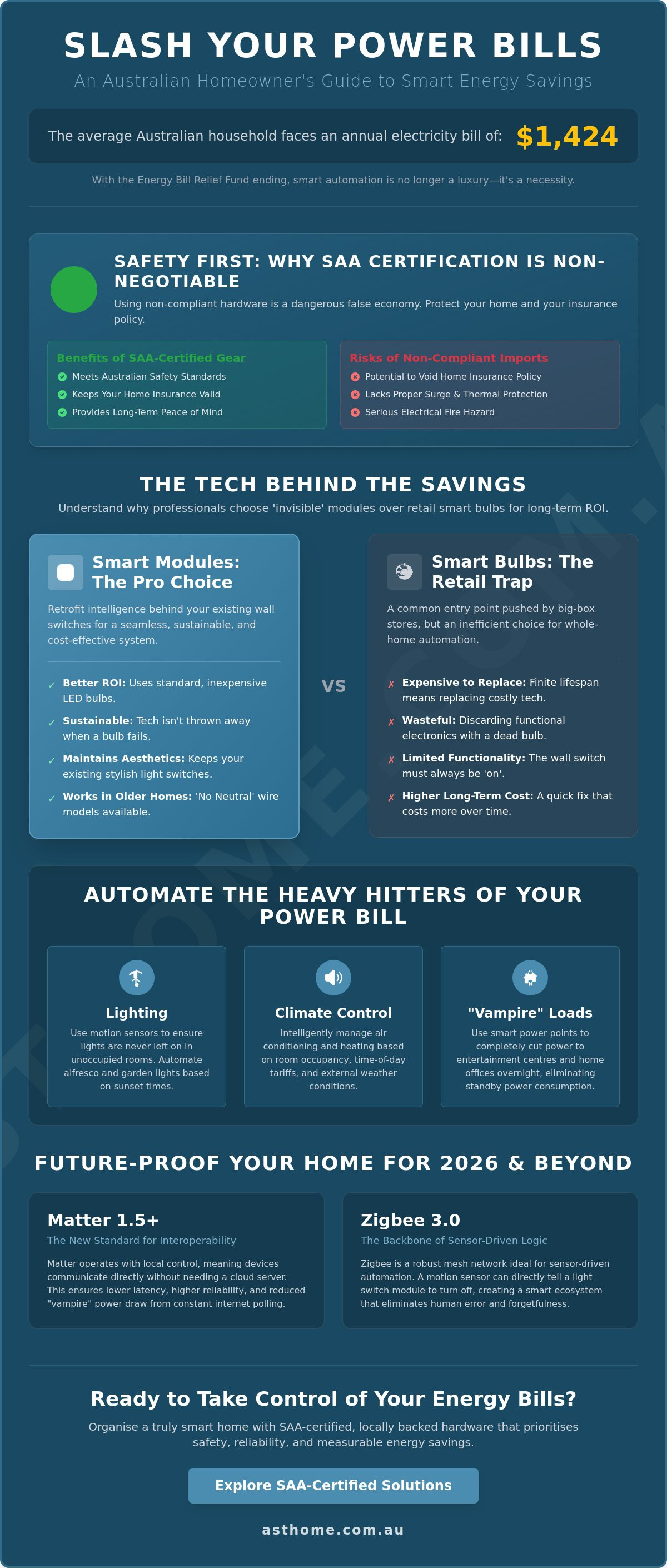
Did you know that the average Australian household is now staring down annual electricity bills of $1,424, despite recent price adjustments? With the federal Energy Bill Relief Fund officially concluded as of December 2025, finding real energy savings with smart home automation has become a priority for every budget-conscious homeowner. It's understandable if you're feeling overwhelmed by technical jargon or worried that non-compliant hardware might void your home insurance policy.
We agree that the shift from traditional switches to intelligent systems should be simple, safe, and effective. This guide promises to cut through the confusion surrounding Matter 1.5 and Zigbee 3.0 standards, showing you exactly how to slash your power bills using SAA-certified smart modules. You'll learn how to implement a future-proof automation strategy that focuses on "invisible" module-level efficiency to deliver measurable reductions in your quarterly energy costs.
Key Takeaways
- Understand why SAA-certified smart modules are the preferred professional choice for long-term ROI compared to standard smart bulbs.
- Discover how to achieve measurable energy savings with smart home automation by targeting high-consumption areas like lighting and climate control.
- Learn the practical steps to identify and eliminate "vampire loads" using smart power points and automated schedules.
- Navigate the 2026 tech landscape with confidence by choosing between Matter 1.5 and Zigbee 3.0 protocols for a future-proof setup.
- Realise the peace of mind that comes from using locally backed, compliant hardware that meets Australian safety regulations and insurance requirements.
What is Smart Energy Automation and Why Does it Matter in 2026?
The Australian energy landscape has undergone a massive shift. With the federal Energy Bill Relief Fund concluding at the end of 2025, households are now facing the full weight of national average electricity bills hitting $1,424 per year. In this high-cost environment, understanding What is Smart Energy Automation has transitioned from a luxury trend to a financial necessity. It involves using SAA-certified hardware to intelligently manage your home's power draw based on real-time occupancy and time-of-use tariffs. This is particularly relevant for the growing smart home community in Point Cook, where local energy demand often peaks during the harsh Victorian summer, putting pressure on both the grid and your wallet.
True energy savings with smart home automation are found in the "invisible" layer of your house. We focus on automation that happens without user intervention. Instead of you remembering to flick a switch, the house makes data-driven decisions to reduce consumption. This practitioner-led approach ensures your home remains efficient 24/7, regardless of whether you are home or away. It's about setting up a system that works for you, rather than you working for the system.
For further inspiration on designing a fully integrated ecosystem, you can learn more about Home-A-Genius and their professional automation solutions.
The Shift from Remote Control to True Automation
There is a significant difference between remote control and genuine automation. Tapping an icon on your smartphone to turn off a light is simply remote control. True automation relies on sensor-driven logic. Imagine your Zigbee 3.0 Smart Switch Module receiving a command from a Smart Motion Sensor because a room has been vacant for ten minutes. This logic eliminates human error, such as forgetting to turn off the alfresco lights after a weekend barbie. By integrating Matter 1.5 and Zigbee protocols, we help you build a unified ecosystem where devices communicate seamlessly to drive down energy savings with smart home automation.
Why SAA Certification is Your First Line of Defence
When you modify your home's electrical system, safety must be the priority. SAA certification is the mandatory safety mark for all Australian electrical products. Many homeowners are tempted by cheap, non-compliant modules from international marketplaces, but this is a dangerous false economy. Non-certified hardware often lacks the surge protection and thermal management required by Australian standards. More importantly, installing non-compliant gear can void your home insurance policy in the event of an electrical fire. We only stock and recommend hardware that has passed rigorous regional testing. This commitment to compliance provides peace of mind while ensuring your smart home remains a safe, high-performing asset for years to come.
The Tech Behind the Savings: Smart Modules vs. Smart Bulbs
While big-box retailers often push smart bulbs as the entry point for home tech, industry professionals know that smart switch modules are the real "tradie's choice" for long-term efficiency. The reason is simple. When you install a smart bulb, you're replacing a perfectly good fixture with an expensive piece of hardware that has a finite lifespan. When that bulb eventually fails, the smart technology goes in the bin with it. By choosing a Matter Smart Switch Module instead, you retrofit the intelligence behind your existing wall plate. This allows you to use standard, cost-effective LED bulbs while maintaining full control. It's a more sustainable approach to energy savings with smart home automation that prioritises long-term ROI over quick fixes.
Government resources on automating the heavy hitters of your power bill highlight that systemic control is key to reducing costs. For owners of older Victorian homes, the "No Neutral" module is a game-changer. Traditionally, smart switches required a neutral wire, often necessitating expensive and invasive rewiring. Modern SAA-certified modules now offer "No Neutral" configurations, allowing you to bring high-level automation to older properties without the need for a sparkie to pull new cables through your walls. For a deeper look at these standards, see our Matter Smart Switch Australia guide.
Matter Smart Switch Modules: The New Efficiency Standard
Matter 1.5 has set a new benchmark for 2026. Because Matter devices operate with local control, they don't need to communicate with a distant cloud server to execute a command. This reduces latency and eliminates the minor but constant "vampire" power draw associated with devices that are perpetually polling external servers. For anyone planning a Point Cook renovation, Matter modules offer the best future-proofing. They fit neatly behind your existing Australian GPO standards and wall plates, ensuring your home remains tech-savvy without losing its aesthetic appeal.
Zigbee 3.0: The Low-Power Mesh Specialist
Zigbee 3.0 remains the specialist for large-scale sensor networks. Unlike Wi-Fi devices that can congest your home network and consume more power, Zigbee creates a low-energy mesh. Each device acts as a repeater, strengthening the signal without increasing energy consumption. By using a Zigbee Gateway Hub, you offload all smart home traffic from your main router, keeping your internet speeds high and your automation reliable. You can find the full technical specs in our Zigbee 3.0 Smart Switch Module Australia guide. If you're ready to upgrade, exploring these modules is the first step toward a more efficient home.
Lighting and Climate: Automating the Heavy Hitters of Your Power Bill
Lighting and climate control are the two biggest contributors to your quarterly energy bill. In the typical Australian household, lighting alone accounts for up to 15% of total electricity consumption. When you factor in the "Point Cook Summer," where air conditioning units work overtime to combat the Victorian heat, these two areas become the primary targets for energy savings with smart home automation. By moving beyond simple manual operation and using sensor-driven logic, you can easily halve the power draw from these systems without sacrificing comfort.
The real efficiency secret lies in the synergy between different devices. For example, a Smart Motion Sensor paired with a Smart Zigbee Dimmer Module ensures that lights in passage areas, like hallways or laundries, only operate when needed. This setup eliminates the common issue of lights being left on for hours in unoccupied rooms. Additionally, a Smart Curtain Motor and Track acts as a passive energy saver. By automating your curtains to close during the hottest part of the day, you reduce the thermal load on your home, meaning your cooling system doesn't have to work nearly as hard to maintain a comfortable temperature.
Precision Lighting with Smart Dimmer Modules
Trade practitioners often recommend dimming lights to 80% as a standard automation rule. To the human eye, the difference in brightness is virtually unnoticeable, but the reduction in energy consumption is significant over time. You can also program an "Away Mode" into your Zigbee Gateway Hub. This ensures every light in the house is killed the moment you leave, preventing human error from inflating your bill. For a detailed breakdown of these logics, check out The 2026 Guide to Smart Light Switches for Australian homes.
Automated Thermal Management
Climate control is about more than just your main split system. You can achieve better energy savings with smart home automation by using a Smart Temperature and Humidity Sensor to trigger your curtains before the afternoon sun hits your windows. For rooms with portable heaters or fans, a Smart Power Point (GPO) allows you to set strict operating schedules or trigger power based on room occupancy. This prevents you from cooling or heating empty spaces, which is one of the most common ways energy is wasted in larger Victorian homes. It's a methodical, safety-first approach to managing your home's thermal envelope.
While automation manages the daily operation of these systems, the quality of the initial hardware setup is paramount. For a deeper look at high-standard climate control setups, Armour Corporation offers an authoritative guide on professional split system installation that ensures your units are primed for maximum efficiency.
5 Practical Steps to Organise Your Home for Maximum Efficiency
Moving from theory to practical application is where you'll see the most significant energy savings with smart home automation. A systematic approach ensures you aren't just installing gadgets, but building a cohesive, energy-efficient ecosystem. Follow these five practitioner-approved steps to organise your home for 2026 energy standards:
- Step 1: Conduct a Vampire Load Audit. Use a Smart Power Point (GPO) to identify which appliances are draining power while on standby. You'll be surprised how much your home theatre and microwave cost you when they aren't even in use.
- Step 2: Retrofit High-Traffic Switches. Install SAA-certified smart modules behind the switches in your kitchen, living room, and outdoor areas. This allows you to maintain your existing aesthetic while adding intelligent control.
- Step 3: Deploy Motion Sensors. Place a Smart Motion Sensor in zones like hallways, laundries, and walk-in robes. These are the areas where lights are most frequently left on by mistake.
- Step 4: Implement Time-of-Use Routines. With 2026 energy tariffs heavily penalising peak-hour usage, program your high-draw appliances to run during off-peak windows. Your Zigbee Gateway Hub can manage these schedules automatically.
- Step 5: Monitor and Optimise. Review your usage data monthly. If a specific room shows high consumption, adjust your sensor time-outs or dimmer levels to refine your efficiency strategy.
Tackling Vampire Power with Smart GPOs
Standby power, often called "vampire power," is the electricity consumed by devices while they're supposedly turned off. This hidden drain accounts for a surprising portion of Australian electricity bills. By installing a Smart Power Point (GPO), you can set "Auto-Off" schedules for devices like coffee machines and gaming consoles that don't need to be live 24/7. A smart GPO can pay for itself in 12 months through standby power reduction alone. It's a simple, set-and-forget method to tighten up your home's energy leaks.
Specialist Efficiency: NDIS SDA Smart Home Kits
In high-care environments, energy management must be balanced with resident comfort and safety. Our NDIS SDA Compliant Smart Home Kit provides the tools to automate lighting and climate for participants with limited mobility. This ensures that rooms are only heated or cooled when occupied, preventing massive energy waste in larger group homes. These kits are designed for reliability and compliance, meeting the specific technical requirements of the NDIS sector. For a full breakdown of these standards, refer to our NDIS SDA Smart Home Technology Australia resource.
Ready to start your retrofit? Explore our range of SAA-certified modules at asthome.com.au to find the right fit for your home.
Future-Proofing Your Point Cook Home with Asthome Smart Electrical Supplies
Achieving long-term energy savings with smart home automation requires more than just a handful of gadgets. It demands a foundation of reliable, compliant hardware backed by local expertise. While international marketplaces are flooded with cheap alternatives, rolling the dice on uncertified gear is a risk most Australian homeowners can't afford. Non-compliant modules often fail to meet SAA standards, which can lead to hardware failure or complications with your home insurance. Asthome Smart Electrical Supplies takes a different approach. As a business run by practitioners for practitioners, we only stock equipment that we've tested and would install in our own homes.
Our commitment to the local Point Cook community extends beyond retail. We understand the specific energy challenges faced by Victorian households, from fluctuating energy tariffs to the seasonal demands of our climate. By providing SAA-certified reliability, Asthome Smart Electrical Supplies ensures your smart home remains a safe and efficient asset. For local sparkies and electrical contractors, we offer dedicated trade accounts to support the regional industry. This peer-to-peer service ensures that professionals have access to the best technical protocols and specialised hardware required for high-stakes residential and commercial installs.
Peer-to-Peer Reliability for Homeowners and Tradies
Our background in the trade means we speak your language. We know that setting up a complex Matter 1.5 or Zigbee 3.0 mesh can be daunting for first-timers. That is why local support is vital. When you buy from Asthome Smart Electrical Supplies, you aren't just getting a product; you're getting access to a seasoned professional who understands the technical nuances of Australian GPO standards and wiring requirements. Point Cook locals trust us because we provide the warmth of a local business combined with the technical authority of industry experts. We help you eliminate the uncertainty that often comes with emerging technology.
Get Started with an Energy Audit Kit
The journey toward a lower power bill starts with the right hardware. Our Matter Smart Switch Module and Zigbee 3.0 Smart Switch Module serve as the foundation of any robust energy strategy. These modules allow you to implement the sensor-driven logic and time-of-use routines discussed in earlier sections. If you are a licensed professional, we encourage you to sign up for a trade account with Asthome Smart Electrical Supplies to access specialised pricing and technical resources. For homeowners, now is the time to transition from basic manual switches to an intelligent, automated ecosystem. Safety, compliance, and efficiency are our core values, and we're here to help you navigate every step of your retrofit.
Browse our SAA-certified Smart Modules and start saving today to secure your home's energy future with Asthome Smart Electrical Supplies.
Take Control of Your Energy Future Today
Achieving real energy savings with smart home automation isn't about chasing the latest gadgets. It's about building a methodical, SAA-certified ecosystem that works silently in the background. By prioritising smart switch modules over temporary bulbs and addressing high-consumption areas like climate control, you can secure a future-proof home that respects your budget. We've seen how simple steps like eliminating vampire loads and automating lighting logic can transform your quarterly power bills from a source of stress into a manageable expense.
As a Point Cook based business run by practitioners, we're here to provide the expert trade support you need. Whether you're a homeowner looking for reliability or a licensed sparkie seeking compliant gear, our range is designed for the specific needs of the Australian market. We stand by our products because we use them ourselves every day. It's time to stop paying for power you don't use and start building a smarter, safer home today.
Upgrade to SAA-Certified Smart Modules and Slash Your Energy Bills
Frequently Asked Questions
How much money can I actually save with smart home automation in Australia?
Most Australian households can reduce their electricity bills by 10% to 30% depending on the level of automation implemented. By specifically targeting lighting and climate control, which are the primary drivers of energy costs, you see the fastest return on investment. The exact savings depend on your current usage patterns and how strictly you apply sensor-driven logic to eliminate waste.
Do I need a licensed sparky to install smart switch modules in Victoria?
Yes, you must engage a licensed electrical contractor for any installation that involves 240V mains wiring. This includes fitting smart switch modules, dimmers, or smart GPOs behind your wall plates. DIY electrical work is illegal in Victoria and will likely void your home insurance policy in the event of a fire or fault.
Is Matter or Zigbee better for reducing my energy bill?
Both protocols are excellent for driving energy savings with smart home automation, but they serve different roles. Zigbee 3.0 is a low-power mesh specialist that is ideal for large networks of sensors and switches. Matter 1.5 focuses on local control and interoperability, which reduces the "vampire" power draw caused by devices constantly polling distant cloud servers.
Will smart home devices themselves consume a lot of electricity?
Smart modules and sensors use a negligible amount of electricity, typically staying well under one watt in standby mode. This tiny power draw is vastly outweighed by the savings gained from turning off lights and appliances that would otherwise stay on for hours. You'll find the net result is a significant decrease in your overall household energy consumption.
Can smart home automation help with NDIS SDA energy management?
Smart automation is a vital tool for NDIS SDA providers to manage energy costs without compromising participant comfort. By using motion sensors and temperature-driven logic, high-draw systems like air conditioning only operate when a room is occupied or when specific thermal thresholds are met. This prevents massive energy waste in high-care environments where manual control might be difficult.
What is SAA certification and why is it important for energy-saving devices?
SAA certification is the mandatory safety mark that proves an electrical product meets Australian and New Zealand standards. It is critical because it ensures the hardware is built to handle local voltage and thermal conditions safely. Using non-compliant gear is a major risk that can lead to electrical failure and the total loss of insurance coverage.
How do smart curtain motors help with heating and cooling costs?
Smart curtain motors act as a passive thermal barrier that manages your home's heat gain and loss. By closing automatically when a temperature sensor hits a certain level or when the afternoon sun is at its peak, they reduce the workload on your split system. This simple automation keeps your home cooler in summer and traps warmth during Victorian winters.
Can I retrofit smart switches into my existing Point Cook home without rewiring?
You can definitely retrofit smart technology into older homes by using "No Neutral" smart modules. These devices are specifically designed to work with older Australian lighting circuits that don't have a neutral wire at the switch. This allows you to achieve energy savings with smart home automation behind your existing wall plates without the cost of a full house rewire.