

What if you could add voice control to your hallway lights without your family "breaking" the smart home every time they flick a wall switch? Many homeowners assume that learning how to make a two-way switch smart requires a complete rewiring of the house or the removal of their physical toggles. In reality, the most reliable way to modernise your home is to keep the hardware you already trust while adding the intelligence behind the wall plate.
We know you value the tactile reliability of a standard switch, and you certainly don't want to risk your home insurance by installing uncertified gear. This guide will show you how to transform your existing two-way lighting into a high-performance system that respects Australian safety standards and works every time. We will explore the 2026 requirements for Matter 1.5 interoperability, solve the "no-neutral" wire headache, and ensure your setup remains fully SAA compliant under the latest AS/NZS 3000 wiring rules.
Key Takeaways
- Prioritise in-wall modules over smart bulbs to ensure your lighting automation remains responsive even when the physical wall switch is flicked.
- Learn the specific master-and-slave logic for how to make a two-way switch smart by repurposing existing traveller wires as signal carriers.
- Select the right protocol for your home, choosing between Matter 1.5 for cross-platform ease or Zigbee 3.0 for robust mesh reliability in larger Australian properties.
- Ensure your installation is fully compliant with AS/NZS 3000 standards by using SAA-certified hardware to protect your home insurance and safety.
- Future-proof your retrofit with local control protocols that keep your smart home functional even if your internet connection drops out.
The Two-Way Switching Dilemma: Why Standard Smart Bulbs Fail
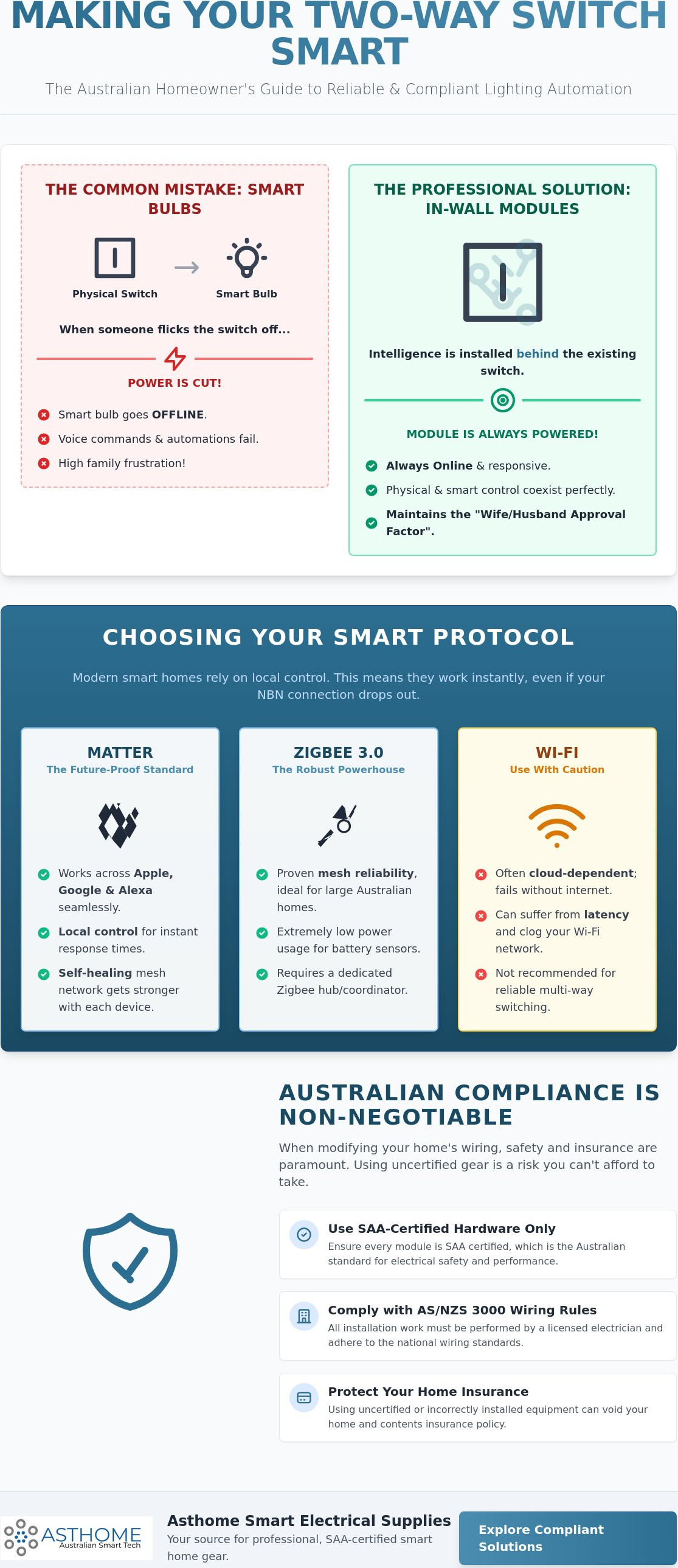
Hallway lighting is the most common use case for two-way switching in Australian homes. You have one switch at the front door and another at the living room entrance. If you've tried using smart bulbs in these areas, you've likely faced the "offline" nightmare. When a family member flicks the physical switch to the off position, the smart bulb loses its 240V supply. Your automations stop, your voice commands fail, and your app shows a device disconnected error. This is a massive headache for anyone trying to figure out how to make a two-way switch smart without causing daily frustration.
The superior retrofit solution for Point Cook homes involves moving the intelligence away from the light fitting and into the wall cavity. By using a smart module approach, you maintain the "Wife/Husband Approval Factor" because the physical switches still work exactly as expected. Guests and family members can use the wall plates like they always have, while you enjoy full app and voice control. It's the only way to ensure your smart home doesn't become a source of household arguments.
How Traditional Two-Way Wiring Works in Australia
Standard Australian two-way circuits rely on a specific configuration of traveller wires, also known as strappers, connecting two switch mechs. Each mech has a Common terminal, an L1, and an L2. When you flick one switch, it toggles the path of the live current between these travellers. This mechanical hand-off is why simple smart switch replacements can be tricky. You aren't just replacing one point of control; you're dealing with a linked system.
Before starting your retrofit, your licensed electrician will need to identify your wiring topology. Older Australian homes often use a "Loop at the light" method, where the neutral wire stays in the ceiling. Newer builds are more likely to have "Neutral at the switch". This distinction is critical for selecting the right hardware, as it determines whether you need a module that requires a neutral wire or one designed for no-neutral environments.
The Module Advantage: Invisible Intelligence
An SAA-certified Matter Smart Switch Module is the professional's choice for modernising existing circuits. These compact units sit comfortably in the wall box behind your existing rocker or push-button mechs. They don't change the look of your home, but they add significant brainpower. They are compatible with almost all standard Australian mechs, meaning you don't have to replace your entire switch plate to get smart functionality.
Because these modules are wired directly into the circuit, they remain powered regardless of the physical switch position. They are also the preferred choice for NDIS SDA compliant homes. In these settings, reliability and manual override are non-negotiable safety requirements. You get the best of both worlds: advanced automation and a physical switch that never leaves you in the dark if the internet drops out.
Choosing Your Tech: Matter vs Zigbee for Two-Way Control
When deciding how to make a two-way switch smart, the physical module is only half the battle. You also need to choose the communication protocol that will run your home. In 2026, the Australian market has shifted away from cloud-dependent Wi-Fi towards local mesh networks. Choosing Your Tech wisely ensures that your lights respond instantly, even if your NBN connection decides to take a breather. High-performance protocols like Matter and Zigbee ensure that your two-way circuit remains a reliable piece of infrastructure rather than a tech gimmick.
Matter 1.5 is the current gold standard for modern retrofits. It allows devices to communicate locally without needing to talk to a server in another country. If you want a system that works across Apple Home, Google Home, and Alexa simultaneously, Matter is the way forward. For larger properties, especially double-storey homes in Point Cook, Zigbee 3.0 remains a powerhouse due to its proven mesh capabilities and lower battery drain on peripheral devices. While Wi-Fi modules are fine for a single switch near your router, they often struggle with the latency required for a seamless two-way experience.
Why Matter is the Future of Australian Smart Homes
Matter-over-Thread offers significant advantages in speed and range. Because Thread is a self-healing mesh protocol, every mains-powered module acts as a repeater, strengthening the network as you add more devices. This eliminates dead zones in sprawling floor plans. Matter is the unifying protocol that finally allows every major smart home ecosystem to speak the same language in 2026. Local execution means your "Hey Google, turn off the hallway" command happens in milliseconds rather than seconds.
Zigbee 3.0: The Reliable Workhorse
If you already own a dedicated gateway, a Zigbee 3.0 Smart Switch Module is an excellent choice. Zigbee operates on a dedicated frequency that helps manage signal interference in high-density Victoria suburbs where Wi-Fi congestion is common. It's also incredibly efficient. This low power consumption is a major benefit for the battery-powered sensors in your mesh, like motion detectors that trigger your two-way hallway lights. For a truly professional setup, we recommend sticking to these mesh-based protocols. You can explore our full range of certified hardware at Asthome to find the right fit for your specific project.
Wiring Logic: How to Organise a Smart Two-Way Circuit
Mastering the logic of how to make a two-way switch smart starts with understanding the "Master and Slave" relationship. In a traditional Australian circuit, both switches physically toggle the live current across a pair of traveller wires. When retrofitting with a smart module, we change this dynamic. You install the smart module behind the load-bearing switch, which is the one where the switch wire actually departs for the light fitting. The second switch no longer carries the full 240V load directly to the light. Instead, the existing traveller wires, often called strappers by local sparkies, are repurposed to send a simple signal back to the module.
This shift in logic is what allows you to keep your existing wall plates and mechs. The module acts as the central brain, listening for a change in state from either physical switch or your smart home app. Your electrician must identify which switch box contains the "switch wire" to the load before installation begins. If the module is placed at the wrong end of the circuit, it may lose power when the other switch is toggled, which leads to the same "offline" issues seen with smart bulbs. Proper placement ensures the module remains energised 24/7.
The Neutral Wire Question
Identifying your wiring is the next hurdle. In Australian homes, the neutral wire is typically blue or white. If you open your switch box and only see red or brown wires, you likely have a "Loop at the light" setup common in older villas. While newer Point Cook developments generally include a neutral at the switch to meet modern standards, older properties require a specific "No Neutral" smart module. These units draw a tiny amount of current through the light fitting to stay powered. For low-wattage LED setups, your electrician might need to install a bypass or capacitor at the light fitting to prevent ghosting or flickering when the light is turned off.
Software Configuration and Pairing
Once the hardware is in, you must tell the module what kind of switches you are using. Most Australian homes use standard rocker mechs, known as "Toggle" switches. If you've upgraded to modern push-button mechs, you'll need to set the switch type to "Momentary" in your app. This ensures the module understands a single pulse as a command to change state rather than waiting for a permanent circuit break.
For a true two-way experience, you'll configure "Multi-way" associations within your chosen ecosystem, such as Apple Home or Home Assistant. This software-level link ensures that both switches stay in sync. Because Matter and Zigbee 3.0 modules use local control, your lights will continue to function even if your gateway goes offline. It's a robust, professional-grade solution for anyone learning how to make a two-way switch smart while maintaining the reliability of a traditional hardwired circuit.
Australian Compliance: Why SAA Certification is Non-Negotiable
Safety is the primary consideration when researching how to make a two-way switch smart. While it's tempting to browse international marketplaces for cheap modules, these devices rarely meet Australian standards. Our electrical grid operates at 240V with specific frequency and surge requirements. Modules built for other markets often lack the necessary internal isolation and thermal protection required to operate safely inside an Australian wall cavity. Using uncertified gear is a gamble that puts your property at risk of fire or electrical failure.
Insurance consequences are equally severe. If a fire occurs and investigators find non-compliant hardware behind your wall plate, your claim will likely be rejected. Most Australian home insurance policies explicitly require all fixed electrical work and components to meet national safety standards. Saving a few dollars on an overseas module could cost you hundreds of thousands in the long run if your cover is voided. Professional-grade hardware is an investment in your home's legal and physical security.
AS/NZS 3000, commonly known as the Wiring Rules, governs all electrical installations in Australia. This standard ensures that circuits are safe, properly grounded, and capable of handling the connected load. A licensed sparky will refuse to install any module that doesn't carry the proper certification. They are legally responsible for the safety of the installation, and uncertified gear represents a liability they simply won't accept. You can find a full range of compliant, professional-grade gear at Asthome to ensure your project meets every regulatory hurdle.
Legal Requirements for Fixed Wiring in Victoria
The law in Victoria is clear: any 240V fixed wiring must be performed by a licensed professional. This includes the installation of smart modules behind your existing switch plates. Once the job is finished, your electrician will provide a Certificate of Electrical Safety (CES). This document is your proof that the work complies with the latest standards and that the hardware used is safe for the Australian market. We actively support the industry by offering specialised Trade Accounts for licensed professionals who need reliable, certified stock for their clients.
Spotting Counterfeit or Non-Compliant Gear
Always look for the RCM (Regulatory Compliance Mark) on the module casing before installation. This tick-in-a-triangle symbol confirms the device has passed the rigorous testing required for Australian conditions. Many overseas products display "CE" or "FCC" marks, but these are European and American standards that do not satisfy Australian law. SAA certification is the only way to guarantee local safety and regulatory approval for Australian electrical products. If the mark isn't there, the module shouldn't be in your wall.
The Asthome Advantage: Professional Smart Gear in Point Cook
Asthome is an Australian-owned and operated business based in Point Cook, Victoria. We aren't just another online retailer; we are practitioners who understand the specific requirements of the local trade. When you're figuring out how to make a two-way switch smart, you need hardware that is tested for Australian conditions and backed by experts who know the difference between a loop-at-the-light and a neutral-at-the-switch setup. Our team curates a range of SAA-certified modules that take the guesswork out of your retrofit project.
We provide fast local shipping across Australia for those urgent renovation projects where you can't afford to wait for overseas deliveries. Every product in our inventory carries the RCM mark, ensuring it meets the strict safety standards required for legal installation in Victoria and beyond. Whether you are a homeowner looking for a single-room upgrade or a licensed electrical contractor managing a full-scale automation project, we offer the technical support and reliable stock you need to get the job done right the first time.
Our Top Picks for Two-Way Retrofits
Selecting the right hardware is the final step in learning how to make a two-way switch smart. We recommend these professional-grade solutions for the best results:
- Matter Smart Switch Module: This is our premier choice for future-proofing. It offers local control and universal compatibility with all major ecosystems.
- Smart Zigbee Dimmer Module: Perfect for lounge rooms and bedrooms where you want to add mood lighting control to your existing two-way circuit.
- Smart Power Point (GPO): Complete your room's transformation by matching your smart lighting with Smart Power Points that follow the same 2026 Australian standards.
Support for the Trade
We understand the unique pressures faced by licensed sparkies in the Point Cook area and across Australia. That's why we offer more than just hardware. We provide comprehensive technical data sheets and wiring support for complex multi-way installs to ensure your projects are both efficient and compliant. Our goal is to be a trusted partner for the trade, providing the reliable components you need to satisfy your clients' smart home ambitions.
For professionals managing multiple sites or high-volume retrofits, we offer wholesale pricing and priority service. You can create a Trade Account today to access discounted rates and a streamlined ordering process. By choosing Asthome, you're supporting a local business that prioritises Australian safety, professional heritage, and peer-to-peer service.
Ready to Modernise Your Australian Two-Way Lighting?
Retrofitting your home doesn't mean you have to sacrifice the reliability of your wall switches or the safety of your household. By choosing in-wall modules over standard smart bulbs, you ensure your lighting remains responsive and functional for everyone. We've explored the critical importance of master-and-slave wiring logic and why local protocols like Matter 1.5 and Zigbee 3.0 are the superior choices for 2026 Australian homes.
Understanding how to make a two-way switch smart is about more than just convenience; it's about building a system that complies with AS/NZS 3000 standards. At Asthome, we specialise in SAA Certified gear that meets strict AU standards, including NDIS SDA Compliant Hardware. Our team provides Point Cook local support to help you or your sparky get the job done right. We carry the professional heritage required to support both retail customers and the trade with confidence.
Browse our SAA-Certified Smart Switch Modules at Asthome to find the perfect fit for your next project. You're just one step away from a smarter, safer, and more efficient home that works exactly the way you need it to.
Frequently Asked Questions
Do I need a neutral wire to make my two-way switch smart?
You don't always need a neutral wire to learn how to make a two-way switch smart. While newer Point Cook homes usually have them, older properties can use "No-Neutral" modules. These units draw a tiny amount of power through the light fitting to stay active. Your sparky can confirm which version is required after inspecting your specific wiring topology.
Can I still use my physical wall switches if the internet goes down?
Yes, your physical wall switches will continue to function perfectly if the internet drops out. Because the modules are hardwired to your mechs, the manual override works independently of your Wi-Fi or gateway. This local control ensures you are never left in the dark during an NBN outage or a router failure.
Is it legal to install a smart switch module myself in Australia?
No, it is illegal to perform any 240V fixed electrical wiring yourself in any Australian state. All smart switch installations must be completed by a licensed electrician to comply with AS/NZS 3000 wiring rules. Once the job is finished, your electrician must provide a Certificate of Electrical Safety to ensure your home insurance remains valid.
Will a smart module fit behind my existing slimline wall plate?
Most smart modules are designed to fit behind standard Australian slimline wall plates. However, the fit depends on the depth of your wall box and the number of mechs on the plate. We recommend using a 35mm deep wall box or a mounting block to ensure there is sufficient room for the module and the associated wiring.
What is the difference between a smart switch and a smart module?
A smart switch is a complete replacement for your existing wall plate and mechs. A smart module is a compact device that sits inside the wall cavity behind your current, traditional switch. Modules are the preferred choice for many retrofits because they allow you to keep your existing aesthetic and high-quality rocker mechs.
Can I use a smart module with a dimmable two-way circuit?
You can certainly use a smart module on a dimmable two-way circuit. You will need to select a specific Smart Zigbee Dimmer Module designed for this purpose. This setup allows you to adjust brightness levels from either physical switch or via your smart home app while maintaining the two-way logic of the circuit.
Do I need a hub for Matter-compatible smart switches?
Matter-compatible switches typically require a Thread Border Router or a compatible Matter hub to function. This device acts as the bridge between your Thread mesh network and your home's internet connection. Many modern smart speakers and home hubs now include this Thread functionality as a built-in feature for 2026 smart homes.
What happens if one switch is up and the other is down in a smart setup?
The physical orientation of the switch doesn't matter when you learn how to make a two-way switch smart. The module detects a change in state rather than a specific "on" or "off" position. Whether the rocker is up or down, flicking it will toggle the light to the opposite state, mirroring the behaviour of a traditional intermediate switch.