

If you're worried your existing Zigbee gear is about to become a pile of expensive electronic waste, you've been listening to the wrong tech pundits. Many Australian homeowners feel the sting of protocol fatigue, juggling half a dozen apps and fearing their reliable hardware will soon be obsolete. You've likely spent years perfecting your mesh network. The thought of ripping it all out for a new standard is both exhausting and unnecessary. Integrating zigbee and matter devices is the key to ending the app clutter while keeping your local control intact.
You deserve a home that just works, free from cloud lag and incompatible ecosystems. This guide promises to show you how to bridge your current Zigbee modules with the universal Matter 1.6 standard for a truly unified experience. We will explore how to use SAA-certified hardware to meet the mandatory cybersecurity standards that commenced in March 2026. You'll learn how to create a future-proofed electrical system where every switch, motor, and sensor speaks the same language through a single app of your choice.
Key Takeaways
- Learn how Matter Bridges act as the essential translator to bring your existing Zigbee modules into the universal Matter fabric.
- Discover why the Matter Smart Switch Module is the ideal foundation for new Australian builds and multi-platform smart home ecosystems.
- Master the technical steps for integrating zigbee and matter devices to achieve seamless local control without the frustration of cloud lag.
- Understand why SAA-certified hardware is non-negotiable for meeting the 2026 Australian cybersecurity and electrical safety standards.
- Get expert tips on managing 2.4GHz interference and hub placement to ensure a rock-solid mesh network across your entire property.
Understanding the Zigbee and Matter Connection in 2026
By August 2026, the Australian smart home market has finally moved past the "walled garden" era. We've seen the release of Matter 1.6 in June 2026, which solidified its position as the universal language for home automation. Matter isn't a physical radio like Wi-Fi or Bluetooth. It's a protocol that allows devices from different brands to talk to each other without needing a cloud translation. For many Aussies, the foundation of their smart setup remains the Zigbee network. Understanding the Zigbee Protocol is vital because this low-power mesh standard is already wired into millions of local GPOs and light switches across the country.
Integrating zigbee and matter devices is the smartest way to bridge the gap between legacy reliability and modern interoperability. While Thread is often discussed alongside Matter as a high-speed networking layer, it doesn't make your existing Zigbee gear redundant. Instead, Matter-compliant bridges allow your reliable Zigbee 3.0 Smart Switch Modules to appear in your Apple Home, Google Home, or Amazon Alexa dashboard just like a native Matter device. This approach ends the "app fatigue" that comes from having a separate controller for every brand of hardware in your ceiling.
Will Matter Replace Zigbee in Australia?
Zigbee is far from dead. It remains the most cost-effective and energy-efficient choice for large-scale mesh networks involving sensors and dimmers. While Matter is the new gold standard for connectivity, it relies on bridges to communicate with Zigbee hardware. Your current investment is safe because the industry has pivoted toward hybrid setups. By integrating zigbee and matter devices, you keep the rock-solid local mesh of Zigbee while gaining the cross-platform flexibility of Matter. This ensures your home electrical system stays relevant for years to come.
The Benefits of a Unified Ecosystem
A unified home offers more than just convenience. Local control is the biggest win for Australian users. Commands stay within your four walls. Your lights turn on instantly without waiting for a server in another country to respond. Setup is also vastly improved. Using standard QR codes to commission new hardware eliminates the "pairing dance" often found with older Wi-Fi gear. Finally, a standardised system increases your home's resale value. Future buyers won't need a degree in IT to operate the house. They just need a single app that works with any SAA-certified hardware you've installed.
How to Use Matter Bridges for Existing Zigbee Devices
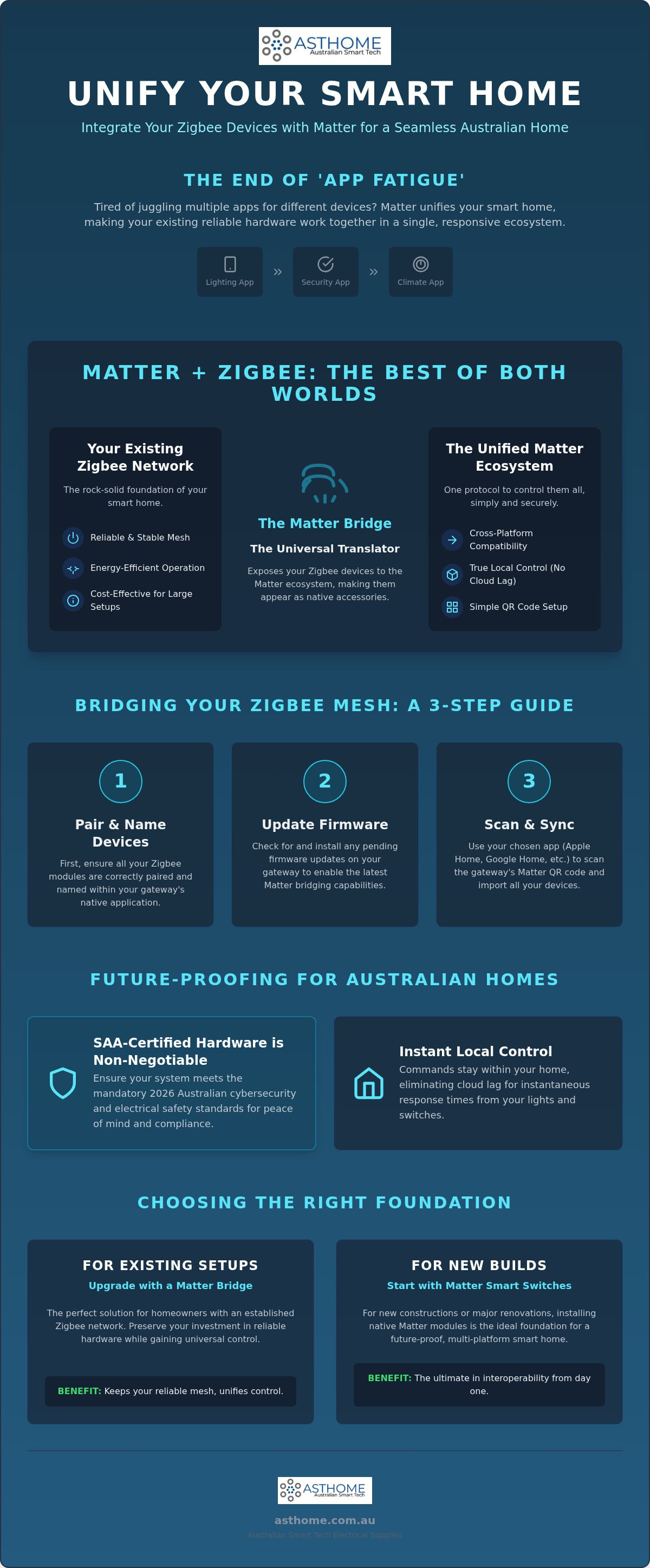
The Matter bridge is the essential translator of the 2026 smart home. It acts as a professional interpreter, allowing your established Zigbee mesh to communicate fluently with the official Matter standard fabric. Integrating zigbee and matter devices doesn't require a total rewire or the disposal of perfectly functional hardware. Instead, you simply need a gateway that supports the "Bridge" device type defined in the Matter specifications. This hardware sits between your Zigbee modules and your home network, exposing every connected light, switch, and sensor as a native Matter accessory.
Setup starts with the hardware. For the most reliable results, connect your bridge directly to your home router using an Ethernet cable. While some hubs offer Wi-Fi, a hardwired connection is always king for trade-grade stability and lower latency. Once powered up, the software commissioning process is remarkably simple. You'll use your preferred app—be it Apple Home, Google Home, or Alexa—to scan the unique Matter QR code located on the bridge. This single action brings your entire existing Zigbee network into your unified ecosystem in one go. If you're starting from scratch, choosing a high-quality Zigbee Gateway Hub with built-in Matter support is the most efficient way to manage your home's electrical logic.
Step-by-Step: Bridging Your Zigbee Mesh
Success depends on a methodical approach. Follow these steps to ensure a clean integration:
- Pair your devices: Ensure all your Zigbee 3.0 modules are correctly paired and named within your gateway's native app first.
- Update firmware: Check for any pending updates. Many gateways released in 2025 required a post-launch patch to enable full Matter bridging capabilities.
- Scan and Sync: Open your Matter-controller app (like HomeKit), select 'Add Accessory', and scan the gateway's Matter code. The app will automatically detect and import your Zigbee devices.
Limitations of Bridging
While bridging is powerful, it isn't a magic bullet. You should be aware that some manufacturer-specific features might not pass through the bridge. For instance, advanced energy monitoring data or complex internal dimming curves often remain trapped in the native Zigbee app. Additionally, the bridge represents a single point of failure. If the gateway loses power, your Zigbee mesh loses its connection to the wider Matter network. Finally, remember that some brands restrict which specific devices they "expose" to Matter, so always verify compatibility before assuming every sensor will show up in your unified dashboard.
Choosing Between Zigbee 3.0 and Matter Smart Switch Modules
Selecting the right hardware for your wall cavity requires a clear understanding of your home's existing wiring and your long-term automation goals. Both protocols are managed by the Connectivity Standards Alliance, which ensures a high level of professional interoperability regardless of which path you choose. In the Australian market, the decision often comes down to whether you are working with a fresh build or updating an older property with limited access to neutral wires. Integrating zigbee and matter devices allows you to mix these technologies based on the specific needs of each room, rather than being forced into a single, restrictive ecosystem.
Safety remains the absolute priority for any electrical installation. Every module you select, whether it uses Zigbee or Matter over Thread, must carry SAA certification to comply with Australian safety standards. Licensed sparkies will rightfully refuse to install any hardware that lacks the RCM mark. Beyond compliance, consider the network density. Zigbee excels in environments with dozens of low-power sensors, while Matter provides the high-speed response times expected in modern multi-platform homes.
Matter Smart Switch Modules: The Future-Proof Choice
Matter modules represent the cutting edge of home electrical supplies. These devices typically use Thread, a mesh networking protocol designed specifically for low-latency and high-reliability tasks. Because Matter is a universal language, these switches integrate directly with your phone or hub without needing a proprietary gateway. They are the ideal choice for future-proofing your home, especially if you want to switch between Apple, Google, and Amazon ecosystems without replacing hardware. They offer a clean, high-speed solution for new builds where neutral wires are standard.
Zigbee 3.0 Modules: The Retrofit King
Zigbee 3.0 remains the industry workhorse for a reason. It is a mature technology with a massive catalogue of compatible hardware. For most Australian homes built before the 2000s, Zigbee is the go-to for retrofitting existing Australian light switches because of the wide availability of "no-neutral" modules. These modules draw a tiny amount of power through the load, making them perfect for older double-brick homes where pulling new cables is a nightmare. Integrating zigbee and matter devices ensures you can use these cost-effective, reliable modules in your bedrooms while running high-speed Matter gear in your main living areas.
Setting Up Your Unified Smart Home Ecosystem in Australia
Setting up a unified system in a high-density area like Point Cook requires a professional approach to signal management. Most Zigbee and Thread devices operate on the 2.4GHz frequency, which is often crowded by older Wi-Fi routers. You should place your Zigbee Gateway Hub in a central spot, but keep it at least two metres away from your main router to avoid signal drowning. Integrating zigbee and matter devices successfully relies on a strong mesh. Use mains-powered hardware, such as a Smart Power Point (GPO), to act as a signal repeater. This ensures your battery-operated Smart Motion Sensors stay connected even in the far corners of the house.
Data security has never been more critical. Since the commencement of the Cyber Security Rules 2025 in March 2026, every smart device sold for domestic use in Australia must meet mandatory minimum standards. Both Matter and Zigbee 3.0 use strong AES-128 encryption to keep your commands private. A standout feature of this new era is "Multi-Admin" support. This allows you to commission a Matter Smart Switch Module into multiple ecosystems at once. You can use Apple Home on your watch while your kids use a Google Nest Hub in the kitchen. It provides total flexibility without the typical brand lock-in.
The Role of the Smart Home Controller
A unified home needs a capable brain. Your Smart Home Controller acts as the local "fabric" where all your devices meet. For a smooth experience, your controller should be a Thread Border Router. This allows Matter-over-Thread devices to communicate directly with your home network. When you are integrating zigbee and matter devices, your controller manages the logic that lets a Zigbee sensor trigger a Matter-enabled light. Ensure your controller is SAA-certified and "Matter-ready" out of the box to avoid compatibility headaches later.
Troubleshooting Integration Issues
"No Response" errors are the bane of any smart home enthusiast. These usually happen when a bridge loses its connection to the mesh or when firmware becomes fragmented. Check that your Zigbee Gateway Hub is updated to the latest version to maintain its Matter bridging capabilities. A stable Wi-Fi backbone is essential for your controllers, so consider using a wired Ethernet connection where possible. If you need hardware that's vetted for local conditions, shop our range of SAA-certified smart modules for a reliable, trade-quality setup.
Future-Proofing Your Home with SAA-Certified Smart Hardware
Building a smart home is an investment in your property's long-term infrastructure. In 2026, the technical complexity of integrating zigbee and matter devices requires hardware that is built to last a decade, not just a season. Every module you install behind your wall plates becomes a permanent part of your home's electrical fabric. Choosing trade-quality gear ensures that your unified ecosystem remains stable, secure, and compliant with local regulations. At Asthome, we specialise in providing SAA-certified hardware that bridges the gap between traditional electrical reliability and modern automation standards.
Our commitment to the Australian trade industry goes beyond just selling modules. We provide specialized solutions like our NDIS SDA Compliant Smart Home Kits, which are designed to meet strict accessibility requirements while maintaining protocol flexibility. Whether you are a homeowner in Point Cook or a developer working on a large-scale project, integrating zigbee and matter devices with our expert-vetted gear means you never have to worry about hardware becoming obsolete. We focus on the technical specifications that matter most to Australians, from local safety marks to regional cybersecurity adherence.
Why SAA Compliance Matters
SAA certification is the only way to guarantee your smart home meets Australian power point standards and electrical safety laws. Using grey-market imports might save a few dollars upfront, but the risks are substantial. Uncertified gear can lead to electrical instability, and more importantly, it can void your building insurance if a fault occurs. Every SAA certificate is valid for five years and costs approximately AUD 770 per product family to maintain, representing a significant investment in consumer safety by the manufacturer. This certification ensures your smart switches can handle the local 230V grid without compromise.
Getting Started with Asthome
Ready to take the next step in your automation journey? You can browse our full range of SAA-certified Matter and Zigbee 3.0 modules online, each selected for its performance in the Australian environment. We provide the technical support needed for complex integrations, helping you choose the right gateway for your specific mesh requirements. If you are a licensed sparkie or an automation professional, you can enquire about a Trade Account for your next project to access bulk pricing and priority technical assistance. We are here to ensure your smart home is safe, compliant, and ready for whatever the next decade of technology brings.
Build a Unified and Compliant Smart Home
Achieving a unified household doesn't mean choosing between your established Zigbee network and the universal Matter standard. By integrating zigbee and matter devices, you gain the best of both worlds: the rock-solid reliability of a local mesh and the cross-platform flexibility of a universal language. Hardware safety remains non-negotiable in the Australian market. Every module you install must meet mandatory cybersecurity rules and carry SAA certification to ensure your property remains insured and protected.
At Asthome, we're practitioners who understand the specific needs of the regional trade industry. We provide expert-vetted modules backed by local support from our base in Point Cook, Victoria. Whether you're a DIY enthusiast or a licensed professional looking for trade pricing, we have the hardware to make your project a success. Shop SAA-Certified Matter and Zigbee Modules at Asthome to build a home that just works. Your future-proofed smart home is only a bridge away.
Frequently Asked Questions
Do I need a new hub to use Matter with my Zigbee devices?
Yes, you typically need a Matter-compatible bridge or a Zigbee Gateway Hub that has received a firmware update to support the bridge specification. This hardware acts as the essential translator between the two protocols. Without this bridge, your existing Zigbee gear won't appear in the Matter fabric. It's a mandatory hardware level requirement for integrating zigbee and matter devices into a single ecosystem.
Can I control Matter and Zigbee devices in the same app?
Yes, once your Zigbee devices are bridged to Matter, they appear alongside native Matter accessories in apps like Apple Home, Google Home, or Amazon Alexa. This setup eliminates the frustration of switching between multiple manufacturer apps for daily control. You get a unified dashboard for every SAA-certified switch and sensor in your home, providing a seamless user experience across different brands.
Is Thread the same thing as Matter?
No, Thread is a networking protocol while Matter is the application language. Think of Thread as the road and Matter as the car. Matter can run over Thread, Wi-Fi, or Ethernet. While many new Matter Smart Switch Modules use Thread for its low-latency mesh capabilities, they are distinct technologies that work together to create a responsive and modern Australian smart home ecosystem.
Will my existing Zigbee 3.0 switches work with a Matter controller?
Yes, provided they are connected through a Matter-compatible Zigbee bridge. The Matter controller, such as a HomePod or Nest Hub, doesn't talk to Zigbee devices directly. Instead, it communicates with the bridge, which then relays the command to your Zigbee 3.0 Smart Switch Module. This professional setup preserves your investment in older, reliable hardware while moving to a modern standard.
Are Matter devices more expensive than Zigbee ones in Australia?
Generally, yes. Matter-over-Thread devices often carry a slight price premium due to the newer radio hardware and the costs associated with the latest certifications. However, the price gap is narrowing as local adoption increases. Zigbee remains the retrofit king for those looking for cost-effective, high-density sensor networks, while Matter is the preferred choice for new builds where future-proofing is the priority.
Can I integrate Zigbee sensors into a Matter-based security system?
Yes, integrating zigbee and matter devices allows your Zigbee sensors to trigger Matter-enabled sirens or smart door locks. Once bridged, a Smart Zigbee Motion Sensor can participate in any automation or security routine within your primary Matter-certified ecosystem. This cross-protocol communication happens locally at the hub level, ensuring your security response is fast and doesn't suffer from cloud lag.
Does integrating these protocols affect my internet speed?
No, smart home protocols like Zigbee and Thread use very little bandwidth and operate on a separate mesh network from your main Wi-Fi. While they share the 2.4GHz frequency, they don't consume your NBN data. In fact, Matter focus on local control can actually reduce the load on your router by keeping daily commands and automation logic off the cloud.
What happens to my smart home if the internet goes down?
Your local automations and physical switches will continue to work perfectly. Both Matter and Zigbee are designed for local control, meaning your Smart Power Point (GPO) will still respond to your sensors even without an active internet connection. You'll only lose remote access features and any voice assistants that rely on cloud processing for speech recognition during the outage.