

What if the very device meant to secure your home actually left a digital back door wide open for hackers? It's a valid concern now that the average Australian household manages around 25 connected devices. You've likely felt that familiar pang of anxiety about batteries dying at the worst possible time or wondered if a new smart door lock will even fit your existing timber or narrow aluminium door frame without a massive headache.
We understand that you need more than just a gadget; you need a professional-grade security solution that won't void your insurance. This guide will help you master the technical specs of Matter 1.5 and Zigbee protocols while ensuring your hardware meets the mandatory Cyber Security Rules 2025 that came into effect on March 4. You'll learn exactly how to choose a lock that integrates with your smart power points and motion sensors, providing secure, keyless entry that actually works with Australian standards. We're diving into everything from SAA compliance to choosing the right gateway hub for a reliable local mesh network that keeps you in control.
Key Takeaways
- Identify whether your home requires a mortise or deadbolt solution based on common Australian timber and narrow aluminium door standards.
- Evaluate the technical differences between Matter 1.5, Zigbee, and Wi-Fi to choose a smart door lock with optimal battery life and local reliability.
- Confirm SAA certification and IP ratings to ensure your hardware is compliant with Australian insurance requirements and suited to local weather conditions.
- Discover how to integrate your entry system into a unified local mesh network using a Zigbee Gateway Hub for seamless automation with sensors and lights.
- Understand the impact of the 2026 cybersecurity regulations to ensure your home security remains protected against modern digital vulnerabilities.
Beyond the Key: The Evolution of the Smart Door Lock in 2026
Smart home security in Australia has reached a turning point. We've moved past the era when a smart door lock was merely a motorised latch you could trigger with a clunky smartphone app. In 2026, these devices function as the primary security node for your entire home ecosystem. This evolution of the smart lock means your front door is now a sophisticated data point that communicates directly with your lights, sensors, and alarm systems. It's no longer just about letting yourself in; it's about how your home prepares for your arrival.
Modern Australian builds now favour biometric fingerprint scanners and NFC-based entry as the baseline standard. Keys have become a secondary backup. For busy Aussie families, the real value lies in the granular access logs and peace of mind they provide. You can check exactly when the kids got home from school or verify that a tradie arrived on time via real-time alerts. This level of transparency eliminates the "did I lock the door?" anxiety that used to plague homeowners.
Why Traditional Wi-Fi Locks are Losing Favour
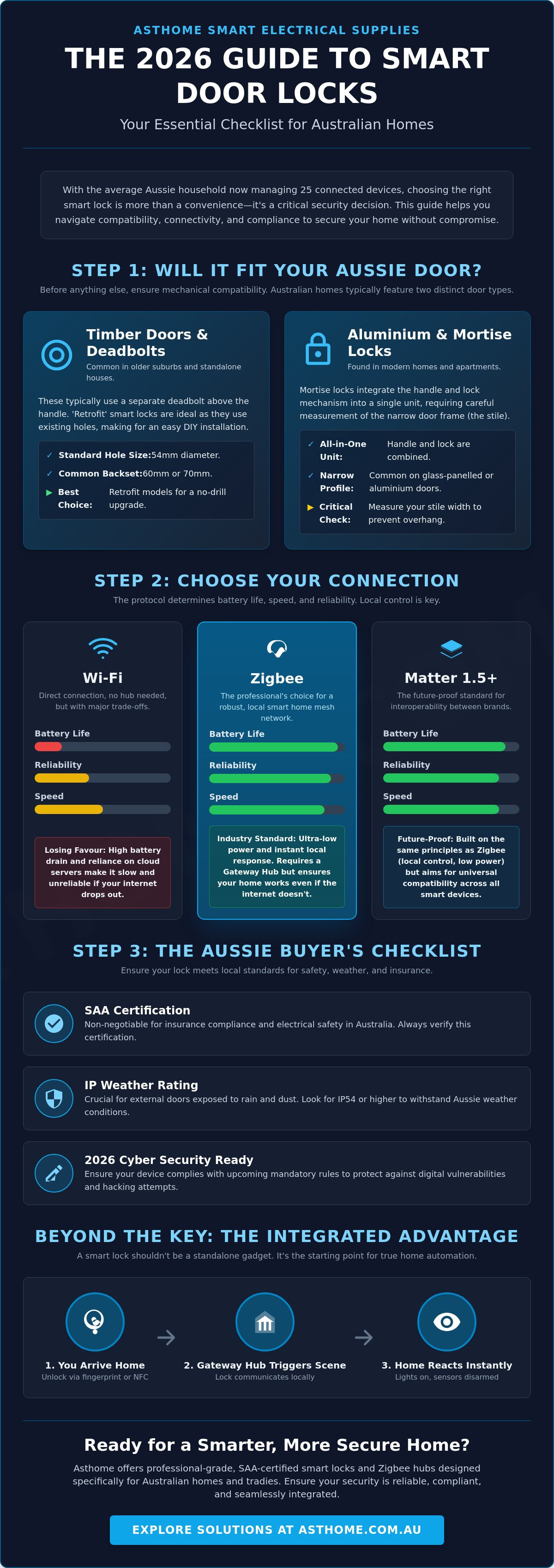
Wi-Fi was the original entry point for home automation, but it's proving inefficient for high-traffic doors. The main issue is battery drain. Constant Wi-Fi pings to maintain a cloud connection eat through AA batteries in weeks. There's also the latency problem. If you're standing on the doorstep with a weak signal, waiting five seconds for a cloud server to authenticate your request is a poor experience. Local control via Zigbee or Matter 1.5 removes these bottlenecks. It ensures your door responds instantly, regardless of your external internet connection status. It's a faster, more reliable way to manage entry.
The Rise of Integrated Home Security
A standalone lock is a missed opportunity in a 2026 smart home. In a truly automated setup, unlocking the door should trigger a sequence of events. It should disarm your motion sensor and illuminate the hallway lights automatically. This level of coordination requires a reliable bridge between devices. A Smart Hub serves as the brain that organises every local device interaction within your network. By offloading the processing to a central gateway hub, your lock remains responsive and secure while acting as the first line of defence in a wider, smarter ecosystem. This creates a seamless transition from the driveway to the living room.
Mechanical Compatibility: Will it Actually Fit Your Aussie Door?
Picking a smart door lock is only half the battle. If the hardware doesn't line up with your door's existing preparation, you're looking at an expensive afternoon with a carpenter. Australian homes present a unique challenge. You'll typically find a mix of heavy timber entry doors in older suburbs and narrow-profile aluminium frames in modern developments. Each requires a fundamentally different mechanical approach. Before you buy, you must identify whether your door uses a standard deadbolt or a more complex mortise system.
Understanding the technical breakdown of smart lock components is vital here. A standard Aussie deadbolt usually sits in a 54mm hole with a 60mm or 70mm backset. If you're swapping a traditional deadbolt for a smart equivalent, look for a "Retrofit" model. These units are designed to use your existing holes, meaning no drilling or re-coring is required. It's the difference between a ten-minute DIY job and a full-day renovation. If you're unsure which physical format suits your entry, check out our range of smart door lock solutions designed specifically for Australian door standards.
The Mortise Lock Challenge
Many high-end Victorian and NSW homes utilise multi-point mortise locks. These are integrated units where the handle and lock are one piece. If your current door has a large metal plate on the edge, you have a mortise lock. Checking your stile width, the flat part of the door frame, is non-negotiable. If your stile is too narrow, a wide smart handle will hang off the edge, ruining the aesthetic and compromising security. Always verify the strike plate alignment. If the latch doesn't sit perfectly, the auto-lock feature will jam, causing the motor to burn out prematurely.
Slimline Solutions for Modern Glass Doors
Modern glass-fronted entries often feature narrow-stile aluminium frames. These doors don't have the surface area for a standard chunky lock. You'll need a slimline model, often as narrow as 35mm to 45mm. Weatherproofing is another critical factor for these doors. Ensure the unit has a high IP rating to withstand driving rain and the harsh Australian UV index. For NDIS SDA participants, mechanical compatibility also covers accessibility. We often recommend automated mechanisms that require zero physical force for entry, ensuring the home remains compliant and inclusive for all residents.
Connectivity Showdown: Zigbee, Matter, or Wi-Fi?
Wi-Fi is the path of least resistance, but it's rarely the path to a reliable smart door lock setup. While Wi-Fi hardware connects directly to your router, it's notoriously power-hungry and relies entirely on an active NBN connection. If your internet drops out, your remote access and automation triggers often fail. Professional installers across Australia are increasingly moving toward local mesh protocols like Zigbee and Matter to ensure "Offline Security." These networks function locally, meaning your door will still lock, unlock, and trigger your hallway lights even if the cloud goes dark.
Building a robust security network requires more than just the lock itself. Integrating a zigbee 3.0 smart switch module australia into your wall plates actually makes your lock network stronger. Because Zigbee is a mesh technology, every mains-powered device acts as a repeater. This extends the signal from your central Zigbee Gateway Hub to the furthest entry points of your property, ensuring your front gate lock never loses contact with the system. It's a logical way to eliminate dead zones in larger Australian suburban homes.
Matter: The 2026 Standard for Future-Proofing
Matter 1.5 has become the universal language for home automation in 2026. It allows your lock to communicate natively with Apple Home, Google Home, or Amazon Alexa simultaneously. For Australian households with a mix of iPhone and Android users, "Multi-Admin" control is a game-changer. It means everyone gets the same level of access regardless of their preferred ecosystem. If you want the best battery performance, look for Matter-over-Thread hardware. Thread is a low-power mesh protocol designed specifically for battery-operated devices, providing the speed of Wi-Fi without the constant drain on your hardware.
Zigbee 3.0: The Reliable Workhorse
Zigbee 3.0 remains the preferred choice for electrical contractors and trade professionals due to its proven stability and local-first architecture. Unlike Wi-Fi locks that might need new batteries every few months, a Zigbee-enabled smart door lock can easily achieve 12 to 18 months of battery life on a single set of AAs. You can build a comprehensive mesh network by using smart GPOs and light switches as signal repeaters. This creates a self-healing network that reaches the front gate or the garage without needing expensive Wi-Fi extenders. It's a pragmatic, trade-grade solution that prioritises uptime and security over flashy cloud features.
The Australian Buyer’s Checklist: Security, Standards, and SDA
Selecting a smart door lock for an Australian home involves more than just comparing app features. You're installing a critical piece of security hardware that must withstand local environmental conditions and meet strict regulatory benchmarks. Skipping these checks can lead to hardware failure or, worse, a voided insurance policy. Use this professional checklist to ensure your hardware is fit for purpose.
- Verify SAA Certification: This is non-negotiable. Using non-compliant hardware that hasn't passed Australian safety testing can void your home insurance. Always look for the regulatory compliance mark before purchasing.
- Check the IP Rating: Australian front entries are often exposed to driving rain and intense UV. Ensure the lock carries at least an IP65 rating to prevent the electronics from perishing in our harsh climate.
- Emergency Access Protocols: Batteries eventually die. Your lock must have a physical key override or an external 9V battery jump-start port. Without these, you're looking at a costly locksmith call-out.
- User Management Capacity: Consider how many unique fingerprints or PIN codes the device can store. For busy households, a capacity of 50 to 100 users allows you to manage access for the kids, the dog walker, and temporary tradies without sharing a master code.
- Fire Rating (AS 1905.1): If you're installing on an apartment entry door, the lock must meet Australian fire safety standards. It must not compromise the door’s ability to act as a fire-resistant barrier.
NDIS and SDA Compliance
Specialist Disability Accommodation (SDA) homes require specific automation features to improve resident independence. For these projects, remote monitoring for carers is essential. The hardware must also feature an "emergency egress" mode, allowing for immediate exit without needing to fiddle with digital interfaces. In Victoria, SDA developers increasingly rely on our NDIS-compliant kits from Asthome Smart Electrical Supplies because they bridge the gap between high-tech accessibility and local safety mandates. These systems ensure that residents remain secure while providing carers with the necessary oversight tools.
Trade-Only Considerations for Electricians
Licensed professionals have a responsibility to install gear that protects their professional indemnity. Installing SAA-certified hardware is the only way to ensure the job meets Australian standards. For those looking to grow their business, pitching a lock upgrade as part of a wider smart light switch installation is a high-value strategy. It allows you to offer a complete "arrival scene" where the lights turn on the moment the door is unlocked. Asthome Smart Electrical Supplies supports the trade with dedicated accounts and wholesale pricing to help you deliver professional-grade results. Secure your next project by choosing a reliable, SAA-certified smart door lock from a partner that understands the Australian trade industry.
Why Asthome Smart Electrical Supplies is the Smart Choice for Aussie Homeowners and Tradies
We operate on a core ethos: we are a business run by practitioners for practitioners. This means we only stock hardware we'd be happy to install in our own homes or on our own job sites. When you buy a smart door lock from Asthome Smart Electrical Supplies, you aren't just getting a device from a shelf. You're getting a vetted security solution backed by genuine trade expertise. We understand the specific requirements of the Australian market because we live and work in it every day.
Safety isn't a suggestion; it's a requirement. Every product in our Point Cook warehouse undergoes rigorous checks to ensure it meets local SAA certification standards. This commitment protects your property and your insurance standing. If you ever hit a snag during setup, you don't have to navigate international time zones or translated manuals. The local technical support at Asthome Smart Electrical Supplies is based right here, providing the peer-to-peer reliability that big-box retailers can't offer. We speak your language and understand your technical needs.
For the professionals, our Trade Accounts provide a streamlined way to manage bulk orders. You get access to discounted pricing and a reliable supply chain for your client projects. We've designed our service at Asthome Smart Electrical Supplies to be as efficient as possible, allowing you to focus on the installation while we handle the hardware compliance. It's a supportive partnership built on traditional trade reliability and modern tech-savvy standards.
The Point Cook Advantage
Our Victoria-based distribution centre ensures fast shipping across Australia. We don't believe in long wait times for critical security gear. Because we're local, Asthome Smart Electrical Supplies has a deep understanding of Victorian building codes and NDIS SDA requirements. This specialised knowledge allows us to provide a level of personalised service that international competitors simply cannot match. Whether you're a homeowner in Melbourne or a contractor in Perth, we're here to help you get the job done right the first time.
Building Your Complete Ecosystem
A secure home works best when every component talks to the next. You can easily bundle your smart door lock with a Zigbee Gateway Hub and Smart Motion Sensors to create a comprehensive security perimeter. Our range is designed for modular expansion. Once your entry is sorted, you can add Smart Curtain Motors or a Smart Power Point (GPO) to the same local mesh network. This creates a unified system that's easy to manage and incredibly reliable. Secure your home with SAA-certified smart door locks from Asthome Smart Electrical Supplies today.
Future-Proof Your Home Security Today
Securing your property in 2026 requires a shift from simple convenience to professional-grade reliability. You now understand how choosing the right protocol, such as Matter 1.5 or Zigbee 3.0, ensures your system stays functional even if the NBN falters. Mechanical compatibility and SAA certification aren't just technical hurdles; they're the essential foundation of a secure, insurance-compliant household. Whether you're a homeowner looking for peace of mind or a tradie sourcing hardware for a project, the right smart door lock must offer seamless integration without compromising on Australian safety standards.
We take the guesswork out of home automation by supplying hardware we've vetted ourselves. From NDIS SDA compliant options for specialised builds to exclusive trade pricing for licensed electricians, our range is built specifically for the local market. Browse our range of SAA-certified Smart Door Locks to find the perfect fit for your front door. It's time to ditch the keys and embrace a smarter, more secure way to manage your home. You've got this.
Common Questions Regarding Smart Entry Systems
Will a smart door lock work if the power goes out or the Wi-Fi is down?
Yes, a smart door lock will continue to function locally during a power outage because it operates on internal AA or lithium batteries. If your Wi-Fi drops out, you may lose remote app control, but your PIN codes and fingerprints will still grant entry. Systems using Zigbee or Matter protocols are even more resilient as they maintain local mesh connectivity without needing an active internet connection to process commands.
Is it legal to install a smart door lock on an Australian apartment door?
It is legal to install a smart lock on an apartment door, provided the hardware complies with Australian fire safety standards (AS 1905.1) and you have strata approval. Apartment entry doors are usually fire-rated, so any modification must not compromise the door's integrity. Always check your specific body corporate bylaws before swapping the hardware to ensure you remain compliant with building regulations and safety mandates.
What happens if the battery in my smart lock dies while I am outside?
If your batteries die while you are outside, you can use the physical key override or the emergency power terminal. Most modern units feature a hidden keyhole or a micro-USB/9V battery jump-start port at the bottom of the external handle. This allows you to provide enough temporary power to the interface to enter your code and gain access to the house to replace the internal cells.
Do I need a locksmith or an electrician to install a smart door lock?
You typically need a locksmith for the physical installation, though many homeowners choose a DIY approach for retrofit models. If your smart door lock requires a dedicated Zigbee Gateway Hub to be hardwired or integrated with new smart GPOs, you should engage a licensed electrician. This ensures the electrical components meet local safety standards and integrate correctly with your home’s existing power circuits.
Can I still use a physical key with a smart door lock?
Yes, most high-quality models include a physical keyway as a secondary backup. This is often hidden behind a removable plate to maintain a sleek aesthetic while providing a "fail-safe" entry method if the electronics fail. Keeping a spare physical key with a trusted neighbour or in a secure location is a recommended practice for any digital entry system to prevent accidental lockouts.
Are smart door locks actually more secure than traditional locks?
Smart locks are often more secure because they eliminate the risks associated with lost keys or "hidden" spare keys under the doormat. You gain the ability to issue unique, temporary codes to visitors and monitor real-time access logs via your phone. Provided the device uses bank-grade encryption and meets the 2026 cybersecurity standards, it offers a higher level of oversight than a traditional mechanical latch.
How long do the batteries usually last in a Zigbee smart lock?
Batteries in a Zigbee-enabled lock typically last between 12 and 18 months under normal residential use. Because Zigbee is a low-power protocol, it doesn't drain energy as quickly as Wi-Fi hardware that requires a constant cloud connection. You'll receive low-battery notifications via your smartphone app well before the unit loses power, giving you plenty of time to swap out the batteries.
Does a smart door lock void my home insurance in Australia?
A smart lock won't void your Australian home insurance as long as the hardware is SAA-certified and meets the deadlocking requirements of your specific policy. Many insurers require entry doors to be fitted with a lock that can be secured from the inside. If you install non-compliant gear from overseas that fails to meet local standards, you may find your claim rejected in the event of a break-in.