

The smartest way to upgrade your lounge isn't by replacing your designer pendants with smart bulbs; it's by making the switches themselves intelligent. You've likely spent hours looking for smart lighting ideas for living room projects only to end up confused by technical jargon or worried about non-compliant hardware. It's a common frustration for Aussie homeowners who want modern control but don't want to lose the reliability of a physical wall switch.
Safety and reliability are paramount, especially with the 2026 GEMS regulations and new mandatory cybersecurity standards now in full effect. This guide will show you how to transform your space using professional-grade modules that keep your insurance valid and your home functional. We'll preview the best ways to balance style with local compliance, ensuring your lounge is both comfortable and technically sound for years to come.
Key Takeaways
- Learn how to layer ambient, task, and accent lighting to create a versatile lounge environment that adapts to your daily routine.
- Discover why professional smart lighting ideas for living room renovations focus on switch-level modules rather than smart bulbs to maintain physical wall control.
- Master the art of automation by syncing your lights with smart curtain motors and motion sensors for a truly hands-free Aussie home experience.
- Understand the importance of using trade-quality, AU-certified hardware to ensure your smart home setup meets local safety standards and insurance requirements.
- Get a practical approach to planning your smart lighting circuit by circuit, focusing on long-term scalability and interoperability with Matter and Zigbee 3.0.
The Foundation of Australian Smart Living Room Lighting
The lounge room is the command centre of the modern Aussie home. It's where you relax, work, and entertain. Implementing effective smart lighting ideas for living room spaces requires moving past the novelty of colour-changing bulbs. True smart lighting is a professional-grade Lighting control system that integrates with your lifestyle while maintaining the physical functionality your family expects. It's about creating a networked environment that manages energy, comfort, and safety simultaneously.
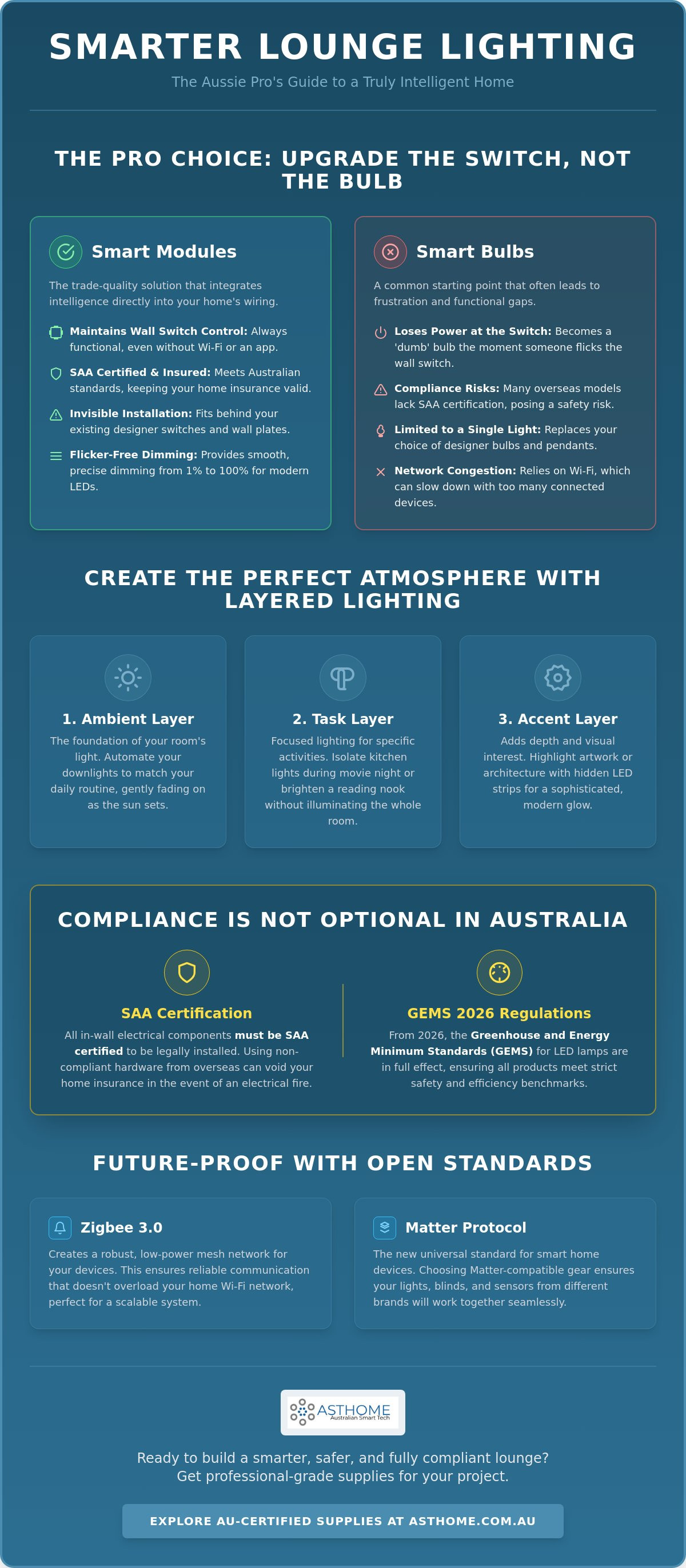
We often see homeowners fall into the smart bulb trap. They buy expensive globes only to find that if someone flicks the wall switch, the smart features disappear. For a reliable lounge setup, the industry standard is shifting toward smart modules. These devices sit behind your existing wall plates, turning your designer pendants and downlights into intelligent assets without losing manual control. This approach ensures your home remains functional for guests and children who might not have an app or voice assistant handy.
Open-Plan Living and Zone Control
Most Australian homes feature open-plan designs where the kitchen, dining, and lounge bleed into one another. You don't want the kitchen's bright task lighting ruining the vibe of your movie night. By using smart zones, you can isolate these areas digitally. A Welcome Home scene can be programmed to trigger at sunset or upon your arrival, gently illuminating the hallway and lounge while keeping the dining area dim. This level of granularity is what separates a basic DIY setup from a trade-quality installation that respects your home's layout.
The Role of Australian Standards (SAA)
Safety isn't optional in the Australian electrical landscape. While it's tempting to grab cheap, unbranded modules from overseas marketplaces, the risks are significant. Non-compliant hardware can void your home insurance if an electrical fire occurs. Every component you install, from a Matter Smart Switch Module to a Zigbee 3.0 Smart Switch Module, must carry SAA certification to be legally installed behind your walls.
As of March 3, 2026, the Greenhouse and Energy Minimum Standards (GEMS) Determination for LED Lamps 2025 is in full effect. This means all LED products must meet strict efficiency and safety benchmarks to be legally sold in Australia. Working with SAA-certified hardware ensures your smart lighting ideas for living room upgrades are sparkie-approved and fully compliant. It provides the peace of mind that your technology won't just look good; it will also keep your home and family protected under Australian law.
Layering Your Light: Task, Ambient, and Accent Ideas
If you're looking for smart lighting ideas for living room renovations, the secret is in the layering. You can't expect a single set of downlights to handle everything from the morning school rush to a late-night cinema session. By separating your lighting into ambient, task, and accent layers, you create a space that feels curated rather than just illuminated. This professional approach ensures every corner of your lounge serves a purpose.
Ambient lighting provides the base level of brightness for the room. In most Aussie homes, this comes from recessed LED downlights. Automating these circuits with a smart module allows you to set schedules that align with your daily routine. For instance, you can program your lights to fade in gently as the sun sets, helping your body transition into a rest state. This level of automation is a core part of global smart lighting standards, focusing on both energy efficiency and user wellbeing.
Smart Dimming for the Perfect Ambience
Standard wall dimmers often cause annoying flicker or "ghosting" in modern LED globes. Upgrading to a Smart Zigbee Dimmer Module solves this by providing precise voltage control at the circuit level. When paired with a high-quality Dimmable LED Driver, you get smooth, flicker-free dimming from 1% to 100%. This is essential for creating "Sunset Dimming" scenes that match your natural circadian rhythm, slowly reducing blue light exposure as you prepare for sleep.
Highlighting Features with Smart Accents
Accent lighting adds depth by drawing the eye to specific points, like artwork, shelving, or architectural alcoves. Hidden LED strips installed behind a wall-mounted TV or under floating cabinetry provide a sophisticated glow without visible fixtures. These strips can be integrated into your broader ecosystem using a Zigbee 3.0 controller, allowing them to sync with your main lights.
For those standalone floor lamps in reading nooks, a Smart Power Point (GPO) is the perfect solution. It allows you to include "dumb" decorative lamps in your smart scenes without cutting any cords or replacing beautiful vintage globes. Task lighting also benefits from smart control. Whether it's a dedicated study zone or a high-intensity lamp for hobbies, you can ensure you have light exactly where you need it. If you're ready to start layering your lounge, exploring a professional smart module range is the best first step toward a truly intelligent home.
Smart Modules vs. Smart Bulbs: The Pro Choice for Retrofits
The "Dead Switch" problem is the single biggest reason smart bulb setups fail in Australian family homes. When you install smart bulbs, the physical wall switch must remain in the "on" position for the technology to function. If a guest or child flicks that switch off, your automations break and your app control vanishes. This is why professional smart lighting ideas for living room renovations almost always prioritise smart modules over individual bulbs.
Smart modules sit behind your existing wall plates, turning the switch itself into an intelligent device. This allows you to keep your high-quality designer pendants or architectural downlights while adding full automation. From a cost perspective, modules are far more efficient for large lounges. Instead of buying eight separate smart bulbs for a single circuit of downlights, one Zigbee 3.0 Smart Switch Module can control the entire group. This approach preserves the tactile experience of a traditional home while layering in 2026-standard connectivity.
Matter Smart Switch Modules: The New Standard
Matter is the unified communication protocol designed to end the "walled garden" era of smart homes. It allows devices from different brands to work together locally without relying on the cloud. A Matter smart switch acts as the essential bridge between your legacy copper wiring and modern digital ecosystems, ensuring your home is ready for any future tech shifts. Whether you use Apple Home, Google Home, or Amazon Alexa, Matter-certified hardware provides universal compatibility and faster response times for your lounge lighting.
Zigbee 3.0: The Reliable Mesh Network
While Wi-Fi is great for a few devices, a lounge filled with thirty smart globes will quickly congest your home network. Zigbee 3.0 operates on a dedicated mesh network, where each mains-powered device acts as a repeater to strengthen the signal. This is the preferred protocol for trade-grade installations because it is incredibly stable and consumes very little power.
To manage this network, you'll need a Zigbee Gateway Hub. This central point handles the communication between your devices, keeping your Wi-Fi bandwidth free for streaming and gaming. For a clean finish on your walls, you can choose between 1, 2, 3, or 4 Gang Smart Wi-Fi Light Switches. These allow you to control multiple circuits, such as your main lounge lights, accent strips, and even your Smart Curtain Motor and Track, from a single, elegant wall plate. It's a streamlined way to execute complex smart lighting ideas for living room projects without cluttering your interior design.
Automations and Scenes for the Ultimate Lounge Experience
Scenes are where your investment in smart lighting ideas for living room hardware finally pays off. It is no longer about flicking individual switches; it is about orchestrating your entire environment with a single touch or voice command. A well-configured system takes the manual labour out of home management, allowing your lounge to adapt to your needs in real time. This level of automation is what transforms a house into a truly intelligent home.
"Movie Night" is the gold standard of lounge automation. With one command, your Smart Curtain Motor and Track glides shut to eliminate glare while your main downlights controlled by Zigbee modules fade to 10%. At the same time, your accent strips behind the TV activate to provide bias lighting, reducing eye strain. This level of coordination creates a cinematic experience that manual switches simply cannot replicate. You can also program your system to adjust colour temperatures based on the season. In a scorching Aussie summer, use cool whites to make the lounge feel refreshed. When the winter chill sets in, shift to warm ambers for a cosier atmosphere.
Sensor-Driven Lighting
Placing a motion sensor in high-traffic transition zones allows for hands-free path lighting. If you walk into the lounge at midnight, the sensor can trigger your accent strips at a mere 5% brightness. This provides enough light to navigate without the blinding shock of full-strength LEDs. Advanced setups can also use daylight harvesting. By monitoring ambient light levels, your smart system automatically dims indoor circuits as the sun hits the room, maximising energy efficiency without sacrificing visibility. Integrating a Smart Temperature and Humidity Sensor adds another layer, allowing your lounge to trigger "Cooling" scenes that close the blinds and dim the lights when the afternoon heat peaks.
Integrating Smart Curtains and Blinds
Smart curtains are the secret ingredient to a professional lounge setup. Beyond just convenience, automating your window treatments helps protect your furniture and flooring from harsh Australian UV rays. By coordinating your curtain closure with your evening light activation, you ensure total privacy the moment your lights come on. This integration creates a seamless transition from day to night that feels natural and intuitive. If you are ready to build a truly automated lounge, you can shop our range of trade-quality automation kits to find the right modules for your project.
Getting Started: Trade Quality Supplies for Your Project
Moving from smart lighting ideas for living room concepts to a finished installation requires a methodical, circuit-by-circuit plan. Don't try to automate every light at once. Start by auditing your lounge to identify which circuits handle ambient downlights and which control your feature pendants. This clarity helps your licensed electrician understand the load requirements and module placement. In Australia, working with a qualified sparkie is non-negotiable for any behind-the-wall work. It ensures your home meets AS/NZS 3000 standards and keeps your insurance coverage intact.
Trade-quality components are built for longevity and safety. Retail-grade gadgets found in big-box stores often struggle with the heat loads inside Australian wall cavities. Our modules, including the Zigbee 3.0 Smart Switch Module and the Matter Smart Switch Module, are engineered for professional use. They carry full SAA certification, meaning they have passed rigorous local testing for electrical safety and electromagnetic compatibility. When you choose trade-grade hardware, you are investing in a system that won't flicker, drop off the network, or pose a risk to your property.
The Asthome Advantage
Asthome is an Australian-owned specialist founded on the principle of being run by practitioners for practitioners. We provide peer-to-peer reliability that international retailers cannot match. Our team understands the specific licensing requirements and regulatory standards of the Aussie trade industry. We stock a comprehensive range of Matter, Zigbee, and Wi-Fi modules designed to work together seamlessly. For professional electrical contractors, our trade accounts offer streamlined access to technical data sheets and bulk pricing, ensuring every project is delivered to a high standard.
Next Steps for Your Reno
Before you begin your lounge upgrade, perform a quick audit of your existing hardware. Check your current GPOs and switch plates to ensure there is sufficient depth for a module retrofit. Choosing the right smart light switch is also about maintaining your home's aesthetic. You want hardware that looks as good as it performs. Once you have your circuit list ready, contact Asthome for bulk project pricing and technical support. We can help you select the right Zigbee Gateway Hub or Dimmable LED Driver to ensure your smart lighting ideas for living room projects are a complete success.
Future-Proof Your Aussie Lounge Today
Asthome is proud to be Australian owned and operated, providing peer-to-peer service for both homeowners and professionals. Our entire range is SAA certified for Australian standards, giving you peace of mind that your installation is safe and compliant. We also provide trade accounts for licensed electricians to support large-scale projects. It's time to stop worrying about tech jargon and start enjoying a truly intelligent home.
Browse Asthome's SAA-Certified Smart Lighting Range and take the first step toward a more connected lounge today. You've got the plan; now get the trade-quality gear to make it happen.
Frequently Asked Questions
Do I need a hub for smart living room lighting in Australia?
You will need a Zigbee Gateway Hub if you choose Zigbee-based modules, which we recommend for stability in larger lounges. While Wi-Fi smart switches connect directly to your router, a dedicated hub offloads the traffic and ensures your automations run locally. This is a critical factor when planning smart lighting ideas for living room projects to avoid congesting your home network.
Can I still use my normal wall switches with smart modules?
Yes, smart modules are specifically designed to sit behind your existing wall plates so your physical switches remain fully functional. This setup effectively solves the "dead switch" problem common with smart bulbs. Guests and family members can still flick the switch manually without breaking your app control or interrupting your scheduled automations.
Is it cheaper to buy smart bulbs or smart switch modules for a lounge?
Smart switch modules are generally more cost-effective for lounge rooms that feature multiple downlights. Instead of purchasing individual smart globes for every single socket, one module can control an entire circuit of standard LED lights. This approach reduces the total hardware cost while allowing you to keep your preferred designer light fittings and high-quality globes.
What is the difference between Zigbee and Matter for lighting?
Zigbee 3.0 is a mature mesh networking protocol known for high reliability and low power consumption. Matter is the newer universal standard that allows devices from different brands to work together natively across Apple, Google, and Amazon ecosystems. Many modern smart lighting ideas for living room upgrades use a Matter-certified bridge to combine Zigbee stability with broad platform compatibility.
Do smart light switches require a neutral wire in Australian homes?
Most professional smart modules require a neutral wire at the switch to power the internal radio. While many older Aussie homes only have a "switch wire" at the wall plate, modern renovations usually include neutral wiring. If your lounge lacks a neutral wire, you must select specific hardware designed for no-neutral installations or have your electrician pull a new cable.
Can I install smart lighting modules myself or do I need an electrician?
You must hire a licensed electrician to install any smart modules or switches that involve 240V fixed wiring. In Australia, it is illegal and dangerous to perform DIY electrical work on your home's power circuits. Using a professional ensures your installation meets SAA standards and protects your home insurance policy in the event of an electrical fault.
How do I ensure my smart lighting is SAA certified?
Look for the Regulatory Compliance Mark (RCM) on the product or its packaging, which confirms the device meets Australian safety standards. Buying from an Australian-owned specialist ensures the hardware has been vetted for local regulations. Avoid importing unbranded modules from overseas marketplaces, as these often lack the necessary certifications for legal and safe use in Australia.
Will smart lighting work if my internet goes down?
Your smart lighting will continue to function via physical wall switches even if your internet connection drops. If you are using a Zigbee or Matter system, your local automations and phone control will also typically function within the home network. Only cloud-dependent features, such as remote access from outside the house or certain voice assistant commands, will be unavailable until the internet returns.