

What if you could turn every light in your house into a smart device without binning your expensive designer wall plates? It's a common frustration for Aussie homeowners and tradies alike; you want the tech, but you don't want a mismatched mess of plastic on the walls. Choosing the right smart switch mechanisms is the secret to a high-end finish that respects your home's aesthetic while adding serious intelligence.
We agree that the technical side can feel like a minefield, especially with the confusion around neutral wiring and the fear of buying gear that won't fit a standard Australian bracket. This 2026 buying guide simplifies the process, showing you exactly how to upgrade your existing plates for a future-proof result. You'll learn how to navigate the new Cyber Security Rules 2025, compare Matter 1.5 against Zigbee 3.0 for long-term reliability, and ensure every module carries the mandatory RCM mark. We also cover the essential AS/NZS 3000:2018 standards for your licensed electrician to follow. From NDIS-compliant kits to high-performance dimmers, we're helping you build a safe, SAA-certified smart home that just works.
Key Takeaways
- Upgrade your existing Australian wall plates without a full renovation by installing compact smart switch mechanisms behind the faceplate.
- Navigate the 2026 protocol landscape to decide if Matter's interoperability or Zigbee 3.0's mesh stability best suits your home network.
- Identify your wiring configuration to choose the right module, including no-neutral solutions that use capacitors to stop globe flickering.
- Compare technical specs between dimmable modules and on/off switches to ensure compatibility with your specific LED drivers and globes.
- Prioritise safety and insurance compliance by only selecting SAA certified hardware that carries the mandatory RCM mark.
What are Smart Switch Mechanisms? Understanding the Retrofit Advantage
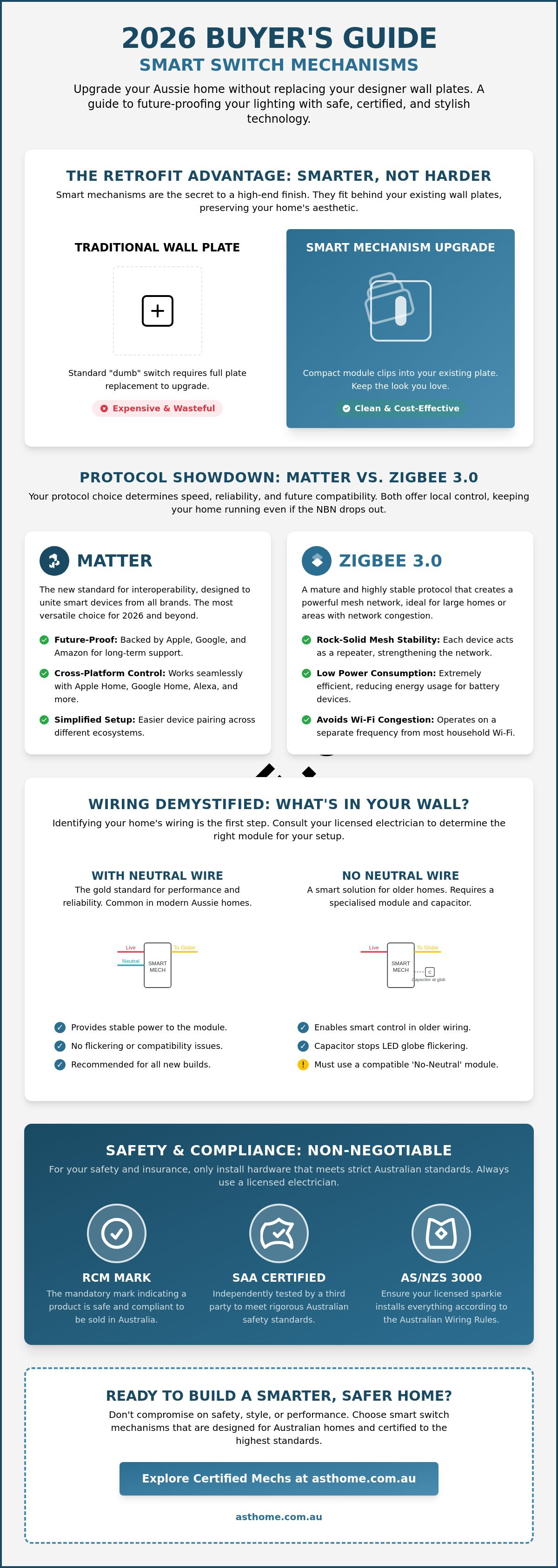
Think of a smart switch mechanism as the hidden engine behind your wall plate. While a standard light switch is just a simple mechanical contact, these compact modules contain the wireless radios and relays needed for modern home automation. In Australia, we've moved away from the clunky practice of replacing entire wall plates. Instead, we swap the internal "mech" while keeping the high-end faceplates you've already paid for. It's a smarter, cleaner way to upgrade.
This modular approach is the preferred choice for Australian renovations and new builds in 2026. Replacing a whole 3-gang or 4-gang plate just to get smart control is expensive and often looks out of place if the new plate doesn't match your existing GPOs. By using smart switch mechanisms, you maintain a consistent look across the home. It's a professional-grade solution that bridges the gap between traditional electrical hardware and the digital age without creating unnecessary plastic waste.
The Modular Approach: Keeping Your Designer Plates
Most Australian homes use the standard 30-series aperture for their switches. This universal sizing means a smart module can clip directly into your existing Clipsal, HPM, or boutique designer plates. Sparkies prefer this method because it's efficient and non-destructive. There's no need to patch plaster or repaint around a new, differently sized wall box. You get the intelligence of a smart home without the cost or headache of a full electrical facelift. It keeps the aesthetic integrity of your interior design while adding powerful connectivity behind the scenes.
Traditional vs. Smart Mechs: What Changes?
Traditional mechs use a physical rocker or toggle to break the circuit. Smart mechs replace this with an electronic relay and a soft-touch or push-button interface. The physical feedback is different; it's a precise, momentary press rather than a clunky click. Internally, the relay does the heavy lifting, allowing for app control, voice commands, and automated schedules. Buying standalone smart switch mechanisms also gives you extra customisation options:
- LED Indicators: Many modules include programmable LEDs to help you find the switch in the dark or show if a light is active.
- Soft-Touch Operation: Provides a premium feel that matches modern high-end home finishes.
- Silent Switching: High-quality relays eliminate the loud "snap" of traditional mechanical switches.
When you look at the numbers, the benefits are clear. A full smart plate replacement often forces you into a specific brand's ecosystem. Using modular mechs allows you to mix and match. You can automate only the circuits you need while keeping the rest of the house looking uniform. It's about targeted, intelligent spending rather than a "rip and replace" strategy that doesn't account for your home's existing style.
Choosing Your Protocol: Matter vs Zigbee Smart Mechs
Protocol selection dictates how your smart switch mechanisms communicate. It's the difference between a system that lags and one that responds instantly. In 2026, the Australian market has matured, moving away from proprietary "walled gardens" toward open standards that actually talk to each other. Whether you're using Apple Home, Google Home, or Home Assistant, your choice of protocol determines the long-term flexibility of your install. Smart lighting doesn't just add convenience; proper automation can save you energy and money by ensuring circuits aren't left running in empty rooms or during peak tariff periods.
The primary decision for most homeowners and tradies comes down to Matter versus Zigbee. Both offer local control, meaning your commands don't have to travel to a cloud server in another country before your lights turn on. This reduces "cloud lag" and ensures your home stays functional even if your NBN connection drops out. However, the way they handle network traffic and device pairing differs significantly, especially in high-density residential areas or large multi-storey builds.
Matter Smart Switch Mechanisms: Future-Proofing Your Home
Matter is the new benchmark for interoperability. With the release of Matter 1.5 in November 2025, this protocol has become the standard for cross-platform control. A matter smart switch technology is the most versatile option for 2026 builds because it eliminates the need for brand-specific gateways. You can pair a Matter-certified mech directly to your existing Apple TV, HomePod, or Google Nest Hub. This direct-to-app connectivity simplifies the commissioning process for sparkies and provides a seamless experience for users who want to mix and match hardware brands without technical friction.
Zigbee 3.0: The Professional Choice for Reliability
While Wi-Fi 7 is the current standard for high-speed data, it's often considered a "noisy" protocol for home automation due to potential congestion. Tradies frequently recommend a zigbee 3.0 smart switch module australia for multi-storey homes because it creates a dedicated, self-healing mesh network. Each mains-powered unit among your smart switch mechanisms acts as a repeater, strengthening the signal as it travels through the house. This is particularly useful in Australian homes with internal brick walls or multiple levels where Wi-Fi signals might struggle. Zigbee remains the gold standard for stability because it operates on a separate frequency, keeping your main Wi-Fi bandwidth free for streaming and gaming.
If you're planning a comprehensive rollout, starting with a Zigbee Gateway Hub from Asthome Smart Electrical Supplies provides a robust foundation for sensors and switches to communicate without taxing your home router. This professional-grade approach ensures that as you add more devices, the network becomes more reliable, not less. It's a proven solution for those who prioritise a dedicated automation backbone over the convenience of hub-free setups.
Wiring and Physical Compatibility in Australian Wall Boxes
Before you commit to a purchase, you need to know what's behind the plaster. Australian wiring standards have changed over the decades, and your smart switch mechanisms must match the physical reality of your wall box. The biggest hurdle for most retrofits is the neutral wire. In many older Aussie homes, only the active and load wires are present at the switch. If you don't have a neutral wire, you'll need a specific "no-neutral" module. These mechs often require a small capacitor installed at the light fitting to prevent low-wattage LED globes from flickering or staying dimly lit when the switch is off.
Safety isn't negotiable in the Australian electrical landscape. Every module you install must carry the Regulatory Compliance Mark (RCM) and meet SAA safety standards. Using non-compliant gear from overseas marketplaces is a massive risk. It can void your home insurance and won't meet the AS/NZS 3000:2018 standards your licensed electrician must follow. Ensuring your hardware is fit for the Australian 240V grid is the only way to guarantee long-term peace of mind.
Neutral vs. No-Neutral Mechanisms
A neutral-required mech is the gold standard for stability. It provides a constant power source to the internal smart chip, ensuring the device never drops off the network. However, for most retrofits where pulling new cables isn't an option, a no-neutral module is the practical choice. Just keep an eye on your total load. Most no-neutral mechs have a minimum wattage requirement. If you're switching a single 5W LED downlight, that capacitor is essential to maintain a clean circuit and prevent the "ghosting" effect.
Fitment Guide for Common Australian Brands
Space is a premium in a standard Australian wall box, especially in timber-framed homes with shallow cavities. Most smart switch mechanisms are designed to fit the universal 30-series aperture found in popular ranges like Clipsal Iconic or HPM Excel. This modularity is what makes them so effective for retrofits.
- Multi-gang plates: Fitting three or four mechs into a single plate requires careful cable management. Choose modules with a slim profile to avoid overcrowding the box.
- Wall box depth: Ideally, your wall box should be at least 35mm deep. This provides enough clearance for the module and the loop-in wiring without crushing the cables.
- Aesthetic consistency: Because these clip into standard plates, you can keep your existing brushed metal or matte black finishes while upgrading the tech behind them.
If you're dealing with a tight multi-gang setup, using a compact Zigbee 3.0 Smart Switch Module can save your sparky a lot of frustration during the fit-out. It's about ensuring the hardware fits the environment rather than forcing it. Always check the depth of your specific wall boxes before ordering to ensure a flush, professional finish.
Key Features to Compare Before You Buy
Choosing the right smart switch mechanisms involves looking past the wireless protocol. You need to consider how the hardware interacts with your home's infrastructure and your daily habits. In 2026, power monitoring has become a standard requirement for energy-conscious Aussies. High-quality modules track energy usage at the switch level. This allows you to identify power-hungry appliances or lights in real time through your dashboard. It's a level of detail that traditional switches simply can't provide.
Customisation is another factor that separates professional-grade hardware from budget alternatives. Premium mechs allow you to adjust the internal LED indicators. You can set the colour and brightness to suit a bedroom, ensuring the status light isn't a distraction at night. This ensures your home automation feels integrated rather than intrusive. Whether you're a tradie quoting a job or a homeowner DIY-ing your setup, these small technical details dictate the final quality of the install.
Smart Dimmer Mechanisms: Precision Lighting Control
Most modern Australian LED downlights require trailing edge dimming for smooth operation. Using the wrong technology causes flickering, audible buzzing, or even premature globe failure. When selecting a Smart Zigbee Dimmer Module, look for adjustable minimum and maximum load settings. This prevents "ghosting", a common issue where lights stay dimly lit even when the switch is off. Soft-start features are also a major plus; they gradually increase brightness to extend the life of your light globes and provide a more luxurious feel when you enter a room.
Accessibility and NDIS SDA Requirements
A significant trend in 2026 is the integration of smart tech into Specialist Disability Accommodation. Effective ndis sda smart home technology australia relies on high-quality smart switch mechanisms to provide genuine independence. These systems offer voice control and automated routines that reduce the physical burden on residents. Physical button tactile feedback is essential for vision-impaired users, providing a clear sensory response that a flat touch-screen lacks. It's about building a home that is inclusive and responsive to every user's needs.
If you're looking to improve accessibility or simply want the most reliable hardware on the market, explore our NDIS SDA Compliant Smart Home Kit for a professional-grade solution that meets strict Australian standards.
Explore the Asthome Mechanism Collection
Success in any home automation project relies on hardware that balances technical sophistication with electrical safety. At Asthome Smart Electrical Supplies, we operate as a business run by practitioners for practitioners. This means our range of smart switch mechanisms is curated specifically for the Australian market, ensuring every module fits standard 30-series wall plates and meets our rigorous local standards. We understand the specific requirements of the AS/NZS 3000:2018 wiring rules, which is why we only supply SAA certified hardware that carries the mandatory RCM mark.
For licensed electricians, we offer dedicated trade accounts that provide access to professional support and efficient bulk ordering. Whether you are managing a large-scale NDIS SDA build or a simple residential retrofit, having a reliable local supplier makes all the difference. We focus on providing the technical brevity you need. Every product in our collection features clear electrical ratings and communication standards, allowing you to quote and install with absolute confidence. Starting your project with the right hardware ensures a future-proof result that won't require a costly rip-and-replace in a few years.
Standout Products in Our Collection
Our inventory is designed to solve the common pain points found in Australian wall boxes. We prioritise connectivity and build quality across all protocols.
- Matter Smart Switch Module: This is our top-selling future-proof choice. It works seamlessly with Matter 1.5, allowing direct integration with Apple Home and Google Home without proprietary gateways.
- Smart Zigbee Dimmer Module: Perfect for Home Assistant enthusiasts and those building a dedicated mesh network. These modules offer precise trailing edge dimming for modern Australian LEDs.
- Smart Wi-Fi Light Switch (1/2/3/4 Gang): Ideal for simple, hub-free setups. These mechanisms provide a cost-effective way to add smart control to multi-gang plates without complex networking hardware.
Why Order from Asthome Smart Electrical Supplies?
We are a 100% Australian-owned and operated business. When you have a technical question about a wiring diagram or protocol compatibility, you can speak with local experts who understand the regional trade industry. We don't believe in vague superlatives; we rely on concrete technical specifications and proven reliability. All orders are dispatched quickly from our Point Cook warehouse, ensuring your project stays on schedule.
Ready to upgrade your home or client project? Browse our full range of smart switch mechanisms today and discover the professional heritage that sets our hardware apart. From Zigbee Gateway Hubs to NDIS-compliant kits, Asthome Smart Electrical Supplies provides the specialised resources you need for a safe, modern, and highly organised smart home installation.
Future-Proof Your Australian Home Today
Upgrading to a connected home doesn't require a total renovation or a compromise on your interior style. By choosing high-quality smart switch mechanisms, you can maintain your home's designer look while gaining advanced automation features. We've explored how the right protocol, whether it's the interoperability of Matter 1.5 or the mesh reliability of Zigbee 3.0, creates a stable foundation for your network. Remember that safety is paramount; always ensure your hardware carries the RCM mark and meets SAA standards to protect your property and insurance coverage.
Asthome Smart Electrical Supplies is proud to be a business run by practitioners for practitioners. We offer expert local support and dedicated trade pricing for licensed electricians to ensure every installation is a success. If you're ready to start your retrofit with hardware you can trust, Shop the Full Range of SAA Certified Smart Switch Mechanisms at asthome.com.au. Building a modern, efficient, and safe smart home has never been more attainable. We're here to help you get the job done right the first time.
Frequently Asked Questions
Do I need a licensed electrician to install smart switch mechanisms in Australia?
Yes, you must engage a licensed electrician to install any mains-wired electrical hardware in Australia. This is a legal requirement under the AS/NZS 3000:2018 standards for all 240V installations. Attempting a DIY install on fixed wiring is illegal, risks your safety, and will void your home insurance policy if an electrical fault occurs.
What is the difference between a smart switch and a smart switch mechanism?
A smart switch usually refers to a complete wall plate with integrated electronics, while a smart switch mechanism is the internal "brain" that clips into a plate. Mechanisms are the professional choice for retrofits. They allow you to keep your existing designer faceplates while only replacing the internal electrical component, ensuring a consistent look across your home.
Will these mechanisms fit my existing Clipsal or HPM wall plates?
Most of our modules are designed to fit the standard 30-series aperture used in popular Australian ranges like Clipsal Iconic, HPM Excel, and Vibe. This universal sizing ensures a flush, professional fit in your existing wall brackets. If you are using boutique or older plates, your sparky can verify the mounting clips before the final fit-out.
Can I use smart switch mechanisms if I do not have a neutral wire?
You can absolutely use smart switch mechanisms in older homes without a neutral wire by selecting a "no-neutral" specific module. These modules are designed to draw a tiny amount of power through the load to stay connected to your network. You will often need to install a capacitor at the light fitting to ensure low-wattage LED globes don't flicker when the switch is off.
Do smart mechanisms work with LED downlights?
Yes, our mechanisms are fully compatible with modern LED downlights. For dimming applications, it is essential to use a trailing edge module to match the requirements of most Australian LED drivers. This prevents the buzzing and flickering often associated with older leading edge dimmers. Always check the minimum and maximum load ratings on the module to ensure a clean circuit.
What happens to my smart switches if the internet goes down?
Your lights will still work via the physical button even if your internet connection drops out. Because Zigbee and Matter protocols support local network operation, your automated schedules and sensors will often continue to function within the home. You only lose the ability to control the switches through your phone or voice assistant when you are away from the property.
Can I mix and match Matter and Zigbee mechanisms in the same home?
You can mix and match protocols as long as your smart home hub or controller supports them. For example, using a Zigbee Gateway Hub alongside a Matter-compatible controller allows both types of smart switch mechanisms to appear in the same app. This flexibility is ideal for 2026 builds where you might want Zigbee for mesh stability and Matter for easy device pairing.
How many mechanisms can I fit into a 4-gang wall plate?
You can fit up to four mechanisms into a standard 4-gang wall plate. However, space behind the plate becomes very limited with multiple modules. You must ensure your wall box has sufficient depth, ideally 35mm or more, to accommodate the hardware and the loop-in wiring. Your electrician will need to manage the cables carefully to ensure the plate sits flush against the wall.