

That unbranded smart switch a client asks you to wire up could cost you far more than a blown fuse; it could cost you your electrical contractor licence. Specifying genuine SAA certified smart modules for electricians has become one of the most critical decisions on the job site, especially since the legal responsibility under AS/NZS 3000 stops squarely with the installer, not an offshore online seller.
Every sparkie knows the headache of wrestling oversized modules into standard wall boxes, troubleshooting erratic wireless networks, or copping unpaid callbacks over flickering LED loads. You shouldn't have to risk your reputation or your margins on questionable hardware. Discover how to specify, verify, and install genuine SAA certified smart modules legally and reliably across Australian trade projects. We break down physical Regulatory Compliance Markings, compare Zigbee 3.0 and Matter protocols for clean switch-plate retrofits, and show you how to access competitive wholesale trade pricing backed by responsive, local Australian technical support.
Key Takeaways
- Understand your strict legal obligations under AS/NZS 3000 and how to verify genuine SAA certification and RCM markings before wiring starts.
- Compare Matter Smart Switch Module and Zigbee 3.0 Smart Switch Module performance behind standard wall plates to eliminate RF signal loss.
- Select the right neutral or no-neutral wiring configurations to prevent ghosting and low-wattage LED flickering on domestic retrofit jobs.
- Follow a systematic five-step commissioning procedure covering mandatory isolation, polarity, and insulation resistance testing.
- Partner with Asthome to source compliant SAA certified smart modules for electricians with trade-exclusive wholesale pricing and prompt Victorian technical support.
Why SAA Certification is Mandatory for Electricians Installing Smart In-Wall Modules
In the Australian trade, the acronym "SAA" gets thrown around casually, often creating confusion between Solar Accreditation Australia installer credentials and genuine product electrical safety approvals. When specifying hardware behind a wall plate, SAA refers to accredited third-party certification schemes accredited by JAS-ANZ to declare compliance with Australian safety benchmarks. As published by Standards Australia, standard AS/NZS 3000 (the Wiring Rules) mandates that any 240V electronic accessory retrofitted into an electrical installation must meet regional safety criteria before energisation. Sourcing verified SAA certified smart modules for electricians is the only foolproof way to keep your work fully lawful.
Installing unapproved, grey-market smart switches leaves you carrying total legal liability. If an uncertified module causes a thermal event or switchboard failure, insurers will deny homeowner claims immediately under non-compliant alteration clauses. That void cascades directly down to your workmanship warranties, turning a quick automation upgrade into an expensive legal battle.
The Legal Reality: Electrical Safety Act and Contractor Liabilities
State regulators, such as Energy Safe Victoria and SafeWork NSW, hold sweeping enforcement powers. Fitting unapproved electrical articles violates state Electrical Safety Acts, exposing contractors to heavy disciplinary fines, defect notices, and potential licence cancellation. A manufacturer's basic factory declaration or an overseas CE mark holds zero legal weight during an audit. You need third-party Australian certification to guarantee protection against personal liability.
Decoding the Regulatory Compliance Mark (RCM) and SAA Databases
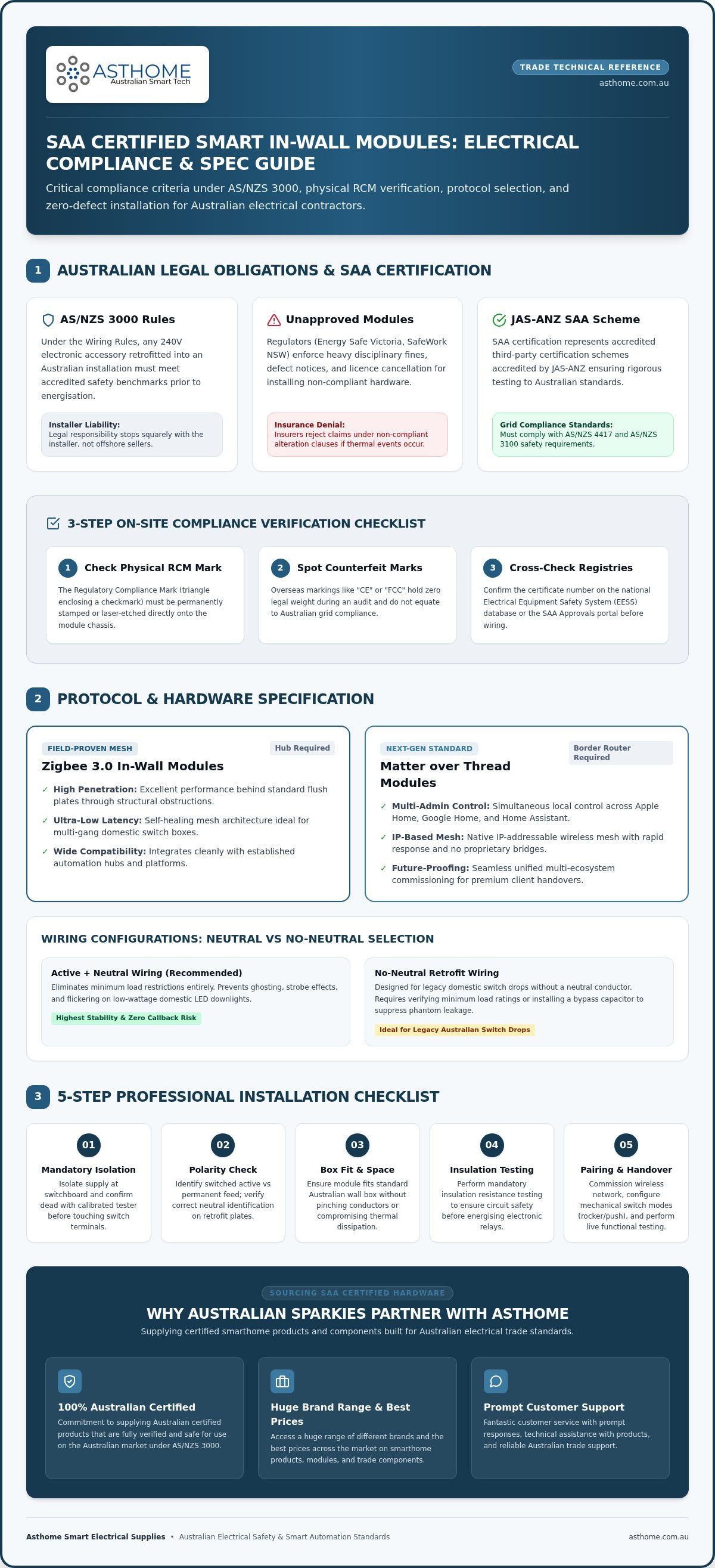
Every legitimate in-wall relay must carry physical proof of compliance directly on the outer casing. To avoid deceptive grey-market imports, follow these strict verification steps on site:
- Look for the RCM logo: The Regulatory Compliance Mark (a triangle enclosing a checkmark) must be permanently stamped or laser-etched onto the module chassis.
- Spot counterfeit marks: Overseas marks like "CE" or "FCC" do not equate to Australian grid compliance under AS/NZS 4417 and AS/NZS 3100.
- Cross-check public registries: Request the official certificate number and verify it through the national Electrical Equipment Safety System (EESS) database or the SAA Approvals portal before wiring.
Taking sixty seconds to confirm that your hardware appears on the national registry guarantees you are fitting authentic SAA certified smart modules for electricians that safeguard your business, your client, and your trade licence.
Evaluating Protocol Performance: Matter Smart Switch Modules vs Zigbee 3.0 Behind Wall Plates
Selecting the right wireless protocol behind a flush plate dictates whether your commissioning takes ten minutes or spirals into hours of unpaid diagnostics. In Australian residential construction, dense double-brick walls, foil-backed insulation batts, and steel framing create brutal RF attenuation. Sourcing reliable SAA certified smart modules for electricians means assessing not just physical safety compliance, but how effectively that radio transceiver pushes through structural obstacles to maintain low latency.
Every in-wall device must meet the mandatory essential safety requirements for electrical equipment, yet real-world field reliability hinges on how your chosen architecture handles wireless interference inside cramped enclosures. Comparing how each standard communicates across modern ecosystems helps keep your client handovers smooth.
Matter Smart Switch Modules: Multi-Admin Control and Future-Proofing
Matter over Thread units offer true multi-admin operability, letting your clients control identical lighting circuits simultaneously through Apple Home, Google Home, or Home Assistant without proprietary cloud bridges. Thread creates an IP-based, low-power wireless mesh designed for speed. However, jobs require a compatible Thread border router (like an Apple TV 4K or HomePod mini) to anchor the network. Read our comprehensive Matter smart switch guide to understand how Thread handles local mesh architecture across residential sites.
Zigbee 3.0 Smart Switch Modules: Mesh Stability and Low Latency
Zigbee 3.0 remains the workhorse of the Australian retrofit market. Mains-powered Zigbee modules act as dedicated mesh routers, strengthening network density across sprawling single-storey and multi-level brick veneer properties with every active switch you install. Pairing them with a centralised Zigbee Gateway Hub delivers ultra-low latency and shields your lighting controls from standard domestic Wi-Fi congestion. Check out our Zigbee 3.0 smart switch module guide for deep-dive technical insights on retrofit topologies.
Smart Zigbee Dimmer Module Integration for LED Lighting Circuits
Dimming circuits demand precise load matching to prevent erratic strobing. When fitting a Smart Zigbee Dimmer Module, pair it with a compatible trailing-edge Dimmable LED Driver to prevent harmonic resonance. Low-wattage architectural downlights often fail to draw sufficient holding current across solid-state relays, causing annoying low-end shimmer. Dialling in minimum brightness trims inside the gateway app solves this issue immediately, eliminating troublesome callbacks.
If you need dependable gear for upcoming fit-outs, browse trade-tested options through asthome.com.au to streamline your next installation.
Wiring Configurations & Box Fit: Neutral vs No-Neutral In-Wall Module Selection
Every contractor knows the sinking feeling of unscrewing an architrave or wall plate only to find a single twin-and-earth switch drop with no neutral in sight. Selecting the right SAA certified smart modules for electricians depends on your circuit topology and the physical cubic volume inside that wall cavity. Balancing electrical loops with real-world enclosure limits keeps your installations tidy and prevents severe thermal build-up behind the plaster.
Tackling Older Switch Drops Without a Neutral Conductor
Pre-2000s domestic builds across Australia commonly loop active conductors through ceiling roses, dropping only an active and a switched active down the stud to the plate. While pulling a fresh neutral conductor down through nogging-blocked framing provides the cleanest long-term connection, it blows out job labour fast. Using a no-neutral module solves this roadblock, but requires careful attention to load thresholds:
- Parasitic trickle currents: No-neutral relays sip power continuously through the switched load to keep their internal logic and radios alive.
- Bypass capacitor installation: When driving highly efficient LED downlights drawing under 15W, that trickle current can cause ghosting, pulsing, or faint glow even when switched off. Fitting an approved bypass capacitor in parallel across active and neutral at the first luminaire clears the leak.
- Minimum load ratings: Check module minimum wattage specs prior to site work to confirm compatibility with high-efficiency luminaire loads.
Physical Dimensions, Gang Configurations, and Enclosure Clearances
Spatial geometry makes or breaks a retrofit. Standard Australian C-clip plaster brackets and flush metal wall boxes offer roughly 35mm to 42mm of working depth. Standard 1.5mm building wire requires generous bending clearance so conductor insulation isn't pinched against rear sharp corners. When forcing a module, multiple loop terminals, and stiff copper conductors behind a classic grid, crowding generates excessive heat under sustained load.
For two-gang or three-gang configurations, avoid jamming individual modules behind every single mechanism. The trapped heat will trigger internal thermal protection cut-outs and shorten component life. Instead, choose multi-channel units or split the relays across separate stud bays. Ensuring healthy clearance preserves convective airflow, guaranteeing that your SAA certified smart modules for electricians operate coolly and reliably within manufacturer temperature ratings.
Professional Installation Checklist: Ensuring Compliance with AS/NZS 3000 and Safety Standards
Signing off an electrical certificate of compliance requires more than proving a circuit turns on via a phone screen. Mandated testing regimes apply just as rigorously to automated relays as they do to traditional mechanical switchgear. When retrofitting SAA certified smart modules for electricians, standardising your commissioning workflow guarantees safety, protects downstream microelectronics, and provides ironclad compliance documentation for state regulators.
Follow this structured five-step commissioning procedure on every fit-out:
- Safe isolation: Lock out the sub-circuit breaker and confirm zero potential at the plate with a calibrated two-pole voltage tester.
- Pre-termination insulation resistance (IR) test: Megger field cables at 500V DC before wiring sensitive module inputs to clear existing faults.
- Mechanical termination: Secure active, load, and switch-loop conductors, observing clean strip lengths to prevent stray strands shorting inside crowded cavities.
- Polarity and continuity verification: Check earth loop impedance and confirm active-neutral orientation across all terminals.
- Energisation and functional pairing: Restore mains supply, test physical push-button toggling first, and complete wireless mesh commissioning.
Pre-Install Testing and Electrical Verification Routine
Blasting a 500V or 1000V DC insulation test directly through a connected smart module will destroy its internal metal-oxide varistors and logic boards instantly. Always perform mandatory IR testing across building wiring prior to final module termination. Once connected, confirm polarity meticulously; reversing active and neutral inputs on electronic switches can energise downstream luminaires even when the relay contacts remain open.
NDIS SDA Environments and Assistive Living Integration
Specialist Disability Accommodation (SDA) developments require uncompromising reliability. In these high-dependency environments, automated lighting and access controls often integrate directly with uninterruptible power supplies (UPS) or sub-circuit changeover systems. Relays installed on backup lighting circuits must maintain their operational state during transfer cycles, ensuring vulnerable residents are never plunged into unexpected darkness. Read through our NDIS SDA smart home resource guide to explore project-ready accessible infrastructure guidelines.
For your upcoming commercial or residential projects, explore fully verified hardware options at asthome.com.au to source certified SAA certified smart modules for electricians designed for dependable field performance.
Sourcing SAA Certified Smart Modules: Why Trade Electricians Partner with Asthome
Sourcing automation hardware shouldn't feel like a roll of the dice on an unvetted marketplace. For licensed electrical contractors, the supply chain needs to be as dependable as the wiring behind the plaster. Operating out of Point Cook, Victoria, Asthome Smart Electrical Supplies serves as a dedicated trade partner, stocking verified SAA certified smart modules for electricians who need compliant, high-performance hardware without international shipping delays.
From individual Zigbee 3.0 Smart Switch Module units and Matter Smart Switch Module options to specialised NDIS SDA Compliant Smart Home Kit hardware, every item in our multi-brand portfolio holds genuine Australian certification. We supply the gear, you handle the tools, ensuring your business protects its margins and its reputation on every rough-in.
The Asthome Trade Advantage: Wholesale Pricing and Verified Stock
Trade accounts unlock immediate commercial advantages tailored specifically for licensed professionals:
- Competitive wholesale rates: Secure the best prices across the market across all leading smart home brands.
- Rapid contractor onboarding: Fast licence verification gets your trade account active without endless paperwork.
- Local Victorian dispatch: On-shelf stock ready to ship directly to your workshop or job site nationwide, avoiding project shutdowns.
Peer-to-Peer Technical Support from Smart Automation Specialists
When you're standing on a ladder troubleshooting a complex multi-way switching loop or pairing a Zigbee Gateway Hub, you need direct answers, not an automated chat loop. Asthome provides practitioner-backed technical support with prompt response times from staff who understand Australian electrical setups. If you're tackling a large multi-dwelling development or need a comprehensive bill-of-materials breakdown for an accessible living project, our team helps you select compatible Smart Zigbee Dimmer Module units, Smart Power Point (GPO) hardware, and sensors that work flawlessly out of the box. Installing fully certified SAA certified smart modules for electricians guarantees total peace of mind for both you and your client.
Future-Proof Your Trade Business with Compliant Smart Installations
Expanding your services into home automation offers serious commercial growth, but protecting your contractor licence and workmanship guarantees must always come first. Backing your work with authentic SAA certified smart modules for electricians ensures total compliance with AS/NZS 3000 wiring rules. Whether you specify the multi-admin flexibility of Matter or the rock-solid field reliability of Zigbee 3.0, verified hardware eliminates nuisance callbacks and hazardous thermal risks inside standard Australian wall brackets.
Asthome is ready to support your business with fully certified hardware, vast multi-brand inventory, and prompt peer-to-peer technical advice from local specialists. Register for an Asthome trade account to access exclusive contractor pricing today, take advantage of rapid dispatch straight from Victoria, and wire your next automation fit-out with absolute confidence.
Frequently Asked Questions
How do I verify if a smart switch module holds genuine SAA certification in Australia?
You verify certification by locating the Regulatory Compliance Mark (RCM) on the unit casing and cross-checking the certificate number on the national EESS database or SAA Approvals registry. Genuine SAA certified smart modules for electricians always show traceable registration numbers linked to the accredited Australian certifier. Never rely purely on paper specification sheets; physically inspect the outer housing for permanent markings before connecting conductors.
Can I legally install imported smart modules if they carry European CE markings?
No, installing modules bearing only CE markings is illegal under Australian electrical safety laws and AS/NZS 3000. The European CE mark represents self-declaration rather than mandatory independent testing to Australian standards like AS/NZS 3100. Installing unapproved imported equipment exposes you to heavy regulator penalties, voids client home insurance policies, and puts your electrical contractor licence at severe risk during state safety audits.
Do smart switch modules require a neutral wire at the wall switch box?
Not all smart modules require a neutral conductor, though models with neutral connections deliver better long-term stability. Standard modules require an active and neutral feed to power their internal electronics. For older Australian homes with two-wire switch loops, no-neutral modules draw trickle power through the lighting circuit. On low-wattage LED circuits under 15W, you'll need to parallel-wire a bypass capacitor across the load to stop pulsing.
Will a smart switch module fit behind existing standard Australian wall plates?
Yes, compact modules fit neatly inside standard 35mm to 42mm plaster C-clips and flush boxes behind classic switch plates. To ensure a clean fit, fold 1.5mm building cables methodically rather than forcing them into the wall cavity. On two-gang or multi-gang installations, avoid packing multiple separate modules into a single cavity bracket; switch to multi-gang or dual-channel relays to maintain airflow and avoid thermal cut-outs.
How does an SAA certified smart module behave during a local Wi-Fi or Internet dropout?
The connected mechanical wall switch maintains full physical operation even if your local network or internet connection drops out completely. Certified smart relays feature direct hardware switching terminals wired straight to your standard rocker or push-button mechanisms. While remote smartphone control and app-based schedules may pause during an outage, the manual switch continues toggling the lighting circuit without hesitation or relay lag.
How do licensed electricians apply for wholesale trade pricing with Asthome?
Licensed electrical contractors can register online directly through Asthome's portal by submitting their trade licence number and business details. Once verified by our local team, your account gives you instant access to tiered wholesale trade pricing across our full multi-brand catalogue. Trade partners also benefit from fast dispatch straight from our Point Cook facility in Victoria, backed by prompt technical support.
What maximum load can an SAA certified smart module switch on LED downlight circuits?
Most smart modules support inductive and capacitive LED lighting loads between 200W and 400W, despite higher nominal resistive ratings like 10A or 2300W. SAA certified smart modules for electricians account for massive inrush currents generated by LED driver switch-mode power supplies. Always calculate total connected driver wattage rather than lamp output, leaving a 20% safety margin to protect the internal micro-relay from contact welding.