

Will your smart home still follow orders when the mercury hits 45 degrees and the signal has to punch through three layers of solid double-brick? Deciding on zigbee vs matter for australian conditions in 2026 is no longer a simple choice between brands. It is now a critical decision about signal penetration, regional regulatory compliance, and meeting the mandatory cybersecurity standards introduced in March 2026.
We understand the frustration of a smart light switch that works intermittently or a hub that refuses to talk to your phone after a software update. You want a system that is snappy, reliable, and fully compliant with AS/NZS 3000 to keep your home insurance intact. This guide clears the confusion by showing you which protocol survives the local climate and provides a truly interoperable ecosystem for your home.
We will examine how Zigbee 4.0 and Matter 1.5 stack up against each other in a real-world Aussie environment. You will learn which hardware carries the essential SAA certification and how to build a setup that stays fast, secure, and responsive well beyond 2026.
Key Takeaways
- Navigate the 2025 Cyber Security mandates to ensure your smart devices meet the latest Australian safety and privacy standards for 2026.
- Assess zigbee vs matter for australian conditions to determine which protocol offers superior signal penetration through double-brick walls and high heat tolerance.
- Identify why Zigbee 3.0 Smart Switch Modules remain the top choice for retrofitting existing wiring while Matter modules lead the way for new builds.
- Maintain full compliance with AS/NZS 3000 by selecting SAA-certified hardware that guarantees reliability and protects your home insurance policy.
- Explore how Matter 1.5 enables cross-brand interoperability, allowing your Apple and Google ecosystems to work together seamlessly without proprietary hubs.
The 2026 Landscape: Zigbee and Matter in the Australian Market
The Australian smart home market hit a definitive turning point in March 2026. This was the month the Cyber Security (Security Standards for Smart Devices) Rules 2025 became legally enforceable across the country. For homeowners, this means that "cheap" imports from overseas marketplaces are no longer just a connectivity risk; they are a compliance liability. Every 240V device, such as a Zigbee 3.0 Smart Switch Module, must now meet strict local encryption standards and carry valid SAA certification to be legally installed. Choosing between zigbee vs matter for australian conditions now requires a "safety-first" mindset. If your gear lacks the Regulatory Compliance Mark (RCM), you risk voiding your home insurance in the event of an electrical fault.
The 2026 landscape is defined by these two protocols working in parallel. Zigbee 3.0 remains the battle-tested choice for local, hub-centric control. Meanwhile, the Matter standard version 1.5 has matured into a robust IP-based solution that aims to end "ecosystem lock-in." While both protocols offer high performance, their suitability depends on your specific property layout and your existing hardware. "Grey market" gear might look identical on a screen, but it lacks the internal component quality required to survive Aussie power surges or the thermal stress of a hot wall cavity.
Zigbee: The Battle-Hardened Veteran
Zigbee 3.0 is the industry standard for local reliability. It operates on a dedicated mesh network that doesn't clog your home Wi-Fi. The "self-healing" nature of a Zigbee mesh is its greatest strength for large Australian homes. If a single device in the hallway fails, the signal automatically reroutes through another module to ensure the rest of the house stays online. This protocol is also incredibly efficient for battery-operated gear. Our Smart Motion Sensors and Smart Door Locks can run for years on a single battery because Zigbee requires very little power to maintain a heartbeat connection to the Zigbee Gateway Hub.
Matter: The New Universal Language
Matter is the first protocol that allows Apple Home, Google Home, and Alexa to control the same device simultaneously without complex workarounds. In 2026, we've seen a massive adoption spike, particularly in Victoria where new builds are increasingly specced with Matter Smart Switch Modules as standard. The key distinction in 2026 is Matter over Thread versus Matter over Wi-Fi. For the best results in Australian conditions, we recommend Matter over Thread. It provides the same mesh-networking benefits as Zigbee but with the universal language that makes adding new devices as simple as scanning a QR code. It's the ultimate choice for future-proofing a modern home.
Technical Tussle: Mesh Reliability vs. IP-Based Connectivity
The core technical debate regarding zigbee vs matter for australian conditions centres on how these devices actually talk to each other. Zigbee 3.0 operates on its own dedicated mesh network, completely separate from your home Wi-Fi. It uses the 802.15.4 standard, which is designed for low-bandwidth, high-reliability tasks like switching a light or reading a sensor. Matter, conversely, is an IP-based protocol. This means every Matter device has its own IP address, just like your laptop or smartphone. This architectural shift allows for deeper integration, but it requires a solid understanding of your home network's backbone.
A common concern for Aussie homeowners is whether Matter will bog down their NBN connection. Because Matter typically runs over Thread or Wi-Fi, it uses your existing network infrastructure. However, Matter is designed for local control. Your commands don't need to travel to a cloud server in California and back just to turn on a lamp. This keeps your internal bandwidth usage negligible and ensures your NBN speed remains untouched. For lighting, local control is non-negotiable. If there is a delay between flicking a switch and the light appearing, the system has failed. Both protocols excel here, but Zigbee’s dedicated "island" network often provides a slight edge in responsiveness in congested Wi-Fi environments.
Network Scalability in 2026
When your smart home grows to 50+ devices, network management becomes critical. Zigbee handles large numbers of devices by routing signals through "always-on" modules, such as a Zigbee 3.0 Smart Switch Module, which acts as a repeater. This creates a dense, resilient mesh. Matter achieves scalability through Thread Border Routers. These are often built into existing hardware like smart speakers or mesh Wi-Fi points. While Matter is designed to be the future, many professional installers still lean towards a dedicated Zigbee Gateway Hub for complex builds. It provides a single point of management that remains stable even if the main house router is acting up.
Interoperability and the "Walled Garden" Breakout
The Connectivity Standards Alliance developed Matter to solve the "walled garden" problem where Apple gear wouldn't talk to Google gear. Matter modules finally end this brand lock-in frustration. You can now mix and match hardware based on quality rather than just compatibility. Matter's multi-admin feature is the definitive solution for household harmony in 2026, allowing every family member to control the home using their preferred platform without conflict. If you have existing Zigbee gear, don't bin it yet. Many modern hubs now act as bridges, allowing your legacy Zigbee sensors to appear as Matter devices in your favourite app.
For those starting a fresh project and wanting the most reliable mesh currently available, our Zigbee 3.0 Smart Switch Module provides a proven, trade-grade solution that won't let you down when the internet is spotty.
Built for the Burbs: Protocol Performance in Aussie Conditions
A standard triple-fronted brick veneer or a modern double-brick townhouse is a signal-killer. When evaluating zigbee vs matter for australian conditions, you must consider the physical density of our building materials. Solid masonry absorbs radio frequency (RF) signals far more aggressively than the timber and drywall common in American homes. If your smart home protocol cannot punch through a double-brick internal wall, your automation will lag or fail entirely. Zigbee 3.0 has a proven track record here because every mains-powered module acts as a repeater, creating a dense mesh that "hops" around structural obstacles.
Heat is the other silent killer in the Australian smart home landscape. During a February heatwave, temperatures inside a wall cavity can easily exceed 60 degrees Celsius. This thermal stress can cause inferior, non-certified smart modules to throttle their performance or suffer hardware failure. Our SAA-certified hardware is specifically engineered for these high-ambient environments. Whether you are using the official Matter protocol or a dedicated Zigbee mesh, the physical build quality of the module determines its lifespan. In high-density suburbs like Point Cook or Parramatta, the 2.4GHz spectrum is often crowded with Wi-Fi noise from neighbours. Zigbee 3.0 manages this congestion through better channel agility, while Matter over Thread provides a similarly robust "self-healing" path to keep your lights responsive.
Structural Obstacles and Signal Strength
Timber-framed homes are much more forgiving, often allowing Matter over Wi-Fi to perform adequately across multiple rooms. However, once you introduce massive masonry internal walls or corrugated iron roofing, the strategy must change. For these "hard" environments, we recommend using Zigbee 3.0 Smart Switch Modules as repeaters to bypass dead zones. If you are extending automation to a backyard shed or an outdoor patio, the signal has to fight through the "Faraday cage" effect of metal cladding. A well-placed Zigbee Gateway Hub near the back door is usually the most reliable way to reach garden lighting and sensors at the back fence.
Environmental Resilience
Aussie conditions vary wildly between states. Smart Temperature and Humidity Sensors need to handle the tropical moisture of Queensland just as well as a freezing Melbourne winter. Moisture ingress can ruin unsealed electronics, which is why we prioritise hardware with robust housing. For outdoor applications, always look for IP-rated housings for your sensors. SAA certification ensures that 240V modules, like our Smart Power Points (GPO), are tested for electrical safety under the specific load and thermal conditions found in Australian households. This regional regulatory adherence provides peace of mind that your gear won't just work today, but will survive a decade of Aussie summers.
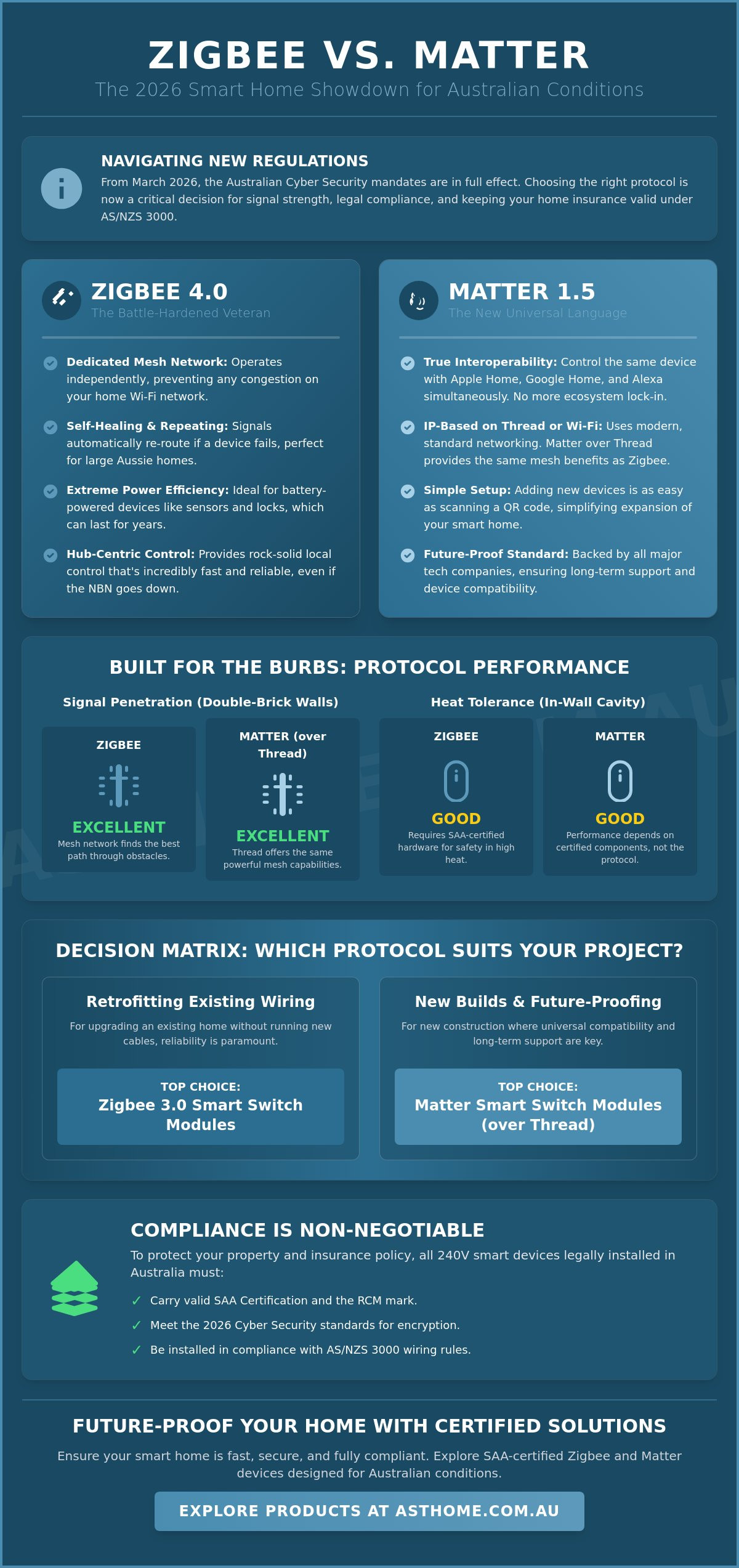
Decision Matrix: Which Protocol Suits Your Project?
Choosing between zigbee vs matter for australian conditions depends largely on the "bones" of your property. For those working with existing structures, Zigbee 3.0 Smart Switch Modules remain the champion of the retrofit. They integrate into older wiring setups without fuss and provide a stable mesh that doesn't rely on your Wi-Fi router's range. If you are currently looking at architectural plans for a new build, Matter Smart Switch Modules offer the ultimate future-proofing. They allow you to build a system that is agnostic to the big tech ecosystems, ensuring your home remains modern well into the 2030s.
Cost is a factor for any project. Zigbee requires an initial investment in a dedicated gateway, but the modules themselves are often more budget-friendly for bulk installs. Matter hardware typically carries a premium price tag because of the higher processing power required for IP-based communication, but you save by not needing a proprietary hub. For NDIS SDA housing projects, where system downtime can impact a resident’s independence, reliability is the only metric that matters. We recommend Zigbee for these critical environments because of its local-only reliability and "set and forget" nature. It ensures that essential services like lighting and climate control remain functional even if the external internet connection drops out.
Homeowner vs. Professional Trade Perspectives
Local sparkies generally prefer Zigbee. Its stability is legendary in the trade because it doesn't require troubleshooting a customer's flaky Wi-Fi password every six months. It just works. Tech-savvy homeowners often lean towards Matter for the DIY flexibility of adding any brand-name device to their Apple Home or Google Home setup. If you are a professional installer, setting up one of our trade accounts is the best way to secure bulk value on SAA-certified modules for your next big project.
Specific Use Cases: Lighting, Power, and Security
In terms of dimming, Zigbee dimmers still lead the pack in 2026. They offer smoother transitions and better compatibility with Australian LED brands. For energy management, Matter-compatible Smart Power Points (GPOs) are excellent for monitoring real-time usage across various apps. In the disability sector, integrating NDIS SDA smart home technology with voice assistants ensures that lighting and climate control are accessible to everyone, regardless of their physical mobility. This level of integration was once a headache, but the 2026 standards have made it a standard feature of any quality build.
Ready to spec your next project with gear that actually meets Australian standards? Explore our range of SAA-certified smart modules to ensure your installation is safe, legal, and reliable.
Future-Proofing with Asthome: SAA-Certified Solutions
When you weigh up zigbee vs matter for australian conditions, the hardware's communication protocol is only half the story. The physical safety and legal compliance of the module are what protect your property and your family. At Asthome, we specialise in SAA-certified 240V modules that are engineered specifically for the Australian electrical grid. Using uncertified gear from international marketplaces is a massive gamble. If an uncertified module causes a fire, your insurance provider has clear grounds to reject the claim because the hardware lacks the Regulatory Compliance Mark (RCM) required by law.
Our "Electrician-First" design philosophy addresses a common frustration for local sparkies: the lack of space in Australian wall cavities. We've ensured our Zigbee 3.0 Smart Switch Modules and Matter Smart Switch Modules are compact enough to fit behind standard wall plates without requiring a hammer and chisel. Buying from our Point Cook headquarters means you get local technical support from practitioners who understand Australian wiring standards. You aren't dealing with a nameless seller on a global marketplace; you're dealing with a local partner who stands by the quality of every sensor and switch we ship.
The Asthome Quality Guarantee
Our testing protocols are designed for the harsh reality of the Australian climate. We subject our modules to thermal stress tests that simulate the extreme heat of a roof space during a Victorian summer. Every piece of 240V hardware we sell is fully compliant with the latest AS/NZS 3000:2026 Wiring Rules. This commitment to regional regulatory adherence ensures that your smart home remains a safe environment. We don't cut corners on component quality, which is why our Smart Power Points (GPO) and Dimmable LED Drivers maintain consistent performance even under heavy electrical loads.
Getting Started with Your Install
If you're a licensed electrical contractor, we recommend applying for a trade account. This provides you with trade-only pricing and priority access to our latest SAA-certified hardware. For those managing complex projects, such as an NDIS SDA Compliant Smart Home Kit, we provide specialised consultation to ensure every sensor and motor meets the strict reliability requirements of the disability sector. Our final recommendation for most 2026 builds is a hybrid setup. By using a Zigbee Gateway Hub to manage your core lighting and sensors, while using Matter for ecosystem interoperability, you get the best of both worlds: rock-solid local reliability and total smartphone flexibility.
Ready to build a smart home that actually lasts? Browse our full range of SAA-certified smart home modules and secure your property with hardware built for Aussie conditions.
Build a Compliant Aussie Smart Home for 2026
Deciding on zigbee vs matter for australian conditions comes down to your specific property and your need for local reliability. You now know that while Matter 1.5 offers exciting cross-platform flexibility, the battle-hardened Zigbee 3.0 mesh remains the gold standard for punching through double-brick walls. The most important takeaway is that your hardware must be SAA Certified for AU Standards to remain legal and insurance-compliant under the latest 2026 wiring rules. Whether you're retrofitting a classic bungalow or speccing a high-tech new build, prioritising local certification over grey-market imports is the only way to guarantee long-term safety.
Asthome is here to support your project with expert advice and Point Cook local support. We offer trade pricing for licensed sparkies and a range of modules designed for easy cavity fitment. Don't leave your home's connectivity to chance. Browse our SAA-certified Matter and Zigbee modules today and create a system that stays fast, secure, and reliable. We look forward to helping you build a smarter, safer home.
Frequently Asked Questions
Do I need a new hub for Matter if I already have a Zigbee gateway?
You don't necessarily need to replace your existing Zigbee Gateway Hub. While Matter devices require a Matter Controller, such as a HomePod or a newer Google Nest Hub, many modern Zigbee gateways are being updated via firmware to act as Matter Bridges. This allows your current Zigbee sensors and switches to show up in a Matter-enabled app. It's about making the two systems talk to each other rather than a total hardware replacement.
Can I mix Zigbee and Matter devices in the same Australian home?
Yes, mixing both protocols is the most effective strategy for 2026. You can keep your lighting on a dedicated Zigbee mesh for rock-solid reliability while adding Matter-certified appliances for easier smartphone integration. When evaluating zigbee vs matter for australian conditions, a hybrid approach ensures you get the best mesh performance in solid-brick rooms without losing the ability to use the latest universal hardware from any major brand.
Does Matter work without an internet connection in Australia?
Yes, Matter is designed to operate entirely over your local home network. Commands are processed locally via Thread or Wi-Fi rather than being sent to a cloud server and back. This local control means that even if your NBN connection drops out during a summer storm, your Matter Smart Switch Modules and automated routines will continue to function perfectly. It's a significant improvement for both speed and data privacy.
Is Zigbee being phased out by Matter in 2026?
No, Zigbee is not being phased out; it is currently co-existing and evolving alongside Matter. With over 3,500 Zigbee-certified products on the market in 2026, the ecosystem remains the industry standard for low-power sensors and trade-grade lighting. Matter is a complementary technology that focuses on high-level interoperability. Many professional installers still prefer Zigbee for its proven stability in complex residential environments where "set and forget" reliability is the priority.
Why is SAA certification so important for smart switches in Australia?
SAA certification is a mandatory legal requirement for all 240V smart home equipment sold locally. It ensures the hardware meets strict Australian safety standards and can handle our specific power grid conditions. Using uncertified gear can void your home insurance and create serious fire risks. Every module we supply carries the Regulatory Compliance Mark (RCM), giving you peace of mind that your installation is safe, legal, and fully compliant.
Which protocol is better for double-brick Australian homes?
Zigbee 3.0 is generally the superior choice for double-brick homes due to its established mesh networking capabilities. Every mains-powered module acts as a repeater, which helps the signal "hop" around dense masonry that would otherwise block a Wi-Fi signal. While Matter over Thread offers similar benefits, the maturity of zigbee vs matter for australian conditions shows that Zigbee’s dedicated frequency management often handles the interference from thick internal walls more effectively.
How does the 2025 Cyber Security mandate affect my current smart home gear?
The March 2026 enforcement of the 2025 Rules means all new smart devices must meet mandatory encryption and security standards. While your existing gear won't stop working, any new modules you buy must be compliant to be sold legally in Australia. Choosing SAA-certified hardware ensures your home network is protected against unauthorised access. This mandate has pushed manufacturers to provide more frequent security updates and better data protection for Australian families.
Can I use Matter modules with my existing Home Assistant setup?
Yes, Home Assistant provides full support for Matter devices through its official integration. This allows you to add Matter over Thread or Matter over Wi-Fi hardware directly into your existing dashboard alongside your Zigbee sensors. It's an excellent way to maintain a locally controlled smart home without being forced to use multiple proprietary apps. You can continue to use your favourite Zigbee modules while slowly adding Matter gear as your system expands.