

Plugging dozens of cheap smart bulbs straight into your Wi-Fi router is the quickest way to break your automation setup before it even begins. If you want to know the best way to start a smart home in 2026, the real answer isn't collecting disposable retail gadgets; it's building reliable, trade-standard infrastructure from the wall plate outwards.
It's easy to see why so many Australian homeowners feel stuck. Sorting through the technical noise of Matter, Zigbee, and Thread while dodging dodgy overseas imports that breach Australian electrical standards can feel like a minefield. You shouldn't have to risk your home insurance policy, crowd your router, or budget for whole-house rewiring just to turn on a few lights.
In this guide, you'll discover how to design an ultra-reliable, future-proof setup using open protocols and fully SAA-certified hardware that keeps working even when the internet drops out. Here is your stage-by-stage installation roadmap tailored specifically for Australian homes.
Key Takeaways
- Separate your control ecosystem from your communication protocol, leaning on Zigbee 3.0 and Matter over Thread to avoid Wi-Fi congestion.
- Discover why the best way to start a smart home in 2026 centres on in-wall micro-modules rather than smart bulbs, preserving your physical wall switches and designer plates.
- Protect your home insurance and household safety by selecting gear backed by genuine SAA certification and Regulatory Compliance Mark (RCM) approvals.
- Follow a structured four-stage rollout plan that secures your network infrastructure and high-impact daily lighting before spending money on extras.
- Scale your setup smoothly with smart motion sensors, curtain motors, and door locks configured for fast local control that functions even during internet outages.
Smart Home Foundations: Choosing Your Ecosystem and Protocol in 2026
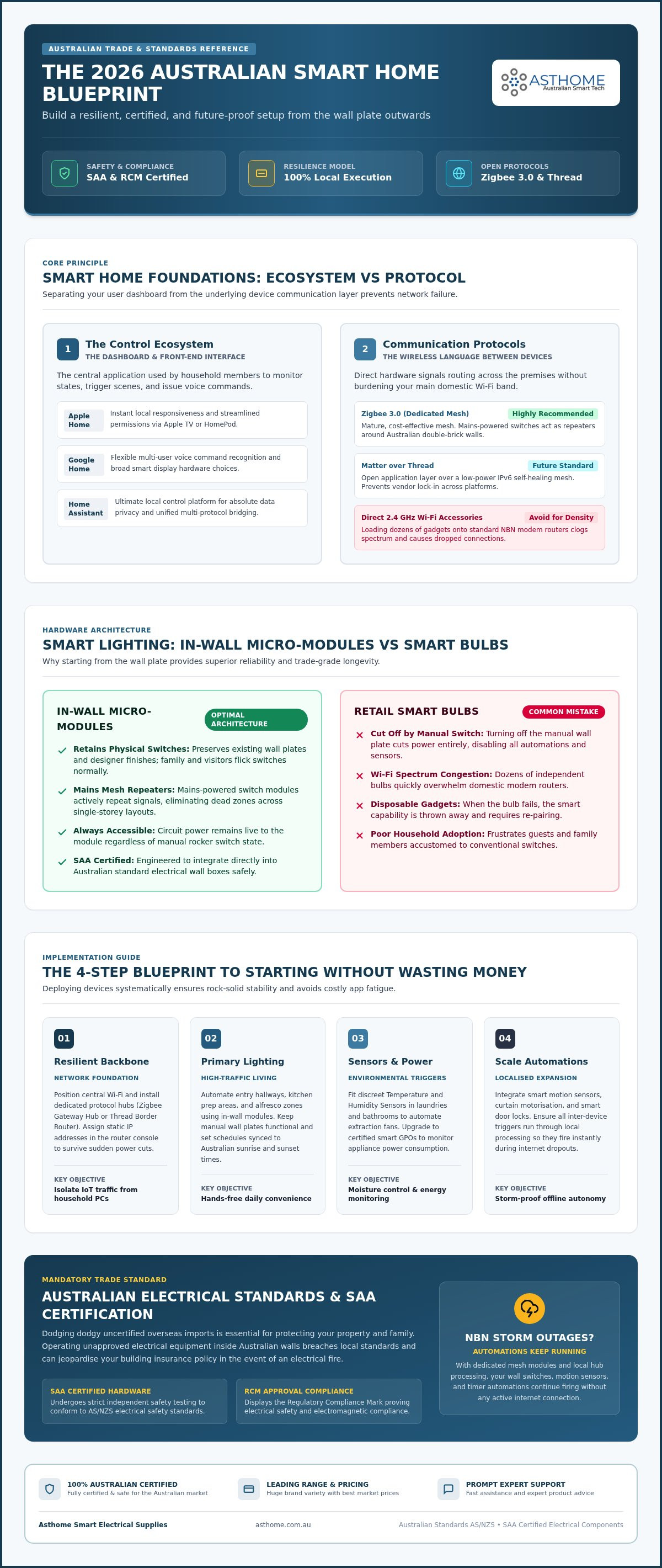
Most beginners trip up on day one by confusing their control ecosystem with their wireless communication protocol. Your ecosystem (Apple Home, Google Home, or Home Assistant) is simply the dashboard where you control devices. Your protocol (Matter over Thread, Zigbee 3.0, or Wi-Fi) is the invisible language the devices use to talk to each other. Treating them as the same thing leads straight to network headaches.
Loading thirty budget Wi-Fi smart accessories onto a standard NBN modem router quickly clogs your 2.4 GHz wireless frequency. Standard domestic routers choke as device density spikes, leading to dropped connections and sluggish response times. To establish the best way to start a smart home in 2026, keep smart accessories off your main Wi-Fi band and deploy dedicated mesh networking protocols instead.
Running local processing means your light switches and sensor triggers run entirely within your home network. If your NBN line cuts out during a storm, your automations still fire instantly.
Matter and Thread Explained for Beginners
Matter serves as an open application standard, letting devices from different brands communicate natively without vendor lock-in. Thread provides the dedicated, low-power IPv6 mesh layer that carries these signals across your house. Choosing an SAA-certified matter smart switch ensures seamless compatibility across multiple platforms while keeping your network traffic snappy and self-healing.
Why Zigbee 3.0 Remains Essential in 2026
While Thread is growing, Zigbee 3.0 remains a rock-solid, mature protocol with an enormous ecosystem of low-cost hardware. Connecting a central Zigbee Gateway Hub to your network creates an ultra-reliable wireless backbone. Every mains-powered Zigbee 3.0 Smart Switch Module or Smart Zigbee Dimmer Module acts as a mesh repeater, routing commands around double-brick walls and sprawling Australian single-storey layouts without dead spots.
Selecting Your Master Control Platform
Choose an operating ecosystem that matches how your household functions daily:
- Apple Home: Delivers instant local responsiveness and straightforward permissions for iOS-heavy homes using an Apple TV or HomePod.
- Google Home: Offers flexible multi-user voice command recognition and broad smart display hardware choices.
- Home Assistant: The ultimate local-control platform for complete data privacy, comprehensive automations, and unified multi-protocol bridging.
The best way to start a smart home in 2026 is to pick hardware featuring universal cross-platform support, giving you total freedom to switch your front-end apps later without rewiring the house.
The 4-Step Blueprint to Starting Your Smart Home Without Wasting Money
Rushing out to automate an entire house over a single weekend is an easy way to burn cash and end up with app fatigue. Rolling out devices systematically ensures your system stays stable and easy for everyone in the house to use. A staged deployment is the best way to start a smart home in 2026 without blowing your renovation budget or introducing network bottlenecks.
Step 1: Build a Resilient Connectivity Backbone
Position your primary Wi-Fi hardware centrally, eliminating wireless dead zones across the floor plan. Next, install a dedicated protocol hub, such as a Zigbee Gateway Hub or a Matter-over-Thread border router, to run low-power device traffic separately from your main home computers. Lock in static IP addresses for these hubs in your router management console to prevent dropped connections after sudden power cuts.
Step 2: Automate Primary Lighting and Common Living Zones
Focus initial upgrades on high-traffic areas where hands-free lighting delivers instant practical benefits: entry hallways, kitchen prep areas, and alfresco zones. Crucially, keep the manual wall plates fully functional so family members and guests can still flick switches normally. Set basic automation rules synced to local Australian sunrise and sunset times to handle evening exterior lights automatically.
Step 3: Deploy Environmental Sensors and Smart Power Points
Discreet Smart Temperature and Humidity Sensors placed in laundries and bathrooms can trigger extraction fans when moisture spikes. Upgrading to a certified power point en allows you to monitor energy consumption on heavy loads like pool pumps, portable heaters, and home office desks. For those seeking trade-tested gear across diverse brands, browsing the SAA-certified lines at asthome.com.au makes sourcing compliant hardware simple.
Step 4: Create Hands-Off, Context-Aware Automations
Shift your setup from phone-based remote controls to genuine automation by layering triggers and conditions:
- Time and presence scenes: Configure a simple "Good Night" routine that sweeps the house to turn off leftover living room circuits and lock exterior doors.
- Illuminance thresholds: Combine a Smart Motion Sensor with light-level conditions so hallway lights only illuminate when ambient daylight drops below set lux targets.
- Dwell-time tuning: Set occupancy shut-off delays based on your family's actual movement habits, avoiding unexpected darkness while someone is still in the room.
Executing this roadmap step by step provides the best way to start a smart home in 2026, delivering rock-solid functionality without unnecessary clutter.
Smart Lighting and Power: Why In-Wall Modules Beat Smart Bulbs
Smart bulbs look tempting on retail shelves, but they introduce a glaring usability flaw. The moment someone naturally flicks the wall switch off, power to the bulb's internal radio cuts out completely. Your schedules fail, automations freeze, and voice assistants reply with frustrating device offline errors. Understanding that smart control belongs behind the plate rather than inside the globe is the best way to start a smart home in 2026.
Fitting an in-wall smart relay behind an existing switchplate preserves constant line voltage to the lighting circuit while maintaining manual rocker control. If a guest switches off the bathroom light manually, the module tracks the state change instantly while remaining connected to your mesh network.
Retrofitting Switch Modules Behind Existing Plates
Modern compact hardware, such as an SAA-approved zigbee 3.0 smart switch module australia homeowners rely on, slips neatly inside standard wall boxes behind your favourite switch plates. This approach keeps your home's architectural finishes consistent without forcing you into cheap-looking plastic touchplates. While modern Australian builds include a neutral wire at the switch, older properties often rely on active switch loops; selecting no-neutral variants ensures smooth retrofitting without paying for costly ceiling cable pulls.
Smart Dimming and Architectural LED Downlights
Controlling modern LED downlights requires stable power management. Pairing a Smart Zigbee Dimmer Module with a compatible Dimmable LED Driver stops the annoying strobing and buzzing caused by mismatched phase-cut dimmers:
- Low-end trimming: Calibrate bottom-end brightness thresholds via your app so low-voltage LEDs never drop out unexpectedly at night.
- Virtual multi-way links: Bind two switches wirelessly across open-plan areas without installing physical multi-core traveller wiring between walls.
- Smooth ramping: Program gentle fade-on transitions that protect eyesight when waking up early.
Smart GPOs and Energy Monitoring Across the Home
Power control extends well past basic lighting circuits. Swapping standard twin sockets for an SAA-certified Smart Power Point (GPO) lets you monitor power hungry entertainment units, home espresso machines, or secondary refrigerators. Built-in power metering tracks continuous kilowatt-hour consumption, allowing you to automatically turn off power-bleeding electronics when rooms sit empty.
Focusing on integrated in-wall relays and smart sockets remains the best way to start a smart home in 2026, delivering seamless automation while keeping standard tactile switches completely functional.
Australian Electrical Safety Standards and SAA Certification
Australia runs a high-voltage 230V/240V 50Hz electrical distribution network. That mains voltage carries serious energy, meaning sub-standard gear presents a genuine hazard. International consumer platforms often recommend cheap smart switches designed for lower overseas voltages or certified solely to US UL or European CE codes. In Australia, those marks carry no legal weight. Purchasing compliant, laboratory-tested equipment is fundamentally the best way to start a smart home in 2026 without risking electrical safety or legal exposure.
Demystifying SAA Certification and the RCM Mark
Every piece of mains-powered smart equipment installed in an Australian wall cavity must comply with strict AS/NZS electrical standards. SAA certification proves the device has passed rigorous independent laboratory testing against fire risk, high-voltage breakdown, and thermal endurance. Look for the Regulatory Compliance Mark (a triangle containing a tick) physically embossed on the product casing. Asthome Smart Electrical Supplies supplies exclusively certified, SAA-approved smart hardware, stocking an extensive catalogue across diverse brands at competitive market prices so you never have to compromise on household safety.
The Role of Your Licensed Electrician ('Sparkie')
Clear boundaries exist between what you can tackle yourself and what requires a trade licence under AS/NZS 3000 (the Australian Wiring Rules):
- DIY safe tasks: Pairing low-voltage contact sensors, placing battery-powered motion units, configuring wireless hubs, and programming app automation logic.
- Licensed trade work: Installing in-wall relay modules, swapping out mains light switches, and terminating fixed smart power points.
Save money on trade call-out rates by grouping your work efficiently. Map your switch plates, audit your neutral wire configurations, and have all your modules boxed and ready on the counter before your sparkie arrives. Always request a signed Certificate of Electrical Safety once the installation finishes.
Protecting Home Insurance and Property Resale Value
Insurance companies regularly assess electrical root causes following residential fires. If a blaze traces back to an uncertified, grey-market smart module imported from an offshore website, insurers can immediately refuse payout. Non-compliant hardware also flags quickly during pre-purchase building and pest inspections when selling your property. Sourcing approved components with documented compliance records protects both your financial equity and your family.
To keep your installation fully compliant from day one, explore trade-tested, SAA-certified hardware directly through asthome.com.au.
Prioritising legitimate Australian certification alongside professional trade installation remains the best way to start a smart home in 2026, delivering long-term peace of mind and total regulatory compliance.
Expanding Your Smart Home: Sensors, Motorisation, and Smart Security
A smart home truly earns its name when it stops waiting for screen taps and starts reacting to its environment. Adding intelligent sensing and motorised elements lets your home take proactive steps on its own. Layering specialised hardware on top of your existing lighting mesh is the best way to start a smart home in 2026 without landing back in single-purpose app silos.
Sensor-Driven Automation: Motion, Temperature, and Humidity
Deploying a discrete motion sensor across high-traffic transition zones turns passive spaces active. Set hallway sensors to guide late-night trips with dim, warm lighting while doubling as armed motion zones when the house is empty. Environmental tracking adds practical utility across diverse rooms:
- Climate triggers: Use a Smart Temperature and Humidity Sensor in bedrooms to switch on fans via a smart socket before summer heat settles in.
- Moisture control: Automate laundry and bathroom exhaust fans based on actual relative humidity spikes, preventing mould growth without leaving noisy fans running constantly.
- Passive monitoring: Place battery-powered sensors in pantries, wardrobes, and linen presses for hands-free cabinet lighting.
Motorised Curtains and Blinds for Energy Efficiency
Australian summers put intense thermal stress on expansive glass sliding doors. Installing a Smart Curtain Motor and Track creates a formidable thermal barrier against harsh afternoon sun. You can automate heavy drapes to glide shut when outdoor temperatures peak, slashing cooling demand on central air conditioning systems. These automated tracks are equally transformative for accessible living, integrating neatly into an NDIS SDA Compliant Smart Home Kit to give residents effortless voice-controlled privacy.
Keyless Entry and Front-Door Security Integration
Front-door access should be effortless, secure, and immune to flat phone batteries. Fitting a dedicated Smart Door Lock provides rapid biometric fingerprint entry, custom temporary PIN codes for trades, and RFID tags, alongside a physical key override for emergencies.
Connecting your entrance hardware into the wider home automates welcoming routines. Unlocking the front door after dark can trigger soft lighting through the entryway and disarm your internal security sensors. When choosing components, browse the extensive catalogue of certified smart electrical supplies to source compliant gear backed by responsive, Victoria-based customer service.
Pairing environmental awareness with secure physical access controls remains the best way to start a smart home in 2026, shifting your property from basic remote control to genuine, hands-off home automation.
Build a Safer, Smarter Home from the Inside Out
Creating a reliable setup doesn't require filling your home with fragile Wi-Fi gadgets or ripping out your existing electrical plates. The best way to start a smart home in 2026 is to build a rock-solid infrastructure foundation using robust mesh protocols like Zigbee and Matter over Thread, backed by in-wall micro-modules that preserve normal wall switch operation. Above all, keeping every 240V component strictly compliant with local standards ensures your household remains safe and fully insured.
Asthome makes executing this strategy straightforward for Australian homeowners and trades alike. You get access to an extensive catalogue of 100% SAA-certified smart modules, dimmers, sensors, and power points across leading brands, all engineered specifically for Australian wiring regulations at the most competitive prices on the market. Backed by prompt, Victoria-based technical assistance and responsive customer service, setting up your dream system has never been more accessible.
Ready to modernise your property with complete confidence? Explore Asthome's Range of SAA-Certified Smart Home Supplies today and take the first step toward a seamless, future-proof home.
Frequently Asked Questions
Can I legally install my own in-wall smart switches in Australia?
No, you cannot legally wire in-wall smart switches yourself in Australia. Under AS/NZS 3000 electrical wiring rules, any mains-voltage (240V) work must be completed by a licensed electrical contractor. Doing it yourself breaches state electrical safety laws and voids household building insurance. You can, however, configure your own Zigbee Gateway Hub, set up battery sensors, and program software automations once your electrician completes the physical wiring.
Is Matter better than Zigbee for starting a smart home in 2026?
Neither protocol is strictly superior; they serve complementary roles when designing your system. Choosing a hybrid setup is often the best way to start a smart home in 2026. Zigbee 3.0 offers a mature, battle-tested ecosystem of cost-effective sensors and in-wall modules with ultra-low latency. Matter over Thread provides native interoperability across Apple, Google, and Home Assistant platforms without proprietary vendor lock-in.
What happens to my smart home if my NBN internet goes down?
Your local automations, wall switches, and sensor schedules will continue operating normally if you build with local protocols. Systems relying on Zigbee, Thread, or local control hubs communicate across an internal radio mesh rather than sending packets to overseas servers. Physical switch toggles, scheduled lighting scenes, and motion-triggered night lights still trigger instantly. You only lose remote smartphone access outside the house.
Do I need a neutral wire behind my light switches to use smart modules?
No, you do not necessarily need a neutral wire in your wall box to install smart switches. While modern Australian homes typically feature a neutral wire at the switch plate, many older houses rely on two-wire switch loops. Asthome supplies dedicated no-neutral smart switch modules engineered specifically to trickle power through the lighting load safely. This eliminates the need to run costly new cables through wall cavities.
Why shouldn't I buy cheap smart switches from overseas retail websites?
Cheap overseas switches rarely carry mandatory Australian SAA certification or the Regulatory Compliance Mark (RCM). Australian homes operate on high-voltage 240V power, and imported units often lack internal thermal fuses or adequate electrical trace clearance. Installing non-compliant hardware creates severe electrical fire hazards and permits insurers to reject property damage claims outright. Sourcing certified gear from an Australian supplier ensures components meet strict AS/NZS safety benchmarks.
How many smart devices can my standard Wi-Fi router handle before slowing down?
Most standard consumer NBN routers struggle once you connect more than 25 to 30 simultaneous Wi-Fi devices. Crowding your router with cheap Wi-Fi switches, smart plugs, and cameras causes packet collisions, latency spikes, and random accessory dropouts. Moving smart lighting, motors, and environmental sensors over to dedicated mesh protocols like Zigbee keeps your 2.4GHz Wi-Fi band free for smooth streaming, remote work, and mobile computing.
Can smart home automation actually lower my Australian power bill?
Yes, smart automation significantly trims electricity usage by curbing standby waste and managing peak cooling demands. Deploying smart power points with real-time energy monitoring lets you identify power-bleeding entertainment systems and turn them off automatically. Coordinating motorized curtains with temperature sensors blocks radiant heat during harsh afternoon sun, reducing the run time of your reverse-cycle air conditioner during expensive peak tariff windows.
Is a smart home setup accessible for elderly relatives or young children?
Yes, provided you prioritise in-wall modules that preserve standard tactile wall switches. Designing around physical switch retention is the best way to start a smart home in 2026 for multi-generational families. Relatives can press light switches exactly as they have always done without touching an app. Meanwhile, gentle motion-activated night lighting, voice-controlled curtain tracks, and biometric smart door locks improve daily comfort across all ages.