

Your NBN drops out during the third quarter of the grand final, and suddenly every smart light in the house goes dark. If that scenario sounds painfully familiar, you already understand why choosing the best Zigbee hub for Australia 2026 is about far more than ticking a protocol box on a spec sheet.
You're not wrong to be frustrated. Most smart home guides are written for the American or European market, ignoring the realities of double-brick construction, congested Wi-Fi routers juggling dozens of devices, and the very real insurance and compliance headaches that come with grey-market gear that's never seen an SAA certification mark. Those concerns are legitimate, and they deserve straight answers.
This guide cuts through the noise. You'll walk away knowing exactly which Zigbee hubs deliver true local processing that keeps your home running through an NBN outage, which hardware is SAA certified and won't void your home insurance, and how to build a stable mesh network that doesn't flinch when your household is streaming, gaming, and automating all at once. We'll cover the key specs, the compliance essentials, and the practical pairing considerations every Australian homeowner and electrical contractor needs to get right in 2026.
Key Takeaways
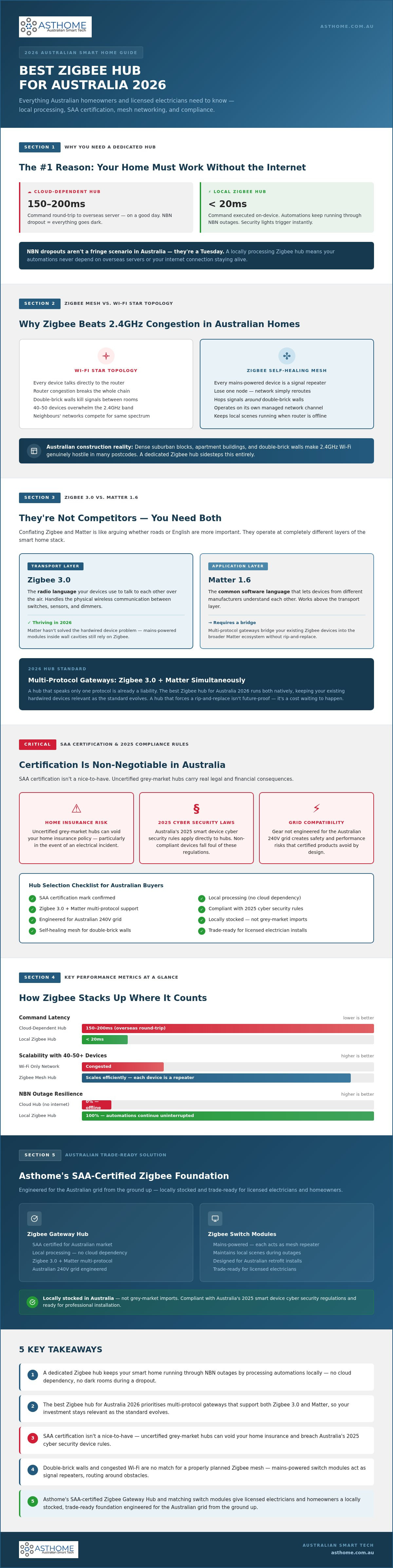
- A dedicated Zigbee hub keeps your smart home running through NBN outages by processing automations locally — no cloud dependency, no dark rooms during a dropout.
- Choosing the best Zigbee hub for Australia 2026 means prioritising multi-protocol gateways that support both Zigbee 3.0 and Matter, so your investment stays relevant as the standard evolves.
- SAA certification isn't a nice-to-have — uncertified grey-market hubs can void your home insurance and fall foul of Australia's 2025 cyber security device rules.
- Double-brick walls and congested Wi-Fi are no match for a properly planned Zigbee mesh; this guide shows you exactly how to build one that holds firm across a full Australian home.
- Asthome's SAA-certified Zigbee Gateway Hub and matching switch modules give licensed electricians and homeowners a locally stocked, trade-ready foundation that's engineered for the Australian grid from the ground up.
Why Your 2026 Australian Smart Home Needs a Dedicated Zigbee Hub
Think of a Zigbee hub as the traffic controller for your smart home. Rather than routing every device command through your router, a dedicated hub manages all that device traffic locally, keeping your Wi-Fi clear for the things that actually need it, like streaming, video calls, and gaming. Without one, every smart switch, sensor, and dimmer competes for bandwidth on the same congested 2.4GHz band your neighbours are also hammering.
That distinction matters far more in Australia than most guides acknowledge. Dense suburban streetscapes, apartment blocks, and the sheer number of IoT devices per household have turned 2.4GHz Wi-Fi into a genuinely hostile environment in many postcodes. A dedicated Zigbee hub sidesteps that congestion entirely by operating on its own managed network.
Zigbee vs. Wi-Fi: Beating the 2.4GHz Crowding
Wi-Fi uses a star topology: every device talks directly back to the router. If the router's busy or the signal's weak, the whole chain breaks. Zigbee works differently. It's a self-healing mesh where every mains-powered device, including your 240V switch modules, acts as a signal repeater for every other device around it. Lose one node and the network simply reroutes.
That mesh architecture is a genuine advantage in Australian construction. Double-brick walls notoriously kill Wi-Fi signals between rooms, but a Zigbee mesh built on mains-powered devices placed throughout the home can hop signals around those barriers rather than trying to punch through them. Asthome's SAA-certified Zigbee modules are designed precisely for this, maintaining local scenes and automations even when the router is under load or offline entirely.
The Local Processing Factor for 2026
Here's the practical difference: a cloud-dependent hub sends your "turn on the lights" command to a server somewhere overseas and waits for a response. Typical round-trip latency sits around 150 to 200 milliseconds on a good day. A locally processing Zigbee hub executes that same command in under 20 milliseconds. You won't consciously clock the difference every time, but you'll feel it when a motion sensor needs to trigger a security light instantly.
More critically, local processing means your automations keep running through an NBN dropout. That's not a fringe scenario in Australia; it's a Tuesday. The Zigbee 3.0 smart switch modules that form the backbone of a modern retrofit depend entirely on hub stability to deliver this reliability. No hub, no local control. It's that straightforward.
Looking ahead, Wi-Fi 7 will deliver impressive raw throughput, but it doesn't solve the fundamental problem of device count. A household running 40 or 50 smart devices still benefits from offloading that traffic onto a dedicated Zigbee mesh. Choosing the best Zigbee hub for Australia 2026 means choosing a platform built for local-first operation, not one that treats cloud connectivity as the default. That's the standard worth holding to.
Understanding Zigbee 3.0 vs. Matter 1.6: The 2026 Tech Landscape
Here's the confusion that trips up even experienced installers: Zigbee and Matter aren't competitors. They operate at completely different layers of the smart home stack. Zigbee is the transport protocol, the radio language your devices use to talk to each other over the air. Matter is the application layer standard, a common language that lets devices from different manufacturers understand each other at the software level. Conflating the two is like arguing whether roads or English are more important. You need both.
In 2026, the hubs worth specifying are multi-protocol gateways that handle Zigbee 3.0 and Matter simultaneously. A hub that speaks only one of these protocols isn't future-proof; it's already a liability. The best Zigbee hub for Australia 2026 runs both natively, bridging your existing hardwired devices into the broader Matter ecosystem without forcing a rip-and-replace.
Is Zigbee Dying? The 2026 Reality Check
Short answer: no. Zigbee 3.0 is thriving precisely because Matter hasn't solved the hardwired device problem. Mains-powered modules, dimmers, and switch relays embedded inside wall cavities need a rock-solid, low-latency mesh protocol. Zigbee 3.0 delivers that. Matter, at its current revision, is far better suited to the controller layer than to the physical device layer for hardwired loads. Australian electrical contractors understand this instinctively: you don't swap out a protocol mid-wall just because a new standard gets a press release. For practical future-proofing advice on the Matter side of the equation, the Matter smart switch guide is worth bookmarking.
Matter-over-Bridge: The Best of Both Worlds
A Matter-Zigbee bridge preserves your entire investment in legacy Zigbee switches by exposing them natively inside Apple Home, Google Home, and Amazon Alexa without any re-pairing or device replacement.
Thread is the third piece of this puzzle. It's a low-power mesh radio standard that shares its IP-based architecture with Matter, making it the natural companion protocol for battery-powered sensors in 2026 ecosystems. A quality hub bridges Thread-based sensors and Zigbee 3.0 switch modules into the same Matter fabric, so your motion sensors and your hardwired dimmers appear side by side in a single app. Practically speaking, this hybrid approach keeps sensors on Zigbee or Thread where they perform best, while the hub speaks Matter to your chosen ecosystem controller.
Australian electrical contractors favour this architecture for a straightforward reason: it separates the installation risk. Zigbee modules go in once, certified and compliant, and the hub handles the translation layer above them. Swap ecosystems later if you need to; the wiring stays put.
Asthome's SAA-certified Zigbee Gateway Hub and matching Zigbee 3.0 Smart Switch Modules are designed with exactly this layered approach in mind, giving licensed electricians a locally stocked, trade-ready foundation that works today and bridges cleanly into the Matter ecosystem as it matures.
Top Contenders: Comparing the Best Zigbee Hubs for Australia
Four hubs dominate the conversation in 2026. Each suits a different type of installer, household, and budget. Here's the honest breakdown, without the international review bias that ignores Australian power standards, double-brick construction, and the very real problem of grey-market warranty support.
Homey Pro vs. Hubitat: The Power User Battle
Both hubs target enthusiasts who want serious automation depth, but they take completely different approaches to getting there.
The Homey Pro's visual flow editor is genuinely impressive. You can build complex multi-device automations by dragging logic blocks across a canvas, which suits homeowners who want granular control without writing a single line of code. It supports Zigbee, Z-Wave, Wi-Fi, and Matter simultaneously, making it one of the most capable multi-protocol controllers available. For a larger home running 80-plus devices across multiple protocols, that flexibility is worth paying for.
The Hubitat Elevation C-8 Pro takes a different stance. Everything runs locally. No cloud dependency, no subscription, no latency spike when Homey's servers have a bad day. Its scripting environment is more demanding, favouring users comfortable with Groovy-based rule engines. The hardware is built for scale: dual Zigbee and Z-Wave radios with dedicated antenna design that holds mesh integrity across larger floor plans. For a three-bedroom home in Point Cook with 40 to 60 devices, the C-8 Pro is arguably over-specced, but that headroom is exactly why integrators love it.
The cost-benefit reality for a typical Australian household: Homey Pro's ecosystem breadth comes at a premium, and some advanced features sit behind a subscription tier. Hubitat has no recurring fees, which matters over a five-year horizon. Neither unit carries SAA certification for the Australian market, which is a compliance consideration worth raising with your insurer before committing.
The Asthome Gateway: Why Simplicity Wins for Trades
Licensed electricians don't want to configure a flow editor on a Friday afternoon. They want a hub that pairs reliably, holds its mesh, and doesn't generate callbacks three weeks later because a firmware update broke an automation.
Asthome's SAA-certified Zigbee Gateway Hub is built around that reality. Pairing with smart light switches is straightforward, with device discovery that doesn't require workarounds or third-party plugins. The gateway is stocked locally in Victoria, which means no six-week international shipping wait when a replacement is needed on a commercial job. Peer-to-peer technical support from people who actually understand Australian electrical requirements is part of the package, not a premium add-on.
For trade accounts, that combination of local stock, SAA compliance, and genuine technical support is the deciding factor. Set it up, commission the switches, hand over the keys.
Aqara M3: The HomeKit Pick
For households already embedded in the Apple ecosystem, the Aqara M3 is the most polished HomeKit-native option available. It bridges Zigbee devices into Apple Home cleanly, supports Thread as a border router, and handles Matter bridging without requiring a separate controller. Its limitation is the inverse of Hubitat's strength: it leans heavily on Apple's cloud infrastructure for remote access, which reintroduces the NBN-dropout vulnerability that a locally processing hub eliminates.
Choosing the best Zigbee hub for Australia 2026 ultimately comes down to one question: who's installing it, and what happens when something goes wrong? For trade-grade reliability with zero compliance risk, the locally stocked, SAA-certified option wins every time.
Selection Criteria: SAA Certification and 2025 Cyber Security Rules
Picking the best Zigbee hub for Australia 2026 isn't just a technical decision. It's a compliance decision. Two regulatory frameworks now shape every legitimate smart home installation in this country: the RCM/SAA certification scheme for electrical safety, and the Australian Government's 2024 voluntary IoT security code that has hardened into a genuine market expectation heading into 2026. Ignore either one and you're not just cutting corners; you're exposing yourself to real financial and legal risk.
Start with what's on the box. Any 240V-powered hub sold in Australia must carry the RCM mark, which incorporates SAA electrical safety certification. No mark, no legitimate sale. It's that simple. Uncertified imports, the grey-market units that arrive via international forwarding addresses with plugs that don't quite match Australian sockets, have cleared no independent safety testing for the Australian grid. They may work fine for months. Or they may not.
On the cyber security side, look for these specific features before purchasing any hub:
- No default passwords: The device must require a unique credential on first setup, not a shared factory default like "admin/admin".
- Automatic security updates: Firmware patches should be delivered and applied without requiring manual intervention from the homeowner.
- Vulnerability disclosure policy: The manufacturer must have a published process for reporting and addressing security flaws.
- Local data processing: Automations and device states should not require overseas server access to function.
- Data residency transparency: You should be able to confirm where your usage data is stored and under which jurisdiction's privacy laws it sits.
That last point matters more than most buyers realise. A hub that routes your motion sensor data through servers in a jurisdiction with weak privacy protections isn't just a philosophical concern; it's a practical one for anyone whose home contains children, elderly residents, or NDIS participants.
Insurance and Safety: The Sparky's Perspective
Licensed electricians won't touch uncertified hardware, and it's not bureaucratic caution. It's liability. If an uncertified power adapter causes a thermal event, the kind where inadequate insulation or substandard capacitors allow heat to build unchecked inside a wall cavity, the installer's licence is on the line alongside the homeowner's insurance claim. Insurers are increasingly scrutinising smart home hardware after fire incidents, and a non-RCM-marked device in the chain is grounds for claim rejection. Asthome's SAA-certified Zigbee Gateway Hub carries full RCM compliance for the Australian market, giving licensed electricians a product they can install, document, and walk away from with confidence.
NDIS and SDA Compliance in 2026
Specialist Disability Accommodation introduces requirements that go well beyond standard residential installs. For participants relying on smart home technology for daily independence, reliability isn't a convenience feature; it's a safety feature. Local control that survives an NBN outage, battery backup for the hub itself, and zero dependency on overseas cloud infrastructure are baseline expectations in SDA environments. Asthome's NDIS SDA Compliant Smart Home Kit is built around exactly these requirements, supporting participants in Point Cook and beyond with hardware that's been specified for the Australian compliance environment from the ground up. When independence is the outcome, the hub holding it all together cannot be a grey-market gamble.
Ready to specify a compliant, trade-ready foundation for your next install? Explore Asthome's SAA-certified Zigbee Gateway Hub and NDIS SDA kits with local stock available now.
Building Your Backbone with Asthome's Trade-Ready Solutions
Every reliable smart home starts with a single decision: what sits at the centre of it all. For licensed electricians and homeowners who've read this far, the answer is clear. The best Zigbee hub for Australia 2026 isn't the one with the flashiest app or the longest spec sheet; it's the one that pairs reliably, holds its mesh under load, and comes with genuine local support when something needs sorting on a job site in a hurry.
Asthome's SAA-certified Zigbee Gateway Hub is that foundational piece. It's designed to anchor a modular system that grows with the home, from a single room commission to a full-property rollout, without forcing a hardware swap at each stage.
From Retrofits to New Builds
The smartest approach to any installation is staged. Start with the hub and one room: a living area or master bedroom where the impact is immediately visible to the client. Commission the Zigbee 3.0 Smart Switch Modules, confirm the mesh is stable, and hand over a working system. That single room becomes the proof point for expanding further.
Scaling from there is straightforward. Add smart power points to the kitchen and home office, pair motion sensors to automate hallway and outdoor lighting, and extend the Zigbee mesh organically as each mains-powered device becomes a repeater node. No rip-and-replace. No re-commissioning the hub. Just methodical expansion.
A Point Cook townhouse project illustrates this well. The installer began with the Asthome gateway and four Zigbee switch modules across the living and dining zones. Six weeks later, the same hub was managing 28 devices across three floors, including smart power points, motion sensors, and a curtain motor, all running local automations that kept working through two separate NBN outages during the build-out period.
The Asthome Support Difference
Grey-market hubs come with forums. Asthome comes with people who've run cable through double-brick and know what a Zigbee mesh looks like when a rogue device is eating channel bandwidth. That peer-to-peer troubleshooting is available when you need it, not buried behind a ticketing system three time zones away.
Stock ships from Victoria. That matters when a replacement gateway is needed to keep a commercial job on schedule, not three weeks from now when an international parcel clears customs.
- Local stock, fast dispatch: No overseas wait for critical components on active projects.
- Trade accounts available: Discounted wholesale pricing for licensed electrical contractors with a dedicated account structure built for repeat orders.
- SAA-certified across the range: Every product ships RCM-marked and ready to document on your compliance paperwork.
If you're specifying smart home systems regularly, a trade account is the obvious move. Volume pricing, priority support, and a local supplier who speaks your language, literally and technically. Shop the SAA-certified Zigbee Gateway Hub and open your trade account at Asthome today.
Your 2026 Smart Home Starts With the Right Hub
The choice is straightforward once you strip away the noise. Local processing keeps your home running through NBN dropouts. SAA certification protects your insurance and your licence. A properly planned Zigbee mesh handles double-brick and congested Wi-Fi without breaking a sweat. Those three principles should anchor every hub decision you make in 2026.
Choosing the best Zigbee hub for Australia 2026 means choosing hardware that's been built for this market, not retrofitted for it. Grey-market units with no RCM mark aren't a bargain; they're a liability waiting to surface on a claim form.
Asthome's SAA-certified Zigbee Gateway Hub gives licensed electricians exactly what the job demands: compliant hardware stocked locally in Point Cook, trade pricing for volume installs, and peer-to-peer support from people who understand Australian electrical requirements firsthand.
Don't leave your next install to chance. Upgrade to a trade-ready Zigbee Gateway Hub at Asthome and commission with confidence from day one.
Frequently Asked Questions
Does a Zigbee hub work without an NBN connection?
Yes, and that's one of the strongest reasons to choose a dedicated Zigbee hub over a cloud-dependent alternative. A locally processing hub runs all automations, scenes, and device commands entirely on your home network. No NBN connection required. Your lights switch, your motion sensors trigger, and your schedules fire exactly as programmed, regardless of what's happening with your internet service provider.
The one exception is remote access. Controlling your home from outside the property, checking device status via a smartphone app while you're at work, does require internet connectivity. But everything that happens inside the home keeps running without it.
How many devices can a single Zigbee 3.0 hub handle in 2026?
Most quality Zigbee 3.0 hubs support between 50 and 200 devices on a single network, depending on the hub's onboard processing capacity and the Zigbee coordinator chip used. For a typical Australian home running 20 to 50 devices, including switch modules, sensors, and smart power points, a single hub handles the load comfortably with headroom to spare.
Mesh depth matters as much as raw device count. A well-planned installation with mains-powered devices distributed throughout the home keeps every node within two or three hops of the coordinator, which maintains low latency and stable mesh integrity regardless of how many devices are active simultaneously.
Is Zigbee dying because of Matter and Thread?
No. Zigbee 3.0 remains the dominant hardwired device protocol in 2026 because Matter hasn't replaced the need for a reliable, low-latency mesh at the physical device layer. Matter operates at the application layer above the radio protocol, meaning the two standards complement each other rather than compete. A quality hub bridges both simultaneously, exposing your Zigbee switch modules inside Apple Home, Google Home, or Alexa without any device replacement.
Thread is the closest thing to a Zigbee competitor, but it's primarily suited to battery-powered sensors rather than mains-powered loads. For hardwired switch modules inside wall cavities, Zigbee 3.0 remains the practical standard of choice for licensed Australian electricians.
What is SAA certification and why does my hub need it?
SAA certification is part of Australia's RCM (Regulatory Compliance Mark) scheme, which confirms a 240V electrical product has passed independent safety testing for the Australian grid. Any mains-powered hub sold legally in Australia must carry the RCM mark. Without it, the product has cleared no Australian safety assessment, which creates real risk: uncertified hardware can void your home insurance policy and expose a licensed installer to personal liability if an incident occurs.
Choosing the best Zigbee hub for Australia 2026 means checking for the RCM mark before purchasing, not after. Asthome's SAA-certified Zigbee Gateway Hub carries full RCM compliance, giving electricians a product they can document cleanly on compliance paperwork without hesitation.
Can I mix different brands of Zigbee sensors on one hub?
Generally, yes. Zigbee 3.0 is an open, standardised protocol, so devices from different manufacturers should pair to any compliant coordinator. In practice, interoperability varies. Some manufacturers implement proprietary extensions on top of the standard Zigbee stack, which can cause incomplete pairing or missing device features when used outside their own ecosystem. Sensors from Aqara, IKEA, and Sonoff typically pair reliably with third-party hubs, but it's worth confirming compatibility before committing to a large mixed-brand rollout.
For trade installs, the safest approach is pairing Asthome's Zigbee 3.0 Smart Switch Modules with the Asthome gateway, then adding third-party sensors once the core mesh is stable and verified.
How do I stop my Zigbee network from dropping out in a double-brick home?
The solution is mesh density, not signal strength. Double-brick walls absorb radio signals heavily, so trying to punch a single strong signal through multiple walls rarely works. Instead, place mains-powered Zigbee devices, switch modules and smart power points specifically, at regular intervals throughout the home so the mesh hops signals around barriers rather than through them. Every mains-powered device acts as a repeater node, extending the network organically.
Battery-powered sensors don't repeat signals, so they shouldn't be relied upon to extend mesh coverage. Map your mains-powered devices first, confirm the mesh is stable between rooms, then add sensors within range of an established repeater node. A structured rollout by room eliminates most dropout issues before they start.
Do Zigbee hubs require a monthly subscription fee?
It depends on the hub. Some platforms, including certain tiers of Homey Pro, gate advanced automation features behind a recurring subscription. Others, like Hubitat Elevation, have no subscription at all. Local processing hubs that run automations entirely on-device typically don't require ongoing fees because there's no cloud infrastructure to fund.
Before purchasing any hub, check specifically whether local automations, remote access, and multi-user control each require a paid tier. Over a five-year installation lifecycle, subscription costs can exceed the upfront hardware price. Asthome's Zigbee Gateway Hub doesn't carry a subscription requirement for core local automation functionality.
What are the Australian Cyber Security Rules 2025 for smart hubs?
Australia's 2024 voluntary IoT security code hardened into a firm market expectation through 2025, covering connected devices including smart home hubs. The key requirements centre on unique credentials at first setup (no shared factory defaults), automatic firmware updates without manual user intervention, a published vulnerability disclosure process from the manufacturer, and transparency around where user data is stored and processed.
Practically, this means avoiding hubs that ship with default passwords like "admin" or that route automation data through overseas servers without disclosing the jurisdiction. Local processing hubs with automatic security updates satisfy the core intent of the framework. When in doubt, ask the supplier directly for their vulnerability disclosure policy before specifying a hub on a commercial or SDA project.