

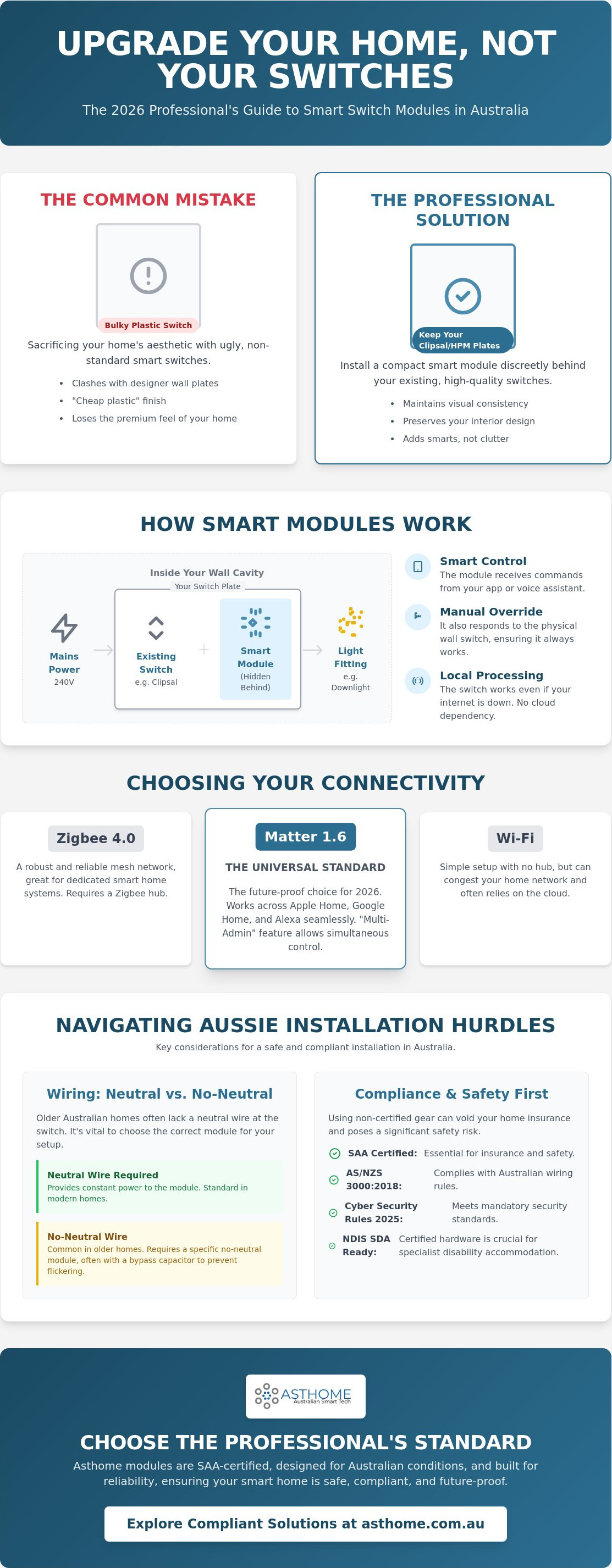
Why should you sacrifice your home's aesthetic for the sake of automation? Most Australian homeowners assume that "going smart" requires replacing their high-quality Clipsal or HPM wall plates with bulky, plastic alternatives. Understanding how smart switch modules work changes that equation entirely. These compact devices sit discreetly inside your existing wall boxes, turning traditional switches into intelligent nodes without altering your interior design.
We know the struggle is real when it comes to shallow Australian wall boxes and the "no-neutral" wiring common in older Victorian-era homes. It's often a tight fit that leaves you worried about safety or voiding your home insurance with non-SAA certified gear. This 2026 guide simplifies the retrofit process, ensuring your setup meets the latest AS/NZS 3000:2018 Wiring Rules and the mandatory Cyber Security Rules 2025. You'll gain the peace of mind that comes with professional-grade, compliant hardware.
You'll discover how to select the right hardware for your specific wiring layout, whether you require the latest Matter 1.6 or Zigbee 4.0 connectivity. We'll preview the essential steps to ensure your hidden automation is reliable, compliant, and ready for the future of the Australian smart home.
Key Takeaways
- Learn why retrofitting modules behind your existing Clipsal or HPM plates is the best way to maintain your home's designer look while adding automation.
- Understand the technical mechanics of how smart switch modules work using internal relays or MOSFETs to control electrical loads via Matter 1.6 or Zigbee 4.0 protocols.
- Identify whether your property requires a neutral or no-neutral module and how bypass capacitors solve common wiring dilemmas in older Australian homes.
- Ensure your smart home project remains fully compliant with AS/NZS 3000:2018 standards and the latest 2026 cybersecurity regulations for total peace of mind.
- Discover why SAA-certified hardware is essential for NDIS SDA environments and maintaining your home insurance coverage in the event of an electrical fault.
What is a Smart Switch Module and Why Install it Behind the Switch?
A smart switch module is a compact electronic relay or dimmer unit. It's designed to be installed by a licensed electrician directly inside the wall cavity, typically tucked behind a standard Australian GPO or light switch plate. Understanding how smart switch modules work is the first step toward a seamless home automation system that doesn't scream "tech" from every wall. These devices are the preferred choice for homeowners who want modern control without the visual clutter of bulky, non-standard hardware.
The module functions as an intelligent secondary bridge between your home's electrical mains and the light fitting. It's essentially a smart relay that listens for two types of inputs. It responds when you flick the physical toggle on the wall and when you send a command via a smartphone app or voice assistant. This dual-control mechanism ensures that your house remains functional for guests or family members who prefer the traditional way of doing things. You get the benefits of scheduling and remote access without losing the manual reliability you're used to.
Modules vs. Smart Wall Switches: The Design Debate
Replacing a multi-gang plate can be a costly exercise. If you have a 3-gang or 4-gang setup, buying a single integrated smart switch plate often means paying a premium for proprietary hardware. Using 2-gang modules is frequently more cost-effective. Interior designers often specify modules because they preserve the tactile click and weight of high-end brass or timber switches. From a maintenance perspective, it's far simpler for a sparkie to swap out a faulty module than it is to replace an entire integrated switch assembly that might no longer be in production. This approach ensures your how smart switch modules work knowledge translates into long-term savings.
The Aesthetic and Functional Benefit
Many entry-level integrated smart switches have a "cheap plastic" finish that clashes with the premium look of Clipsal or HPM plates. By choosing modules, you maintain visual consistency across your entire home. You can automate the living room and kitchen while leaving the guest bedroom as a standard circuit, yet all wall plates will match perfectly. In a 1920s bungalow retrofit, for example, you can hide a Zigbee 3.0 Smart Switch Module behind original heritage toggles. This adds modern convenience without ruining the period features that define the property's value. Point Cook residents particularly value this "invisible" advantage when upgrading modern designer homes where specific plate finishes are non-negotiable.
How Smart Switch Modules Work: Matter, Zigbee, and Wi-Fi Protocols
Understanding how smart switch modules work requires looking under the hood at the communication protocols that drive them. In 2026, the landscape has shifted from fragmented Wi-Fi setups to unified standards that prioritise speed and reliability. Inside the module, a relay mechanism handles the 240V load. Most modern modules use a MOSFET (Metal-Oxide-Semiconductor Field-Effect Transistor) for silent dimming or a high-quality solenoid for standard switching. This internal component receives a low-voltage signal from the module's brain and physically bridges the circuit to your light fitting.
A critical feature of professional-grade modules is local control. Even if your NBN connection drops out during a Melbourne storm, the physical connection between the wall toggle and the module remains active. Your lights will always respond to the manual switch. This local processing is a core component of how smart switch modules work to ensure your home remains functional regardless of your internet status. It's a fail-safe that distinguishes trade-quality hardware from cheap, cloud-dependent alternatives.
Matter Modules: The Universal Language
The release of Matter 1.6 in June 2026 has revolutionised the Australian market. Matter smart switch modules are now the industry benchmark for interoperability. This protocol eliminates "hub fatigue" by allowing different ecosystems like Apple Home, Google Home, and Alexa to control the same device simultaneously. The "Multi-Admin" feature is a game-changer for shared households where residents use different phone brands. These modules also meet the mandatory Cyber Security Rules 2025 that came into effect on 4 March 2026, ensuring unique default passwords and encrypted local communication for total peace of mind.
Zigbee 3.0: The Reliable Retrofit
For larger properties in Point Cook where Wi-Fi signals might struggle to penetrate internal brick walls, Zigbee 3.0 smart switch modules remain a stalwart choice. These devices create a mesh network where each mains-powered module acts as a "router", passing signals along to the next device. This extends your range far beyond a single router's reach. While Zigbee 4.0 was released in November 2025 with enhanced security, Zigbee 3.0 remains the most widely compatible standard for stable retrofit projects. You'll need a dedicated Zigbee Gateway Hub to manage this traffic, which keeps your Wi-Fi bandwidth free for 4K streaming and home office requirements.
Australian Installation Hurdles: Neutral Wires and Wall Depth
Australian homes present a unique set of challenges for smart retrofits. While the protocols discussed earlier handle the digital logic, the physical wiring determines which hardware you can actually use. The most common hurdle is the neutral wire dilemma. Standard Australian lighting circuits often only run an active wire to the switch. If your Point Cook home lacks a neutral wire at the wall plate, you'll need a no-neutral module. These devices "steal" a minute amount of power from the circuit to keep the module's radio active. This often requires a bypass capacitor installed at the light fitting to prevent low-wattage LEDs from flickering. Understanding these physical constraints is a vital part of how smart switch modules work in a local context.
Physical space is the next battle. Many Australian wall boxes, especially those using C-clips or shallow render brackets, are only 35mm deep. Once you factor in the switch mechanism and the standard 1.5mm or 2.5mm cabling, there's very little room left. Slimline module designs are essential for a successful fit. Forcing a module into a cramped space creates thermal management issues. Electronic components need a small amount of airflow to dissipate heat. Overcrowded wall boxes can lead to premature module failure. Choosing a module with a high thermal rating ensures the device operates safely within the tight confines of a standard wall cavity.
SAA Certification and Insurance Compliance
SAA certification is the most important thing to check before buying any module online. All 240V hardware sold in Australia must carry the Regulatory Compliance Mark (RCM). Using uncertified gear imported from overseas is a major risk. It can lead to fire hazards and will almost certainly void your home insurance if a fault occurs. You should always consult a reference guide to Australian GPO and switch standards before starting a project. This ensures your hardware is legally compliant and safe for long-term use.
Wiring for the Modern Australian Home
Identifying the wires behind a Clipsal or HPM plate requires professional expertise. You'll typically find an Active (Brown or Red), a Load wire going to the light, and sometimes a Neutral (Blue or Black). If you want to maintain smooth dimming without the "strobing" effect common in cheap setups, consider using a smart Zigbee dimmer module specifically tuned for Australian LED downlights. Regardless of the module type, you must hire a licensed sparkie for all fixed wiring work. Under AS/NZS 3000:2018, performing your own electrical work is illegal and dangerous. A licensed professional ensures the installation is grounded correctly and meets all safety benchmarks, which is fundamental to how smart switch modules work reliably in your home.
Step-by-Step Guide to the Retrofit Process
The transition from a standard light to a smart one involves more than just a hardware swap. Because all fixed wiring in Australia must be handled by a licensed electrician, the retrofit process follows a strict safety protocol. First, the sparkie will isolate the circuit at the mains switchboard. Verifying the absence of voltage with a calibrated volt tester is a non-negotiable step before any wall plate is unscrewed. This ensures the environment is safe to begin the physical integration of the module.
Wiring the terminals is the core of how smart switch modules work in a real-world application. The electrician connects the Active (L) and Neutral (N) wires to power the module itself. The existing wall switch is then wired into the S1 and S2 terminals. This creates a low-voltage sensing loop that allows the module to detect when you've physically toggled the switch. Managing the "spaghetti" of cables is the final physical hurdle. Given the 35mm depth of many Australian wall boxes, folding the 1.5mm cables neatly behind the module is essential to ensure the Clipsal or HPM plate sits flush against the render or plaster.
Once the plate is secured, commissioning begins. For 2026 Matter-enabled devices, this is as simple as scanning the unique QR code via your preferred smart home app. If you're using Zigbee, you'll trigger the pairing mode to link it with your Zigbee Gateway Hub. Testing confirms the success of the install. You should be able to toggle the light via the physical switch and immediately see the status update on your smartphone. This dual-state synchronisation is fundamental to how smart switch modules work to provide a reliable user experience.
Handling 2-Way and 3-Way Switching
Automating hallway or staircase lights doesn't require a module behind every switch. In a standard Australian 2-way circuit, a single module is typically installed at the "load" end where the light wire returns. This single device senses toggles from either physical switch in the loop. If you're dealing with a 2-gang or 3-gang plate, using a dual-channel module saves significant space. It allows you to control two separate lighting circuits from one compact unit hidden in the wall cavity.
Integrating with Sensors and Automations
The true power of a retrofit comes after the wiring is done. You can create "Arrival Scenes" by pairing your new modules with smart motion sensors. Imagine the front porch and hallway lights activating automatically when you pull into your Point Cook driveway after dark. You can also schedule lighting patterns to simulate occupancy while you're on holiday, which is a proven deterrent for intruders. Voice control via Siri, Alexa, or Google Home adds the final layer of convenience, allowing for hands-free operation across your entire home. To start your retrofit project with trade-quality hardware, explore the range of SAA-certified modules at Asthome today.
Why Asthome Modules are the Professional Choice in Australia
Selecting the right hardware is just as critical as understanding the technical logic of how smart switch modules work. While the basic principle of relay-based switching is universal, the build quality and regulatory compliance of the device determine its longevity in the harsh Australian climate. Asthome Smart Electrical Supplies provides a range of Matter and Zigbee modules that carry full SAA certification. This isn't just a badge; it's a guarantee that the hardware meets the rigorous safety standards required by Australian law. When you choose SAA-certified gear, you protect your property and ensure your home insurance remains valid in the event of an electrical fault.
Our commitment to the local industry goes beyond simple retail. We operate as a business run by practitioners for practitioners. This means our support team understands the specific nuances of Australian wiring, from the colour-coding of older Victorian homes to the latest AS/NZS 3000:2018 requirements. If a sparkie encounters a complex 3-way switching loop or a particularly shallow wall box, they can speak directly to a local expert at Asthome Smart Electrical Supplies who knows the hardware inside out. This peer-to-peer reliability is why we are the trusted partner for retrofit projects across Victoria.
NDIS SDA Compliance and Accessibility
Reliability is non-negotiable in Specialist Disability Accommodation (SDA). Our hidden modules are designed to meet the strict NDIS smart home technology standards for "Improved Liveability". Unlike cheap plug-in adapters that can be easily bumped or disconnected, the hardwired modules from Asthome Smart Electrical Supplies provide a permanent, stable solution for participants. Automated lighting and voice-controlled switches are core components of independent living. By integrating these modules behind standard plates, we provide participants with a home that is both highly functional and aesthetically normal, avoiding the institutional look of traditional assistive technology.
The Asthome Trade Advantage
We provide specialised support for licensed electrical contractors through our dedicated trade accounts. Registered sparkies gain access to wholesale pricing, bulk discounts, and technical wiring diagrams that simplify how smart switch modules work in multi-dwelling developments. We understand that time is money on a job site. That's why we offer fast local shipping from our Point Cook distribution centre directly to your project location. Whether you are outfitting a single 1920s bungalow or a block of new townhouses, Asthome Smart Electrical Supplies provides everything needed for a compliant, professional-grade smart home installation. Licensed professionals can create a trade account today to access priority technical support and industry-leading rates on all Matter and Zigbee hardware.
Future-Proof Your Australian Home Today
Choosing to automate your property doesn't have to mean compromising on the timeless aesthetic of your interior design. By mastering how smart switch modules work, you can hide advanced Matter and Zigbee technology behind the wall plates you already love. We've explored how these compact units bridge the gap between traditional mechanical switching and modern digital control, providing a reliable solution that respects both heritage homes and sleek new builds.
The foundation of any successful retrofit is a commitment to local standards. Ensuring your hardware carries the RCM and is installed by a licensed sparkie protects your investment and your peace of mind. From navigating shallow wall cavities to configuring multi-way hallway lighting, the right preparation turns a complex technical challenge into a seamless lifestyle upgrade that adds genuine value to your home.
Take the next step in your home automation journey by selecting hardware designed for the unique demands of our local market. Shop SAA Certified Smart Switch Modules at Asthome Smart Electrical Supplies to access professional-grade gear and expert local support. Your smarter, more efficient home is just behind the wall plate.
Frequently Asked Questions
Do I need a neutral wire to install a smart switch module in Australia?
You don't always need one, but your specific wiring layout will dictate which hardware you require. While standard units need a neutral wire to power the internal radio, no-neutral modules are available for older Australian homes. As we explored in the wiring section, these "no-neutral" versions often require a bypass capacitor at the light fitting to ensure low-wattage LEDs don't flicker when the circuit is off.
Can I install a smart switch module myself or do I need a licensed electrician?
You must hire a licensed electrician for all fixed wiring installations in Australia. Under AS/NZS 3000:2018, DIY electrical work is illegal and carries significant safety risks. A professional sparkie ensures the unit is grounded and safely integrated into your circuit, which is fundamental to how smart switch modules work without risking a fire or voiding your home insurance.
Will these modules fit behind standard Clipsal or HPM wall plates?
Yes, they are designed specifically to sit behind standard Australian switch plates. The main constraint is the depth of your wall box. Most slimline modules are under 20mm thick, which allows them to fit inside a standard 35mm wall cavity while leaving enough room for the existing 1.5mm or 2.5mm cables and the mechanical switch mechanism.
What is the difference between Matter and Zigbee smart modules?
Matter is a hub-free universal protocol for easy interoperability, while Zigbee 3.0 uses a dedicated gateway to create a stable mesh network. Matter 1.6 is ideal for households using a mix of Apple and Android devices, whereas Zigbee is often preferred for larger Point Cook properties to keep smart home traffic off the main Wi-Fi bandwidth.
Do smart modules work with dimmable LED downlights?
They do, provided you use a dedicated smart dimmer module. These units use trailing-edge MOSFET technology to prevent the buzzing or strobing often associated with older dimming hardware. To maintain a smooth dimming curve from 1% to 100%, always ensure your LED globes are specifically marked by the manufacturer as dimmable.
What happens to my lights if the Wi-Fi or NBN goes out?
Your lights will still work via the physical wall switch. Because the module is hardwired between the switch and the light fitting, the manual override remains active even without an internet connection. This local processing is a key reason why understanding how smart switch modules work is vital for maintaining a reliable home that doesn't fail during an NBN outage.
Are Asthome switch modules SAA certified for use in Victoria?
Yes, every module supplied by Asthome Smart Electrical Supplies carries full SAA certification and the Regulatory Compliance Mark (RCM). This is a mandatory legal requirement for all 240V hardware sold in Victoria and across Australia. We only stock hardware that meets these strict safety standards and the latest 2026 cybersecurity regulations.
How many lights can I control with a single smart switch module?
One module typically controls one lighting circuit or "gang", regardless of the number of globes on that loop. You simply need to stay within the module's maximum load rating, which is usually between 200W and 300W for LED lighting. For multi-gang plates, you can either install multiple modules or use a single dual-channel unit to save space.