

That bargain motorised track you found on an international marketplace might be the most expensive mistake you ever make for your home insurance. While the promise of automated luxury is tempting, many Australian homeowners are unknowingly installing non-compliant hardware that fails to meet AS/NZS 3820:2020 standards. If you are researching how to automate curtains Australia, you need a solution that balances technical reliability with local safety certifications. It is about more than just convenience; it is about ensuring your smart home remains legal and functional.
You likely want the seamless experience of voice-controlled drapes but feel overwhelmed by the choice between battery retrofits and hardwired motors. This guide provides the professional blueprint for a reliable, SAA-certified installation. We'll show you how to use Matter-compatible tracks to future-proof your home and explain why thermal automation is a game changer for your energy bills. From high-torque lithium-ion motors to robust Zigbee 3.0 integrations, you'll learn how to build a curtain system that stays online even when the NBN drops out.
Key Takeaways
- Identify the best power source for your project, comparing the ease of battery retrofits with the long-term reliability of hardwired 240V AC motors.
- Learn how to automate curtains Australia using SAA-certified hardware to ensure your installation meets local safety standards and protects your insurance.
- Select Matter or Zigbee 3.0 protocols to avoid NBN signal dropouts and ensure your smart home remains functional even without an active internet connection.
- Enhance your home's thermal efficiency by linking motorised tracks with temperature sensors to automatically block out the harsh Australian summer sun.
- Understand the requirements for NDIS SDA compliance and how automated window coverings can significantly improve accessibility and independent living.
Why Automate Your Curtains in Australia? Beyond the Luxury Factor
Automating your window coverings is no longer just a high-end novelty for luxury penthouses. In the context of the Australian climate, it's a practical upgrade that addresses energy efficiency, security, and the longevity of your interior finishes. When we talk about how to automate curtains australia, we aren't just discussing a motor that pulls a string. We're looking at a sophisticated home automation system that integrates motorised tracks, smart switch modules, and intelligent sensors to create a responsive living environment.
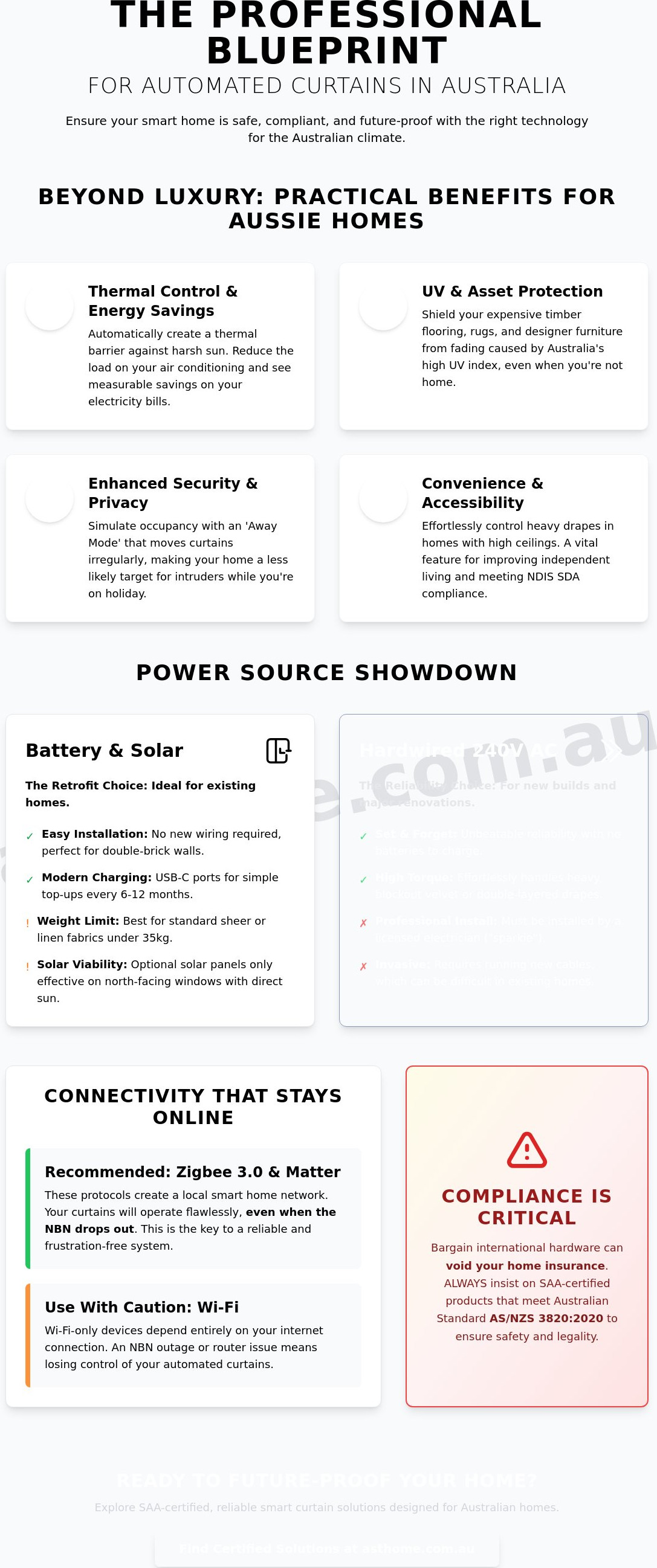
The primary driver for many Aussie homeowners is the harsh UV index. Unprotected timber flooring and designer furniture can fade significantly within a single summer season. By installing a smart curtain motor and track, you can ensure your home protects itself even when you're not there to pull the cord. It's about shifting from manual chores to logic-based living where your home reacts to the environment in real time. This technology provides peace of mind, knowing your expensive interior assets are shielded from the sun's most damaging rays without you lifting a finger.
Thermal Control and Energy Savings
Australian homes face extreme temperature fluctuations. During a January heatwave, the glass in your windows acts as a massive radiator. Automated curtains respond to the sun to lower your cooling costs by creating a thermal barrier before the room overheats. By integrating your tracks with motion sensors or temperature sensors, the system can automatically close drapes during peak UV hours. Curtain automation is a key tool for passive thermal management. This proactive approach reduces the load on your air conditioning, leading to measurable savings on your quarterly electricity bill while keeping your living spaces comfortable year-round.
Security and Privacy Perks
A home that looks occupied is a less likely target for intruders. You can schedule an "Away Mode" that moves your curtains at irregular intervals throughout the day, simulating natural occupancy while you're on holiday. It's a simple way to add a layer of security without complex alarm systems. For daily life, the "Sunrise" routine is a popular choice; it allows you to wake up to natural light as your curtains slowly open at a set time, replacing the jarring sound of a traditional alarm with a gentler, biological start to your day.
In regions like Victoria, many heritage homes feature soaring ceilings and heavy, ornate drapes. Manually operating these can be a physical strain or simply impossible without a ladder. Motorised tracks are essential for these high-ceiling properties, providing effortless control over heavy fabrics that would otherwise remain permanently closed. Learning how to automate curtains australia ensures these architectural features become functional assets rather than maintenance headaches, combining old-world charm with 2026 technical standards.
Powering Your Tracks: Battery-Powered vs. Hardwired AC Motors
Deciding on a power source is the most critical technical step when planning how to automate curtains australia. You have two main paths: DC battery motors or AC hardwired systems. Your choice depends on whether you're working with an existing room or a blank-canvas renovation. Both options have distinct advantages, but matching the motor's torque to your fabric weight is essential for long-term performance.
The Retrofit Choice: Battery and Solar
Battery-powered motors are the go-to for established Aussie homes where running new cables through double-brick walls is impractical. Modern lithium-ion batteries typically last six to twelve months on a single charge, based on two cycles per day. Most units now feature USB-C charging ports, making them as simple to maintain as a smartphone. You can also add solar-assisted charging panels to extend this interval. However, solar is only viable for north-facing windows with direct sun. South-facing windows or those shaded by deep eaves won't generate enough current to keep the motor topped up.
Weight limits are the primary constraint for battery units. While they handle standard linen or sheer fabrics with ease, they can struggle with heavy blockout velvet or double-layered drapes. If your fabric choice exceeds 35kg, a battery motor might experience premature wear or slower travel speeds. For these heavier applications, you should consider a high-torque smart curtain motor and track designed for Australian conditions.
The Professional Choice: 240V Hardwired
Hardwired motors are the gold standard for new builds and major renovations. These 240V systems provide consistent power and higher torque ratings, ensuring even the heaviest floor-to-ceiling drapes move smoothly. The biggest advantage is the total elimination of "battery anxiety." There are no packs to charge and no performance drops as voltage dips. From an aesthetic standpoint, hidden wiring creates a seamless look that complements modern Australian architecture.
Installation requires a licensed electrician, often called a "sparkie," to ensure the work meets local regulations. Adhering to Queensland's electrical safety laws and similar state-based requirements is mandatory for insurance compliance. For the best results, many professionals now specify SAA-certified smart modules to manage these tracks. This allows you to integrate your motorised curtains into a wider ecosystem while maintaining strict safety standards. If you're building from scratch, pre-wiring your window headers is a low-cost way to future-proof your home's value and comfort.
Choosing Your Protocol: Matter, Zigbee, or Wi-Fi?
The protocol you select is the invisible language your curtains speak. If you choose the wrong one, you'll face laggy response times and frequent dropouts. Most homeowners start with Wi-Fi because it seems simple. However, entry-level Wi-Fi motors can quickly clog your NBN router. Every smart device you add competes for a limited number of "slots" on a standard home gateway. When your network is busy with streaming or gaming, your curtains might fail to respond to schedules. This is a common frustration when researching how to automate curtains australia for a full-house installation.
Professional installers prefer dedicated protocols like Matter or Zigbee 3.0. These move the heavy lifting away from your main Wi-Fi network. They offer local control, meaning your curtains still open and close even if your internet connection drops out. This reliability is vital for security and climate control. You don't want your home's thermal management to fail just because of a temporary NBN outage or a distant cloud server error.
Future-Proofing with Matter
Matter is the 2026 industry standard for unified smart homes. It allows devices from different brands to work together without proprietary hubs. If you use an iPhone but your partner uses an Android, Matter ensures you both have seamless control. For those following the NDIS guide to assistive technology, Matter provides the high level of interoperability required for complex care environments. Specifying a smart curtain motor with Matter support means your hardware won't be obsolete in two years. It's the smartest way to ensure your investment stays current as smart home ecosystems evolve.
Reliability with Zigbee 3.0
Zigbee 3.0 remains the gold standard for large, multi-room Australian homes. It uses mesh networking technology. Each mains-powered device acts as a signal repeater, strengthening the network as you add more modules. A Zigbee 3.0 smart switch module communicates with a central gateway rather than your router. This keeps your Wi-Fi bandwidth free for high-speed tasks like work and entertainment. Zigbee devices also feature incredibly low power consumption and near-instant response times. When you trigger a "Good Night" scene, all your curtains will close simultaneously and reliably, every single time. It's a robust, trade-grade solution that eliminates the guesswork from home automation.
Installation and Compliance: SAA Certification and the "Sparkie" Factor
Setting up your motorised tracks requires a methodical approach to ensure both mechanical smooth-running and legal compliance. When planning how to automate curtains australia, you must distinguish between the DIY-friendly mounting of the track and the restricted electrical work required for power. Following these five steps will ensure a professional result:
- Step 1: Measure your window frame precisely. Decide if a wall mount or ceiling mount suits your room height; ceiling mounts are often preferred for a seamless look in modern Australian homes.
- Step 2: Source SAA-certified hardware from a reputable local supplier.
- Step 3: Engage a licensed electrician for all 240V hardwired connections to ensure the installation meets the Wiring Rules.
- Step 4: Install the motor unit and tension the belt system to prevent slipping or excessive noise.
- Step 5: Pair the smart module with your Zigbee or Matter hub and calibrate the open/close limit positions.
Proper calibration is vital for the longevity of your system. It prevents the motor from over-travelling and putting unnecessary strain on your fabric or the track's internal pulleys. A well-tensioned system should operate almost silently, providing that premium feel you expect from high-end automation.
Understanding Australian Electrical Standards
Compliance with AS/NZS 3000, commonly known as the "Wiring Rules," is non-negotiable for hardwired curtain motors. Using non-SAA certified imports might save a few dollars upfront, but it creates a massive risk for your home insurance. If an uncertified motor causes an electrical fault, your insurer can legally void your claim. Always look for the Regulatory Compliance Mark (RCM) on your smart hardware. This tick-and-triangle symbol is your proof that the device has passed rigorous testing under AS/NZS 3820:2020 for Australian conditions.
For peace of much-needed peace of mind and total compliance, you can shop our range of SAA-certified smart curtain motors and tracks that meet all local safety requirements.
Working with Your Electrician
Your sparkie needs to be involved early in the process, especially if you're pre-wiring a new build. Brief them on the specific placement of the smart module, which usually sits behind the curtain head to remain invisible. Once the job is done, ensure you receive an Electrical Safety Certificate for your records. This document proves that the work was performed by a licensed professional and complies with state regulations. Professional installation is the only legal path for 240V automation in any Australian jurisdiction.
Advanced Automation: Sensors, Scenes, and NDIS Accessibility
Basic scheduling is just the starting point for a modern smart home. To truly master how to automate curtains australia, you need to shift from simple timers to sensor-driven logic. This approach allows your window coverings to think for themselves. Instead of closing at a fixed time every day, your curtains can react to real-time environmental changes. It represents the difference between a simple motorised track and a fully integrated living space that anticipates your needs.
Creating "Scenes" is where the technology becomes most tangible. With a single "Movie Night" command, you can trigger a sequence where your smart light switches dim to 10%, the media centre powers up, and your drapes glide shut. Voice control through Google Home, Apple HomeKit, or other leading voice platforms provides a hands-free experience that is both convenient and essential for users with limited mobility. It's about removing the friction from daily routines and making your home's infrastructure work harder for you.
Smart Sensors and Logic
Integrating motion sensors and light sensors takes your automation to the next level. You can program your curtains to close automatically when afternoon glare hits the TV or when the room's temperature exceeds a specific threshold. This synergy with your smart thermostat ensures climate harmony throughout the house. For guests or children who aren't familiar with the app, the "Touch-and-Go" feature is a vital manual override. A gentle tug on the fabric triggers the motor to take over, ensuring the system remains user-friendly for everyone in the household.
NDIS SDA and Assistive Technology
Automated curtains are a core component of NDIS SDA smart home kits. For participants with limited physical mobility, the ability to control light and privacy without assistance is a significant step toward independent living. It transforms a difficult physical task into a simple voice command or a tap on a tablet. This autonomy is a key goal of the Specialist Disability Accommodation (SDA) framework.
Reliability is the most critical factor in assistive technology. This is why practitioners prefer Zigbee or Matter protocols over standard Wi-Fi. In an NDIS context, a device dropout isn't just an inconvenience; it's a barrier to accessibility. By using a dedicated mesh network, you ensure that motorised tracks remain responsive 24/7. When researching how to automate curtains australia for NDIS requirements, always prioritise SAA-certified hardware and robust local protocols to ensure the system meets the high standards required for long-term care and safety.
Take Control of Your Home's Climate and Privacy
Mastering how to automate curtains australia is about choosing the right infrastructure for your specific property. Whether you're retrofitting a Victorian terrace with lithium-ion battery motors or pre-wiring a modern build with 240V AC tracks, the focus must remain on compliance and connectivity. By prioritising SAA-certified hardware and future-proof protocols like Matter and Zigbee 3.0, you protect your home insurance and ensure your smart home remains functional for years to come. These systems do more than just move fabric; they create a more accessible, thermally efficient environment that responds to your lifestyle.
You don't have to handle these technical standards alone. Our Melbourne-based team provides expert support and fast nationwide shipping to get your project moving quickly. We also offer dedicated trade accounts for licensed sparkies who need reliable, compliant hardware for their clients. Every product in our range is tested to meet strict Australian safety standards, giving you total peace of mind. Your journey toward a fully automated home starts with the right professional foundation.
Shop SAA-Certified Smart Curtain Motors and Modules at Asthome and start building a more responsive, energy-efficient home today.
Frequently Asked Questions
Is it legal to install my own motorised curtains in Australia?
You can legally install battery-powered or low-voltage motorised curtains yourself as a DIY project. However, any hardwired 240V AC motor installation must be performed by a licensed electrician to comply with Australian wiring rules. Self-installing mains-powered equipment is illegal and will likely void your home insurance if a fault occurs. Always ensure your hardware carries the Regulatory Compliance Mark before starting.
Do I need a special hub for Matter-enabled curtain motors?
You need a Matter Controller to manage Matter-enabled curtain motors. This hub can be an existing device like an Apple HomePod, Google Nest Hub, or Amazon Echo, provided it supports the Matter protocol. Unlike older proprietary systems, Matter allows you to mix and match brands without needing a specific manufacturer's bridge. This simplifies the process of how to automate curtains australia across different smart ecosystems.
What happens to my automated curtains if the NBN goes down?
Your curtains will continue to operate via local schedules and physical remotes if you use Zigbee 3.0 or Matter protocols. These systems don't rely on a cloud connection for basic logic. While you might lose the ability to control them via a smartphone app from outside the home during an NBN outage, your internal automation scenes and voice commands typically remain functional within the local network.
Can I motorise my existing curtain tracks or do I need a new system?
Most high-performance automation requires a dedicated motorised track system designed to house the motor and internal drive belt. While some retrofit robots can pull along a standard rod, they often lack the torque and reliability of a purpose-built track. For a professional result that handles heavy Australian blockout fabrics, replacing your existing hardware with a motorised track is the recommended path for long-term durability.
How long does the battery last on a cordless curtain motor?
A high-capacity lithium-ion battery motor typically lasts between six and twelve months on a single charge. This estimate is based on average usage of two full cycles per day. Battery life can vary depending on the weight of your drapes and the length of the track. Most modern units feature USB-C ports for easy recharging or can be paired with solar panels for continuous operation in sunny windows.
Are motorised curtains noisy when they operate?
Modern motorised tracks are designed for ultra-quiet operation, usually producing noise levels below 40 decibels. This is roughly equivalent to a soft whisper. The sound is a gentle mechanical hum rather than a loud grinding noise. High-quality systems use dampened motor mounts and precision-engineered belts to ensure your morning routines don't wake you up before the curtains are fully open.
Will automated curtains work with heavy blockout fabrics?
Automated curtains are perfectly capable of moving heavy blockout fabrics if you select a motor with sufficient torque. Hardwired 240V AC motors are particularly effective for floor-to-ceiling drapes or double-layered systems. When planning how to automate curtains australia, ensure your motor is rated for the total weight of your fabric. Most professional-grade tracks can comfortably handle loads up to 50kg without straining the internal components.
Can I still move my curtains manually if the power is out?
Most premium motorised tracks include a manual override or "Touch-and-Go" feature that allows you to move the drapes by hand during a power failure. The internal clutch system disengages the motor, preventing damage to the gears when the fabric is pulled manually. This ensures you are never locked out of your privacy or light control, even if the local electrical grid experiences a temporary blackout.