

What if your high-tech home became a collection of expensive paperweights the moment your NBN connection dropped or a manufacturer decided to shut down its servers? For many Australians, the debate of local control vs cloud based smart home isn't just about technical specs; it's about making sure the lights actually turn on when you hit the switch. We know there's nothing more frustrating than standing in a dark hallway waiting for a cloud server halfway across the world to authorise a simple command. It's time to move past the lag and the uncertainty of external dependencies.
With the Cyber Security (Security Standards for Smart Devices) Rules 2025 in effect as of March 2026, the shift toward local-first systems has moved from a niche hobby to a professional trade standard. This guide will show you how to build a private, lightning-fast ecosystem using Zigbee 3.0 and Matter 1.5 protocols that function 100% of the time without an internet connection. We'll explore how to achieve instant response times for your switch modules and full remote access without sacrificing your data privacy or relying on third-party servers.
Key Takeaways
- Understand the fundamental architecture differences between local control vs cloud based smart home systems and why local processing is the professional standard for 2026.
- Discover how to configure Matter 1.5 and Zigbee 3.0 hardware to ensure your curtain motors and light switches remain operational even when the NBN goes down.
- Protect your household data and meet the latest Australian cybersecurity regulations by keeping device communication off the public internet.
- Identify the hidden costs and privacy risks associated with offshore cloud servers and how to bypass them for a faster, more responsive home.
- Ensure your installation remains SAA-compliant and insurance-friendly by selecting hardware that meets rigorous Australian safety standards.
Understanding Local Control vs Cloud-Based Smart Home Systems
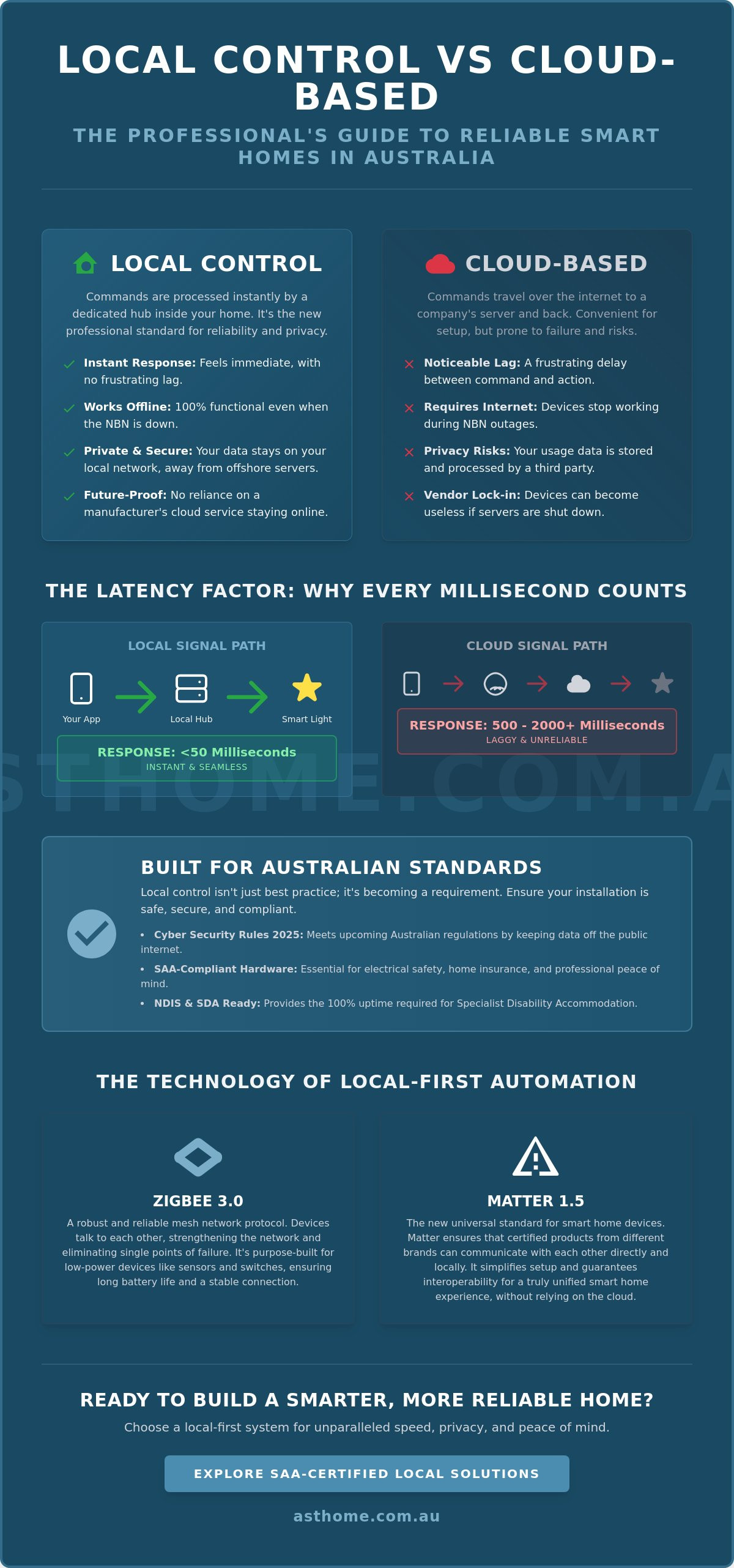
In the world of home automation, the "brain" of your system determines how reliably your house responds to your commands. When we talk about local control vs cloud based smart home setups, we're describing where the actual decision-making happens. Local control means every instruction, from dimming a light to closing a curtain, is processed on a hub or gateway located physically inside your home. It doesn't need to ask for permission from a server in another country to turn on your bedside lamp.
Cloud-based systems take a different path. Every time you tap your smartphone screen, that command travels through your NBN connection, across undersea cables to an offshore data centre, and then all the way back to your device. In 2026, with the typical Australian home now averaging over 23 connected devices, this distinction has become the primary factor in system stability. If your internet drops out or the manufacturer's server goes offline, a cloud-dependent house effectively breaks. A local-first system keeps running regardless of your NBN status.
How the "Brain" of Your Smart Home Functions
A dedicated Zigbee Gateway Hub or Matter-compatible controller acts as the local translator for your hardware. These gateways allow devices like a Smart Zigbee Dimmer Module to communicate directly with your sensors without ever touching the public internet. While many basic Wi-Fi devices are popular because they're cheap and easy to set up, they almost always default to cloud communication. This creates a "silo" effect where your devices can't talk to each other if the web is down. Premium Australian installs now prioritise "Local-First" architecture. By using a Matter Smart Switch Module or Zigbee 3.0 hardware, you ensure the logic stays within your four walls, providing a level of reliability that Wi-Fi-only systems can't match.
The Latency Factor: Why Every Millisecond Counts
The "round-trip" delay inherent in cloud processing is the leading cause of smart home frustration. Even with high-speed fibre, sending a signal to a server and waiting for a response creates a noticeable lag. Local control feels instant because the communication distance is measured in metres, not thousands of kilometres. This speed is vital for automated routines. If you have a Smart Motion Sensor set to trigger a Smart Wi-Fi Light Switch in a dark pantry, a two-second cloud delay is unacceptable. With local processing, the light is on before you've even fully stepped into the room. This immediate response transforms the user experience from a clunky tech experiment into a seamless, professional utility.
The Benefits of Local Control: Speed, Privacy, and "Offline" Reliability
Choosing between local control vs cloud based smart home systems is ultimately a decision about who owns your home's functionality. Local control offers total internet independence. If your NBN connection drops, your Matter Smart Switch Module continues to respond to your commands without a hiccup. This isn't just about convenience; it's about security. Your data stays on your local network, protected by the Cyber Security (Security Standards for Smart Devices) Rules 2025, rather than being harvested on an offshore server.
Security also improves at the network level. By keeping device communication local, you reduce the number of open ports on your router, effectively shrinking your digital attack surface. This architecture ensures your devices won't become "bricks" if a manufacturer goes bust or stops supporting their cloud service. For those building for the long term, we define local reliability as the baseline for NDIS-compliant smart homes.
NBN Reliability and Your Smart Home
In regional Victoria, NBN outages are a common frustration, often caused by weather events or infrastructure maintenance. Even in high-density Melbourne suburbs like Point Cook, peak-hour congestion can cause cloud-based devices to lag or fail entirely. A Zigbee Gateway Hub solves this by maintaining all schedules and automations locally. Your porch lights will turn on at sunset and your Smart Power Point (GPO) will shut off as programmed, even if the rest of the street is offline.
NDIS SDA Requirements: Why Local Control is Vital
For participants in Specialist Disability Accommodation (SDA), 100% uptime is a non-negotiable requirement for safety and independence. Relying on a cloud-based server to open a Smart Curtain Motor and Track is a significant risk. If the internet fails, a participant could lose their ability to control their environment. This is why local-first protocols are essential for compliance. You can learn more about these requirements in our NDIS SDA smart home technology Australia resource guide.
When you Build With Matter or Zigbee 3.0, you are investing in a system designed for professional-grade reliability. This trade-focused approach ensures that accessibility features remain active regardless of external connectivity. If you're ready to secure your home's future, explore our range of SAA-certified smart hardware to get started.
The Cloud-Based Model: Convenience, Remote Access, and Hidden Risks
The primary appeal of cloud-based systems is their "plug-and-play" simplicity. For many homeowners, the ability to buy a Smart Wi-Fi Light Switch, connect it to a home router, and have it working in minutes is a strong draw. This model handles remote access automatically; you don't need to be a networking expert to check your status from the office. However, when evaluating local control vs cloud based smart home architectures, this convenience often masks significant long-term risks. You aren't just buying a device; you're entering a dependency on a manufacturer's ongoing server maintenance and business stability.
Hidden costs are a major factor in the cloud ecosystem. Features that should be standard, such as detailed energy history for your Smart Power Point (GPO) or advanced automation triggers, are frequently locked behind monthly subscription paywalls. Beyond the cost, there's the "brick" risk. We've seen numerous instances where companies have shut down their servers or discontinued legacy support, rendering perfectly functional hardware useless. In a professional trade context, installing gear that relies on a third party's financial health is a gamble most practitioners won't take.
Remote Access: Is the Cloud Necessary?
A common misconception is that you need the cloud for remote control. Modern local hubs and gateways now provide secure remote access via encrypted tunnels. This allows you to toggle your Smart Door Lock from anywhere in the world without your data ever sitting on an unauthorised server. For example, Apple HomeKit uses a local-first approach where a local hub (like an Apple TV or HomePod) acts as a secure bridge. You get the same "tap-to-action" experience as a cloud app but with the privacy and speed of a local network. You don't have to sacrifice your personal data just to turn off the iron from your smartphone.
The Problem with "Hubless" Wi-Fi Devices
Marketing for "hubless" devices is often misleading. In reality, "hubless" simply means the hub is a server located in another country. Every time you add a hubless Wi-Fi device, you add another client to your home router. A standard ISP-provided router will often struggle and eventually crash once you exceed 30 to 50 active Wi-Fi clients. This network congestion leads to dropped connections and sluggish performance. By offloading this traffic to a dedicated Zigbee Gateway Hub, you create a separate mesh network. This keeps your Wi-Fi clear for streaming and work while ensuring your Smart Motion Sensor and lighting modules communicate on a reliable, interference-free channel.
Matter and Zigbee 3.0: The Future of Local-First Automation
By mid-2026, the smart home industry has consolidated around two primary protocols that effectively end the debate of local control vs cloud based smart home systems. Matter and Zigbee 3.0 have emerged as the winners for Australian homeowners who value speed and reliability. These protocols don't just offer a faster way to turn on a light; they provide a unified language that allows hardware from different manufacturers to communicate directly within your four walls. This interoperability ensures that your Smart Motion Sensor can trigger a Smart Power Point (GPO) without ever needing to ping an external server.
The release of Matter 1.5 in late 2025 solidified this local-first approach. Matter is designed to run locally over your existing Wi-Fi or a newer, low-power mesh network called Thread. In a 2026 ecosystem, the Thread Border Router plays a critical role. It acts as the local gateway, bridging your Thread-enabled devices to your home network. Because Matter mandates local control by design, you no longer have to worry about a manufacturer "locking" features behind a cloud subscription. The intelligence stays on your hardware, where it belongs.
Matter Smart Switch Modules: The Best of Both Worlds
For many Australian homeowners, a Matter Smart Switch Module is now considered the "gold standard" for future-proofing. It combines the extreme speed of local processing with the user-friendly interfaces of Google Home, Amazon Alexa, or Apple Home. You get the convenience of voice control and sleek apps without the privacy risks associated with traditional cloud-only Wi-Fi gear. If you're planning a new build or a major renovation, check out our Matter smart switch Australia resource for a deep dive into the latest hardware standards.
Zigbee 3.0: Why Sparkies Still Love It
While Matter is the newcomer, Zigbee 3.0 remains the workhorse for professional trade retrofits. Local sparkies prefer Zigbee for its proven reliability in large, multi-storey Australian homes. Unlike Wi-Fi, which can struggle to penetrate double-brick walls or reach the far corners of a block, Zigbee creates a robust mesh. Every mains-powered device, like a Smart Zigbee Dimmer Module, acts as a repeater to extend the signal. This makes it the superior choice for low-power sensors and battery-operated Smart Door Locks that need to last for years on a single charge. If you're looking to upgrade an existing home, our Zigbee 3.0 smart switch module Australia guide explains how to integrate these modules behind your current wall plates.
Ready to build a system that won't let you down? Explore our range of SAA-certified local control modules and take the first step toward a faster, more private smart home today.
Implementing Local Control: A Trade-Professional Approach
Moving from a cloud-dependent setup to a local-first architecture requires a shift in how you source and install hardware. When weighing up local control vs cloud based smart home systems, the most critical factor for any Australian installation is SAA certification. We've seen a surge in cheap, uncertified Wi-Fi gear entering the market, but using non-compliant hardware is a massive risk. If a faulty, uncertified module causes a fire, your insurance provider will likely knock back the claim. Professional practitioners always prioritise SAA-certified modules to ensure both safety and regulatory compliance.
Your choice of ecosystem will dictate the user experience. For those who want a "set and forget" system, Apple Home offers a robust local-first platform. If you're a power user or a contractor looking for total customisation, Home Assistant or Hubitat provide deeper control over every automation. The trade advantage of a local-first approach lies in modularity. By installing a Matter Smart Switch Module or a Smart Zigbee Dimmer Module behind existing wall plates, you maintain the home's aesthetic while providing a high-tech foundation that doesn't rely on external servers.
The Electrician’s Checklist for Local-First Installs
A professional install starts with a solid foundation of lighting and power. Before you begin your reno, ensure you've ticked off these essentials:
- Verify Compliance: Always check for the RCM (Regulatory Compliance Mark) and SAA certification on all smart light switches to meet Australian safety standards.
- Standardise Outlets: Ensure your power point (GPO) standards are met, especially when installing smart outlets that handle heavy appliance loads.
- Centralise the Logic: Set up a dedicated Zigbee Gateway Hub to offload smart traffic from the client's main Wi-Fi router, preventing network congestion.
- Future-Proof: Opt for Matter-compatible hardware where possible to ensure interoperability with the latest 2026 software updates.
Why Asthome is the Choice for AU Pros and Locals
We're practitioners who understand the specific needs of the Australian trade industry. Whether you're a homeowner in Point Cook looking for a reliable DIY upgrade or a licensed contractor managing a multi-storey build, we provide the hardware and expertise to get the job done right. We offer direct e-commerce sales with fast nationwide shipping, ensuring your project stays on schedule. For our fellow sparkies and integrators, we provide trade accounts with wholesale pricing to support your business growth. Our Australian-based support team is always ready to help with Matter and Zigbee 3.0 troubleshooting, so you're never left in the dark. Enquire about a Trade Account or browse our SAA-certified range today.
Secure Your Home with Local-First Reliability
Building a smart home that remains functional during an NBN outage requires a deliberate move away from offshore dependencies. The choice between local control vs cloud based smart home architectures ultimately defines your system's longevity and response time. By keeping your data within your four walls, you ensure your lighting and security remain private, fast, and fully operational regardless of your internet connection status.
This focus on independence is equally important for those who enjoy remote exploration. Just as you secure your home's functionality, an adventure travel agent Scarborough QLD can help you plan off-grid journeys where staying connected to the cloud is impossible, ensuring your next adventure is as reliable as your smart home.
We've explored how protocols like Matter 1.5 and Zigbee 3.0 are leading the way for professional trade installs in 2026. These standards provide the interoperability needed to create a seamless environment without the hidden costs of cloud subscriptions or the risk of hardware becoming obsolete. As a local Point Cook business with nationwide shipping, we specialise in SAA-certified hardware that meets rigorous Australian safety standards, giving you peace of mind that your installation is both secure and compliant.
Upgrade to Local-First Smart Home Gear at Asthome and experience the difference of a system built by practitioners for practitioners. Your home should work for you, not for a server halfway across the world. Get started on your local-first journey today.
Frequently Asked Questions
Does local control mean I can’t use my phone when I’m away from home?
No, you can still control your home remotely with a local-first system. You simply use a local hub, such as a Zigbee Gateway Hub, which acts as a secure bridge to the outside world. It creates an encrypted tunnel between your smartphone and your home network. This allows you to check your Smart Door Lock from the office without your private data ever sitting on a public offshore server.
Is a local smart home system more expensive to set up than a cloud-based one?
While the initial hardware cost might be slightly higher because you need a dedicated hub, it is usually cheaper over the life of the system. Cloud-based devices often hide advanced features behind monthly subscription fees. By choosing hardware like a Zigbee 3.0 Smart Switch Module, you pay for professional-grade quality once and own the functionality forever without ongoing costs or "renting" your own home's intelligence.
What happens to my smart home if my internet service provider has an outage?
Your smart home continues to function perfectly during an internet outage if you have a local-first setup. Because the processing happens on your internal network rather than a remote server, your automations and schedules remain active. Your Smart Motion Sensor will still trigger your lights even if the NBN is completely down. This reliability is the main advantage in the local control vs cloud based smart home debate.
Can I mix cloud-based devices with local control devices in the same home?
Yes, you can certainly mix both types of devices, though they may not always communicate with each other during an outage. You might use a cloud-based camera alongside a local Matter Smart Switch Module. While they can coexist on your network, the cloud-reliant gear will stop working if your internet fails. For critical systems like lighting and entry, we recommend migrating to local-first hardware for consistent performance.
If you are looking for high-quality surveillance that supports local recording and access, cctvshop.com.au provides a range of options that avoid the pitfalls of cloud-only security cameras.
Why is Matter considered better for local control than standard Wi-Fi?
Matter is superior because it mandates local communication by design. Most standard Wi-Fi devices are built to default to a manufacturer's server for every command. Matter 1.5 hardware uses your local network to talk directly between devices, resulting in near-instant response times for your Smart Zigbee Dimmer Module. It also ensures your system stays compliant with the latest Australian cybersecurity standards for smart devices.
Do I need a special hub for local control, or can I just use my router?
You generally need a dedicated gateway or hub to manage local-first protocols like Zigbee or Thread. While your home router handles standard Wi-Fi traffic, it isn't designed to manage a low-power mesh network. A Zigbee Gateway Hub offloads this specific smart home traffic from your main router. This prevents your Wi-Fi from becoming congested or crashing when you add dozens of sensors and power points to your system.
Is local control safer against hackers than cloud-based smart homes?
Yes, local control is significantly more secure because it keeps your device communication within your private network. Cloud systems require your devices to maintain constant connections to external servers, which creates more potential entry points for hackers. A local system keeps the "brain" of your house behind your firewall. This architecture is the most effective way to protect your Smart Door Lock and personal data from external breaches.
Can I use local control with voice assistants like Alexa or Google Home?
Yes, modern local systems integrate seamlessly with all major voice assistants. Protocols like Matter allow your local devices to appear in the Google Home, Alexa, or Apple Home apps for easy voice control. While the voice command itself may be processed in the cloud, the actual execution happens locally on your network. This gives you the perfect balance of local control vs cloud based smart home convenience and reliability.