

Why does your "smart" lighting feel so dim-witted the moment you try to drop the brightness below 20%? It's a common frustration for homeowners and trade professionals across the country. You invest in high-quality LEDs only to be met with strobe-like flicker or "ghosting" because the driver and dimmer aren't speaking the same language. Finding a high-performance smart dimmer for led downlights australia has become even more technical with the introduction of the Cyber Security Rules 2025 and new GEMS energy standards in March 2026.
We understand that you need reliability, not a science experiment in your ceiling. We promise to help you master the technical nuances of dimming so you can achieve flawless 1% to 100% control and full voice integration without risking your electrical compliance. This explainer guide breaks down the shift from congested Wi-Fi to Matter 1.5 and Zigbee 3.0 protocols. We'll also cover why SAA certification is your primary safety anchor and how to select modules that won't void your insurance or fail the latest Australian regulatory audits.
Key Takeaways
- Stop flicker and "ghosting" by understanding the LED dimming curve and the minimum load requirements of your specific drivers.
- Prioritise Matter 1.5 and Zigbee 3.0 protocols to avoid the connectivity dropouts common with high-density Wi-Fi setups in Australian homes.
- Learn why a smart dimmer for led downlights australia in module form is the best way to keep your existing designer fittings and physical wall switches functional.
- Verify your hardware’s SAA certification and check for a neutral wire to ensure a seamless, compliant installation by your licensed electrician.
- Discover how practitioner-led support helps you navigate the strict 2026 Australian cybersecurity and energy efficiency mandates.
Solving the Flicker: Why Smart Dimming for LED Downlights in Australia is Tricky
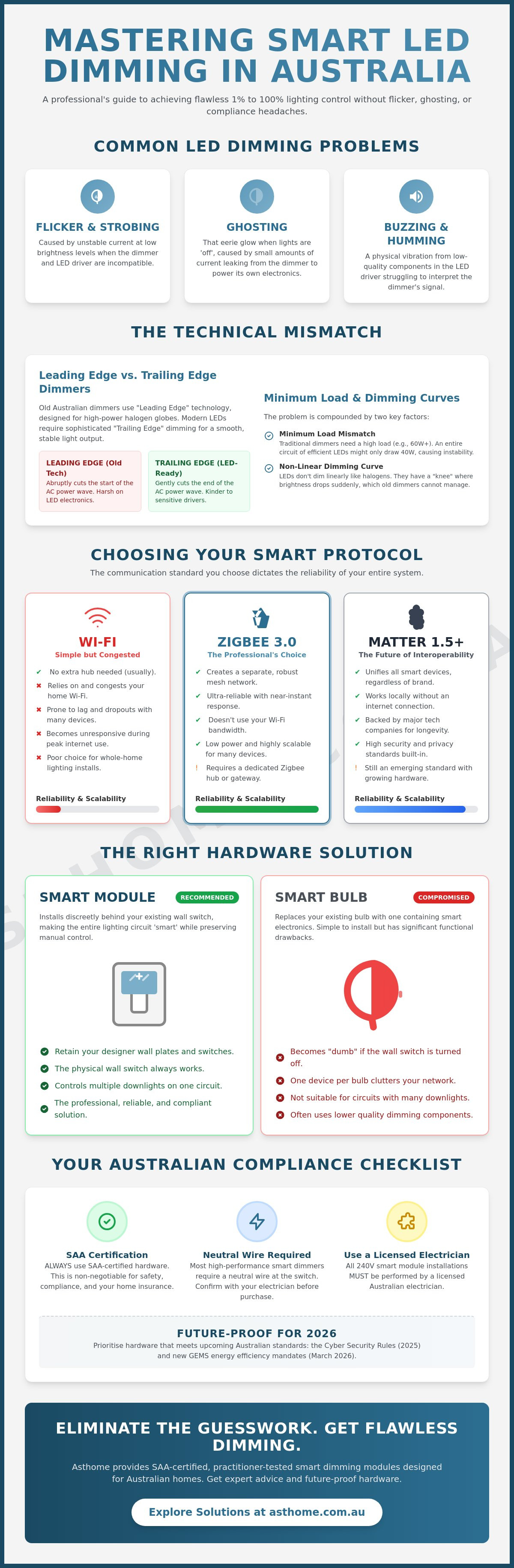
Most Australian homeowners expect a simple "plug and play" experience when upgrading to smart lighting. However, our 240V mains power environment presents unique challenges. Unlike old-school halogen globes that relied on simple resistance to dim, modern LED lamp technology uses complex internal circuitry. This difference creates a non-linear "dimming curve." While a halogen globe dims predictably from 100% to zero, an LED might stay bright until it hits a "knee" in the curve, where it suddenly drops out or starts strobing. This is why finding a high-quality smart dimmer for led downlights australia is essential for a professional finish.
Compatibility issues usually manifest in three ways: strobing, buzzing, or ghosting. Strobing occurs when the dimmer cannot provide a stable current at low levels. Buzzing is often a physical vibration within a low-quality driver struggling with the dimmer's signal. Ghosting is perhaps the most annoying; it's that faint, eerie glow your downlights emit even when the switch is technically "off." This happens because some smart dimmers leak a tiny amount of current to power their own internal radios, which is just enough to illuminate sensitive LED chips.
Minimum load requirements are the final hurdle. Traditional wall dimmers were designed for circuits drawing 60W to 400W. A modern kitchen might have six LED downlights drawing only 42W total. If the total wattage falls below the dimmer’s minimum threshold, the circuit becomes unstable. Smart modules solve this by using advanced digital processing to manage low-wattage loads without the flicker.
The Science of LED Dimming
There are two primary ways to dim an LED: Pulse Width Modulation (PWM) and Analogue dimming. PWM flickers the light on and off thousands of times per second, while Analogue reduces the actual current. Cheap, generic LED drivers are the #1 enemy here. They often use basic components that can't interpret the rapid signals from a smart dimmer. High-quality smart modules stabilise the incoming current, ensuring that the signal sent to the light is clean and consistent, even at a 1% brightness setting.
Why Traditional Dimmers Fail with Smart LEDs
The conflict often boils down to "leading edge" versus "trailing edge" technology. Most old Australian dimmers are leading edge, designed for inductive loads like motors or halogens. LEDs almost always require trailing edge dimming, which is gentler on the electronic components. You cannot "smartify" an old knob-style dimmer by simply screwing in a smart bulb. For a reliable, professional-grade result, you must use a dedicated smart module paired with high-quality dimmable LED drivers. This combination ensures the hardware is perfectly matched for the 240V smart dimmer for led downlights australia market, giving you smooth control without the hardware hum.
Choosing Your Protocol: Zigbee, Matter, or Wi-Fi for Aussie Dimmers?
Selecting a smart dimmer for led downlights australia requires looking beyond the physical switch. You're choosing a communication protocol that dictates how every light in your home behaves. In 2026, the Australian market has consolidated around three main standards: Wi-Fi, Zigbee 3.0, and Matter. While Wi-Fi is accessible, it's a poor choice for large-scale installs. A typical four-bedroom home might have 30 or more downlights. If each one is a Wi-Fi device, your router will struggle with the high density of connections. This leads to lag, dropped connections, and a frustrating user experience where lights become unresponsive during peak internet usage.
For a seamless renovation in areas like Point Cook, you need hardware that doesn't compete with your Netflix stream. Wi-Fi is often considered a "noisy" protocol for high-density automation. It's fine for a single smart plug, but for a whole-house lighting solution, it lacks the stability required by professional installers. Using a dedicated frequency ensures your lighting remains functional even if your internet service provider has an outage. Local control is the priority for anyone wanting a reliable smart home that doesn't rely on a distant cloud server to turn on a light.
Zigbee 3.0: The Reliable Workhorse
For practitioners and serious enthusiasts, Zigbee remains the gold standard. It operates on a separate mesh network, meaning it doesn't use your Wi-Fi bandwidth. Each smart zigbee dimmer module acts as a repeater. This strengthens the signal as you add more devices throughout the home. This architecture eliminates the "popcorn effect" where lights turn on one by one with a visible, staggered delay. It's fast, local, and offers deep compatibility with Home Assistant, Hubitat, and Amazon Echo.
Matter: The New Universal Language
Matter is the future-proof standard for the Australian market. It's a unifying protocol backed by the biggest names in tech, including Apple, Google, and Amazon. Choosing Matter-certified modules today prevents your hardware from becoming "e-waste" if you decide to switch ecosystems later. Standards set by the National Construction Code (NCC) focus heavily on energy management. Matter's precise data reporting helps homeowners meet these efficiency targets through better automation logic.
Matter often runs over Thread, a low-power mesh network that provides the reliability of Zigbee with better cross-brand integration. This ensures that your lighting, climate control, and security systems work together without needing five different hubs. If you want a system that just works across every device in the house, exploring a Matter Smart Switch Module is the best path forward for a modern Australian home.
Smart Modules vs. Smart Bulbs: The Best Path for Your Reno
Choosing between a smart module and a smart bulb is the most critical decision in any lighting upgrade. In a typical Australian family home, the "Wall Switch Problem" is the primary deal-breaker for smart bulbs. If a guest or a child flips the physical switch to "off," a smart bulb loses power and becomes completely unresponsive to app or voice commands. By contrast, a smart dimmer for led downlights australia installed as a module sits behind your existing wall plate. This setup ensures the circuit remains powered for smart control while allowing the physical switch to function as a manual override. It’s a more robust system that respects how people actually use their homes.
Aesthetics play a significant role in high-end renovations. Most smart bulbs are bulky and may not fit the specific cut-outs of architectural downlight fittings. Using a module allows you to keep your designer hardware and high-CRI (Colour Rendering Index) globes. This is particularly important for maintaining a consistent look across open-plan living areas. From a maintenance perspective, modules are superior. If an LED globe fails, you simply swap it for a standard dimmable replacement. If a smart bulb fails, you're forced to buy an expensive, proprietary replacement that might have been discontinued or updated with a different colour temperature.
Cost-efficiency is where modules truly shine in the Australian market. Outfitting a large lounge room with 10 to 12 smart bulbs is a significant investment. A single smart dimmer module can control that entire circuit for a fraction of the cost. This approach also reduces network clutter, as your hub only needs to manage one device instead of a dozen individual bulbs. This streamlined setup is much easier to manage over the long term.
Why Modules are the Electrician’s Choice
Sparkies prefer modules because they integrate seamlessly with standard Australian wall plates from brands like Clipsal or HPM. This keeps the interior design consistent throughout the house. Modules provide a permanent, hardwired solution that meets Australian essential safety requirements for fixed electrical equipment. They also offer better dimming performance, as they work directly with the dimmable drivers already installed in your ceiling, preventing the software lag sometimes seen with cheap smart bulbs.
When to Choose Smart Bulbs Instead
Smart bulbs have a place, particularly in rental properties where you can't modify the wiring. They’re a pure DIY solution that doesn't require a licensed electrician for installation. If you want full RGB colour-changing capabilities for a theatre room or a kid's bedroom, smart bulbs are the easiest way to achieve that effect. However, for the main living areas of a permanent home, the reliability and integrated look of a smart dimmer for led downlights australia will always be the professional's recommendation.
Installation Essentials: Wiring, SAA Standards, and Your Sparky
Installing a smart dimmer for led downlights australia isn't a DIY weekend project. In Australia, any work involving 240V mains wiring must be performed by a licensed electrician. This isn't just about safety; it’s a legal requirement to ensure your home remains compliant with local wiring rules. Before your sparky arrives, you need to identify your wiring configuration. The "Neutral Wire Dilemma" is the first hurdle you'll face. Most smart modules require a neutral wire to power their internal radios when the lights are switched off. If your home was built or rewired after 2010, you're likely to have a neutral wire at the switch. Older homes often only have an "active" and a "switch wire" behind the wall plate.
Brief your electrician thoroughly before they start the job. Ask them to check the depth of your wall boxes, as smart modules require extra space behind the physical switch mechanism. Once the hardware is installed, the job isn't finished. You must use the associated app to calibrate the dimming range. Setting a "minimum brightness" level, typically between 5% and 10%, ensures the LED driver always receives enough voltage to stay stable. This step is the secret to eliminating the low-end flicker that plagues many generic smart dimmer for led downlights australia installs.
The Neutral Wire vs. No-Neutral Debate
Modern Australian homes usually include a neutral wire at every switch point, making the installation of Matter or Zigbee modules simple. If you're dealing with older wiring, you'll need a specific "No-Neutral" module. These units draw a microscopic amount of current through the light circuit to stay powered. In some instances, your sparky might need to install a bypass capacitor at the first downlight in the chain. Using precision parts from specialists like Adage Components ensures these capacitors absorb leakage current effectively, preventing your LEDs from flickering or "ghosting" when they should be completely off.
Compliance and Safety in Australia
The Regulatory Compliance Mark (RCM) is the most critical spec on the box. It indicates the device has passed SAA safety testing and is approved for use on the Australian grid. Importing non-compliant hardware from overseas marketplaces is a dangerous gamble. These units often fail to meet our strict insulation and surge protection standards. If a non-certified device causes an electrical fire, your insurance provider can legally reject the claim. All smart light switches and dimmers must be installed by a pro to ensure your home stays covered. Browse our range of SAA-certified smart dimmer modules to ensure your project meets every local safety and cybersecurity standard.
The Professional Edge: Why Asthome’s Dimmers Lead the Market
Choosing the right hardware for a high-stakes project requires more than just reading a spec sheet. At Asthome Smart Electrical Supplies, we operate as practitioners for practitioners. This means our range is curated by professionals who've spent years on-site dealing with the exact compatibility issues discussed in this guide. When you select a smart dimmer for led downlights australia from our catalogue, you aren't just buying a component. You're investing in a solution backed by local technical expertise and a commitment to Australian regulatory adherence. We understand the 2026 cybersecurity mandates and GEMS energy standards because we live them every day.
Local support is the backbone of our service. If a sparky is on-site in Point Cook and hits a snag with a specific wiring configuration, they can speak to a team that knows the local grid and housing stock. Every product at Asthome Smart Electrical Supplies comes with a genuine Australian warranty and the peace of mind that it has passed rigorous SAA safety testing. We also specialise in NDIS SDA (Specialist Disability Accommodation) compliant smart home kits. These systems ensure that automated lighting is accessible, reliable, and meets the strict safety requirements for assisted living environments, providing a level of reliability that generic international brands can't match.
Engineered for Australian Conditions
Australian roof spaces are notorious for extreme thermal fluctuations. Our smart modules are engineered with high thermal tolerance to ensure long-term stability in these harsh environments. They feature compact form factors designed specifically to fit behind standard Australian wall plates and GPOs without requiring massive modifications to the wall box. Whether you're integrating them with our smart wi-fi light switches or a complex Zigbee 3.0 mesh network, our hardware is built to maintain a stable connection through thick brickwork and insulated ceilings.
Supporting the Local Trade
We actively support the professionals who build our communities. Developers and sparkies can access trade accounts at Asthome Smart Electrical Supplies that offer bulk pricing for large-scale residential projects. We provide comprehensive technical documentation, including clear wiring diagrams, to make the installation process as efficient as possible. This reduces time on-site and ensures a "first-time fix" for your clients. If you're a homeowner or a contractor looking for a reliable smart dimmer for led downlights australia, contact our Point Cook team for expert advice. We'll help you manage the technical nuances of the 2026 standards to ensure your lighting project is flicker-free and future-proof.
Future-Proof Your Home Lighting Today
Achieving the perfect ambiance in an Australian home requires more than just picking a box off a shelf. You now know that a high-quality smart dimmer for led downlights australia depends on hardware-level compatibility and the right communication protocol. Prioritising Matter 1.5 or Zigbee 3.0 ensures your network remains stable while smart modules keep your physical wall switches functional. Most importantly, always verify the Regulatory Compliance Mark to ensure your project meets the strict 2026 safety and cybersecurity standards.
As an Australian owned and operated business, we provide the practitioner-led expertise you need to get the job done right. Our entire range is SAA Certified and RCM Compliant, giving you peace of mind regarding insurance and electrical safety. We also have trade discounts available for developers and sparkies working on large-scale residential projects. Browse our SAA-certified Smart Dimmer Modules to start your flicker-free lighting journey. We're here to help you build a smarter, more efficient home that stands the test of time.
Common Questions About Smart Dimming in Australia
Do I need a neutral wire for a smart dimmer in Australia?
Yes, most high-performance smart dimmer modules require a neutral wire at the switch point to maintain a constant power supply for their internal radios. While "no-neutral" modules are available for older homes, they often require a bypass capacitor at the light fitting to prevent ghosting. Check with your sparky to see if your wall box has a neutral loop before purchasing your hardware.
Can I use any LED downlight with a smart dimmer module?
No, you must ensure your downlights are specifically labelled as "dimmable" and compatible with trailing-edge dimming technology. Even if a bulb is dimmable, it may have a narrow dimming range if the internal driver is low quality. For the best results with a smart dimmer for led downlights australia, pair your module with a high-quality dimmable LED driver designed for the local 240V grid.
Why do my LED downlights flicker when I dim them?
Flicker usually occurs because the total wattage of the circuit has fallen below the dimmer's minimum load requirement or there is a protocol mismatch. Many LEDs draw so little power that the dimmer struggles to maintain a stable current at low levels. You can often resolve this by using the app to set a minimum brightness threshold of around 10% to ensure the driver stays engaged.
Is it legal to install a smart dimmer myself in Australia?
No, it is illegal for an unlicensed person to perform any 240V electrical work in Australia, including the installation of hardwired smart dimmers or modules. All wiring modifications must comply with AS/NZS 3000 standards and be performed by a licensed electrical contractor. DIY installation not only poses a safety risk but will also void your home insurance and any manufacturer warranties.
What is the difference between Zigbee and Wi-Fi smart dimmers?
Zigbee dimmers create a dedicated mesh network that doesn't compete for bandwidth with your phones or streaming devices. Wi-Fi dimmers connect directly to your router, which can lead to network congestion and lag if you have dozens of downlights. For a reliable smart dimmer for led downlights australia, Zigbee 3.0 or Matter over Thread is the preferred choice for practitioners due to their superior stability.
Will a smart dimmer work with my existing Apple HomeKit setup?
Yes, provided you choose a module that is Matter-certified or uses a compatible Zigbee gateway hub. Matter is the new universal standard that allows seamless integration with Apple Home, Google Home, and Alexa. If you are using Zigbee, ensure your gateway is HomeKit-enabled to bridge your dimmer modules into the Apple ecosystem for voice and automation control.
How many LED downlights can I connect to a single smart dimmer module?
The number of lights depends on the total wattage of the circuit and the maximum load rating of the dimmer, which is typically between 200W and 400W for LEDs. For example, if you have 10W downlights and a 200W rated dimmer, you could theoretically connect up to 20 lights. However, practitioners usually leave a 20% safety margin to account for inrush current during start-up.
Do smart dimmers save energy compared to standard switches?
Yes, smart dimmers reduce energy consumption by lowering the actual power delivered to the LED chips when brightness is reduced. Beyond the dimming itself, the real savings come from automation features like occupancy sensors and "all off" schedules. These ensure that lights aren't left running in empty rooms, helping you meet the latest energy efficiency standards set by the 2026 GEMS regulations.