

Imagine it is a humid Tuesday evening in Brisbane and your NBN connection suddenly drops out right as you are trying to secure the house for the night. For many, the immediate fear is what happens to a smart home when the internet is down. You might worry about being locked out of your own front door or finding your automated lighting completely unresponsive. It is a valid concern, especially for those relying on smart tech for NDIS or SDA requirements where reliability is a matter of safety, not just convenience.
We agree that your home should work for you, not the other way around. This guide promises to show you how to build a resilient, "internet-independent" setup that keeps running even when the wider network fails. We will dive into the technical advantages of local-first protocols like Matter 1.5 and Zigbee 4.0. You will learn why choosing the right hardware, such as Zigbee Gateway Hubs and Matter Smart Switch Modules, ensures your devices communicate directly with each other without ever needing to touch the cloud.
Key Takeaways
- Understand how local-first communication keeps your home functional even if your NBN connection or router drops out.
- Learn exactly what happens to a smart home when the internet is down and how Matter and Zigbee protocols keep your devices talking locally.
- Discover why prioritising SAA certified switch modules and Zigbee Gateway Hubs is critical for insurance compliance and hardware reliability.
- Identify the specific automated features, like smart curtain motors and motion sensors, that remain fully operational during a network outage.
- Gain insights into building a resilient NDIS-compliant system that ensures safety and accessibility without relying on an external internet connection.
The NBN Outage Myth: Does Your Smart Home Actually Stop Working?
If you have ever stared at a spinning loading icon while trying to turn off your bedroom lights, you have felt the anxiety of cloud-dependency. There is a persistent myth in Australia that a smart home is essentially a paperweight without an active NBN connection. If you are wondering what happens to a smart home when the internet is down, the answer depends entirely on how you have built your ecosystem. A poorly planned setup might fail, but a trade-grade system remains fully operational.
Understanding what happens to a smart home when the internet is down starts with distinguishing between smart functions and basic functions. If you install a Matter Smart Switch Module or a Zigbee 3.0 Smart Switch Module behind your wall plate, the physical switch still works perfectly. You are never stuck in the dark because the electrical circuit is still physically there. The smart layer is an enhancement, not a replacement for your home's fundamental wiring. Your physical switches remain the ultimate fail-safe, providing peace of mind for your family or NDIS tenants.
What is Local Control vs. Cloud Control?
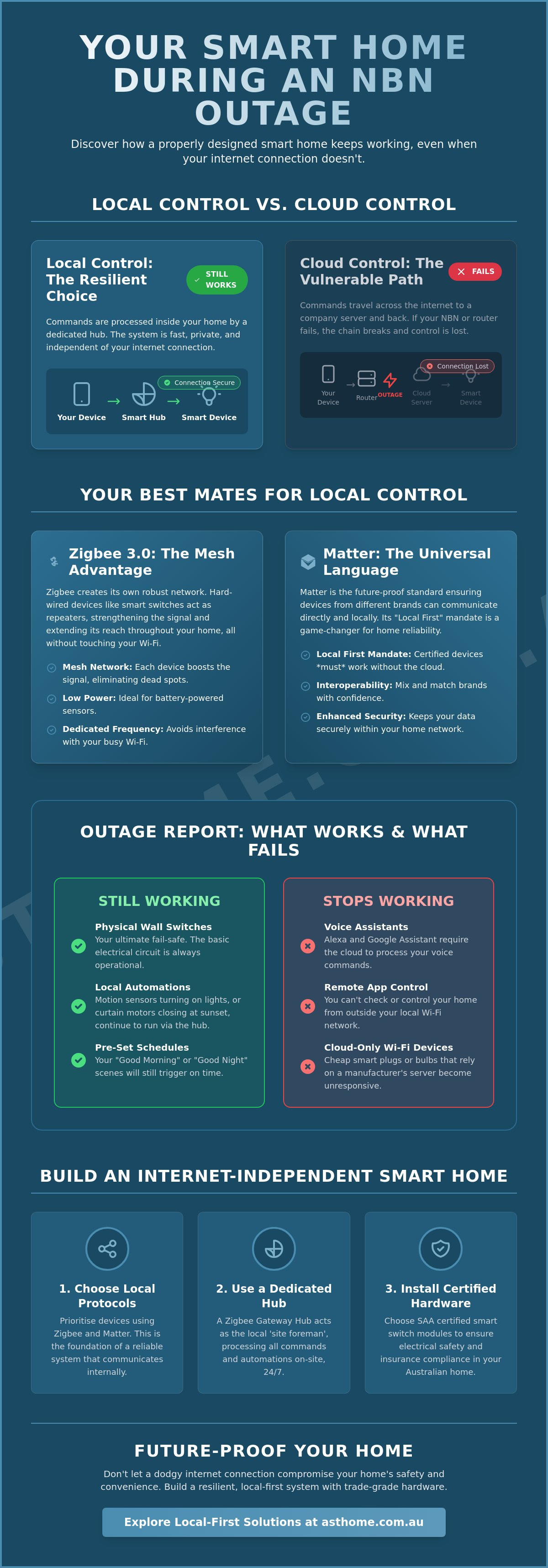
Cloud control relies on your command travelling from your phone to a server, often located overseas, before returning to your device. If the NBN fails, that loop breaks and your device stops responding. Local control keeps everything within your four walls. By using technologies within the Internet of Things (IoT), devices like sensors and switches talk directly to each other. This is why cloud-dependent Wi-Fi devices brick when the internet drops, while local-first systems continue to run your schedules and automations without a hiccup.
The Role of the Smart Hub in an Outage
Think of your Zigbee Gateway Hub as the local site foreman. Unlike a standard Wi-Fi router that just passes data to the web, a dedicated smart hub processes logic on-site. If your smart motion sensor is programmed to trigger a light, a local hub handles that instruction instantly. It doesn't need a cloud handshake to function. This local processing is a critical safety requirement for NDIS SDA participants, ensuring that accessibility tools and safety sensors remain active 24/7, regardless of whether your service provider is having a bad day.
Matter and Zigbee: Why These Protocols Are Your Best Mates
Choosing the right wireless protocol is the difference between a resilient home and a frustrating one. While Wi-Fi is great for streaming video, it is often the weakest link in home automation because it relies heavily on your router and internet connection. When considering what happens to a smart home when the internet is down, the protocol you choose determines if your automation thrives or dies. This is why we prioritise Zigbee and Matter. These protocols are designed to be "local-first," meaning they don't need to phone home to a server just to turn on a lamp.
Zigbee 3.0 has long been the industry standard for low-power mesh networking. It creates a dedicated frequency for your devices, keeping them off your congested 2.4GHz Wi-Fi band. If the NBN fails, your Zigbee devices continue to communicate with your hub as if nothing happened. This reliability is why trade professionals across Australia trust these systems for high-stakes environments like NDIS housing, where consistent performance is a non-negotiable safety requirement.
The Zigbee Mesh Advantage
Unlike Wi-Fi where every device must talk directly to the router, Zigbee uses a mesh topology. Hard-wired devices, such as Zigbee 3.0 smart switch modules, act as repeaters. They pass signals along to the next device, effectively strengthening the network as you add more hardware. Because this mesh is entirely internal to your home, it doesn't care if your ISP is having an outage. Your data stays off the public internet, which also provides a significant boost to your home's cybersecurity.
Matter: Future-Proofing Local Control
Matter is the newest universal language for the smart home, and it takes local control to the next level. The Matter 1.5 standard, released in late 2025, mandates that all certified devices must be capable of operating without a cloud connection. This "Local First" mandate is a game-changer for AU homes. It means that Matter smart switches from different brands can finally talk to each other directly without needing the internet as a middleman.
For NDIS and SDA housing providers, Matter simplifies the setup process significantly. It ensures that a participant can move into a home and have their assistive tech work instantly, regardless of the internet status. If you are looking to build a system that stands the test of time, you can explore our range of local-first hubs to start your internet-independent journey today.
What Works (and What Doesn't) When Your Router is Blinking Red
When your router starts blinking red, it is more than just an NBN service interruption; it is a live test of your home's digital architecture. If you have built your system on cloud-only Wi-Fi devices, you might find yourself in a frustrating situation. However, for those who have followed trade-grade best practices, the house continues to function. To truly understand what happens to a smart home when the internet is down, you must look at the difference between local hardware execution and cloud-based services.
Your home's core infrastructure should never be a hostage to your internet service provider. This is why we emphasise the use of hardware that maintains a physical or local wireless link. In a well-designed Australian smart home, the "smart" part is an enhancement, while the "home" part remains a reliable machine. If the internet drops out at 2:00 AM, your safety sensors and basic lighting must still perform their duties without hesitation.
Devices That Stay Fully Functional
- Physical Light Switches and GPOs: Your Smart Power Point (GPO) and any lights controlled by a Matter or Zigbee 3.0 Smart Switch Module will work perfectly via the wall plate. The physical toggle remains the primary override.
- Smart Curtain Motor and Track: These units typically include local RF (Radio Frequency) remotes or Zigbee connectivity. They will continue to open and close on schedule if that schedule is stored locally on your hub.
- Smart Motion Sensors: When paired with a local Zigbee Gateway Hub, a Smart Motion Sensor can still trigger your hallway lights. The signal travels directly from the sensor to the hub and then to the switch, never leaving your property.
- Smart Door Locks: A trade-quality Smart Door Lock stores your PIN codes and RFID credentials locally. You will never be locked out of your home just because the NBN is offline.
Features You Will Temporarily Lose
While the hardware remains robust, the "concierge" features of your home will take a hit. Most voice assistants, including Siri, Alexa, and Google Assistant, require an active internet connection to process your speech. Unless you are running a dedicated local voice processing server, your smart speakers will likely tell you they are having trouble connecting. This is a critical distinction to manage, especially for NDIS SDA housing where participants may rely heavily on voice commands for accessibility.
You will also lose remote access. If you are at the office, you won't be able to check your Smart Temperature and Humidity Sensor or receive notifications from your motion sensors. Furthermore, any automations that rely on external data, such as "close the curtains if the Bureau of Meteorology predicts rain," will fail to trigger. Your home becomes a local island; safe and functional, but temporarily cut off from the wider world.
How to Build an 'Internet-Independent' Smart Home in Australia
Building a resilient system requires moving past the "plug-and-play" consumer gear found in big-box retailers. To ensure your house remains functional, you must select hardware that treats the internet as a bonus, not a requirement. When planning a new build or a major retrofit, the primary question isn't just what happens to a smart home when the internet is down, but how you can design the system to ignore the outage entirely. It is about shifting from a "connected home" to a "local-first home."
For trade professionals and savvy DIYers, this means opting for a mesh-first mentality. While Wi-Fi is convenient for a single Smart Wi-Fi Light Switch in a small flat, it often fails at scale in larger Australian homes. Instead, prioritise Zigbee 3.0 or Matter Smart Switch Modules that require a neutral wire. A neutral wire provides constant power to the module, ensuring it never drops off the network or requires a power cycle after an NBN blip. This creates a rock-solid foundation for any NDIS SDA Compliant Smart Home Kit where reliability is a mandatory requirement.
Choosing the Right Hub for Local Automation
A dedicated Zigbee Gateway Hub is the cornerstone of local-first automation. Unlike cloud-based apps that poll a server to see if a sensor has been tripped, a local hub receives the signal directly. When you program your logic—such as "If Smart Motion Sensor detects movement, turn on Dimmable LED Driver"—that instruction is stored and executed on the hub's internal memory. This local execution removes the lag associated with cloud processing. It ensures your automations stay active during a network failure, providing a seamless experience for the occupants.
The SAA Certification Factor
In Australia, electrical safety is a legal and insurance requirement. Installing non-certified hardware from overseas marketplaces can void your home insurance and put your property at risk. Always ensure your hardware meets Australian Standards. Using SAA certified power points (GPOs) and switch modules provides the stability needed for trade-grade installs. These devices are tested for our specific voltage and environmental conditions, offering a level of reliability that generic alternatives cannot match. When you consider what happens to a smart home when the internet is down, having certified hardware ensures that the physical fail-safes are engineered to last.
If you are ready to secure your home's future, you can shop our full range of SAA-certified local-first hardware to guarantee performance regardless of your internet status.
Future-Proofing with Asthome: Trade-Grade Local Hardware
Asthome is built on a foundation of professional trade expertise. We aren't just shifting boxes; we are practitioners who understand the specific requirements of the Australian electrical industry. When we address what happens to a smart home when the internet is down, we do so with the confidence of having tested these scenarios in real AU homes. Our curated range prioritises local-first reliability. This ensures that every Matter Smart Switch Module or Zigbee Gateway Hub we sell performs its job without needing a constant handshake with an overseas server.
The "Asthome Difference" lies in our commitment to quality and regional regulatory adherence. We select hardware that simplifies the installation process for sparkies while providing a seamless experience for homeowners. By focusing on protocols like Zigbee 3.0 and the latest Matter 1.5 standards, we provide solutions that eliminate the uncertainty of cloud-dependency. Your home remains a functional, secure environment regardless of NBN status or router health.
Reliable Hardware for NDIS and Accessibility
For those managing disability housing, reliability is a non-negotiable safety standard. We understand that NDIS SDA smart home technology must be resilient. If a participant relies on a Smart Curtain Motor or a motion-triggered light for independence, that device cannot fail during a network outage. Our local-first sensors and modules ensure that critical automations remain active 24/7. This provides peace of mind for participants and care providers alike, knowing that the "smart" features are as dependable as the physical wiring.
Support for the Australian Trade Industry
We are a specialized resource for fellow professionals. Whether you are an electrician in Point Cook or a builder working on a large-scale SDA project, we provide the technical literacy you need. We offer wholesale pricing and dedicated technical support to help you deliver "internet-independent" homes to your clients. Our stock is held locally, ensuring you get the right gear for the job without the long lead times of international shipping. We focus on SAA-certified hardware that meets every Australian safety standard, distinguishing our range from generic international competitors.
Don't leave your clients wondering what happens to a smart home when the internet is down. Build it right the first time with hardware designed for the Australian landscape. Register for a Trade Account or browse our Matter modules today.
Build a Home That Never Stops Working
A resilient smart home is no longer a luxury; it is a technical necessity. By prioritising local-first protocols like Matter and Zigbee, you ensure your lighting, security, and accessibility features remain active during any NBN outage. We have explored how the right hardware choices eliminate the worry of what happens to a smart home when the internet is down, effectively shifting the brain of your home from a distant server to your own local gateway hub.
At Asthome, we provide the trade-grade gear required to make this independence a reality. Every module in our catalogue is SAA Certified for Australian Standards, ensuring your installation is safe, compliant, and insurance-friendly. We also offer specialised NDIS SDA compliant smart home kits and dedicated trade accounts for licensed professionals looking to provide the best for their clients. It is time to stop relying on the cloud and start building for local reliability.
Shop our range of Matter and Zigbee modules for local-first reliability and take control of your home automation today. Your smarter, more dependable home is just one retrofit away.
Frequently Asked Questions
Will my smart lights still turn on if my Wi-Fi is down?
Your smart lights will still operate via the physical wall switch regardless of your Wi-Fi status. If you have installed a Zigbee 3.0 Smart Switch Module, you can also continue using local remotes or sensors to trigger them. However, generic Wi-Fi bulbs without a physical override or a local hub will lose their "smart" functionality until the connection is restored. This is why trade-grade retrofits are far more reliable than simple bulb swaps.
Do Matter devices require an internet connection for daily use?
Matter devices do not require an internet connection for day-to-day operations. The Matter protocol mandates "local-first" communication, meaning devices talk directly to your hub over your home network. While you still need the internet for initial commissioning or firmware updates, your switches and sensors will continue to function during an NBN outage. This architecture is a key part of what happens to a smart home when the internet is down in 2026.
Can I still use my smart door lock if the internet fails?
You can absolutely use your Smart Door Lock during an internet failure. Professional-grade locks store your PIN codes and RFID credentials on the hardware itself, not in the cloud. You won't be able to issue new temporary codes remotely or receive "door opened" notifications on your phone during the outage, but your primary access methods remain 100% functional. You will never be locked out of your own home due to a provider issue.
What is the difference between a Zigbee hub and a Wi-Fi router?
A Wi-Fi router manages your connection to the wider internet and high-bandwidth data like 4K streaming. A Zigbee Gateway Hub is a dedicated "brain" for your smart devices. It uses a low-power mesh network to control modules and sensors locally. While your router might be the gateway to the world, the Zigbee hub is the local supervisor that keeps your automations running even if the router loses its NBN feed.
Will my automations (like motion-triggered lights) work offline?
Your automations will continue to work offline if they are processed by a local controller. When a Smart Motion Sensor triggers a light through a Zigbee hub, the logic happens entirely inside your home. This is a critical feature for NDIS participants who rely on automated lighting for safety. Cloud-dependent automations, such as those using third-party web services, will fail, but local-first logic remains rock solid during any network downtime.
Do I need a special router to keep my smart home running during an outage?
You don't need a special router, but you do need a local-first ecosystem. A standard router only handles Wi-Fi and internet traffic. To keep things running during an outage, you should invest in a Zigbee Gateway Hub or a Matter-compatible controller. These devices ensure that even if the router is "blinking red," your internal network of switches and sensors stays organised and responsive to your manual and automated commands.
Why do some smart devices stop working when the internet is down?
Many consumer-grade devices are "cloud-dependent," meaning every command must travel to a manufacturer's server before returning to the device. If the NBN is out, that signal path is severed. This is the main reason people worry about what happens to a smart home when the internet is down. Moving to trade-grade hardware like Matter or Zigbee modules removes this single point of failure by keeping the signal path local to your property.
How can I tell if a smart device supports local-first control?
Look for specific protocol certifications on the packaging or technical specs. Devices labelled with Matter, Zigbee 3.0, or Thread are designed for local interoperability. If a device only mentions "Wi-Fi" and requires a specific manufacturer's app to function, it is likely cloud-dependent. For the best results in Australian homes, always check for SAA certification to ensure the hardware meets local safety and performance standards for permanent trade installation.