

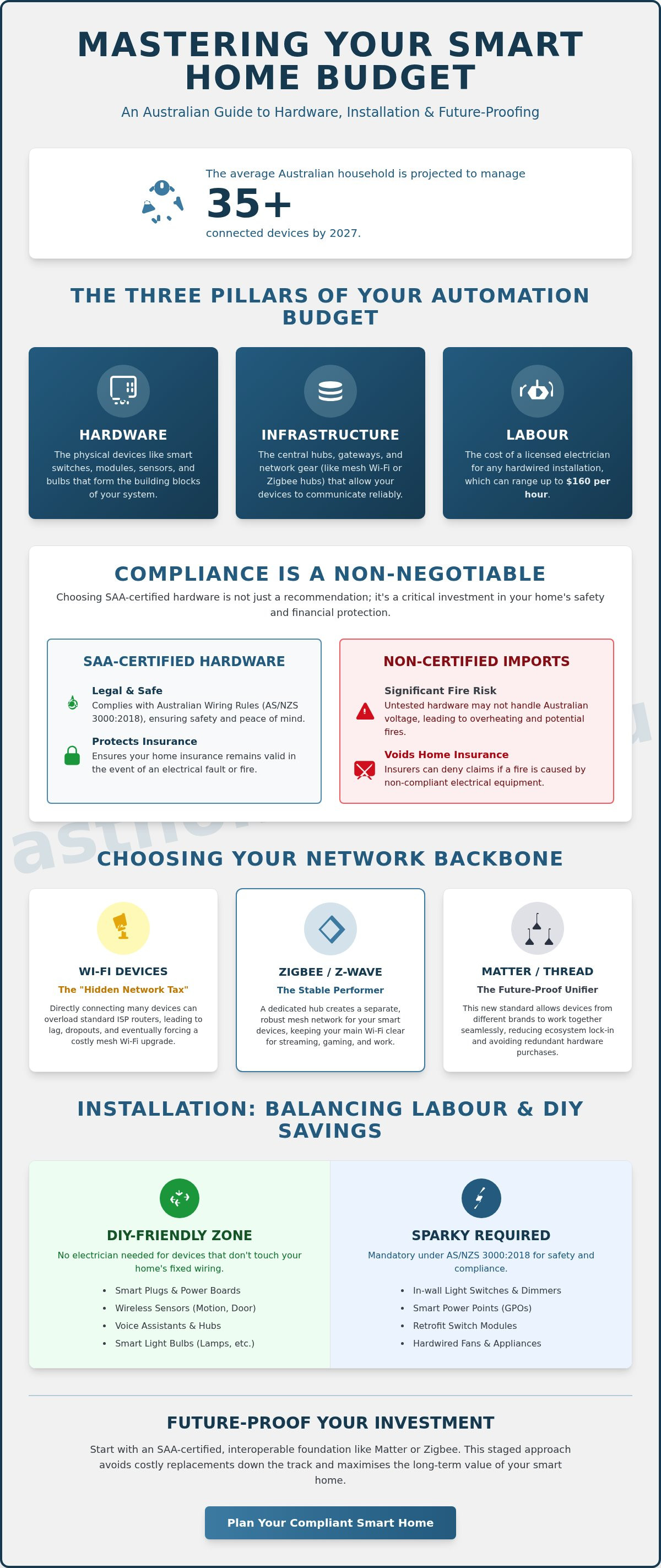
Did you know the average Australian household is projected to manage 35 connected devices by 2027? Even with this rapid adoption, many people struggle to pin down the actual cost of smart home equipment australia before they start their project. You've likely worried about hidden installation fees that can hit $160 per hour or the fear that non-compliant gear might void your home insurance. It's frustrating to balance the desire for a modern home with the strict requirements of the AS/NZS 3000:2018 Wiring Rules.
This guide helps you master your automation budget with a clear breakdown of hardware, installation, and long-term savings. We promise to provide a staged roadmap for your project, comparing the value of smart bulbs against modular switches. You'll gain the confidence to choose between Matter and Zigbee protocols while ensuring your setup meets Australia's mandatory 2026 cybersecurity standards. Let's get your home automation plan on track without the financial surprises.
Key Takeaways
- Identify the three core pillars of home automation budgeting to eliminate hidden expenses and accurately forecast your project spend.
- Navigate the cost of smart home equipment australia by prioritising SAA-certified hardware that ensures compliance with local safety regulations and protects your insurance.
- Discover how modular retrofitting with Zigbee 3.0 or Matter modules can lower total project costs by reducing the need for complex rewiring.
- Understand the legal boundaries between DIY-friendly sensors and the hardwired installations that require a licensed sparky under the Wiring Rules.
- Future-proof your investment by selecting interoperable protocols like Matter and Thread to avoid the high long-term price of proprietary systems.
The Realities of Smart Home Equipment Costs in Australia (2026)
Planning a home automation system requires a clear eyed view of your total investment. You can't just look at the price of a single bulb and call it a day. The true cost of smart home equipment australia rests on three distinct pillars: the hardware itself, the hubs or infrastructure that connect them, and the professional labour needed for hardwired installs. Understanding these categories early prevents budget blowouts halfway through your project.
In 2026, the 'Australia Tax' remains a point of contention for many buyers. This isn't just a random markup; it's the cost of rigorous testing to achieve SAA certification. Local standards ensure that your gear can handle our specific voltage and environmental conditions. Buying grey market imports might save you $20 upfront, but it leaves you exposed to significant risks that far outweigh the initial savings. Matter has finally reached maturity this year, and this interoperability standard is a massive budget win. It reduces ecosystem lock-in, meaning you won't be forced to buy expensive proprietary hardware just because you started with one specific brand.
Why SAA Certification is a Non-Negotiable Budget Item
Australian law is very clear about electrical safety. Every module or switch behind your wall must carry the Regulatory Compliance Mark (RCM) and SAA approval. If a non-certified device causes a fire, insurance companies in states like Victoria are known to knock back claims immediately. It's a high stakes gamble. Choosing a certified Zigbee 3.0 smart switch module ensures you're protected both legally and financially. Think of the extra few dollars per unit as a one time insurance premium for your home's safety and your family's peace of mind.
Hidden Infrastructure Costs: Wi-Fi vs. Zigbee vs. Matter
Don't let 'no hub required' marketing fool you. Cheap Wi-Fi switches often lead to a hidden 'Network Tax'. Once you hit 20 or 30 devices, your standard ISP router will likely crash. This eventually forces you into an expensive mesh Wi-Fi upgrade that could cost hundreds. Zigbee hubs offer a more stable alternative for a small one off cost. They create a dedicated mesh network for your devices, keeping your main Wi-Fi clear for streaming and work. This setup prevents the lag and dropouts that plague overloaded networks. Matter is the unified standard that prevents redundant hardware purchases by allowing devices from different manufacturers to communicate through a single compatible controller.
Tiered Budgeting: From Entry-Level DIY to Full-Home Automation
Budgeting for automation isn't a one size fits all exercise. Your total cost of smart home equipment australia depends heavily on whether you're tackling a single room or a complete house build. Staging your spend is often the smartest way to avoid financial strain while building a robust system. We recommend starting with your home's backbone. Choosing a Matter smart switch provides a future proof foundation. This ensures you won't have to rip out hardware when you decide to expand your system in two years.
A whole home tier goes beyond simple lighting. It integrates every GPO, light switch, and climate control point into a unified environment. This level of integration is where you see the most significant impact on your utility bills. The Australian government's guide to energy savings highlights how smart systems manage peak loads and reduce standby power waste. For homeowners in regional Victoria, smart climate control isn't just about comfort; it's a critical tool for managing rising energy prices. Efficiency is the primary driver for these larger installations.
The Starter Setup: Lighting and Power
Most Aussie homeowners begin in the kitchen and lounge. These high traffic areas offer the best immediate return on investment. You can effectively automate four or five key zones using multi gang smart Wi-Fi switches. If you've already invested in designer faceplates, don't throw them away. You can use smart modules behind the wall to maintain your home's aesthetic while adding full app control. Always budget for a central gateway hub early on. This device organises your mesh network and prevents your devices from dropping off when the household bandwidth is under pressure.
NDIS SDA and Accessible Automation Costs
Accessibility automation has specific technical requirements, particularly for NDIS Specialist Disability Accommodation (SDA). In Victoria, these systems must meet strict reliability and safety standards to ensure participant safety. The cost benefit analysis here shifts from simple convenience to essential independence. Automated curtain motors and smart door locks provide critical autonomy for residents. For a detailed breakdown of compliance and hardware needs, refer to our NDIS SDA Resource Guide. If you're building for accessibility, starting with an NDIS SDA compliant smart home kit ensures all components meet the necessary regulatory benchmarks from day one.
Hardware Selection: Modules vs. Full Switch Replacement
Choosing between a visible smart switch and a hidden module is a major fork in the road for your budget. While designer smart switches offer a high tech look, they often carry a premium price tag per unit. A Zigbee 3.0 smart switch module is often the more economical choice for those who value their existing decor. These devices sit behind your current switch plates, preserving your home's original aesthetic while adding modern intelligence. This is a massive win if you've already invested in high end architectural hardware.
The "No Neutral" factor is the biggest labour saver in the industry. Many older Australian homes lack a neutral wire at the switch. Pulling a new wire through a double brick wall or a tight ceiling space can cost hundreds in sparky labour. Choosing a "No Neutral" module bypasses this requirement entirely. It drastically reduces the total cost of smart home equipment australia by cutting down on hours of difficult electrical work. This modular approach also supports scalability. You don't need to automate the whole house at once. You can start with the master suite and expand room by room as your budget allows.
Retrofitting with Smart Modules
Space is a premium in modern Point Cook townhouses and urban apartments. These modules are compact enough to fit into shallow wall cavities where bulky smart switches might struggle to clear the mounting hardware. Matter modules are particularly valuable for mixed brand households because they allow you to mix hardware without losing connectivity. These modules can also be wired behind standard outlets, effectively turning any standard GPO into a smart power point for appliances and lamps.
Full Switch Replacements: When are they worth it?
Sometimes, the physical hardware is the right call for a renovation. Smart Wi-Fi light switches, available in 1, 2, 3, or 4 gang configurations, provide a clean and unified look. Tactile feedback matters for everyday use. Guests and elderly family members often prefer "button pushing" over "app tapping" because it's intuitive and familiar. From a resale perspective, visible high end smart switches often command a better price in the Australian market. They provide immediate proof to potential buyers that the home is modern and fully automated. If you're doing a full "back to studs" renovation, full switch replacements are often the most satisfying path forward.
Installation and Compliance: Balancing Labour and DIY Savings
Understanding the legal boundary between DIY and professional work is essential for managing your budget. You can legally set up your own hubs, sensors, and plug-in devices. However, the AS/NZS 3000 Wiring Rules mandate that a licensed sparky must handle any hardwired components. This includes your smart light switches, GPOs, and hidden modules. Attempting to DIY these 240V connections isn't just dangerous; it's a quick way to void your insurance and face heavy fines in Victoria.
A major "trade secret" for lowering the cost of smart home equipment australia involves how you source your hardware. Licensed professionals often have access to better rates that they can pass on to you. If you're building a new home in Point Cook, plan your "rough-in" phase early. Having your electrician run neutral wires to every switch box during the initial wiring stage is far cheaper than retrofitting them later. A tech-savvy local electrician will understand the space requirements for modules, saving you hours of troubleshooting and re-work.
Working with a Licensed Electrician
Efficiency is the key to lowering labour costs. Don't call an electrician out for a single smart switch. Bundle your installation by zones, such as the entire ground floor or all outdoor lighting. This spreads the call-out fee across multiple units. In Victoria, always insist on a Certificate of Electrical Safety (COES) once the job is done. This document is your proof of compliance for future home sales and insurance purposes. If you're a professional installer, you can sign up for an Asthome trade account to access wholesale pricing on our entire range of SAA-certified gear.
DIY Savings for Non-Hardwired Gear
You can significantly reduce your project spend by handling the low-voltage setup yourself. Focus your DIY efforts on motion sensors and temperature sensors that run on batteries. These devices are the "eyes and ears" of your home and don't require a license to mount. You can also take charge of configuring your Zigbee gateway or Home Assistant Green server. Integrating smart curtain motors is another high-ROI move. They automate your home's thermal management, closing during the heat of a Victorian summer afternoon to slash your cooling costs. For the best results, start with a high-quality Zigbee gateway hub to ensure all your DIY sensors communicate reliably with your hardwired switches.
Maximising ROI: Future-Proofing Your Australian Smart Home
The most significant hidden cost of smart home equipment australia isn't the initial purchase; it's the price of obsolescence. Many homeowners fall into the trap of buying proprietary systems that only work with one specific app or hub. If that manufacturer goes out of business or stops supporting the hardware, your entire investment becomes e-waste. Avoid this financial risk by prioritising open standards. Investing in hardware that supports Matter and Thread ensures your home remains functional and compatible for at least the next decade. Buy once, buy right, and you won't have to pay for a total system overhaul in five years.
Energy efficiency provides a direct return on investment that offsets your hardware spend. By installing smart power points, you can identify "vampire loads" from appliances that drain power even when they're on standby. Real-time energy monitoring allows you to automate shut-offs during peak tariff periods. This level of control can slash household electricity bills significantly, turning your smart home from a luxury into a cost-saving asset.
Why Matter is the Smartest Financial Move
Matter is a game changer for your renovation budget because it eliminates the need for redundant bridges and multiple hubs. You can use a single Matter module to communicate across Apple Home, Google Home, and Alexa simultaneously. This cross-platform compatibility means you aren't locked into one ecosystem if you decide to switch from an iPhone to an Android device later. For a deep dive into the technical requirements and wiring diagrams, refer to our Matter Smart Switch Guide. It's the most efficient way to build a flexible, high-performance system.
The Asthome Commitment to Value
We believe in providing professional-grade gear at prices that make sense for the average Aussie reno. Our hardware is designed by practitioners who understand the specific needs of the local trade. If you run into a configuration snag, our local support centre in Point Cook is ready to help you troubleshoot. This peer-to-peer service ensures you get the most value out of every module you install. Before you sign off on your budget, use this final checklist:
- Certification: Is every hardwired device SAA-certified and RCM-marked?
- Installation: Have you booked a licensed sparky for all 240V modules and GPOs?
- Protocol: Does your hardware support Matter or Zigbee 3.0 for long-term interoperability?
- Scalability: Are you starting with high-impact zones to manage initial cash flow?
Browse our SAA-certified smart modules and start your budget-friendly automation journey today.
Build Your Future-Proof Home Today
Mastering the cost of smart home equipment australia comes down to making informed, compliant choices before the first wire is pulled. You've seen how modular retrofitting saves on labour and how Matter protocols eliminate the need for redundant hardware. By focusing on SAA-certified gear, you protect your home insurance and ensure your family's safety. It's about building a system that works for you, not one that requires constant expensive upgrades.
We're based in Point Cook, Victoria, and our team of practitioners is here to support your project from start to finish. We offer specialised trade accounts for licensed sparkies and provide professional grade hardware for every Australian household. You can eliminate the guesswork by choosing gear designed for our local standards and regulations. Don't settle for grey market imports when you can have peace of mind with local expertise.
Shop SAA-Certified Smart Home Modules at Asthome
Start small, plan for compatibility, and enjoy the comfort of a truly intelligent home. Your automation journey is just a few modules away.
Frequently Asked Questions
How much does it cost to automate a 3-bedroom house in Australia?
A basic, professionally installed system typically starts at about A$2,999. This entry-level price point usually covers six smart light switches and basic app control. For a mid-range setup that includes integrated climate control and smart bulbs, you should budget from A$3,999 upwards. Advanced whole-home systems with high-end security and extensive automation can range from A$8,000 to over A$25,000 depending on the complexity of the installation.
Can I install smart switches myself in Victoria?
No, you cannot legally install hardwired smart switches yourself in Victoria. All electrical work involving 240V wiring must be performed by a licensed electrician to comply with the AS/NZS 3000:2018 Wiring Rules. Attempting DIY work on light switches or GPOs is illegal and will likely void your home insurance policy. You are only permitted to handle non-hardwired gear like plug-in hubs and battery-powered sensors.
Are smart home modules cheaper than smart light switches?
Smart home modules are generally more cost-effective than full switch replacements, particularly for retrofit projects. Using a module allows you to keep your existing designer faceplates while adding smart functionality behind the wall. This choice often reduces the total cost of smart home equipment australia because "No-Neutral" modules eliminate the need for expensive rewiring labour that full smart switches often require in older homes.
Do smart home devices increase electricity bills?
Smart devices actually help lower your overall electricity bills through improved efficiency and automation. While each device has a tiny standby power draw, the ability to automate lighting schedules and monitor energy usage leads to significant savings. Some Australian households report energy reductions of 20% to 40% by using smart thermostats and automated shut-offs for "vampire loads" on appliances.
Is Matter better than Zigbee for a budget smart home?
Matter is an excellent choice for budget planning because it offers universal interoperability across Apple, Google, and Amazon platforms. This prevents you from being locked into a single expensive ecosystem and having to replace hardware later. Zigbee remains a highly stable and mature choice for large mesh networks. For most users, a hybrid approach using a Matter-compatible bridge is the smartest way to balance current performance with future-proofing.
Does smart home equipment need special insurance in Australia?
You don't usually need a special insurance policy, but your existing coverage requires all installed electrical equipment to be SAA-certified. Using non-compliant or grey-market gear that lacks the Regulatory Compliance Mark (RCM) can lead to rejected claims if an electrical fire occurs. Always ensure your sparky provides a Certificate of Electrical Safety (COES) for any hardwired smart home installations to keep your coverage valid.
What is the most expensive part of a smart home setup?
Professional labour and infrastructure wiring are typically the largest expenses in any automation project. Licensed electricians in major cities like Melbourne or Sydney charge between A$85 and A$160 per hour, plus call-out fees. For new builds, the starting cost for comprehensive smart wiring is approximately A$2,000. Choosing modular, wireless protocols like Zigbee or Matter helps keep these infrastructure costs down compared to traditional hardwired systems.
How can I save money on professional electrical installation?
You can save money by bundling all your hardware installations into a single visit to minimise the impact of call-out fees. Choosing "No-Neutral" modules also prevents the high labour costs associated with pulling new wires through existing wall cavities. If you're a trade professional, signing up for a specialised trade account provides access to wholesale pricing, which significantly lowers the overall cost of smart home equipment australia for your project.