

If a standard smart globe flickers out in a typical lounge room, it's a minor annoyance. However, if a non-compliant automation system fails in a High Physical Support home, it's a critical loss of independence for the resident. Building or retrofitting an ndis sda smart home is a high-stakes task where "near enough" simply isn't good enough. You've likely felt the frustration of navigating confusing SAA certifications or the fear that the hardware you install might fail when a participant relies on it for daily tasks.
We understand that you need trade-quality gear that works every time. This 2026 buying guide cuts through the technical noise to help you select SAA-certified hardware that meets strict NDIS Specialist Disability Accommodation standards while remaining user-friendly. We'll preview the essential Zigbee and Matter modules required to automate lights, curtains, and climate control seamlessly. By following this guide, you'll learn how to specify a future-proof setup that ensures compliance, empowers participants, and provides long-term reliability for any SDA project.
Key Takeaways
- Understand why SAA certification is non-negotiable for Australian safety standards in every ndis sda smart home project to ensure long-term reliability.
- Learn to distinguish between local control and cloud-based systems to keep critical automation running during internet outages.
- Discover why a hardwired data backbone is the most vital component for supporting monitoring equipment and assistive technology.
- Identify five common installation mistakes that lead to non-compliance or overly complex user interfaces for participants.
- Master interoperability by selecting Zigbee 3.0 and Matter-compatible hardware that integrates seamlessly via a central gateway hub.
What is an NDIS SDA Smart Home?
An ndis sda smart home isn't just a house with a few smart globes. It's a highly engineered environment designed to provide autonomy for people with extreme functional impairment or very high support needs. Under the National Disability Insurance Scheme (NDIS), Specialist Disability Accommodation (SDA) refers to the physical dwelling. However, the hardware inside, specifically the Assistive Technology (AT), is what actually transforms a building into a functional home. It's the difference between a resident needing a carer to open the blinds and being able to do it themselves with a voice command or a tablet.
2026 has become a major turning point for the industry. We've moved away from closed, proprietary systems toward interoperable standards like Matter and Zigbee 3.0. This shift means you're no longer locked into one brand for the next decade. For an electrician or developer, the priority has shifted from "will this work today?" to "is this trade-certified hardware that meets Australian standards for the long haul?" Cheap consumer gadgets from overseas marketplaces don't cut it here. They lack the necessary electrical safety certifications and often fail when internet connectivity drops out, which is a risk no provider should take.
The Four Categories of SDA
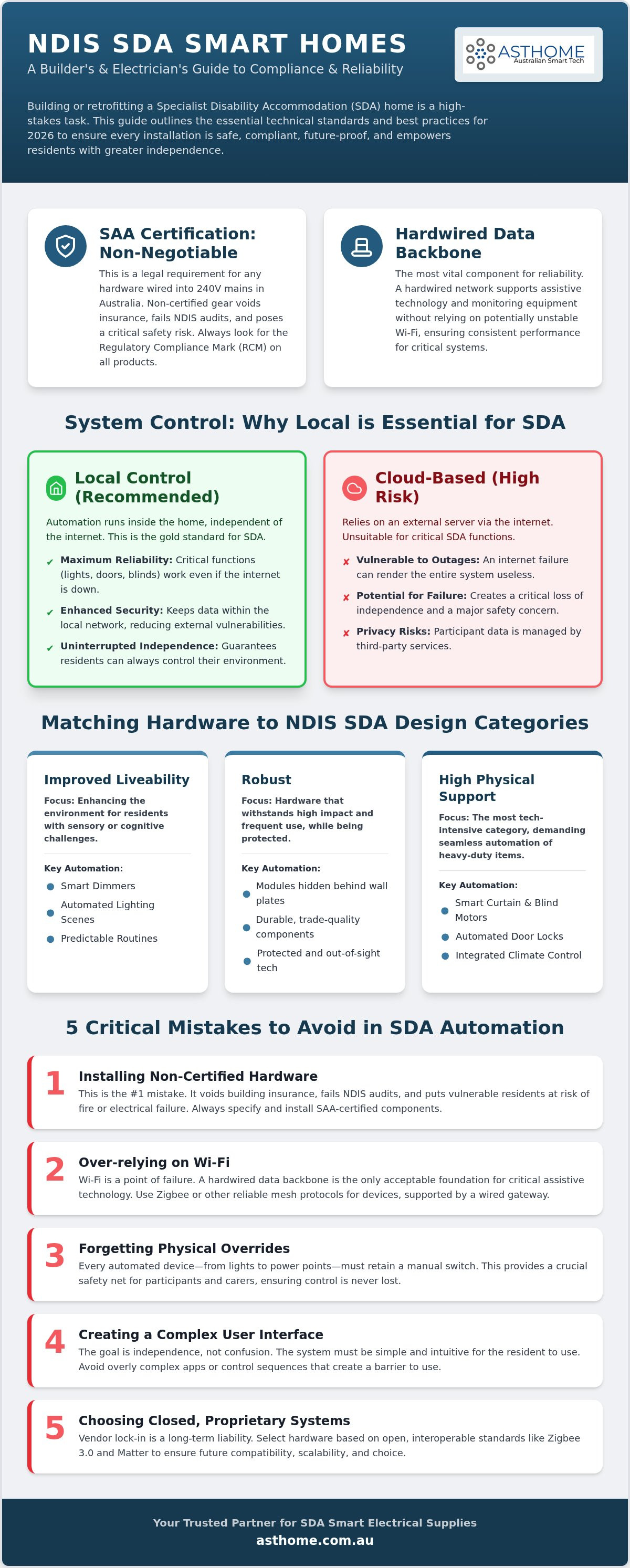
The NDIS defines specific design categories, and your hardware choice must match the participant's requirements. Each category has different priorities for automation.
- Improved Liveability: Focuses on enhancing the environment for those with sensory or cognitive challenges. Smart dimmers and automated lighting scenes help manage sensory overload and improve predictability.
- Robust: Requires hardware that can withstand high impact and frequent use. We recommend using modules hidden behind wall plates, like the Zigbee 3.0 Smart Switch Module, to keep the tech protected and out of sight.
- High Physical Support: This is the most tech-intensive category. It demands seamless automation of heavy-duty items. This includes Smart Curtain Motors, automated door locks, and integrated climate control that a participant can trigger via voice or specialised switch interfaces.
SAA Certification: The Non-Negotiable Standard
In Australia, any hardware wired into the 240V mains must be SAA certified. This isn't a suggestion; it's a legal requirement. If you install non-certified modules, you're voiding the building's insurance and risking a failed NDIS audit. Worse, you're putting a vulnerable participant at risk of electrical fire or equipment failure. It's a high-stakes environment where reliability is paramount.
Genuine SAA-certified gear, such as our Smart Power Points (GPO), undergoes rigorous testing to ensure it meets local safety protocols. Always look for the RCM (Regulatory Compliance Mark) on the product housing. Finally, remember that while the app setup might be user-friendly, every 240V component must be installed by a licensed electrician. It's the only way to ensure the ndis sda smart home remains safe, compliant, and reliable for the long term.
Key Features to Compare When Buying SDA Hardware
Selecting hardware for an ndis sda smart home requires a different mindset than a standard residential renovation. Reliability is the primary metric. While a consumer might tolerate a hub rebooting, a participant relying on a smart door lock or curtain motor cannot afford downtime. You must prioritise local control over cloud-based systems. Local control ensures that if the internet connection drops out, the automation keeps running within the four walls of the home. This is vital for safety and peace of mind in any Specialist Disability Accommodation (SDA) build.
Physical overrides are equally critical. Every automated light or power point should retain a manual switch. This provides a safety net for participants and ensures carers can operate the home without needing app access or voice commands. Scalability also matters. A participant’s mobility or cognitive needs may change over time. Using modular hardware allows you to add sensors or change switch behaviours without ripping out the internal wiring. It makes the property adaptable to different residents over its lifespan.
Matter vs Zigbee 3.0 for Accessibility
By 2026, Matter has emerged as the universal language for smart devices. It allows a Matter Smart Switch Module to communicate directly with Apple HomeKit, Google Home, or Alexa without complex bridges. However, Zigbee 3.0 remains the gold standard for reliable mesh networking. It handles low-power sensors and dimmers with incredible stability. For those upgrading existing properties, our Zigbee 3.0 Smart Switch Module Australia: The 2026 Retrofit Guide explains how to integrate these into older wall plates effectively.
Voice Control and Haptic Feedback
Voice control is often the primary interface in a High Physical Support home. Integrating with established platforms provides hands-free operation of climate, blinds, and lighting. For participants with vision or hearing impairments, haptic feedback and visual cues are vital. You can programme smart switches to provide multi-press automation. For example, a long-press on a bedside switch could trigger a "Goodnight" scene that locks the front door and dims all lights. Choosing the right ecosystem is about finding a balance between advanced features and rock-solid performance. If you are currently specifying a project, you can browse our SAA-certified smart modules to find hardware that meets these strict safety requirements.
Essential Connectivity: The Data & TV Collection for SDA Homes
The backbone of any successful ndis sda smart home isn't the flashy voice assistant or the motorised blinds. It's the physical data cabling hidden behind the plaster. While Wi-Fi technology has improved significantly by 2026, it remains a shared medium prone to interference and congestion. For critical medical equipment, fall detection sensors, and 24/7 monitoring systems, a hardwired connection is the only way to guarantee uptime. You simply can't risk a participant's safety on a wireless signal that might drop because a neighbour is using high-powered equipment or the network is congested.
Organising these connections requires a central, accessible hub. This is where you house the Zigbee Gateway Hub, network switches, and patch panels. By centralising the "brains" of the home in a dedicated comms cabinet, you make maintenance simpler for technicians and ensure the system remains organised as it scales. High-quality CAT6 or CAT6A cabling and shielded connectors are essential to future-proof the build against the increasing data demands of assistive AI. This robust infrastructure is a core requirement of the SDA Design Standard, which emphasises the need for infrastructure that supports participant independence and safety.
Reliable Networking for Assistive AI
Low latency is non-negotiable for voice-activated emergency systems. If a participant calls for help, the system must process that request instantly. Professional installers should separate smart home traffic from general internet usage using a VLAN or a dedicated router. This prevents a high-definition video stream in the lounge from delaying a critical alert in the bedroom. Using high-quality wall plates and data jacks ensures that these hardwired points remain reliable over thousands of plug-in cycles. It's about building a network that works as a silent, dependable partner in the participant's daily life.
Standout Products for SDA Connectivity
Our range includes professional-grade data modules and TV accessories designed specifically for the Australian trade. These components provide the stable foundation required for a Matter smart switch ecosystem to thrive. Without a solid data backbone, even the most advanced Matter devices will struggle with responsiveness and sync issues. We focus on providing trade-quality hardware that won't let you down on site. If you're currently specifying a project or finishing a rough-in, you can Browse the Data & TV Collection for SDA Connectivity to secure the jacks, plates, and accessories your installation deserves.
5 Mistakes to Avoid When Automating an SDA Property
Automating an ndis sda smart home isn't the same as setting up a hobbyist's lounge room. The stakes are significantly higher. One wrong choice can lead to a compliance fail or, worse, a safety risk for a resident with high support needs. We see many projects stumble because the focus remains on the "cool factor" rather than the fundamental requirements of reliability and safety. Avoiding these common pitfalls ensures the property remains a functional, long-term asset for both the provider and the participant.
One frequent error is neglecting the hardware basics. Standardised wall plates and sockets are the primary interface for every resident. Neglecting the importance of a professional Power Point (GPO) standard often leads to mismatched hardware that is difficult for participants with limited dexterity to operate. Similarly, failing to plan for power outages is a critical mistake. If a smart door lock or curtain motor lacks a manual override or battery backup, a participant can become trapped or vulnerable during a simple blackout. You must specify hardware that defaults to a safe, usable state when the power or network fails.
Finally, avoid "closed" ecosystems. Choosing a system that only talks to its own brand limits the property's future. As assistive technology evolves, you need the flexibility to add new sensors or modules without replacing the entire backbone. Stick to interoperable standards like Zigbee 3.0 or Matter to keep your options open.
The "Cheap Gear" Trap
Buying non-compliant hardware from overseas marketplaces is a dangerous shortcut. These modules often lack the rigorous testing required for the Australian market. SAA compliance is the legal baseline for Australian electricians in 2026. Using non-certified gear creates genuine fire risks and will lead to insurance denials if a fault occurs. Trade-quality gear is designed to last longer in High Physical Support environments where devices are used more frequently than in a standard home. It's better to invest in certified hardware once than to replace cheap modules every six months.
Ignoring the Participant Experience
Always design for the user, not the tech enthusiast. A complex app with dozens of menus is useless if the participant only needs to control three things. Consistency is vital. Ensure there is clear feedback, such as a subtle light or sound, when a command is executed so the user knows the system has responded. Sensor placement is another common oversight. Ensuring sensors are placed correctly for motion sensor automation prevents "dead zones" where a resident might be left in the dark or unable to trigger a safety alert. To ensure your project meets these high standards, shop our range of SAA-certified smart modules designed specifically for the Australian trade.
Why Asthome is the Trusted Partner for SDA Smart Electrical Supplies
At Asthome, we operate with a clear ethos. We are a business run by practitioners for practitioners. We understand that when you are on-site at an ndis sda smart home project, you need more than just a box of parts. You need hardware that you can trust to meet Australian safety standards without second-guessing. Every product we stock, from our Zigbee 3.0 Smart Switch Modules to our Smart Power Points (GPO), is SAA certified. This commitment to regional regulatory adherence provides the peace of mind required in high-stakes disability accommodation builds where technology failure isn't an option.
We've simplified the specification process by developing specialised NDIS SDA Compliant Smart Home Kits. These kits are designed to meet the specific requirements of the SDA Design Standard, ensuring you have the right mix of sensors, modules, and gateways to empower participant independence. Based in Point Cook, we offer fast shipping across Victoria and nationwide, ensuring your project stays on schedule. We aren't an anonymous international marketplace; we're a local Australian business that understands the specific licensing and safety requirements of the regional trade industry.
Trade Accounts and Professional Support
We know that licensed electricians and NDIS-registered builders face unique challenges with smart home integration. That's why we offer dedicated trade accounts that provide access to wholesale pricing and bulk discounts. Our support is peer-to-peer. If you're unsure about how a Matter Smart Switch Module will interact with a specific Zigbee Gateway Hub, we have the technical literacy to provide a concrete answer. We help sparkies deliver compliant projects on time by offering expert advice on Zigbee, Matter, and Wi-Fi protocols, ensuring the final handover is seamless for the participant and the provider.
Ready to Future-Proof Your SDA Project?
Building for independence requires a foundation of certified, reliable hardware. As we've explored in this guide, the key to a successful ndis sda smart home is choosing trade-quality gear that offers local control and seamless interoperability. By specifying SAA-certified modules, you protect the participant's safety and the property's long-term compliance. For a deeper dive into the technical specifications and regulatory requirements for 2026, we invite you to consult our NDIS SDA Smart Home Technology Australia: The 2026 Resource Guide. If you're ready to secure the backbone of your next project, you can Shop the Data & TV Collection for Your Next SDA Install and experience the reliability of trade-grade connectivity.
Building for Independence and Compliance
Success in any ndis sda smart home project depends on moving beyond consumer gadgets and investing in trade-certified infrastructure. By prioritising SAA-certified modules and a hardwired data backbone, you ensure the property is safe, compliant, and genuinely functional for the resident. We've seen how local control via Zigbee 3.0 or Matter provides the offline reliability that participants need for their daily independence. Avoiding cheap, non-certified imports is the only way to protect your reputation and the participant's safety.
Asthome is Australian-owned and operated in Point Cook. We're here to support fellow professionals with verified trade pricing for licensed electricians. All our products are SAA certified for Australian standards, so you can install with confidence. View our NDIS-ready Data & TV Collection to secure the professional-grade components your next project deserves. It's time to future-proof your SDA build with hardware that stands up to the task and empowers participants to live with greater autonomy.
Frequently Asked Questions
Can I use NDIS funding to buy smart home hardware?
Yes, you can use NDIS funding for smart hardware if it's deemed "reasonable and necessary" to help you achieve your goals. This typically falls under the Assistive Technology (AT) budget in your plan or is included as part of the capital cost for a new build. In 2026, the NDIS categorises AT into three cost tiers, and most smart modules fall within the low-cost or mid-cost brackets, which simplifies the purchasing process for many participants.
Do smart home switches need to be SAA certified in Australia?
Yes, any smart switch or module wired into the 240V mains must carry SAA certification to be legal for use in Australia. Installing non-certified gear from international marketplaces is a breach of local electrical safety regulations and will void your property insurance. Every ndis sda smart home component we supply carries the Regulatory Compliance Mark (RCM), ensuring it meets the strict safety protocols required by Australian electricians.
What is the best smart home protocol for a disability home?
Zigbee 3.0 and Matter are the preferred protocols for disability housing because they offer superior reliability compared to standard Wi-Fi. Zigbee creates a stable mesh network that doesn't slow down when multiple devices are added, which is vital for sensors and dimmers. Matter is the new universal standard that allows hardware from different brands to work together seamlessly, ensuring the home remains easy for participants to control via a single interface.
Can a tenant install smart switches in an SDA rental?
A tenant cannot install smart switches themselves because all 240V electrical work must be performed by a licensed electrician. If you're in an SDA rental, you'll need written permission from the housing provider before any electrical modifications are made. We often recommend using smart switch modules that sit behind your existing wall plates, as this allows a sparky to upgrade the home's tech without changing the physical look of the property.
How does smart home technology improve safety for NDIS participants?
Smart technology improves safety by automating routine tasks that might otherwise pose a risk, such as navigating dark hallways or reaching for high window latches. For example, a Smart Motion Sensor can trigger "pathway lighting" at night to prevent falls. Automated door locks and smart curtain motors also allow participants with limited mobility to secure their home instantly using voice commands or a smartphone app, providing both physical safety and peace of mind.
Do I need a special hub for an NDIS smart home kit?
Yes, a dedicated Zigbee Gateway Hub is essential for any professional ndis sda smart home setup. This hub acts as the central brain, allowing your sensors and switches to talk to each other without relying on your internet router. Using a gateway hub ensures your automation routines work with much lower latency, meaning lights and emergency alerts trigger instantly when they're needed most.
What happens to the smart home if the internet goes down?
If your system is built with local control hardware, your smart home will continue to function for most tasks even during an internet outage. While you might lose remote app access or some voice assistant features, your pre-programmed automation and physical wall switches will still work perfectly. This is why we prioritise Zigbee and Matter hardware, as they keep the home's critical functions running locally within the building's own network.
Are Asthome products compatible with Home Assistant?
Yes, our Zigbee 3.0 and Matter-certified modules are fully compatible with Home Assistant and other open-source automation platforms. This compatibility is a major advantage for trade professionals who want to build highly customised environments for participants with complex needs. Because our hardware follows industry-standard protocols, it integrates easily with various coordinators and hubs, giving you the flexibility to design a truly bespoke assistive environment.